Keir Starmer Richly Deserves This Defeat
In Britain, Thursday’s Gorton and Denton by-election was a historic victory for the Greens. Labour prime minister Keir Starmer chased the Left out of his party, and he is now seeing its voter base collapse.
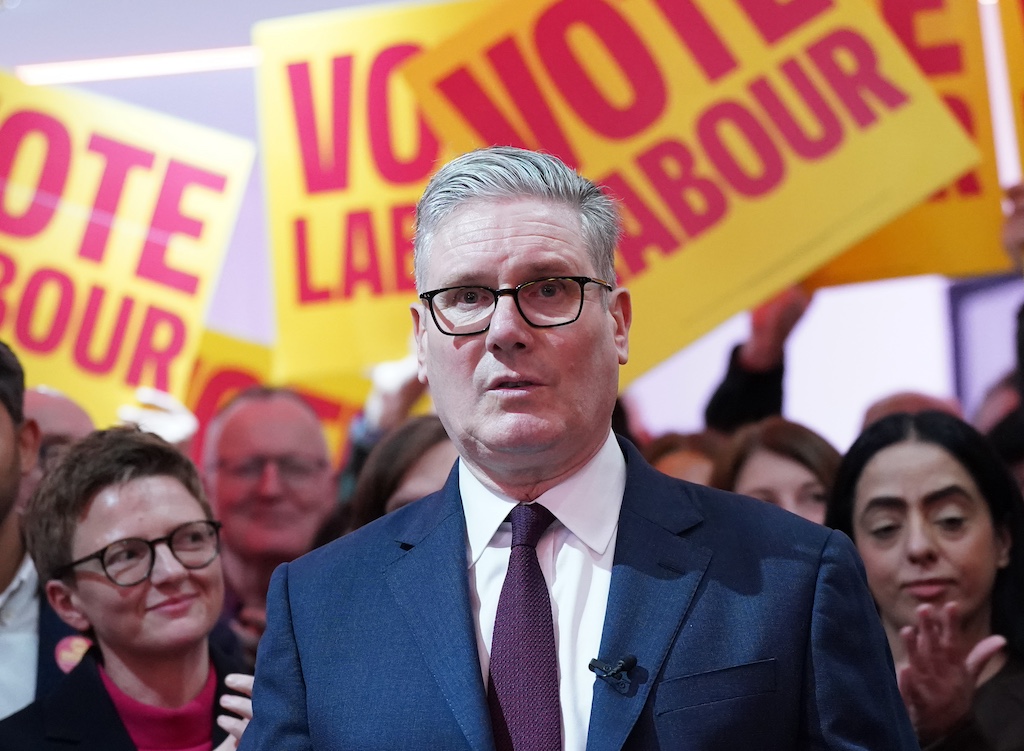
Keir Starmer rose to the Labour leadership in 2020 promising a kind of diluted Corbynism, only to become the most right-wing Labour prime minister yet. (Ian Forsyth / Getty Images)
News of the Greens’ victory in the Gorton and Denton by-election came at 4:30 a.m., but the losers’ excuses were already prepared. The Labour Party had suffered a typical defeat for incumbents but still run a “positive campaign,” reasoned its deputy leader, Lucy Powell. Supporters of Nigel Farage’s Reform UK insisted they had won the “working-class” vote, but had been outdone by “sectarian” “Islamists” and by Muslim men pressuring their wives’ choice.
Some of this was a bit of a stretch. Labour’s supposedly “positive” campaign had prominently accused the Greens of encouraging schoolkids to take heroin. The party also photoshopped a fake tactical-voting organization, alongside poll charts telling voters it was in a “two-horse race” with Reform UK (thus cropping out the Greens, who ultimately won handily, with 40 percent support).
Likewise hard to fathom was the supposed Muslim “sectarian” vote for a white, female candidate for a Green party with a gay, Jewish leader. Pundits on Sky and GB News nonetheless talked up such claims, while also insinuating that Muslims in Manchester simply aren’t working-class, or that Muslim women might have voted for a right-wing, anti-immigrant party if not for undue pressure from their husbands.
The Green Party’s Hannah Spencer won by a more than ten-point margin, in a contest that was less neck and neck than it seemed. Incumbents do often lose by-elections, yet this one was called barely eighteen months into Keir Starmer’s government, and at a moment when his ruling Labour Party’s national-level support has collapsed. It was less an “upset” than a snapshot of the national trend, with Labour and the withered Tories outflanked on either side.
Starmer is drastically unpopular. Much of this attaches to the man himself. While centrist admirers endlessly hark back to his pragmatic “Mr Sensible” branding — today wondering if he is just too decent for voters to accept in an “age of populism” — perhaps the problem instead lies in his trampling on what are broadly still imagined to be Labour values. Since winning the 2024 election (one-third of votes, two-thirds of seats) he has consistently leaned into anti-immigration postures and austerian penny-pinching in order to appeal to conservatives. He has spoken of the “incalculable damage” caused by immigration and promised that sacrifices today will mean future economic growth, just not yet. It hasn’t worked.
Right-wing media derides Starmer as an authoritarian, ultra-woke “socialist.” Yet since limping to victory against the exhausted Tories in 2024, Starmer has proven unable to rally either older working-class voters or younger, more progressive ones of working age. As part of this, he has also massively shed support among Muslim Brits (in what one Labour official reportedly called “shaking off the fleas” of pro-Palestinians). This recent collapse of Labour support, to under 20 percent in national polls, is not the same thing as the rise of an angrier right in Reform UK.
Is Labour, still holding a massive parliamentary majority, able to rally and stop Farage from becoming prime minister? One exit route — replacing Starmer with popular Manchester mayor Andy Burnham — was cut off at least temporarily when Labour’s ruling council (i.e., Starmer’s allies) refused Burnham permission to run in this by-election. Despite his New Labour past, Burnham would surely have put up a better campaign than Labour actually did run, likely more focused on national direction and issues like cost of living. Yet the Greens’ momentum also matters and will not easily be recaptured by Labour if and when Starmer is ousted.
Starmer allies can drone on and on about “antisemitism” in the Green Party or the broader left. They might joke at the dismal spectacle of Your Party, the new force launched by former Labour-left MPs Jeremy Corbyn and Zarah Sultana, which quickly sank into petty chicanery and infighting. Starmer’s great initial success had been one of party management: winning enough “Corbynite” Labour members to take the leadership in 2020, then using the party machine to oust the Left. Its strength within the party remains much reduced, or at least quashed.
Yet the Greens’ breakthrough, under Zack Polanski’s leadership rivaling Labour in national polls, shows that the tides on which Corbynism rose keep coming back, even under different and perhaps more effective leadership. The long, stop-start rise of a left-wing challenge to New Labour — punctuated by the invasion of Iraq in 2003 and the postcrisis anti-austerity movement, but now especially Gaza — has produced tens of thousands of mostly younger activists, but it has also found a far wider electorate for whom voting for Labour is hardly automatic.
The sheer strength of the Green vote on Thursday cuts against the idea that this is all just about downwardly mobile graduates. Spencer, a plumber by trade, is not herself one. Yet Starmer’s collapse shows that Labour is today on the same course as the French Socialists and German Social Democrats: the crumbling of a historic party’s older working-class base, the alienation of new and younger left-wing activists, and the weakening of its claim to be a natural force uniting these groups. Around Europe, this has tended to produce fragmentation rather than create a simple “replacement”: Britain’s first-past-the-post electoral system will also add its own obstacles.
It may be that ties to Peter Mandelson, the New Labour guru and friend of Jeffrey Epstein who was arrested this week, trigger Starmer’s ultimate downfall. Such collusion around the billionaire pedophile is no trivial issue. Yet nor should we ignore the effect of the genocide in Gaza and British elite support for Israel, the epitome of the moral depravity in which Starmer is mired. Despite what British media often tells us, even Muslims don’t only vote “for Palestine.” Yet Starmer’s defense of the indefensible is also an excellent reason to oppose him, indeed one that most British people agree on.
Starmer, as a young man a Trotskyist, rose to the Labour leadership in 2020 promising a kind of diluted Corbynism, only to become the most right-wing Labour prime minister yet. His triumph was to snuff out what remained of the Corbynite rebellion, pushing it out of the party. Yet this never created real enthusiasm for his project, and today much of the Left and its most enthused social base has regrouped in the Greens. For socialists who have remained in Labour, removing Starmer can’t come soon enough. But it’s also no easy route back to success.