The GOP May Block Regulation of Corporate Landlords
Claiming to be working to stop corporate landlords from buying up single-family homes, an industry-backed GOP senator is circulating legislation that could block states from regulating the institutional investors purchasing hundreds of thousands of homes.
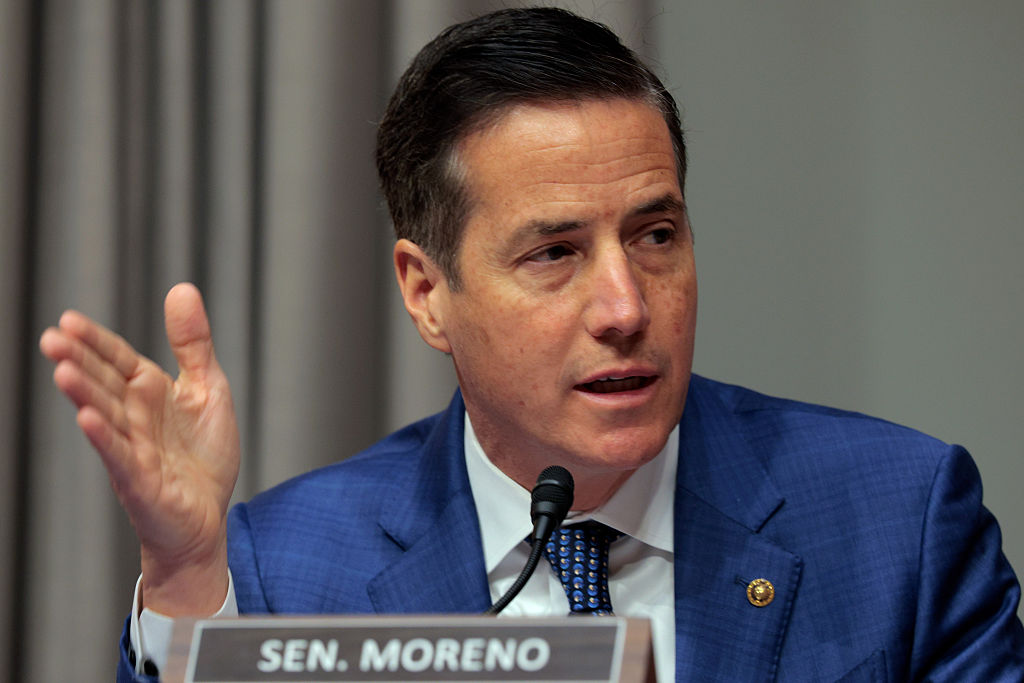
GOP senator Bernie Moreno’s purported federal “ban” on corporate landlords buying up single-family homes could carve out exemptions for many of the US’s largest institutional homebuyers, while preempting state or local regulation of the practice. (Chip Somodevilla / Getty Images)
Claiming to deliver on President Donald Trump’s promise to stop corporate landlords from buying up single-family homes and fueling the housing crisis, an industry-backed Republican senator is circulating legislation that could actually block states from regulating the institutional investors purchasing hundreds of thousands of homes nationwide.
At the same time, the purported federal “ban” would carve out exemptions for many of the country’s largest institutional homebuyers.
If passed, such legislation could derail ongoing efforts in at least eighteen states to limit large corporations from buying up residential properties and using them as investment vehicles. The phenomenon has been shown to lead to higher numbers of evictions, neglected property maintenance, and rising rents and may limit families’ ability to access the housing market.
Last month, Trump announced he would bar major investors from buying up single-family homes, issuing an executive order directing the government to block the purchases. And in his State of the Union address yesterday, the president demanded Congress make the ban law, noting, “We want homes for people, not for corporations.”
The office of Sen. Bernie Moreno (R-OH) is circulating draft legislation that would ostensibly do just that. The bill would prohibit institutional investors from owning more than one hundred single-family homes.
But one draft of the legislation reviewed by the Lever contains a clause that would bar any state or locality from imposing its own restrictions on investors buying up homes. Another draft would only preempt weaker state-level regulations on the matter.
The tactic to preempt state action on corporate landlords bears resemblance to lawmakers’ recent efforts — at the behest of tech industry lobbyists — to introduce a ten-year ban on all state and local regulations of artificial intelligence on matters like privacy, safety protocols, and discrimination. Those efforts have so far failed in Congress, though the White House issued an executive order in December imposing a similar moratorium on state AI regulations.
“We would not be surprised if the private equity industry has been pushing for preemption in housing laws,” said Matt Parr, the communications director at the Private Equity Stakeholder Project, a research group focused on the impacts of private equity. The industry is known for buying up companies, slashing costs, and adding fees to boost returns for investors — including in the housing market.
The draft language sets a “concerning precedent,” said Parr.
Parr noted that other federal proposals to regulate corporate homeownership — including Republican-backed measures, like a bill introduced by Rep. Anna Paulina Luna (R-FL) last month — do not include language preempting state rules on the matter. Efforts to loosen investors’ grip on the single-family housing market have faced significant industry pushback, as Sen. Jeff Merkley (D-OR), who sponsored one such proposal, previously told the Lever.
Moreno, who is among the wealthiest members of the Senate, has extensive ties to Wall Street interests. Stephen Schwarzman, the CEO of Blackstone, a massive asset manager with one of the largest single-family home portfolios of any institutional investor, donated more than $3 million to the super PAC supporting Moreno’s Senate campaign in 2024.
Moreno’s office did not immediately respond to a request for comment from the Lever.
Last week, Punchbowl News published draft legislation for an institutional investor housing ban that the Trump White House was reportedly distributing to lawmakers. That draft is quite similar to the two drafts that Moreno’s office has been circulating, though it does not include any preemption provisions.
In one draft reviewed by the Lever, dated February 20, the preemption clause would effectively bar any state or locality from imposing regulations on single-family home purchases by institutional investors.
Another draft, dated February 24, revised that provision so that it only prohibited “less restrictive” state regulations, meaning state and local regulators could still theoretically pass corporate-landlord rules that were more robust than federal standards.
Preemptions and Exemptions
According to the Private Equity Stakeholder Project, at least thirty-eight bills are currently moving through eighteen state legislatures designed to limit institutional investors and private equity’s ability to buy up housing properties. Those proposals range from banning large investment firms from owning single-family homes to cutting off government funding for such corporate investments.
According to advocates, many of those state-level bills include stronger regulatory provisions than the draft language being considered at the federal level in Sen. Bernie Moreno’s proposal, which only restricts institutional investors from owning more than one hundred homes.
Both versions of the Moreno legislation also include other loopholes that advocates say could undermine its ostensible ban on corporate landlords.
For instance, one provision in Moreno’s bill would exempt owners of increasingly unaffordable “build-to-rent” homes, single-family developments that are designed to be rentals. This language mirrors carve-outs in Trump’s recent executive order directing the relevant federal agencies to bar corporate investment in single-family homes, as well as in Republican legislation on the matter introduced in Congress.
Build-to-rent homes represent one of the fastest-growing segments of the housing market, and some of the largest corporate real estate companies in the country, such as Greystar, have invested in these projects. Moreno reportedly has over $1 million invested in a build-to-rent company.
Both draft versions of the Moreno bill also include an exemption for investment firms that provide a “homeownership program,” which are becoming increasingly common at large real estate companies.
These programs can resemble “lease-to-own” options, in which a buyer leases a home for a set number of years as a down payment before purchasing it. While promising a pathway to homeownership, lease-to-own contracts have historically failed to produce many home sales and have been criticized for including exploitative provisions, such as requiring renters to make their own repairs. Invitation Homes, the nation’s largest corporate landlord, which owns 86,000 housing properties nationwide, currently offers this kind of homeownership program.
This is a “potentially gigantic loophole,” Parr said.