Beating Trump Requires a Stronger Populist Agenda From Dems
The most effective counter to Donald Trump’s State of the Union lies is an affordability agenda with teeth, writes New York socialist congressional candidate Claire Valdez, backed up by an organized working-class majority.
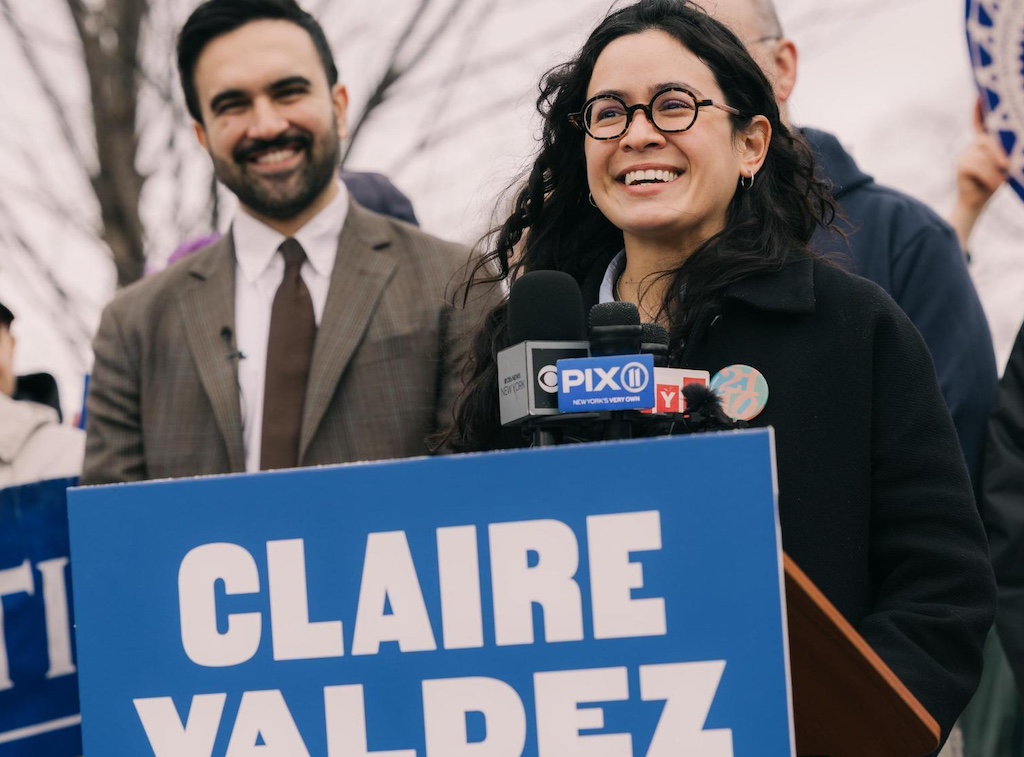
Claire Valdez speaking at her campaign launch on January 8, 2026, with Mayor Zohran Mamdani looking on. (Claire Valdez for Congress)
In last night’s Democratic response to the State of the Union address, Abigail Spanberger didn’t mention Zohran Mamdani’s earthquake election as New York City mayor. But the party clearly learned one of his campaign’s core lessons.
“Democrats across the country are laser-focused on affordability,” the Virginia governor said.
It’s an urgent issue to prioritize. More than a third of all Americans couldn’t cover an emergency expense of $400 without taking on debt. A majority can’t come up with $1,000. Any increase in the cost of living can spell bankruptcy, hunger, or homelessness.
Spanberger skipped over Mamdani in her list of big Democratic wins last year, perhaps driven by swing-district polling or discomfort about our democratic socialist mayor among parts of the donor class. New Yorkers should take no offense. The mayor is focused on the five boroughs, not brandishing his national image.
But Democrats would be wise to learn other lessons from our victory in New York. Talking about affordability without a concrete economic agenda to lower costs confuses the public. And draining the message of class conflict is bad politics.
When Zohran launched his campaign in October 2024, it would have been easy enough to simply invoke the affordability crisis and hang it like an albatross around the neck of any status quo politician, associating himself broadly with change but never saying what he would actually do about it.
Instead, he put forward three headline policies — freezing the rent, making buses fast and free, delivering universal childcare — that became synonymous with the candidate and the campaign. More than a hundred thousand volunteers were able to bring a concrete agenda to the doors. The message wasn’t just “Here’s my resume” or “Here’s what I care about.” It was “Here’s what we can do together.”
Historically, establishment Democrats have been reluctant to commit to anything but the most modest reforms, lest they be expected to deliver on them when in power. But affordability can’t just be a vibe. It needs to be a program.
And central to that program is naming who profits from current order. Spanberger, understandably, focused on Donald Trump. “He’s enriching himself, his family, his friends,” she said. “The scale of the corruption is unprecedented.”
All true. But the problem is far deeper.
The extreme concentration of wealth in this country is not background noise to the political and economic crisis we’re living through. It is the crisis. When a handful of billionaires can spend unlimited sums on elections, own the media, capture regulatory agencies, and openly buy access to the presidency itself, we are no longer living in a functioning democracy — regardless of who holds office. And those same billionaires and monopolistic corporations have every incentive and every ability to raise prices.
Trumpism didn’t create this condition. He is an expression of it. And an accelerant.
Where does that leave the Democratic Party? For too long, establishment leaders have met rising fascism and imperial violence with appeals for transparency, prayers for judicial intervention, or modestly helpful but vastly insufficient tweaks to our rapacious health care system.
These impulses rest on a premise that has been tested across two Trump terms: that confronting power with the facts of its wrongdoing is a strategy. It isn’t.
Instead of trying to speak truth to power, we should start speaking it to each other instead.
The labor movement has always known something electoral candidates are constantly having to relearn: you don’t start by winning the argument. You start by finding the shared interest.
In most workplaces, you’ll find people from different backgrounds, identities, and opinions about just about everything. A good organizer doesn’t paper over those differences, but she identifies what everyone has in common: they all need the job to make rent, buy food, and take care of the people they love.
From that shared condition, people who had every reason to distrust each other recognize a common interest and become agents of their own lives. That’s the history of every gain working people have ever made.
What the Left needs to offer this midterm year is not a better rebuttal to Trump’s State of the Union. It needs to offer a different orientation entirely: one that learns from and partners with already-organized workers, and that reaches the millions of working people who remain unorganized — telling them the truth about the system we live in and what we can do about it together.
The truth isn’t just that Trump is corrupt or reckless. It’s that a tiny oligarchy has captured our economy and our politics, and that the only force capable of taking it back is a working-class majority that knows its own power.
That majority exists. It just needs to be organized. And that work is the most important thing the Left can do right now.