Communists Helped Build the Mighty New York Hotel Union
Before they faced fierce repression from the US government at the outbreak of the Cold War, early 20th-century Communist labor organizers helped build the New York hotel workers’ union into one of the city’s most militant unions.
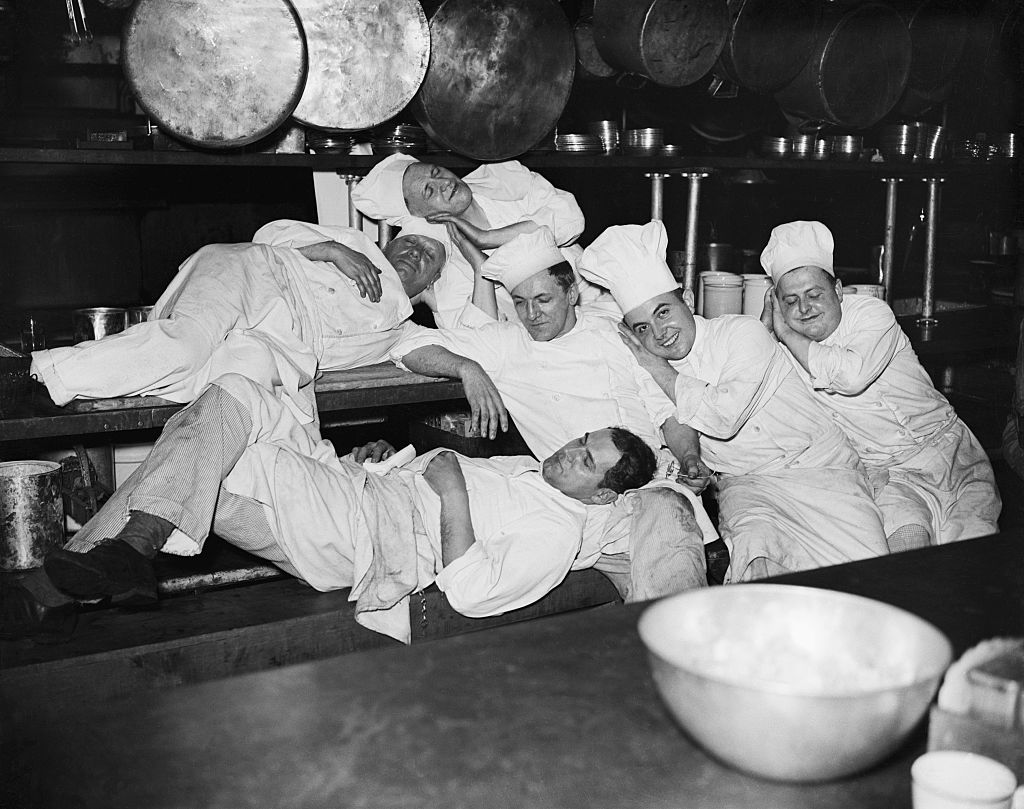
The US government’s use of deportation to punish political dissidents harkens back to the history of the New York Hotel Union during the Red Scare. (Bettmann / Getty Images)
- Interview by
- Jenny Hunter
The second Trump administration has been labeling political leftists as “domestic terrorists” and targeting immigrants whose beliefs it disagrees with for detention and deportation. This would not have surprised Michael J. Obermeier, the president of the Hotel, Restaurant and Club Employees and Bartenders Union Local 6, who in 1947 was arrested at his union’s office for being an “undesirable alien.”
Obermeier, who was born in Germany in 1892, left home as a teenager and become a steward on steamships traveling around the world. When World War I broke out, he was in England; he was banished and landed in New York, where he got a job as a waiter at the Vanderbilt Hotel and joined a union organizing effort. He spent three decades building a scrappy group of hotel workers into a powerful, militant union that still today represents more than 90 percent of hotel workers in New York.
But as the Cold War dawned, Obermeier, who had never become an American citizen, was arrested, convicted of perjury for having falsely denied being a member of the Communist Party, and deported to Germany. He died in poverty in Spain in 1960.
Obermeier’s story provides a compelling through line in Shaun Richman’s latest book, We Always Had a Union: The New York Hotel Workers’ Union, 1912–1953, which traces the propulsive story of one of New York City’s most powerful unions through world wars, Prohibition, the Depression, and into the Red Scare.
For Jacobin, Jenny Hunter spoke with Richman about how he first became interested in Obermeier while working as an organizer for Local 6, the continuity between the US government’s use of deportation to punish political dissident immigrants in the Cold War and its weaponization of deportations now, and what insights his book might hold for today’s labor movement.
Jenny Hunter
Shaun, you worked as an organizer for Hotel Employees Local 6, the current incarnation of the local union that’s featured in your book. What drew you to the idea of writing a history of that union?
Shaun Richman
When I worked there, we told ourselves this legend that one of the first presidents of the union was arrested at the union office for being a Communist and was deported.
This was in 2000 or 2001, when the union had endorsed Republican George Pataki for reelection. So the idea that there had been a Communist president who was deported was kind of unthinkable.
When I wound up in grad school and took a history course, I wanted to find out more about this president. And it turned out that the story is fascinating; it became a passion project.
I was a union organizer for many years and couldn’t get the time to do it, couldn’t get the confidence to do it. It was only after I wound up in academia, and after I wrote my first book, that I said, now I know how to write a book, I’m going to dig in on this project. And I started writing it the day that I sent the manuscript for my first book, Tell the Bosses We’re Coming, to the publisher.
Jenny Hunter
That union president, Michael J. Obermeier, has a roller coaster of a life story, as you talked about in a piece in Jacobin last year. How did he end up being arrested and deported?
Shaun Richman
Obermeier was a day-one joiner of the Communist Party (CP) in 1921. He becomes a figure in the Comintern. During that time, he’s on and off secretary of his branch of the union.
One of the reasons that he’s on and off, I realize in my research, is he’s traveling to Moscow a lot. He leads a strike against the Plaza Hotel in 1923, and he’s in the New York Times explaining the reasons for the strike. But then, in 1925, I don’t find his name in the union’s newspaper at all. Then he’s back in 1929 to lead another strike. It’s got to be that he was traveling abroad.
As the Communist Party line changes, he’s a big part of this effort to create these red unions. He becomes secretary of the Food Workers Industrial International Union. He’s on the executive board; he’s a key mover of it. But he does such a good job that he’s rewarded with two years at the Lenin Institute in Moscow.
That 1931 trip to Moscow is the one that ultimately gets him into legal trouble. He never naturalized — he never gained US citizenship. When he landed in New York in 1917, it was still relatively easy to become a US citizen. But when we get to the Cold War era, the federal government is really targeting Communists based on their immigration status.
From a twenty-first-century perspective, you ask, why didn’t he become a citizen when he had the chance? But the answer is actually kind of obvious. He’s been going in and out of the country, back and forth to Moscow, illegally. So it wasn’t actually that easy for him to apply for citizenship. It was more helpful to not be a citizen. And he considers himself a citizen of the world revolution, not a citizen of the United States.
Jenny Hunter
It seems like it wasn’t a legal or a cultural problem for an American labor leader to be openly Communist in the 1920s and 1930s. When did that start to change?
Shaun Richman
Like many Communists during World War II, Obermeier did superpatriotic work. Being German, he forms a German American labor council. There were Italian American labor councils and others that were focused on getting immigrants who were connected to the Axis powers to support the Allied war effort.
So he’s doing radio broadcasts for the Office of Strategic Services (OSS) [the wartime intelligence agency that was a forerunner to the CIA]. He’s even in talks with the OSS about becoming an agent. This is what gets him on the radar of the FBI.
Jenny Hunter
Why was the FBI interested in him if he was working with the US government?
Shaun Richman
The idea is, okay, you’re working with these immigrants now, but at some point, a lot of these guys are going to return to Germany to be a part of what the next German government is, and it’s clear that they want to help set up a Communist government.
That’s what gets the investigation started. In the book, instead of treating this as an abstraction, I really try to go through week by week so you feel this noose tightening around his neck.
Jenny Hunter
The book does give that strong sense of dread. Obermeier and all these other labor leaders and organizers have been openly Communist for decades, and then gradually, or suddenly, the US government turns on them.
Shaun Richman
Yeah. And when the Department of Justice begins its deportation drive, he is the second one arrested.
First is John Santo at the Transport Workers [union], second is Michael J. Obermeier, and then it’s seven hundred other people after that. They’re all labor activists, immigrants, Communists — all three of those things.
Jenny Hunter
How did Obermeier end up being targeted?
Shaun Richman
He tries to become a citizen very late. It’s very fraught. It’s during World War II that he finally puts in paperwork to become a citizen. And now the law has changed: there’s this anti-Communist law, the Smith Act, enacted in 1940.
So the Immigration and Naturalization Service (INS) [the forerunner to Immigration and Customs Enforcement (ICE)] conducts an interview with him, and there’s a standard question: Are you now or have you ever been a member of the Communist Party? In those interviews, he says no.
After he’s arrested and there’s an effort to deport him, it’s time to come up with a legal strategy. So his lawyers and the CP decide that they’re going to test this as a First Amendment case. He stipulates to being a member of the Communist Party just from 1930 to 1939. He’s splitting hairs, because the [Communist] Party he belonged to was called the Workers Party before 1930, so he could only join the Communist Party when it began to exist in 1930.
The CP was going to make the case that there’s nothing wrong with that. It’s a legitimate political party. There are two members of the New York City Council who are Communists. They said, we’ll put all our books and pamphlets on the record. You won’t find us calling for the violent overthrow of the US government. The Smith Act says merely belonging to the Communist Party means that you’re calling for the violent overthrow of the US government. They wanted to show that they weren’t.
Jenny Hunter
But he was convicted and deported for perjury, not for being a Communist, right?
Shaun Richman
At some point, his deportation case gets thrown out also on a technicality, because — in shades of the Trump administration — in their rush to do this they got sloppy. There was a vacancy in the Department of Justice, and that vacancy was not filled by anybody that the Senate vetted. So at some point, the Supreme Court says that any actions taken under that person are null.
So he was going to get off, but then the government turned around and said, wait a second, we had a piece of paper here where he says, “No, I was never a Communist.” We have another piece of paper here where he says, “Actually, yes, I was.”
He’s convicted of perjury in 1951. He appeals, but his appeals run out pretty quickly. He serves a little bit of jail time, but then he agrees to self-deport. He could’ve cut a deal that involved naming names and he might have seen no jail time, but he refused.
So, he went back to Germany. He had some family left there, but it had been decades. He’s this crazy uncle from America who got into some trouble. He winds up in Spain when he dies in 1960. That seems like a really strange place for a Communist to be at that time. But Spain had better hospice care at home, and he needed that at that point.
But the union stuck with him. I find this almost poetic. The union began having these annual Michael J. Obermeier tribute dinner dances. They were raising money for him because he didn’t get a pension. They were trying to raise enough of a nest egg that they could get him an annuity. But he passed a few months later.
Jenny Hunter
There are a lot of echoes between the Red Scare history you write about and now. The Trump administration is trying to criminalize protests and “antifa” and anybody who disagrees with it. Its also using the threat of deportation to get rid of or chill expression by people they consider their enemies. Was that on your mind as you were writing your book?
Shaun Richman
I actually wound up writing an article for In These Times in 2020, which was a review of Julia Rose Kraut’s book, Threat of Dissent: A History of Ideological Exclusion and Deportation in the United States, and a bit of it was my first time announcing that I was working on the Obermeier project. I wrote in that review that one of the things that’s still in the law is the Smith Act. It was enacted in 1939 to deal with the “Communist threat.” A couple of laws have amended it since, but the federal government’s position and laws passed by Congress say that threatening to overthrow the government by force, and that includes being accused of terrorism, is grounds to denaturalize a citizen and deport them.
As I said at the time, it’s an election year. If we don’t treat the next Democratic president as much a threat to democracy as our current president is, we’re leaving a ticking time bomb. I hope Stephen Miller doesn’t read Kraut’s book.
Jenny Hunter
If he reads books, maybe he already has.
I have the impression that the Red Scare purges of Communists from the labor movement in the 1940s and ’50s contributed to the labor movement overall becoming more conservative and less radical. Do you think that’s accurate?
Shaun Richman
It’s hard to say. We could overstate how much influence the Communist Party had and how “left” the Communist Party kept the labor movement. And particularly, by the time you get to World War II, I don’t even find “left” and “right” a very useful descriptor of what’s going on. The Communist Party spent five years strictly enforcing a no-strike pledge during the war. What’s left about that?
But what the Red Scare did is it took out one of the last bastions of disagreement. Which is important in labor, because there’s a natural tendency for union people to think we’re better together, we’re better unified, we’re better if we have the same plan and we agree. And that’s great — if we have good plans.
But when we’re in an era like we’re in now, where it’s just genuinely unclear what the best bet for the future of labor is, maybe you need more disagreement.
Jenny Hunter
I was really struck that your book reads like a movie or TV show. You can picture it: you’ve got elevator operators going out on strike and leaving the elevators on random floors so everyone is stuck, and the waiters blow whistle to signal the beginning of their strike during a meal and leave the rich hotel customers with no food. You’ve got people secretly traveling to Moscow, and bootleggers, racketeers, and labor leaders being assassinated.
Did you think of it that way as you were writing it? Did you want the book to convey a vivid, cinematic narrative?
Shaun Richman
So, I should just say the name David Simon, so that if he has a Google Search alert for himself, he will see this. I think any writer . . . you’d be lying if you don’t have these fantasies of: we could turn this into a movie if the right people got interested.
But the main thing is, I did want to write it as a story. That’s a little out of fashion in history books in general. But it was important to me, because I’m not just writing a history. I want to write something that could impact modern trade union organizers.
And union folks still read books. So I knew I wanted to tell a good story. Also, it had these very cinematic moments, some very poignant moments, and some hilarious moments. I love the act of sabotage, of striking hotel cooks throwing fistfuls of asafetida [a spice used sparingly because of its powerful fetid odor] into the upholstery in the dining room. Or the story that strikers descended on a trainload of scabs at Grand Central, and they bring cayenne pepper and throw it at their eyeballs. And it turns out, they were scabs, but they were the wrong scabs — they weren’t being brought in to break the hotel strike.
Jenny Hunter
What lessons do you take from this history that unions should be thinking about today? Are there particular strategies that you think should make a comeback?
Shaun Richman
One of the main takeaways was the experimentation. Union organizers switched radically, and sometimes very rapidly, between strategies. They spend the entire 1920s doing a union hiring hall and refusing to sign any contracts. And then from there, they go to a court-type system of arbitration and one big industry-wide agreement.
That would give you whiplash. But they fit their times. You weren’t going to get that impartial chairman system in the 1920s. So they got something that made sense, which gave them a toehold and the ability to live to fight another day. That’s the kind of strategic nimbleness that unions need to have.
Jenny Hunter
Reading your book as a lawyer, I was struck by how many of the tactics that the workers and the union used were things that I would advise clients against doing — sit-down strikes, sabotage, the thing with the cayenne pepper. You could say this is because labor laws are restrictive and the courts are hostile. But the workers in this period faced huge risks too.
Do you think the workers and the labor leaders of this period had a different attitude about risk compared to their modern counterparts?
Shaun Richman
Yeah, I mean, if you don’t have a pension and health insurance connected to the job, what do you care if you get fired?
Jenny Hunter
Which is ironic, since you show that the hotel workers’ union helped to pioneer those things.
Shaun Richman
Another answer I would have is — it’s a little bit pithy and perhaps too cute — but you know the saying that there’s no illegal strike, there’s only a strike that you lost. . .
Jenny Hunter
Yes. But there are strikes that are illegal and that you lose that are potentially ruinous.
Shaun Richman
Right. But even today the Hotel Trades Council still does quickie strikes and essentially sit-down strikes. When the contract’s still in effect, if they’re in a boss fight with a particular hotel corporation, they might call a union meeting in the middle of the day, in the lobby. And all the work grinds to a halt, and nobody’s getting sued over it; nobody’s going to jail over it. And usually, the dispute du jour is settled within a couple of hours after the start of that union meeting.
But yes, one reason that you don’t see some of those tactics as much anymore is that they’re not legally protected.
There’s also an element of muscle memory. Getting out of that mindset of, this is the way it’s always been done. I think union organizers learn, generationally, almost the lore by the campfire. So, if your immediate mentor did things one way, in your head, well, that’s how we’ve always done it.