US Union Membership Actually Held Steady in 2025

Overall union density in the US ticked up slightly last year to 10%. This figure doesn’t account for Donald Trump's executive order last March that commanded agencies to ignore contracts and bargaining rights for nearly a million federal workers.
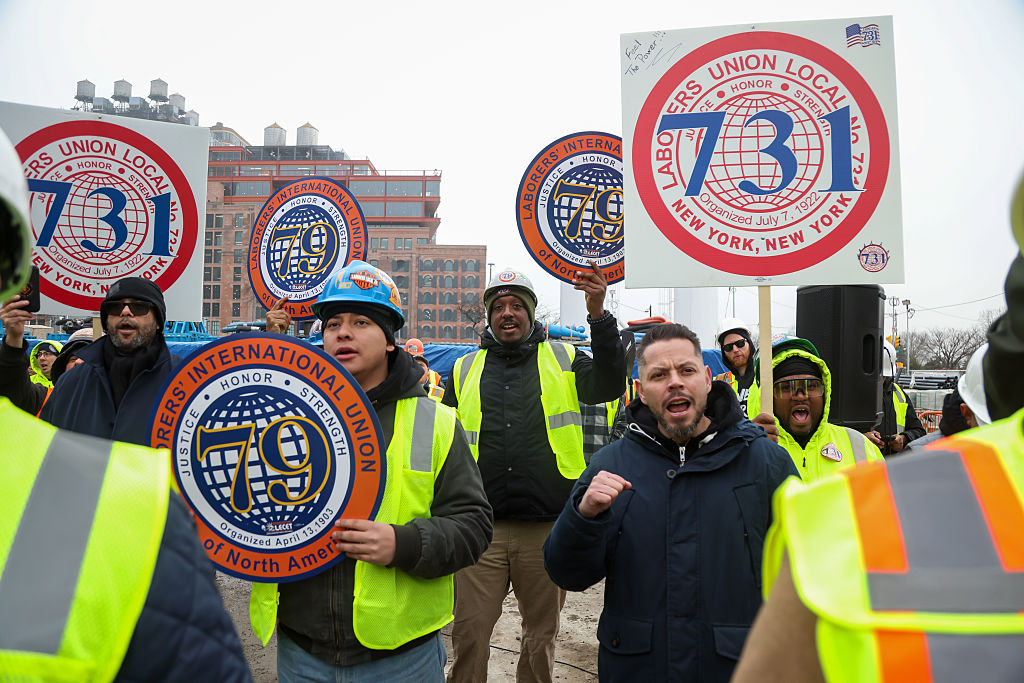
In the private sector in 2025, the greatest union growth happened for construction and health care workers. (Michael Nagle / Bloomberg via Getty Images)

For four decades, a federal count of union members has been the annual physical exam for the labor movement. Did we grow or shrink, and where?

The tally just came out for 2025. At face value, the number looks better than expected, given a year of open warfare on us from CEOs who want to automate everything and a bloodthirsty federal government.

The feds asked fifteen thousand households per month whether they included a union member. Based on that survey, they estimated an additional 463,000 workers were represented by unions compared to 2024, roughly half of them in the public sector and half in the private sector.

Some 14.7 million workers were estimated to be members of unions in 2025, which is 10 percent of the workforce, narrowly up from the previous year. An additional 1.8 million were represented by a union but were not members. According to analysis by the Economic Policy Institute, nearly half the union growth was in the South.

But these headlines mask a grimmer picture. The new count doesn’t account for how, in March last year, a Trump executive order suddenly went nuclear on federal unions, commanding agencies to ignore contracts and bargaining rights for the lion’s share of federal workers, totaling nearly a million, from Department of Veterans Affairs nurses to fraud fighters.

Federal workers joined their unions at record rates to fight back, but their bosses now largely refuse to acknowledge their contracts. If a million federal workers were counted as effectively no longer having a union, 2025’s numbers would look very different.

The report also averages out job numbers across the whole year. In effect, that undercounts an additional two hundred thousand federal workers who were pressured out of their jobs or laid off by the administration’s chainsaw cuts to public programs in the final months of the year.

Winners and Losers

In the private sector in 2025, the greatest union growth happened for construction (84,000 more workers were represented by unions) and health care workers (78,000).

Construction unions grew from representing about 11 percent of their sector to 12 percent, as construction employment grew by a hundred thousand. The union share is still down from a decade ago, or even 2023. Last year’s uptick reflects a data center building boom that was 70 percent of construction growth last year, along with public water and highway projects. New members might leave the unions if those unionized jobs don’t continue, or if the building trades unions continue to struggle at organizing nonunion contractors from the bottom up.

Health care union members grew in number, but the unionized share of the sector stayed flat at about 8 percent. Health care was the fastest-growing source of employment last year, adding half a million workers.

The biggest losses in union membership came for logistics and manufacturing unions. The “transportation and warehousing” industry lost one hundred thousand workers covered by union contracts, even as jobs in the sector grew by twice that number. Anti-union Amazon and other shippers have been gobbling up deliveries from the unionized United States Postal Service (USPS) and United Parcel Service (UPS), where closures and layoffs have hit hard.

In manufacturing, Trump’s boast of a “Made in America” revival was a union-busting smokescreen. The number of factory jobs covered by a union dropped by 34,000. The number of total factory jobs grew by 33,000.

Despite being often trotted out for politicians’ photo ops, mining and drilling workers got even worse treatment, losing 51,000 jobs in the sector, and their unions declined even faster, losing a third of their membership in a single year.

The number of workers participating in unionization elections through the National Labor Relations Board had been on the rise — 2023 and 2024 saw the highest figures in a decade. But for 2025, this number dropped by 42 percent to just 82,625 workers, according to the Center for American Progress.

Public Sector Question Marks

Voided contracts for federal workers are the biggest asterisk in this year’s union member count.

Another asterisk: the workforce of state employees grew by an estimated 259,000 in 2025, including 180,000 more worker represented by unions. But how much of this growth will last?

The state budgets of 2025 were built on federal support set in prior years. This year, massive cuts to federal support for Medicaid, food stamps, transit, and other public programs will leave states facing a devastating gap. Those shifts are sure to spell cuts to state and local programs and the workers who staff them.

It’s fair to take a bit of hope from the fact that union membership apparently grew in absolute numbers and roughly held the line as a share of the workforce, despite profound attacks. More workers joined unions to fight back. The total number of union members was the highest in nearly a decade.

It’s up to us to translate that number into power against the boss.