Diego Rivera Was the Painter of the Mexican Revolution
The Mexican Revolution inspired an extraordinary cultural efflorescence, with painting as its leading art form. The spectacular murals of Diego Rivera, inspired by Mexico’s popular history and culture, are the most remarkable legacy of that period.
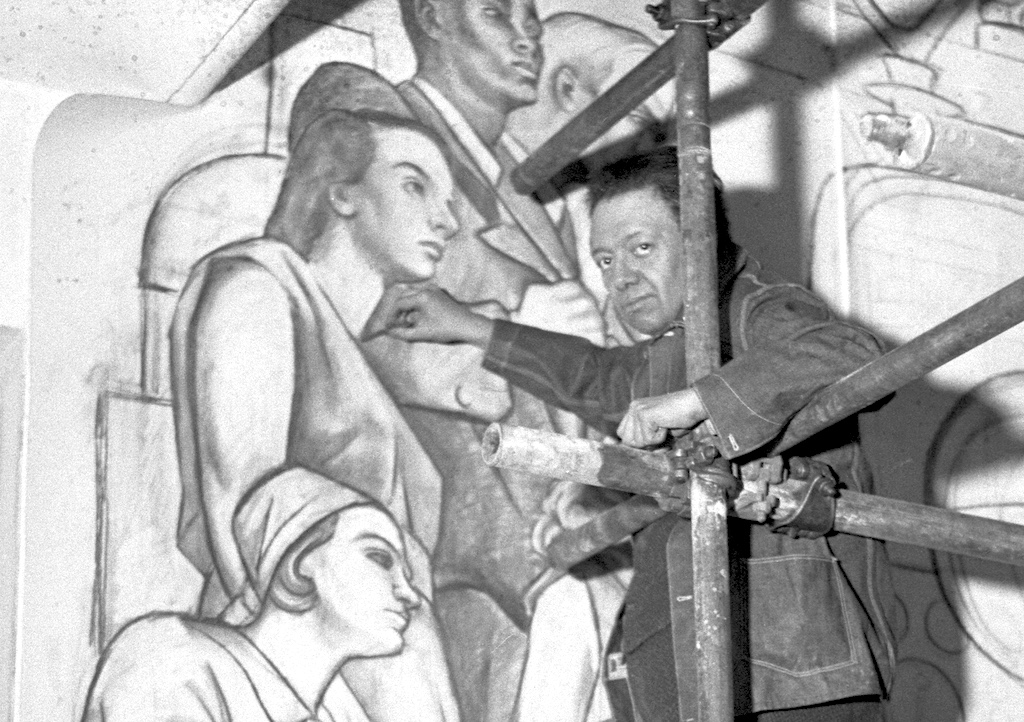
Diego Rivera at work on the mural at Rockefeller Center, New York. (Bettmann / Getty Images)
The art of Diego Rivera is inseparable from the revolution that Mexico experienced in the early twentieth century and the state that was built in its aftermath. The revolutionary process began in 1910, when Porfirio Díaz, who had ruled Mexico for thirty-four years, announced that there were going to be presidential elections.
Díaz had overseen the growth of an economy based on exports such as sugar, coffee, and tobacco, and new industries like oil and textiles, most of which were financed by foreign capital. Mexico’s rural population, Indian and mestizo, lived under the whip of the latifundistas, the landowning class, and the threat of violence from Díaz’s rural police, the rurales (as documented in John Kenneth Turner’s book Barbarous Mexico).
The social tensions were palpable, but the spark that lit the fuse for the revolution of 1910–17 was a politically moderate pamphlet by Francisco Madero, the son of a wealthy landowning family, advocating universal suffrage and a vote against Díaz. Madero’s demands were limited to political reform, and he was soon driven into exile. But his words echoed across a country riven with social conflict.
In the state of Morelos, with its highly profitable sugar plantations, peasant resistance under the leadership of Emiliano Zapata defended rural communities against the expansion of the huge estates. In the north, a sometime cattle thief called Pancho Villa led his own rebellion. Protests against Díaz spread until the dictator fled to Britain early in 1911.
In this vacuum of power, the old ruling class fought to control the remains of the Porfirian state in shifting alliances with the middle class. While each armed movement claimed the revolution for itself, it was the Zapatistas alone who were leading a mass revolutionary struggle.
Mexico’s new constitution of 1917 rested on a promise of modernization, development, land redistribution, and national control of the subsoil (oil above all). It was under the presidency of Álvaro Obregón (1920–24) that construction of the new state began, in the name of a “popular alliance.”
Artist of the Revolution
Obregón was committed to education as an instrument of change, and he appointed the philosopher José Vasconcelos as his minister of education. Vasconcelos launched the muralist project to decorate the walls of Mexico’s public buildings with images of classic universal culture. He argued that societies advanced to a higher stage of universal civilization through the arts, but what he had in mind was the European classics, perhaps combined with some representations of stereotypical Indians.
However, the muralist movement that emerged after his retirement in 1924 arose from a very different spirit. Diego Rivera and his generation had rejected the conservative Eurocentrism of the art establishment and called for an art that reflected Mexico’s reality. Dr Atl, a Spaniard originally called Gerardo Murillo who adopted an Aztec name and became the director of the leading art school at the time, was highly influential in his fascination with the volcanoes of the country.
Rivera was actually in Europe during the Mexican Revolution, working with Cubists and Surrealists in Paris and later absorbing the fresco techniques of Italy’s Renaissance masters. In 1921, he returned to Mexico to join the muralist movement, bringing with him the modernist methods he had learned in France.
He had a clear commitment to a Mexican modernism that would not imitate Europe’s but rather express the transformation of Mexico based on its own history and its rich and varied indigenous culture. His only surrealist painting — Zapatista Landscape (1915), a composition with a peasant hat, a rifle, and a Mexican blanket (serape) against a background of mountains — anticipated the centrality of indigenous Mexico in his work from then on.
New Heroes
His first mural, The Creation, was for display in the new National Preparatory School. Rivera still made reference to universal myths but used images from indigenous life in the painting of the mural. His first major commission to decorate the three floors of the new Education Ministry building followed.
Unusually, Vasconcelos had left the content of the murals open to the choice of the artists. Rivera was already working with popular and peasant organizations, and he shared with the two other leading muralists, José Clemente Orozco and David Alfaro Siqueiros, a vision of the new monumental art. In Rivera’s words, “For the first time in the history of monumental art, Mexican Muralism ended the focus on gods, heroes, and heads of state. . . . For the first time, it made the masses the heroes of monumental art.”
It was in a way a massive exercise in creating a national consciousness with a clear understanding of class. The language of this new public art drew on Mexico’s rich indigenous culture, whose colors and forms reached back to the history of the Aztec and Maya worlds, even though the contemporary descendants of those worlds were held down in poverty and the most intense exploitation.
In the Court of Labor in the Education Ministry, Rivera painted the daily life of workers in agriculture and industry. In the Court of Fiestas, he drew on the rituals and ceremonies of indigenous and mestizo communities that gave a sense of their relationships to the landscape and history of Mexico, like the Day of the Dead, with its ubiquitous skeletons.
The third gallery used a different language, that of the “socialist realism” he had encountered in a visit to Russia in 1928–29. In Distribution of Arms, he included his wife Frida Kahlo, the photographer Tina Modotti, and her lover Julio Antonio Mella, founder of the Cuban Communist Party.
Land and Liberty
Rivera himself joined the Mexican Communist Party, as did Orozco and Siqueiros; all three were members of its central committee. It was a reflection of the role of the muralists in shaping the revolutionary culture.
For Rivera, art, and especially public art, was a form of productive labor that transformed the material environment and the masses who inhabited it. The role of the artist was, in contrast to the bourgeois conception of the artist as an individual creator, to be a worker in a collective creation. That creation was not simply the work of art but the revolution itself.
In that spirit, Rivera, Siqueiros, and Orozco formed the Union of Painters, Sculptors, and Technical Workers. They produced a newspaper, El Machete, which was designed using dramatic woodcuts that made a clear reference to traditional crafts. It later became the publication of the Communist Party.
Unlike the Russian Revolution, the Mexican Revolution was not shaped by a dominant party based on the working class nor driven by a conception of the state. The mass revolutionary movement was the rural insurrection led by Zapata, who had been murdered in 1919. Yet his slogan “Tierra y Libertad” (“Land and Liberty”) became the watchword of the revolution.
In 1929, Rivera was asked to decorate the chapel of the new agricultural college at Chapingo. Rivera conceived the project as a celebration of the redistribution of land among the peasantry. The most moving and most poignant of the murals shows Zapata and his colleague Otilio Montaño buried beneath a field of maize with new plants growing out of their bodies. It is a prophecy of a revolution to come, and perhaps a foreshadowing of the reemergence of Zapatismo as a revolutionary movement in Chiapas during the 1990s.
In the same year, Rivera began his masterpiece in the National Palace in Mexico City, The History of Mexico from the Conquest to 1930. This huge mural above the central stairway portrays the Aztec civilization and the chief deity of the pre-Hispanic cultures, Quetzalcoatl, the Plumed Serpent. In the background is the glorious Aztec capital, Tenochtitlan. This part of the mural depicts the brutal Spanish conquest of that world and the cruelty of the Catholic Church.
The depiction moves on in a sweeping curve through the independence wars to a predicted Mexico of workers’ and peasants’ struggles and later an industrial future, overseen from above by Karl Marx. That sense of the future is central to Rivera’s work, but the presence of Marx was enough to persuade right-wing students to attack this and his other murals, many of which still bear the scars.
Between Stalin and Trotsky
By 1929, the Communist International (Comintern) was fully under the command of Joseph Stalin and was expelling supporters of Leon Trotsky and the Left Opposition, with which Rivera had already expressed his sympathy. In line with the sectarian “class against class” policy of the Comintern at the time, the Mexican Communist Party launched a bid to overthrow the postrevolutionary government whose dominant figure was Plutarco Elías Calles. This came just as the government also faced a reactionary Catholic insurrection known as the Cristero War.
The coup attempt failed. Rivera opposed it from the outset and was expelled from the party, with Siqueiros as his chief accuser. Mischievously, Rivera voted for his own expulsion, perhaps because his views as an artist meant that he rejected the rigid orthodoxy demanded both politically and artistically by Stalinism.
He then spent some time in the United States, where he received commissions in Detroit, San Francisco, and (most famously) from Nelson Rockefeller to paint a mural in the entrance hall of New York’s Rockefeller Center. Rivera included the figure of Vladimir Lenin and the mural was destroyed. His Detroit murals are celebrations of industry itself and echo that industrial section of the National Palace mural.
The Communists in Mexico and the United States used these commissions as an opportunity to attack Rivera, depicting him as a tool of the Mexican government and a servant of big capital. He and Kahlo subsequently befriended Trotsky, and Rivera used his influence with Lázaro Cárdenas, who became Mexico’s president in 1934, to offer the great revolutionary asylum.
Trotsky moved into Kahlo’s Blue House in Mexico City, where she and Rivera lived. Trotsky and his wife stayed there until personal problems (not to mention Trotsky’s brief love affair with Kahlo) made their coexistence impossible. Trotsky moved to a nearby house where he was the target of a failed assassination attempt in 1940 by a hit squad led by none other than Siqueiros. A few months later, a Stalinist agent managed to kill him at his desk.
A few years before his death in 1957, Rivera applied to reenter the Communist Party, perhaps out of nostalgia for the early years of the muralist movement. But it was still the same party that had branded him as a renegade, a rightist, and a tame servant of the government, in the withering accusation of Siqueiros.
Revealing Mexico
In 1938, Rivera and the French surrealist poet André Breton had cosigned a manifesto that Trotsky helped draft with the title “Towards a Free Revolutionary Art.” It contained the following words:
In the contemporary world we must recognize the ever more widespread destruction of those conditions under which intellectual creation is possible. . . . True art, which is not content to play variations on ready-made models but rather insists on expressing the inner needs of man and of mankind in its time — true art is unable not to be revolutionary, not to aspire to a complete and radical reconstruction of society.
The art critic Meyer Schapiro noted that Rivera’s murals “produce a powerful impression of the density of historical life . . . no other painter of our time has been so prolific and inexhaustibly curious about life and history.” Schapiro went on to ask “how such an art could be produced in a semi-colonial country dominated by foreign imperialism.” Part of the explanation lay in Rivera’s discovery of the enormous intellectual richness of indigenous Mexico.
In his mural The History of Medicine in Mexico: The People’s Demand for Better Health at the Hospital de la Raza in Mexico City, the procession of scientists includes Aztecs, showing that theirs was an advanced civilization. When he described the art of the indigenous world, Rivera praised its spiritual depth. In fact, the mural form itself was highly developed in the pre-Hispanic world (for example, the Pyramid of the Moon in Teotihuacán) and in Mexico’s popular culture (consider the murals in the country’s pulqueria bars).
Rivera was irrepressibly energetic and inspired in his application of some of the avant-garde methods he had encountered in Europe. He could paint ferocious caricatures like those in Night of the Rich and intensely emotional portrayals like Entry into the Mine, where we see the miner about to enter the underground realm whose entrance yawns like a mouth about to swallow him up. There is a religious reference here, but Rivera himself was a materialist and an atheist, and the metaphors echo popular religion rather than any Catholic orthodoxy.
Rivera was an enormously creative individual, devoted to a collective cause that gained depth and imaginative power through his brilliant murals. To take just one example, La Maestra Rural (The Rural Teacher) shows a young teacher during the national literacy campaign in a village instructing a circle of students who have the form and shape of pre-Hispanic art. A guard on horseback watches for attacks by local peasants urged on by the local priest — a frequent occurrence at the time.
Octavio Paz once remarked, “The Revolution revealed Mexico to us. Or better it gave us eyes to see it.” Diego Rivera, in his immense body of work, was central to that new vision.