Trump Is Tearing Apart the North American Auto Industry
In the 1960s, the Auto Pact deal integrated the US and Canada’s auto sectors. Donald Trump’s trade war will all but guarantee its unraveling, spelling catastrophe for workers and firms alike.
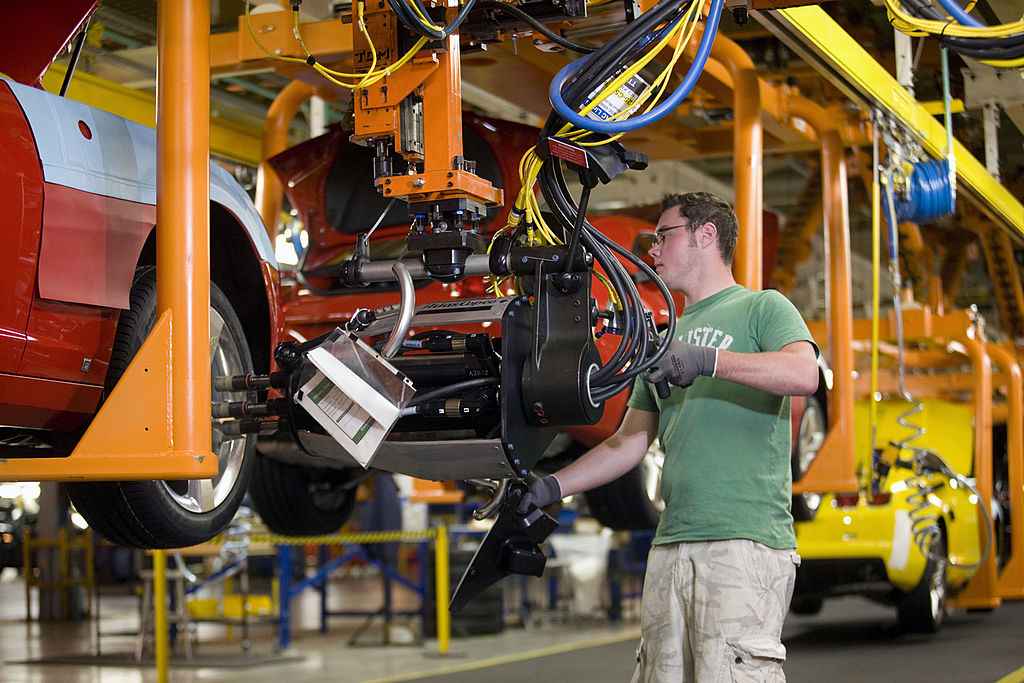
General Motors has indicated that Donald Trump’s tariffs will cost the company $4 billion this year. (Norm Betts / Bloomberg via Getty Images)
“There’s just one line I’d like to change,” says the American.
The dialogue doesn’t quite line up with the actor — the accent betrays that this is a Canadian production — but the look is down pat. Slicked back hair, Oliver Peoples glasses, a designer suit that seems better tailored than his Canadian counterpart’s. He could easily have been an extra in Wall Street or American Psycho. The two men are seated at a table, alone in a large, well-appointed room, going over paperwork. The American and Canadian flags are behind them. The men’s voices echo in the empty room, the color of the film is desaturated. A backroom deal is being worked out in plain sight.
“Which line is that?” asks the Canadian, incredulous.
“Well, this one here, it’s just getting in the way.”
The camera shifts to a top-down perspective as we see the American use a pencil eraser to gently remove a line from a map of North America. It’s the border between Canada and the United States. The rest of the thirty-second spot asks, “Just how much is Canada giving away in the Mulroney trade deal?” — a reference to former Canadian prime minister Brian Mulroney’s free-trade proposal. Water? Health care? Culture? The voiceover reminds viewers not to let Mulroney deceive them again, and further states that the 1988 Canadian federal election wouldn’t be like any other. It was, in effect, not just a referendum on free trade, but on the future of Canada itself.
“Erasing the Line” may have the peculiar distinction of being the most successful political advertisement in Canadian history that didn’t help the party it was created for. Though the majority of Canadians voted against free trade in 1988, the vote was split between the Liberal Party of John Turner (which had commissioned the advertisement) and the New Democratic Party of Ed Broadbent. During a particularly heated exchange in a televised debate, Turner said Mulroney had sold Canada out, and that the inevitable consequence of free trade was that Canada would become a colony of the United States. He concluded his criticism with a prescient comment: “When the economic levers go, political independence is sure to follow.”
Despite the evident and widespread opposition to the free-trade deal — and the loss of several dozen seats in parliament — Mulroney went ahead with it. Within a year, Canada was in a recession, particularly the industrial heartland of the country’s most populous province, Ontario, resulting in hundreds of thousands of job losses.
Protectionism Lost
The free trade debate of 1988 was hardly new. It is foundational to Canada’s very existence, and even predates Canadian Confederation. Resisting economic dominance by the United States was crucial to Canada’s development as an independent nation. And yet, trade with the United States was always going to be inevitable, just as it would be uneven — especially as the Canadian economy developed independently of the United Kingdom. As Canada’s economy grew in size and confidence, it would, ironically, grow closer to, and become increasingly dependent upon, the United States.
If there was any hope that free trade might benefit Canada, it lay in the Canada-United States Automotive Products Agreement of 1965, better known as the Canada-US Auto Pact. The agreement addressed Canadian protectionist concerns while building on existing tendencies toward economic integration that benefitted American automakers. But unlike what the Mulroney government committed Canada to in 1988, the Auto Pact wasn’t a blanket free-trade agreement. It created an integrated and tariff-free North American automotive sector and common automotive market, a rare success for workers and car manufacturers alike.
Donald Trump’s trade war with Canada has not only been the defining Canadian news event of the last year, it’s largely responsible for the defeat of the Conservative Party in last spring’s Canadian federal election. And it has arguably permanently altered Canada-US relations. Though the government of Mark Carney has disappointed economic nationalists and social progressives alike by pursuing a conciliatory tone with the Trump administration throughout much of 2025, Canadians have nonetheless maintained an effective voluntary boycott of American products as well as travel to the United States.
But because Canada’s automotive industry is largely integrated with that of the United States, Canadian autoworkers — and their powerful union — find themselves in an unenviable and awkward position. They are caught between the patriotic call to resist an unjustifiable trade war and annexation threats on the one hand, and the reality that their jobs are entirely dependent on unfettered, tariff-free international supply chains and trade agreements.
Nearly forty years after the free-trade agreement was signed, Canadians discovered in 2025 just how vulnerable they are to America’s fits of populist economic nationalism. Dire warnings from decades ago, long dismissed, about the loss of economic sovereignty leading to the end of political sovereignty are beginning to look uncomfortably accurate.
Caught in the cross fire is arguably Canada’s most important manufacturing sector — and the shining beacon of Canada-US economic cooperation.
The Road to the Auto Pact
At the beginning of the automotive industry, car manufacturing was more artisanal than industrial. Henry Ford’s assembly line hadn’t been invented yet, and cars were largely manufactured one at a time, by hand, in small shops, some of which also built carriages.
“Around the turn of the century, on both sides of the border, there are all kinds of automotive entrepreneurs building cars,” said Dimitry Anastakis, author of Auto Pact: Creating a Borderless North American Auto Industry, 1960-1971. “In the United States, obviously, they have much greater economies of scale, a much bigger market, and are much more able to maximize technology and capital to build big companies. By the 1920s, there are only a few companies left because the automotive industry is the most competitive industry in the entire world.”
Anastakis is arguably Canada’s leading expert on the history of the Canadian automotive industry — and the Auto Pact specifically.
“Because of the difficulties around the technology requirements, the capital requirements, the economies of scale that are necessary, eventually, all of the independent Canadian car companies go bankrupt,” says Anastakis.
Compounding matters was a tariff wall between Canada and the United States, a consequence of protectionist measures taken by both countries in the latter decades of the nineteenth century. This included a 35 percent tariff on horse-drawn carriages, which was meant to protect the carriage industry in Canada.
In 1904, Gordon McGregor, president of the Walkerville Wagon Works, crossed the Detroit River from Windsor, Ontario, and met Henry Ford. McGregor, a carriage maker, was aware of the emerging automotive sector developing in Detroit and wanted to make a deal with an American manufacturer. Ford wanted unfettered tariff-free access, not only to Canada’s market but the developing automotive markets of other Commonwealth countries, like Australia and New Zealand.
The two men came to an agreement that launched the Ford Motor Company of Canada: Ford-branded cars, designed in Detroit and manufactured in Canada, all sold tariff-free throughout the British Empire. This would be the model for US auto sector development in Canada for the first half of the twentieth century.
By the middle decades of the twentieth century, the American automotive industry had consolidated into the Big Three US automakers (Chrysler, Ford, and General Motors), each with its own Canadian subsidiary. Though not completely integrated — a tariff wall continued to separate the two national automotive sectors — they nonetheless benefit from a united binational union, as well as centralized designed bureaus and research and development facilities. And while the Canadian market was nowhere as large as that of the United States, Canadian car and truck plants could export American-designed vehicles throughout the British Empire, giving the Canadian subsidiaries a value greater than the sum of their parts.
Important changes began after World War II. Canada’s auto industry attempted to build as many models as were being designed in Detroit. “Because of postwar prosperity,” says Anastakis, “there’s a proliferation of model types and it’s hard for Canada’s auto sector to keep up.” The tariff structure only protected vehicles made in Canada. “So, while Canada produces Chevrolets and Buicks, which are protected by tariffs, Cadillacs aren’t.”
The result was expensive luxury cars like Cadillacs — among many other new models invented by Detroit automakers in the postwar boom — being exported from the United States to Canada tariff-free, a reality that didn’t sit well with Canadian politicians, the domestic auto industry, or Canadian economic nationalists.
At the same time, the importance of the automotive sector’s role in establishing and maintaining postwar prosperity on both sides of the border was becoming obvious to politicians and policymakers in Washington as much as in Ottawa. With hundreds of thousands directly employed by the sector, and perhaps as many more working in related fields, the auto sector was driving North America’s manufacturing economy.
This strategic importance gave workers an edge in negotiations as much as it encouraged politicians and the management of the Big Three to cooperate with unionized autoworkers. Reuther’s Treaty of Detroit, a negotiated agreement between General Motors and the United Auto Workers, got the union to agree to a long-term contract in exchange for extensive health care, unemployment, and pension benefits, as well as increased vacation time and higher wages.
“Instead of demanding more radical solutions to the way a capitalist economy functions — which had been seriously entertained in the 1930s and 1940s — the agreement winds up shifting a lot of the wealth generated by the auto sector into the hands of the workers,” says Anastakis.
“That helps to create the North American middle class. And that prosperity fuels this never-ending desire for more cars and different types of cars, which the Canadian manufacturers try to accomplish but really can’t.”
Keeping the Market Captive
By the late-1950s, a trade imbalance had developed. Though Canada had previously been able to export cars within the Commonwealth, decolonization and the independent economic development of former British dominions, like Australia, ate into Canada’s automotive export market.
Separately, a major technological change — the advent of the automatic transmission — signaled an additional challenge to Canada’s auto sector. Given automatic transmission vehicles were only being produced in the United States at the time, they, too, could get around the tariff barrier, and there was no incentive for American automakers to share the technology with their Canadian subsidiaries.
“So, you’re not just facing a massive and growing trade deficit between the two countries but the very real threat of Canada’s automotive sector becoming technologically obsolete,” says Anastakis, noting that similar situations developed in the 1980s as a consequence of manufacturing automation, and again more recently with the advent of electric vehicles.
The crisis led to the creation of a number of reports, including the Bladen Report in 1961, which advocated the removal of tariffs if Canadian production of vehicles and parts aligned with US sales, effectively leading to continental integration of the automotive sector. Canada was running an automotive trade deficit approaching $500 million in 1963–64 (over $5 billion adjusted for inflation), exported virtually no automotive components to the United States, and had seen its efforts to compel automakers to increase Canadian production fall flat. Despite this, there was considerable interest in finding a mutually beneficial solution, particularly given that the Big Three automakers and their Canadian subsidiaries are effectively owned by the same people, and that almost all their workers are part of the same union.
“The irony of Trump complaining that Canada’s stealing American industry, at least with regards to the automotive sector, is that the idea for continental industrial integration is largely an American idea,” says Anastakis.
Henry Ford II essentially called US president Lyndon B. Johnson and said, ‘The Canadians have this idea for how to remake the auto industry that will allow us to get rid of all the tariffs, but they have conditions that allow them to keep their auto sector.’ And this is what the people who own the Big Three want, because the collapse of the Canadian auto sector affects their bottom line too. They’ve sunk a lot of money building those plants in Windsor, Oakville, and Oshawa.
If America’s Big Three automakers were perceived as having contributed to the collapse of the Canadian automotive sector — and the prosperity that came with it — Anastakis argues, they risked losing what had essentially been a captive market for the better part of the preceding half-century, as Canadians would likely respond by boycotting American cars.
The solution was the Auto Pact, a unique compromise that permitted both duty-free bilateral trade with mutually beneficial conditions and trade-offs. In essence, it represented the intersection of free trade and economic protectionism. The Big Three could sell as many cars and trucks in Canada as they liked, just so long as they built an equal number in Canadian factories.
“This actually required Ford to build a new truck plant in Oakville,” notes Anastakis.
The agreement also required a minimum number of Canadian parts in each car and truck, so as to avoid the possibility of the United States having a monopoly on car parts production. The agreement essentially guaranteed the Big Three — which owned their Canadian subsidiaries outright — continued unfettered access to the Canadian market.
More significantly, it expanded the integration that had already been taking place for many decades, finalizing the integration of the North American automotive industry and allowing it to operate at maximum efficiency. Other advantages — including high-skilled Canadian labor, universal health care for Canadian workers, and, later, a weaker Canadian dollar — ultimately served the interests of the Canadian and American governments, workers on both sides of the border, and the bottom lines of the Big Three alike.
Trump Is Dynamiting Big Auto’s Two-Way Street
The Auto Pact went into effect in January of 1965. The effect was a “tremendous reorganization of the North American auto industry” says Anastakis, as the Big Three rationalized production on a continental basis. Canadian plants, such as the General Motors facility in Oshawa, Ontario, which had previously produced as many as twenty-two different vehicle models for sale in the Canadian market, would instead produce just four models, though they’d be sold throughout North America. Similarly, Ford of Canada, which had previously produced as many as two hundred different engine models in Canada, was rationalized down to just four different models, even as overall output rose to meet continental demand.
The effect was significant.
“In 1963, Canada builds something like 600,000 vehicles and they export like 9,000 of those to the United States,” says Anastakis. “A decade later, Canada’s building 1.3 or 1.4 million vehicles and exporting one million of them to the United States. And at the same time, Americans are now exporting hundreds of thousands of vehicles to Canada every year, duty free. It’s a two-way street.”
Beyond its immediate benefits to the automotive sectors of both countries, Anastakis argues that the agreement had by the 1980s produced such deep integration that it became virtually impossible to tell how much of each car was made in what country, given the interwoven nature of the Big Three’s supply chains.
This integration has been upended by the Trump administration’s tariff war.
“Unraveling this is a real problem,” says Anastakis. “Sure, it can be done. But what you’re doing is you are choosing to destroy the advantages that the industry has taken full advantage of for the last sixty years.”
Among those advantages, Anastakis cites the relatively cheaper Canadian dollar and Canadians’ access to public health care as major competitive advantages for Canadian labor. “There’s also specialization in Canada, such as the tool and dye makers of Southwestern Ontario, or the close proximity to Quebec’s aluminum industry, which is used in parts that crisscross the border many times over.”
Anastakis argues that even though the Auto Pact was terminated after a ruling by the World Trade Organization (WTO) in 2001, its legacy carried on in important ways. By that point, the integration of the North American automotive sector had already been completed and the benefits were clear to all involved. Even so, while Canada’s automotive sector performed well during the broader economic adjustment to free trade in the 1990s, the WTO decision heralded the beginning of a long decline.
“Since 2001, you’ve seen a real shrinkage in the footprint of the Canadian operations of the Big Three because they’re no longer required to meet these demands,” says Anastakis. “The reason that they stay in Canada is because there’s this huge unavoidable legacy of production that goes back and forth across the border. And because they still have all these very valuable facilities.”
Anastakis notes that several high-selling models continue to be built in Canadian plants, and that Ford’s engine plants in Essex and Windsor, Ontario, are crucial to their operations. “Trump’s irrationality is having a chilling effect on the industry,” says Anastakis, noting that the engines for the Ford F-150 — a product more valuable than Coke or Nike — are manufactured in Canada. “The CEO of Ford said tariffs will blow a hole in the whole industry. And keep in mind, it was Trump who negotiated CUSMA [the Canada-United States-Mexico Agreement].”
“No business leader has really any kind of sense of what’s going to happen going forward,” says Anastakis, who also notes that interruptions to North American supply chains, such as those that occurred after 9/11, the 2008 financial crisis, or the COVID-19 pandemic, all had negative effects on the automotive sector and contributed to the bankruptcies of two of the Big Three in the last twenty years.
“This is hair-on-fire territory.”
Moving Forward and Moving Apart
While Anastakis believes Canada should engage in hardball negotiations and counter-tariffs in the short term, he argues that the best option for Canada’s automotive sector in the long term is separation.
“Trump broke something that worked, and he doesn’t understand transitioning to electric vehicles (EV) is the future,” says Anastakis, noting that Canada could — and should — become a leader in EV manufacturing. The problem, he argues, is that the Big Three are trying to maintain both conventional and electric production lines, something Anastakis thinks is untenable given the scale of Chinese EV competition.
In December, Ford announced it was terminating the Ford F-150 Lightning, the electric version of its popular light truck. This decision fits with a general move away from electric vehicles by the Big Three, itself a consequence of the Trump administration’s ideological opposition to electric vehicles — or indeed, to any effort to curb climate change.
More recently, Trump referred to the CUSMA free-trade agreement as irrelevant while touring a Ford plant in Detroit. General Motors has since indicated that they believe Trump’s tariffs will cost the company US$4 billion this year, an increase of nearly $1 billion over 2025. GM is also expected to axe seven hundred jobs at its Oshawa, Ontario, truck plant as it moves production to Indiana.
“It boggles the mind how anybody could be left alone to do this kind of destruction, this wanton destruction upon their own industry,” says Anastakis.
Whether Canada remains committed to the integrated auto sector created through the Auto Pact or transitions away from the United States remains to be seen. As Canada seeks to develop new economic relationships with China as a way to break free from the economic turmoil of the Trump administration, auto sector loyalties have been seriously tested.
Unifor, which represents Canada’s unionized autoworkers, came out against a proposal to allow an import quota of Chinese EVs in exchange for lowered tariffs on Canadian canola exports to China. Unifor said it posed an extreme risk to the Canadian automotive sector. Ontario premier Doug Ford followed by calling for a Canadian boycott of Chinese EVs.
But it’s obvious that the union’s continued support of an auto sector that’s being hollowed out in Canada is untenable. Preserving automotive jobs may ultimately require a wholesale separation from the increasingly protectionist United States and the pursuit of new agreements with Asia.
Ottawa and Seoul have announced a memorandum of understanding that would see South Korean auto manufacturing come to Canada, possibly in exchange for the procurement of South Korean submarines for the Canadian Navy. Anastakis notes that Honda stated in 2024 that they wanted to develop a comprehensive EV supply chain in Canada, a proposal that was championed by the Canadian government as much as by Premier Ford.
However, the Carney administration has offered little clarity on regulations tied to a proposed mandate to require 20 percent EV production from the Big Three. The mandate, which was supposed to come into effect this year, was paused in late 2025. The chief executives of Ford, GM, and Stellantis’s Canadian operations urged Carney to repeal the EV mandate in a joint statement in December 2025.
“In the best of times, this is the most difficult industry in the world,” says Anastakis. “The transition to EVs is absolutely necessary, not just for the health of our planet but for the industry, because that’s where the industry’s going. Anyone like Trump who feels like we can bring back coal and keep internal combustion engines is so out of touch with reality, they might as well be pushing horse-drawn carriages.”