How Canada Can Say No to Donald Trump
By substantively rebuilding its national sovereignty, Canada can de-link itself from US economic and political domination.
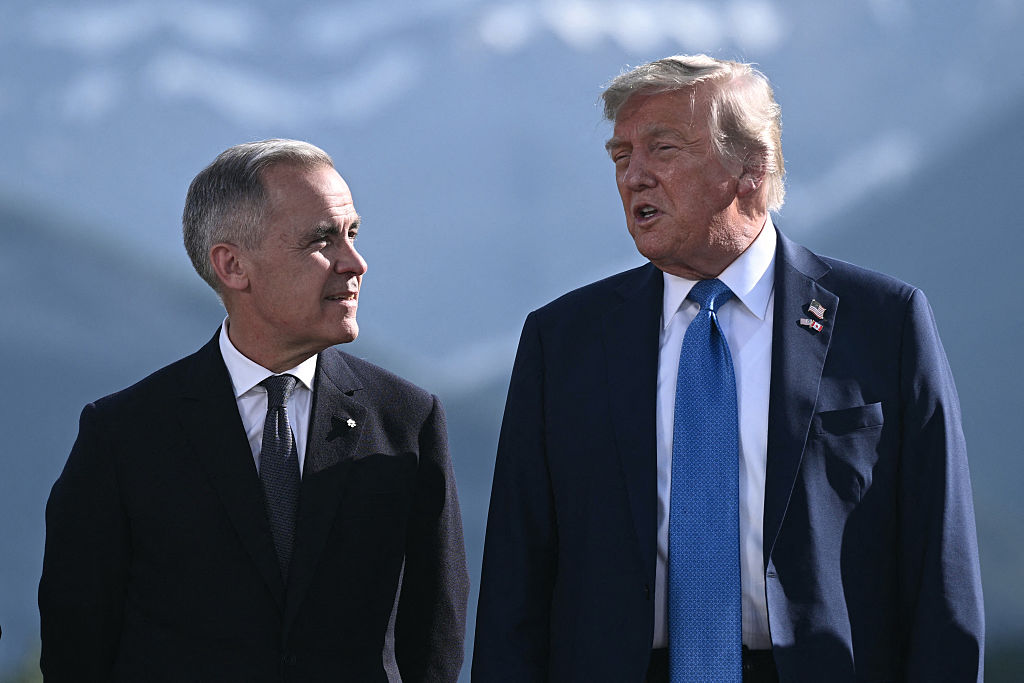
Canadian prime minister Mark Carney and US president Donald Trump during the Group of Seven (G7) Summit in Alberta, Canada, on June 16, 2025. (Brendan Smialowski / AFP via Getty Images)
An all-too predictable pattern has emerged in US-Canada relations. US president Donald Trump makes Canada “an offer it can’t refuse.” What follows is a national gnashing of teeth, flag-waving, businesses and politicians going patriotic. The Canadian government then caves, lamenting we had “no choice.”
What would it take to truly have a choice? An end to Trump’s on-again, off-again tariff ultimatums would obviously be welcome, but our previous “normal” was never actually all that great, and it misses the larger point. Our quandary doesn’t lie in this or that policy conflict but something far deeper: unless we break out of this never-ending story by considerably de-linking from the United States — soberly, of course, and necessarily over time — we’re stuck with the fatalism of having “no choice.”
Canadians understand full well that it is our sovereignty that is at stake. But we differ on where this might take us. Talk of Canada becoming America’s fifty-first state is a red herring; it is not Canada’s formal sovereignty that is in danger. What we confront is the drip-by-drip erosion of our substantive sovereignty: the loss, already well under way, of democratic capacities to determine the kind of society we hope to build.