Trump Wants a “Video Game War” in Iran
Donald Trump has resurrected the military fantasy of the “video game war,” waged mostly through high-tech, lethal air power with few US casualties. But his administration may have miscalculated the ease of what can pass as victory.
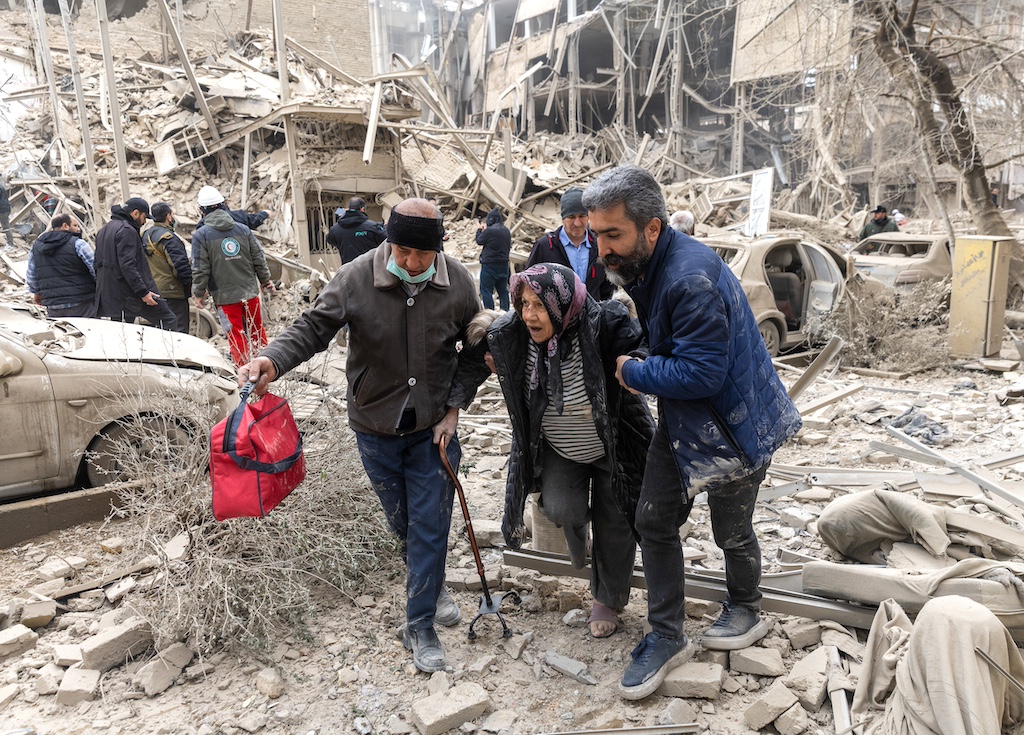
Americans and the world watch a video game war unfold in what they long feared: unhinged conflict throughout the Middle East. (Getty Images / Stringer)
Within hours of the September 11, 2001, attacks, pundits scrambled to explain what they signified. “Perhaps,” Naomi Klein wrote days later, 9/11 will “mark the end of the shameful era of the video game war.” By that she meant, for Americans, the bloodless entertainment — familiar since the 1991 Gulf War — of watching precision bombs pulverize distant targets.
Americans now knew what the video game war, enabled by a nationalist media, concealed: the devastation, especially for civilians, when terrible violence strikes. This suffering, Klein felt, was the point of the terror: “The era of the video game war in which the U.S. is always at the controls has produced a blinding rage in many parts of the world, a rage at the persistent asymmetry of suffering. . . . [T]wisted revenge seekers make no other demand than that American citizens share their pain.”
Despite promises of swift victory, the Afghanistan and Iraq Wars confirmed for Americans the sentient hell of actual, blood-and-guts war. Both ended when the country had seen enough chaos, loss, and drift. Thereafter, the “Iraq syndrome” limited US aggression, while incentivizing advances in remote killing via drones. That was then.
Now Donald Trump’s attack on Iran has brought the video game war back with frightful vengeance. There is the Pentagon’s puerile mash-up of real bombing footage with scenes from Call of Duty. More than that, Trump has resurrected the military fantasy at the heart of the video game war: armed conflict with (nearly) zero losses, made imaginable by technological advances, chiefly in lethal air power. Equally important is its political premise: that Americans will scarcely object to, or even care much about, any war so long as victory is certain and costs are low.
It barely feels like the Iran War is happening at all, save on TV or social media. This is by design.
The Trump administration has largely dispensed with the dismal rituals by which the nation marches to major wars. Gone are the months of propaganda and pressure campaigns to hype the threat and demonize the enemy; to build support within Congress and the United Nations; and to work the country into an exceptionalist lather, amped to teach the world a lesson about American benevolence and resolve. Implicit in these blowoffs is Trump’s conceit that he can make war without accountability, constraint, or even manufactured consent.
Trump has managed only a grudging pantomime of commander-in-chief statecraft. His shifting explanations of why the war is happening at all feel half-hearted. He recites world-saving rhetoric — Iran, “the hour of your freedom is at hand” — as if quoting lines from a bygone movie. The administration’s true zeal is for its menacing memes and taunts, stripping death of both gravity and dignity. Among its perpetrators, the video game war is, indeed, treated like a game.
Even the media seems detached. Where is the saturation coverage and celebrity anchors rushing to the region, Kevlar helmets in tow? The tough questions for Pentagon briefers and sparring with Trump himself? So far, the war is just another story, not a national fixation.
This is not to say that the war lacks purpose within time-honored patterns of US aggression. Its origin is likely some combination of historical score-settling; strategic opportunity, given Iran’s regional isolation and internal conflicts; Israeli pressure; nuclear nonproliferation; neocon ambition; the timeless quest for oil; and Trump’s will to dominate as an end in itself. Empire never sleeps. Still, the nation seems dull to the fight, as yet visible only as a distant, screen-managed spectacle.
How to Lose a Video Game War
That all could change, slowly or quickly. The Trump administration may have badly miscalculated the ease of what can pass as victory.
Within a long view, Trump’s video game war 2.0 is apt to reignite global outrage at American arrogance and an escalating “asymmetry of suffering.” (The Iranian government reports more than 1,400 civilians dead and damage to nearly 43,000 civilian structures.) Already there have been at least three alleged domestic terror attacks, for which the war may have been the trigger. Who knows what bitter and aggrieved enemies might one day pull off.
Here, this week’s resignation of Joe Kent, a Trump appointee and leading counterterrorism official, is telling. In a remarkable rebuke of the president, his resignation letter stated that “Iran posed no imminent threat to our nation.” The war, not Iran on its own, puts American lives at risk.
More immediately, Trump has tangled with a tenacious regime, expert in hybrid and irregular warfare. Technological advances cut both ways: pricey missile defense systems and precision bombs dropped by multimillion-dollar aircraft, as well as cheap drones and torpedo skiffs capable of hobbling global trade. With proxies across the region, Iran has found a way to raise the cost to the United States in treasure, if not yet in blood.
The costs are to the national budget, private business, and the individual consumer. Gasoline prices, not American body bags, might prove decisive, and Iran knows it. A pitfall of the video game war is the public’s general indifference to it. Few are invested in its success and will embrace shared sacrifice if it goes wrong.
US “boots on the ground,” even for tailored counterstrikes, exponentially increase the military, human, and political risk. With a large-scale, regime-toppling invasion, the United States would rediscover what it learned in Iraq: that even an oppressed people, bombed by their “liberators,” do not welcome military occupation. Such an occupation would doubtless brutalize civilians and foment both an insurgency and internal, lethal strife.
It is also a multitheater war with a dizzying array of actors, each with their own priorities. No coalition gives them a common purpose. A single-shooter approach doesn’t work in such a crowded battlefield. Nothing suggests that the Trump administration has given serious thought to the complex dependencies, vulnerabilities, rivalries, and capacities of putative allies. As a consequence, Trump is begging NATO nations and even China to police vital shipping lanes with their warships. So far, no takers.
Each day, panicked foreign nationals seek exit from the chaos. Americans and the world watch unfold what they long feared: unhinged conflict throughout the Middle East. Eventually, heartbreaking images of the civilian dead in Iran will hit the Western press, shifting the emotional landscape. More Americans will die.
Saying No to War
The US public, by a firm majority, does not want this war. Extraordinary opportunities exist for mobilizing to bring its end and weaken Trump. Yet antiwar sentiment has not translated into a visible antiwar movement.
That condition can change. The history of post-9/11 protest, which I write about in Our Grief Is Not a Cry for War, shows how the grassroots — even in the face of great adversity — can rally against war.
Sickened by the 9/11 attacks, a small but spirited minority of Americans feared the US onslaught to come. The ANSWER Coalition quickly formed to oppose looming war. From the rubble of a canceled global justice mobilization, the group held an antiwar rally of up to twenty thousand people in Washington, DC, in late September, before the invasion of Afghanistan had even begun. When the invasion did begin on October 7, ten thousand people rallied for peace in New York City.
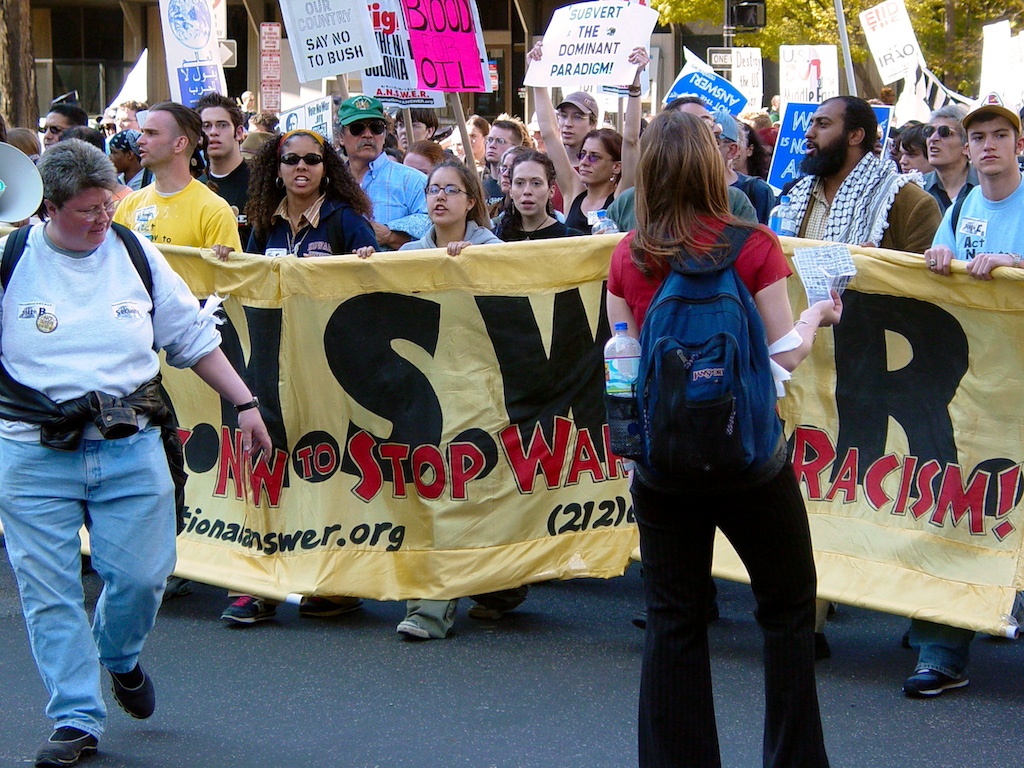
Weeks into the war, Code Pink cofounder Medea Benjamin and other Americans rushed to the region to document civilian harm. Activists, including family members of the 9/11 dead, successfully lobbied the US government for compensation for Afghani victims. All this happened when much of the nation seethed with fear and anger, and even mild dissent was tarred as treason.
George W. Bush’s plodding buildup to the Iraq invasion gave antiwar forces time to gather strength. From the summer of 2002 to the war’s start in March 2003, millions of Americans attended thousands of antiwar actions. In October 2002, a new coalition, United for Peace and Justice, formed. Stitching together hundreds of groups, it madly planned for a day of global protest.
Under the banner “The World Says No to War!” between fifteen and thirty million people rallied on February 15, 2003, in seventy-two countries. Four hundred thousand turned out in New York City at the steps of the United Nations. The protests that day remain the largest in human history. While not preventing war, they isolated Bush on the world stage and made the war harder to fight.
The bitter years of the conflict saw ceaseless antiwar protest. This included a peace witness in Iraq itself, public anger from the grieving families of fallen soldiers, searing testimony from antiwar veterans just back from battle, whistleblower defections throughout government, and courageous acts of civil disobedience. Often ignored by the media and the political class, the movement helped turn hearts and minds against the war and hasten its end. Bipartisan disdain for “stupid wars” is, in part, a legacy of the movement.
Saying No to War, Again
To be sure, antiwar protest — from vigils to congressional call-ins — exists today. Stalwarts of the post-9/11 movement, like Veterans for Peace and Code Pink, remain vigorous. (In a poignant protest, vigil participants displayed children’s shoes outside of New York City’s famous public library to represent the more than 170 people killed in the US airstrike of an Iranian girls’ school.) Peace delegations will doubtless visit Iran to take stock of the destruction.
But such protests are nowhere near the frequency and scale of post-9/11 activism. There is no new, bold antiwar coalition nor, as yet, any signature mass demonstration commanding media attention. Many reasons account for the relative quiet. The peace camp, like most everyone, was caught off guard by Trump’s brazenly unilateral decision to start a war. Competition for one’s compassionate action is stiff at a time when the Trump administration is delivering a firehose of evil. Dissenters are rushing from one moral emergency to the next and battle outrage fatigue.
The war itself and its existing optics have limited outrage too. Fought mostly from the sea and air, the war has claimed just a handful of US soldiers, whose deaths always draw public concern. Few images of Iranian suffering have emerged beyond the girls’ school. So far, the video game war is partly fulfilling its purpose of blunting opposition. And Americans are likely suffering from Trump Resignation Syndrome — the wearying sense that Trump will do what Trump will do, regardless of laws, norms, judicial censure, and even public opinion. The temptation is to simply watch Trump’s war badly unravel and hope that he pays a big political price.
It is a temptation worth resisting. First, no one wants more chaos and death. The war should be pushed to a close by public pressure — not simply implode — in that way save lives. Second, the war is the ultimate expression of Trump’s authoritarianism and sociopathic love of domination, violence, and the murder of perceived lessers. (It is a “great honor,” he boasted, to kill Iranians.) Antiwar protest is a vital plank in a broader antifascist project.
Third, to resist war is to resist oligarchy and promote a fair economy. The Pentagon has made the staggering request of $200 billion to fund the war, on top of nearly $1 trillion in military spending in 2025. Taxpayers will be stuck with this new bill, while the superwealthy luxuriate in billions of tax savings from Trump’s “Big Beautiful Bill.” It is an ugly picture of a decaying empire, pocked by growing class cleavage and scattershot foreign wars.
In addition, recent precedent tells us that principled, public outrage can make Trump back down. The magnificent protests, and terrible murders, in Minneapolis galvanized the nation in resistance to Immigration and Customs Enforcement’s (ICE) lethal predations. For now, at least, the kind of blitzkrieg sieges seen in Minneapolis, Chicago, and Los Angeles have been suspended.
The very idea of fully authoritarian wars, waged against Iran and threatened against Cuba, must be rejected. An antiwar movement could lead the way. Finally, antiwar protest — especially if welcoming Republicans — could help to fracture the MAGA movement (or at least peel off some of its GOP enablers) and diminish its power in a post-Trump world. That world cannot come soon enough, and it will be better if progressive social movements till its soil.
Whether a robust antiwar movement of mass protests and direct action will emerge remains to be seen. Overwhelm, resignation, and sanitized images of war are powerful headwinds to overcome. Against ominous signs, the war could end relatively soon, with politically manageable costs in blood and treasure and an outcome Trump can claim as victory.
So much is unknown, except the stakes: life and death and the survival of even a shred of American democracy.