The Many Invasions Survived by Lebanon
- Rona Lorimer
Israel is again invading Lebanon and displacing hundreds of thousands of people. With Israel determined to crush all forms of resistance, Lebanon has been dragged into a war it did nothing to start.
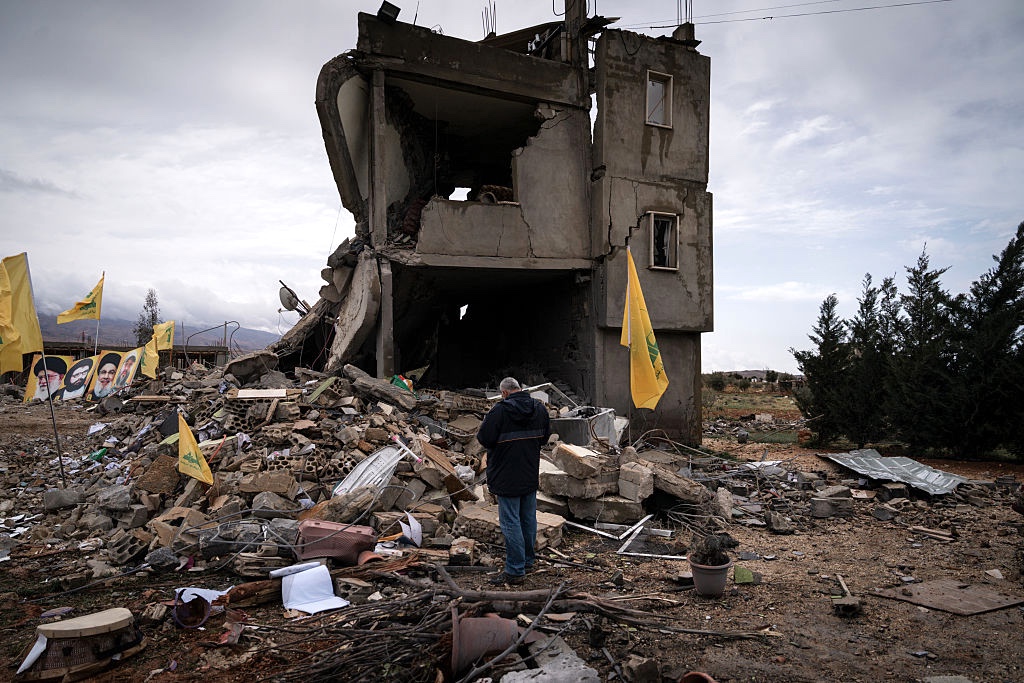
The return of the Israeli army to Lebanese territory is no longer only about occupying but also about emptying the south of its population. (Adri Salido / Getty Images)
Although long used to all manner of wars, Lebanon is watching in stunned disbelief as catastrophe strikes with an unprecedented violence. Everyone here remembers that in 2000, under pressure from Hezbollah, Israel withdrew from the south of the country, which it had occupied for eighteen years. The Shiite organization earned its nickname “Resistance” there, becoming the only Lebanese militia to keep its weapons — allowing it to become the Iran-backed “state within a state” that we know today.
The terrifying return of the Israeli army to Lebanese territory thus takes on the air of revenge, but with a key difference: it’s no longer only about occupying but also about emptying the south of its population (8 percent of the country’s land area) and ordering residents in the southern suburbs (some 800,000 in a country of five million) to evacuate as well — before the bombings.
In both regions, the panicked populations immediately fled their houses without looking back. Pursued by Israel’s watchful eye (and bombs), which nothing escapes, men, women, and children took refuge further north in schools emptied of their pupils, in rentals whose prices suddenly became prohibitive, or else outside, during this winter month, on the pavements of Beirut and elsewhere.
The truth is, the war in Gaza has taught Israel one simple thing: there’s no longer any need to conquer a territory by force; all it takes is WhatsApp or an X account to sow terror by ordering evacuations, on pain of suffering — in the words of Israeli minister Bezalel Smotrich — the fate of the Gazan city of Khan Younis (400,000 inhabitants), almost entirely razed to the ground in 2024.
One man whispers in another’s ear, and his flattering murmur precipitates a cataclysm of global proportions. It’s like this that the diabolical Benjamin Netanyahu managed to drag the president of the world’s greatest power into a devasting war without cause or defined objectives.
The chain reaction was immediately set in motion: decapitated in the first hours of conflict, the Iranian regime lashed out far and wide, particularly against Saudi Arabia and the Gulf states, all of which are close allies of the United States and hosts of its military bases. One can imagine the Israeli prime minister gloating: Iran’s retaliation has established his country as an objective ally of the oil monarchies.
In Lebanon, under the pretext of avenging Ayatollah Ali Khamenei’s death, Hezbollah made the improbable decision to fire several rockets at northern Israel, offering Netanyahu the ideal pretext to massacre it — and massacre the unhappy Lebanon along with it. And so finished the race that had been underway for a year between Israel and the new Lebanese government over the question: Who will disarm Hezbollah?
President Joseph Aoun and his prime minister, Nawaf Salam, had committed to doing so and more or less managed to in the south. But they were moving slowly — too slowly? — in the rest of the country in order to avoid a direct confrontation between a still-fragile national army and a still-formidable Shiite militia. For although weakened by the war waged against it by Israel and the fall of its Syrian ally, the regime of Bashar al-Assad, Hezbollah remained capable of resisting the Lebanese government and even of carrying out its threat to spark a civil war.
The aim appears to be the same. But if it’s Israel rather than the government of Beirut that incapacitates Hezbollah, the situation changes completely. Conscious of the danger, the Council of Lebanese Ministers decided — a little late — to formally ban all of Hezbollah’s military activities and arrest members of the Iranian Revolutionary Guards present in Lebanon with a view to extraditing them. The latter, who likely fired the rockets that set the powder keg ablaze — since Hezbollah’s Lebanese leaders were not really in control — had, for the most part, left the country once their crime was committed.
Lebanon on Its Knees
Everything has started to work in Netanyahu’s favor. Under the pretext of protecting his northern border from the “existential” threat that the Shiite militia poses to his country, he is seeking to create an uninhabitable buffer zone as wide as possible in southern Lebanon. For now, he is bombarding the country with the aim of bringing it to its knees, forcing it to surrender and sign an uneven peace treaty.
Hezbollah’s rockets will ultimately have served the same purpose as the massacre carried out by Hamas on October 7, 2023: to give Israel the opportunity to destroy Gaza on the one hand and fracture Lebanon on the other.
The aim of the war that Donald Trump let himself be dragged into appears just as nebulous, and even his MAGA base is beginning to realize it. Contrary to what he believes, the destruction of all of Iran’s military capacities will drive it far more likely into civil war and generalized chaos than to lead to regime change.
The objectives pursued by Israel are much more tangible. Its goal is to be the only armed country in the region where all of its enemies will be disarmed so that it may quietly pursue its grand historical ambition: to annex occupied territories and thus devour the whole of historic Palestine, “from the river to the sea.” But it has to act quickly — its “gains” only being possible thanks to the presence of Trump in the White House, which won’t last forever.
That leaves one question: What can Israel do with its uncontested military supremacy? In other words: What is its plan for the day after? The answer is that there isn’t one. Yet it is difficult to imagine a peaceful future based entirely on subjugating the Middle East through brute force. Without a positive vision, it will never work — but Israel may not be capable of understanding this, as it thinks only of itself.
Between a US-Israeli coalition that is setting the region on fire in defiance of international law and an Iranian regime that shamelessly massacres its own people and bombards its neighbors indiscriminately, it is impossible to choose. The only hero in this story is the long-suffering Iranian people, whose courage and resilience are overwhelming.
As for Lebanon, the victim of a predatory neighbor and a militia obeying the orders of a foreign country, it is being dragged against its will into a war in which it is truly not to blame.
It must remember that, as small and fragile as it is, the country has survived all its invaders since the dawn of time. A series of stelae (commemorative stones) a few kilometers north of Beirut, at Nahr el kalb (“Dog River”), bear witness to this.