Middle East Wars Are Still About Oil and Empire
Gilbert Achcar explains how oil, US power, and regional rivalries have shaped decades of conflict in the Middle East — and why the confrontation with Iran fits a long imperial pattern.
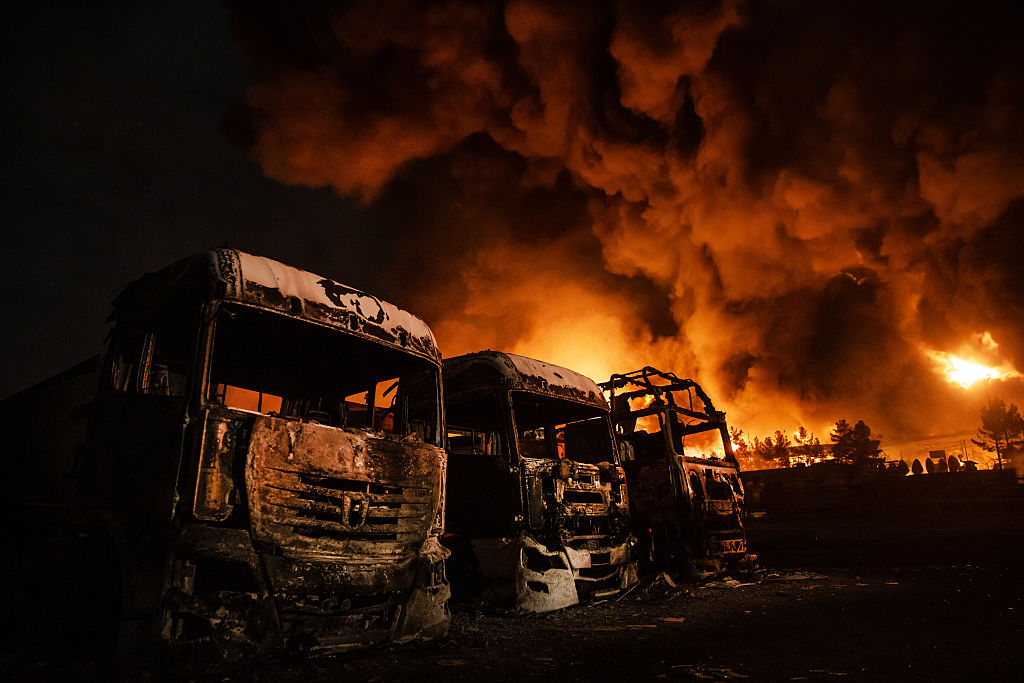
Fire breaks out at the Shahran oil depot in Tehran, Iran, after US and Israeli attacks on March 8, 2026. (Hassan Ghaedi / Anadolu via Getty Images)
- Interview by
- Bashir Abu-Manneh
Why has the Middle East been so consistently wracked by war? In an interview with Jacobin contributing editor Bashir Abu-Manneh, political economist Gilbert Achcar argues that the answer lies above all in the region’s central place in the global oil economy and the strategies of great powers seeking to control it. Achcar discusses the logic of US intervention, the limits of the US-Israel alliance, Iran’s strategy in the current conflict, and the regional consequences of Washington’s evolving imperial doctrine. This interview has been edited for clarity.
It is impossible to talk about the Middle East without talking about war. It’s probably the region most ruptured by war in the post-1945 era. In the last decade and a half alone, many Arab uprisings devolved into prolonged civil wars. Not to mention Israel’s forever war against the Palestinians. Why do you think war is so prevalent in the region?
There is no doubt that the Middle East and North Africa (MENA) region is, of all world regions, the one that has witnessed the highest number of armed conflicts since 1945, with an impressive number of interstate wars and foreign expeditions. The latter category increased exponentially after the USSR’s collapse, when the United States felt free to intervene in the region starting from the 1991 war against Iraq. Russia followed suit under Vladimir Putin, starting from its intervention to shore up the Syrian regime in 2015.
The reason for this prevalence of war is straightforward: it is what is often referred to in the region as the “oil curse,” the fact that the Gulf and bordering countries have been known since the eve of World War II to hold the world’s largest reserves of oil, of a kind that is particularly profitable at that, due to relative ease of extraction.
Oil, or more precisely hydrocarbons, taking natural gas into account, have been at the center of MENA’s politics since the end of the war. The huge interest of US imperialism in the region, upheld by US oil majors, was exemplified by the famous stopover of Franklin Delano Roosevelt in the Red Sea in February 1945, on his way back from the crucial Yalta Conference where the Allies discussed the shape of the postwar world. That meeting on board USS Quincy with King Abdul Aziz, the founder of the Saudi kingdom, was followed by the construction of a US Air Force base in Dhahran, in the heart of the key Saudi oil fields exploited by the then US-dominated Aramco (originally, the Arabian American Oil Company) and strategically located for Cold War purposes.
I once called the Saudi kingdom the true fifty-first state of the American Union, a de facto status that it held before the Israeli state was even born. The kingdom and the whole Gulf region have been and remain at the center of US imperial strategy in the Eastern Hemisphere, pace countless attempts to outsmart common wisdom by explaining that “it is not about oil” or “not only about oil.” Commenting on the 2003 US-led invasion of Iraq, Former Federal Reserve chairperson Alan Greenspan wondered in his memoir why “it is politically inconvenient to acknowledge what everyone knows: the Iraq War is largely about oil.”
Of course, being about oil is not only — or even not primarily for Washington — about US access to Iraqi or Gulf oil. It is about controlling the huge amount of oil money detained by the Gulf states (their sovereign wealth funds own over $3 trillion in assets, close to 40 percent of the world’s total held in such funds) and benefiting from their considerable purchasing power, especially in funding the US military-industrial complex. It is also about controlling other states’ access to Gulf hydrocarbons. As David Harvey aptly put it once, “whoever controls the Middle East controls the global oil spigot and whoever controls the global oil spigot can control the global economy, at least for the near future.”
This also shows how mistaken have been the many who believed that the surge of shale hydrocarbon production in the United States, combined with the rise of China’s power, meant that the Middle East has lost its importance for Washington. Much of this kind of deluded commentary was poured over the Obama administration’s famous “pivot to Asia.” What such comments completely overlooked is that controlling the Gulf “oil spigot” is crucial for the US strategy toward China, about half of whose oil imports originate from the Gulf. The ongoing joint ventures between US AI majors and Arab Gulf states – leading to the construction there of highly energy-consuming data centers, taking advantage of those states’ abundance of money and cheap energy — add a major element to the region’s overall importance for the United States.
Last but not least in the specific case of the Trump administration, the considerable vested interests of the Trump, Kushner, and Witkoff families in the Arab Gulf states bring Washington’s interest in the MENA region in general and the Gulf in particular to a historical peak, which translated into Donald Trump militarily intervening there more than in any other part of the world.
Indeed, Trump stands in a long lineage of US presidents who use military force in the Middle East as a core part of US strategy. What are the immediate causes and long-term policy objectives of the US attack on Iran? What explains the Trump administration policy on Iran?
Ever since the 1979 Iranian revolution brought down the shah’s regime, a major regional US ally, Tehran has become an annoying thorn in the side of the United States. Relations between the two countries have nevertheless gone through contrasting phases: as odd as it may seem, there have been phases of cooperation between Washington and Tehran after 1979. In the 1980s, the United States and Israel sustained Iran’s war effort against Iraq in what became known as the Iran-Contra affair. It was then in their best interest to prolong the war between what they viewed as two rogue states threatening their interests. Then Iran backed the 2003 US-led invasion of Iraq through the collusion of its Iraqi proxies with Washington.
Paradoxically, the US military brought with it those proxies and installed them in power. The result was that Iran became the main beneficiary of the invasion, eventually achieving more sway over Iraq than the United States — one reason why Iraq is regarded as a major fiasco in US imperial history, on par with Vietnam.
The nuclear deal that the Obama administration concluded with Tehran in 2015 did not prevent Iran from furthering the expansion of its regional influence, which was boosted by its intervention in Syria on the side of the Bashar al-Assad regime starting from 2013 and by the Houthis’ takeover of the northern part of Yemen in 2014. In this regional expansion, Tehran exploited both anti-Israel and anti-US resentment and Shia-sectarian allegiance. It is the main reproach addressed by Trump, Benjamin Netanyahu, and the key Gulf monarchies to Obama, whom they all begrudge because he concluded the nuclear deal at a time when Tehran’s regional power expansion was in high gear, without giving due attention to limiting that expansion. On the contrary, the deal improved Iran’s economic standing, hence facilitating its regional policy.
Consider all the reasons that we’ve mentioned, and you’ll understand the strong rationale behind Trump’s policy on Iran. Through the present onslaught, he is hoping to achieve dominance over that country, which would complete and hugely enhance US dominance over the Gulf as well as over the whole MENA region.
This war seems like Netanyahu’s dream come true. Are US war aims and objectives the same as Israel’s or are there significant divergences?
There are both convergences and divergences, to be sure. The convergences are obvious: both the United States and Israel — not Netanyahu’s government alone, but the whole Zionist power elite — want to put an end to Iran’s nuclear program. Israel sees this matter as an existential threat, jeopardizing its present status as the only nuclear-armed state in the region. Washington sees the not-so-hypothetical future possession of nuclear weapons by Iran as a major deterrent since Tehran could threaten to nuke neighboring Arab oil fields, provoking a disaster for US interests and the global economy. And both Washington and Israel have a clear interest in rolling back Iran’s regional influence.
Now, there are divergences too, even though they aren’t as obvious as the convergences. More generally, there has hardly ever been total overlap between Israel’s goals and those of the United States. Take the first major Israeli war serving US interests: the June 1967 Six-Day War through which Israel dealt a heavy blow to the two Arab states that were then radically opposed to US imperialism — Egypt under the leadership of Gamal Abdel Nasser and Syria under the leadership of the left-wing of the Arab-nationalist Ba’ath party. Israel seized the opportunity of the 1967 war to complete its takeover of the whole of British mandate Palestine from the Jordan River to the Mediterranean Sea, primarily at the expense of the Jordanian monarchy — a staunch US ally that had been ruling the West Bank after having annexed it in 1949. This was certainly not something Washington wished.
In the ongoing onslaught on Iran, the divergence is getting more visible every time Netanyahu calls for “regime change” and supports the restoration of the monarchy under Reza Pahlavi, the son of the 1979-deposed shah, while Trump dismisses the latter as he dismissed the Venezuelan right-wing opposition leader, María Corina Machado, after abducting Nicolás Maduro. Compare Netanyahu’s stance with the candid statement by Trump to Fox News on March 6: “It’s gonna work very easily. It’s going to work like did [sic] in Venezuela. We have a wonderful leader there. She’s doing a fantastic job. And it’s going to work Iike in Venezuela,” he said, referring to acting president Delcy Rodriguez.
Trump also said he was open to having a religious leader in Iran. “Well I may be yeah, I mean, it depends on who the person is. I don’t mind religious leaders. I deal with a lot of religious leaders and they are fantastic,” he said. And pressed on if he is insisting there needs to be a democratic state, Trump told CNN, “No, I’m saying there has to be a leader that’s going be fair [sic] and just. Do a great job. Treat the United States and Israel well, and treat the other countries in the Middle East — they’re all our partners.”
The crux of the matter is that, whereas Netanyahu and the whole Zionist power elite would see very favorably a collapse of the Iranian state, which would very well fit their long-standing project to fragment their regional environment, a collapse and fragmentation of the Iranian state, close to half of whose population are ethnic minorities, would be a disaster for US regional interests. This is because it would hugely destabilize the whole region, starting with Washington’s closest allies. The latter certainly supports the US goal in the onslaught against Iran, but, as certainly, they reject Israel’s goal — not to mention that despotic states as they all are, they can only resent Netanyahu’s hypocritical advocacy of “democracy” in Iran.
In order to understand what I called Trump’s “old-new imperial doctrine,” one must bear in mind the lessons of Iraq, which Trump closely observed. Washington’s dismantling of the Iraqi state after occupying that country in 2003 led to a chaos that facilitated Iran’s dominance over the country’s Arab Shia majority and the spread of anti-US insurgency among the Arab Sunnis, which later morphed into the Islamic State of Iraq and Syria. The conclusion was that instead of “regime change” — as championed by the neocons who were dominant in the Department of Defense during George W. Bush’s first term, and were backed by Donald Rumsfeld and Dick Cheney — the United States should rather impose its will on existing regimes as they stand, regardless of their character.
One could say that the United States has shifted under Trump, in his second term, to a modernized version of the nineteenth-century “gunboat diplomacy,” when major powers forced their will over weaker states by threatening to bomb them, or by actually bombing them if recalcitrant. There was then no concern about the nature of governments — only the naked will to crudely impose imperialist interests on weaker countries.
Lots of US opponents of the US-Israel joint attack on Iran, on the Left as well as on the Right and far right, see it as unjustified, especially since Iran presents no imminent threat to America, and, to explain it, land on the notion that the US is doing Israel’s bidding. The war yet again brings into focus the question about whether Israel and its lobby determine and distort US foreign policy in the Middle East. What’s your view on the US-Israel alliance and its underlying causes both historically and now?
Well, from what I explained about the divergences between Washington and Israel, it should be clear that the Israeli tail is not wagging the US pit bull. The two states have converging interests in hammering Iran as they are presently jointly doing, but they don’t share the same goals. As for the much-commented statement by Marco Rubio saying,
“We knew that there was going to be an Israeli action, we knew that that would precipitate an attack against American forces, and we knew that if we didn’t preemptively go after them before they launched those attacks, we would suffer higher casualties,”
the truth is that it has been widely misinterpreted.
To understand that statement, one must consider that a central element of the new Trump doctrine of “change of behavior by a regime” instead of “regime change” — in the felicitous words of House Speaker Mike Johnson commenting on the US act of piracy in Venezuela — is the elimination of the regime leaders deemed to be an obstacle for behavior change. Since it was neither possible nor useful to abduct Iran’s supreme leader, Ali Khamenei, the only remaining option was to assassinate him, an art in which Israel and its Mossad, the Israeli counterpart of the CIA, have become renowned specialists. Washington thus relied on its junior partner to execute that task. We know from an investigation conducted by the Financial Times that Israel spotted a particularly favorable slot on Saturday.
When the CIA and Israel determined that Khamenei would be holding a meeting on Saturday morning at his offices near Pasteur Street, the chance to kill him alongside so much of Iran’s senior leadership was especially opportune. . . .
The US military cleared the path for Israeli fighter jets to bomb Khamenei’s compound by launching cyber attacks “disrupting, degrading and blinding Iran’s ability to see, communicate and respond”, according to General Dan Caine, chair of the US joint chiefs of staff.
Now, in claiming that the Israeli tail wags the US pit bull, conservatives — such as John Mearsheimer, Stephen Walt, and the wing of the MAGA sphere represented by Tucker Carlson — try to obscure the reality of US imperialism and attribute its failures to the Israel Lobby, if not to “the Jews,” as in the case of Carlson.
The famous 2007 best-seller by Mearsheimer and Walt made the point about the botched US invasion of Iraq, as if the very much oil-smelling George W. Bush administration, riddled with members of the Project for the New American Century who had lobbied Bill Clinton for that invasion, needed the Israel Lobby to seize the opportunity offered by the 2001 9/11 attacks and invade Iraq. This at a time when Iraq was completely exhausted after eight years of war with Iran, followed by twelve years of a debilitating and criminal US-enforced embargo. In fact, Israel would have much preferred the United States to attack Iran at that time already. It certainly resented the fact that Washington brought Tehran proxies over its tanks and installed them in power in Baghdad.
Washington’s “special relation” with the Zionist state is because it views the latter as a watchdog for US regional interests — a highly efficient military ally, able to make up for it when it is prevented from intervention by domestic factors, or to efficiently complement it as now seen in their joint onslaught on Iran as well as in the previous onslaught of last June. Whatever Washington gives Israel in military aid is but small change compared to the gigantic US military budget, and it certainly is an investment of very good value compared to the marginal effect of the same sum were it added to the Pentagon’s outlays. At times, an ideological factor can enhance Washington’s support to Israel, as was the case with Joe Biden, certainly the most genuinely and staunchly Zionist of all US presidents, and one proud to be so at that.
In its response to the US-Israeli aggression, Iran is doing what it said it will always do: attack US interests in the region, including in Gulf countries. What are Iran’s objectives in this war, and will Iran’s domestically unpopular regime survive?
Iran’s objectives in spreading the war to the whole region are very clear and have indeed been stated in threat form long before the onslaught began. That’s actually Iran’s only military card in facing the onslaught: on top of bombing Israel and US forces within its reach, it seeks to create such a disruption of the Gulf states and of their oil exports that it would exert an important pressure on the global economy and on these states, leading them in turn to put pressure on Washington in order to stop the onslaught as soon as possible.
As for the survival of Iran’s government, I don’t see for it presently any credible prospect of falling. The popular uprising against the government may well resume after the end of the war, but one can hardly imagine that people would take to the streets in Tehran under the bombs. And even if they did, there is no organized opposition force in Iran able to overthrow the Islamic Republic. In the face of the uprising that started at the very end of last year and became the largest that Iran has ever witnessed since the uprising that toppled the shah in 1979, the theocratic regime has shown that it won’t hesitate to kill thousands upon thousands of people to secure its survival. The only alternative scenario would be a split of Iran’s armed forces — such as one between the regular army and the Revolutionary Guards, the government’s specific armed backbone — leading to a Syria-like civil war. But that is precisely Washington’s nightmare, although it is Israel’s sweet dream.
This explains Trump’s insistence on wishing for a change from within the state, even looking forward to cooperating with “religious leaders” that are amenable to US interests. For now, the Iranian regime seems to have chosen to continue the confrontation by selecting Khamenei’s son, Mojtaba, as new Supreme Leader. Whether Trump will eventually get what he wishes for, or the Iranian regime is going to stick to its guns, is anyone’s guess at the moment, although the initial indication points in the latter direction.
What about your own country, Lebanon? Israel has not stopped bombing it since October 7 and Hezbollah is a severely weakened force both militarily and politically and has lost much of the popular support it had when it fought Israel in 2006, especially after intervening on the side of the brutal Assad regime. Where is Hezbollah going?
Israel sees Hezbollah exclusively as a proxy for Tehran. But Hezbollah is also a mass-based party upholding the same ideological mix as Tehran of anti-Zionism, anti–US hegemony, Shia sectarianism, and Islamic fundamentalism. This means that, like in its onslaught to destroy Hamas, Israel is trying to terminate Hezbollah by a combination of direct hits, including the movement’s decapitation in the autumn of 2024, with the tried-and-tested counterinsurgency strategy called “drain the sea” — meaning attack the popular constituency that supports the enemy to bring it to detach itself from it and eventually turn against it.
The Israeli version of this strategy is known as the Dahiya doctrine, after Beirut’s southern suburbs (dahiya is suburb in Arabic) densely populated with a Shia majority, which were heavily pounced upon and in great part destroyed during Israel’s 2006 onslaught on Hezbollah, along with other Shia-majority pro-Hezbollah Lebanese areas. This is what Israel is now inflicting again upon Lebanon, even more brutally than in 2006 or 2024, with the intent of forcing the Lebanese governmental forces to coerce Hezbollah into disarming. How all this will end is difficult to predict, since it very much depends on the outcome of the ongoing onslaught on Iran.
Allow me one final comment in this regard. In its genocidal war on Gaza, presented as an onslaught on Hamas, as well as its murderous onslaught on Lebanon targeting Hezbollah, Israel, by one of the bitter ironies of its history, is acting in a way quite similar to what is usually seen as an early instance of the “drain the sea” strategy: the Roman Empire’s terribly brutal suppression, in the second century CE, of the Jewish revolt against it that was led by Simon bar Kokhba.
It is as if the Zionist state was keen on imitating all the historical oppressors of the Jews, from antiquity to the twentieth century, in inflicting similar treatment on the peoples of the Middle East. The Zionists’ “Darwinian mimicry” of the Jew-haters, foreseen by the founder of political Zionism, Theodor Herzl, is truly complete.