Cuba Is on Edge Waiting for Donald Trump’s Next Move
Cuba has been living in the shadow of US threats and blackmail ever since the revolution of 1959. But Donald Trump’s nakedly imperialist power grab in the Americas represents one of the most serious dangers its people have faced in all that time.
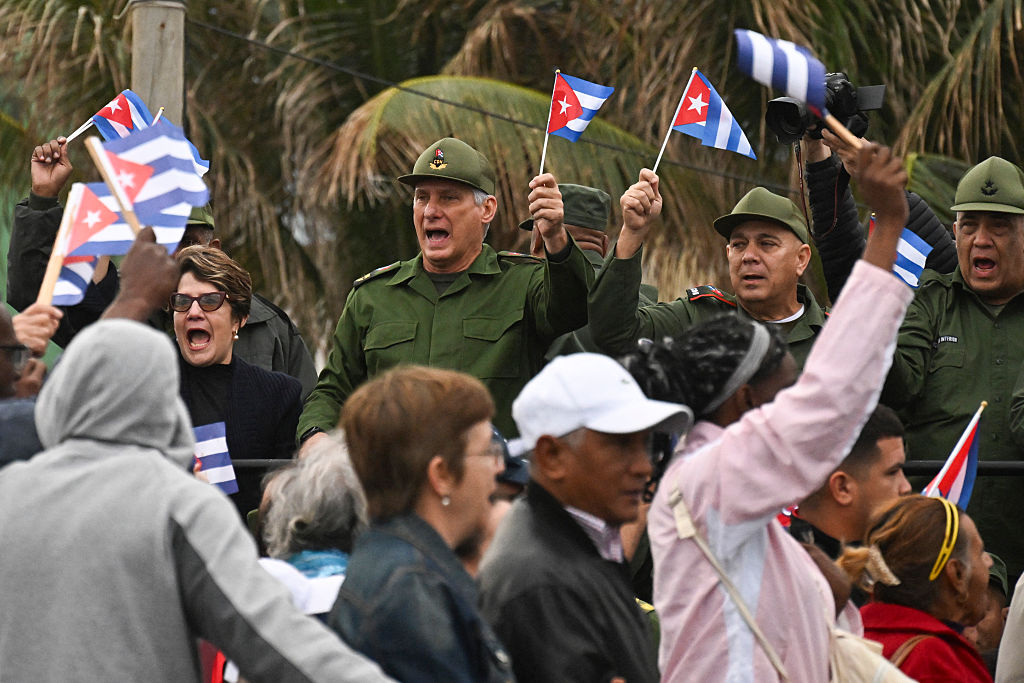
Cuba's president Miguel Díaz-Canel takes part in a protest in front of the US Embassy against the US incursion in Venezuela, where thirty-two Cuban soldiers lost their lives, in Havana on January 16, 2026. (Yamil Lage / Pool / AFP via Getty Images)
In the aftermath of the Trump administration’s startling (and illegal) removal of Nicolás Maduro, the Venezuelan president, most global attention began to focus on Donald Trump’s follow-up threats to take control of Greenland, regardless of the implications for NATO’s possible reaction and future, and his drug-related belligerence toward Colombia.
However, Cuba is the country most obviously imperiled by what Trump vaingloriously termed the “Donroe Doctrine” and the “Trump Corollary,” proudly recalling US declarations of 1823 (by James Monroe) and 1904 (by Teddy Roosevelt), which framed US policy toward the Latin American “backyard” until the 1930s.
Ever since the days of Thomas Jefferson, Cuba has figured large in US attitudes to (and actions in) the Caribbean and Central America. However, the Maduro episode brought a new dimension to US policy in the region: as the first open military incursion in the South American mainland, it suggests that there are now no limits to US activism in the Americas. That seems to have put Cuba firmly in the firing line for future US intervention. Or has it?
On a War Footing
At one level, all of the above truths seem self-evident, given the unpredictability of Trump’s actions. He followed up his Greenland threats by suggesting that Cuba’s president, Miguel Díaz-Canel, might do well to change his policies if he wanted to avoid Maduro’s fate.
Furthermore, we should remember that the US secretary of state, Marco Rubio, who is a second-generation Cuban American, has long advocated a more aggressive use of sanctions on Cuba — which are still very much in place and have been repeatedly tightened in recent decades — and even a more interventionist approach to finally end the Cuban political system. Indeed, one can possibly see his influence in Trump’s latest executive order on January 29, of which more later.
Meanwhile, Cubans on the island have drawn their own conclusions, with growing fears of what Trump might do. Cuba’s armed forces, which have always been on the alert since 1960, are on a war footing, accelerating and extending their annual military exercise, known as the “War of all the People,” for serving personnel and reservists.
However, it is worth remembering that Pentagon planning scenarios regarding military action against Cuba have repeatedly concluded that the cost in US casualties would be politically unacceptable, given the preparedness and training of the forces at the Cuban government’s disposal. That may explain why relatively few statements about Cuba have emanated from Trump or Rubio. Broadly, therefore, the assessment of specialists tends to be that an invasion is still unlikely.
Tightening the Noose
Much more likely is the very real threat of additional measures to tighten the embargo’s noose around the Cuban economy. Trump’s first term of office saw over 240 measures of that nature, further limiting Cuba’s ability to attract investment, receive hard currency, or import much-needed oil and food.
The reach of the embargo, which is still mostly enacted only by the United States and Israel, now extends across the globe, since the complex networks backing non-US banks and insurance companies often include US-based entities that adhere to US laws. Hence, although most governments reject the embargo in de jure terms, their banks de facto accept it.
They also take due notice of the unilateral US definition of Cuba as a state sponsor of terrorism. That has all added a new sense of crisis to the “perfect storm” that assailed Cuba in 2018–2020, with the coincidence of Trump’s first presidency, the COVID-19 pandemic, the end of Raúl Castro’s presidency, and the long-overdue fusion of the dual Cuban currencies.
US intervention in Venezuela has since included threats to end both Venezuela’s and Mexico’s supplies of oil to Cuba. On January 29, Trump signed an executive order to enforce, as an emergency measure to protect US security, the blocking of any oil tankers destined for Cuba. All in all, those threats are likely to worsen Cuba’s already drastic shortage of fuel for transport and energy, a shortage that has brought Cubans years of daily, demoralizing, and now angering power outages, especially in the countryside and interior provinces.
However, the assumptions about the importance of Venezuelan oil may have been somewhat wide of the mark. Venezuelan exports to Cuba (long exchanged for Cuba’s supply of medical and other professionals) have steadily declined as US sanctions on Venezuela affected investment in oil infrastructure to maintain and modernize production.
Given that decline, Cuba has recently been buying more of its oil from Brazil, Mexico, Colombia, and Spain, and has also purchased power from Turkey in the form of generator ships. Those measures are never enough, of course, but do account for up to 50 percent of Cuba’s needs. In that context, Trump’s new hints about Mexico’s oil lifeline to Cuba and the executive order threats are much more ominous for Cuba and Cubans.
Patriotism
Beyond Rubio’s threats to finally destroy Cuba’s economy, a significant dimension to the crisis involved the killing of all thirty-two Cuban military personnel who were guarding Maduro when the US forces invaded the presidential house. The fact that all thirty-two were killed suggests that, although the defenders were sworn not to surrender, they were effectively executed by the invaders.
That news has had a very particular, but perhaps predictable, impact inside Cuba. For decades, Cubans have had a mostly positive view of their country’s foreign policy strategy of providing active “internationalism” across the world, with the substantial dispatch to other Global South countries of volunteer workers in medical, scientific, educational, agricultural, and other fields. This holds true in spite of the loss of lives that sometimes resulted from it, notably in the course of Angola’s liberation from South Africa’s US-backed invasions between 1975 and 1989.
It is no exaggeration to say that most Cubans have continued to see that strategy as a source of national pride, especially when responding to COVID-19 and other epidemics, and to natural disasters. Many observers in Cuba at the time of the Maduro capture saw clear evidence that most Cubans, even those critical of the government and/or system, reacted with horror and anger at the shootings.
There were large crowds filing past their coffins, lying in state after their remains were returned to Cuba, and joining massive marches the following day in Havana and across all of Cuba’s 169 municipalities. That turnout seemed to confirm what observers were seeing elsewhere, namely the (perhaps rhetorical) determination of Cubans to resist any drive by Trump to exact the same fate on their country, including any drive to reshape the Cuban political system by coercion or threats.
In other words, the deaths seem to have rapidly fanned the flames of the well-known and deep Cuban propensity for nationalism. Throughout the years, the actions of US presidents to pile yet more misery on the Cuban population have often fanned those same flames, reflecting the patriotism that has long characterized Cuba’s political and ideological culture, both before and after 1959.
During the 1990s especially, in the depths of the “Special Period” crisis and austerity that followed the collapse of the Soviet Union, patriotism became one of the keys to the system’s remarkable survival. The latest popular reaction to US heavy-handedness should therefore come as no surprise, perhaps suggesting that there is greater support for (or tolerance of) the system than many had assumed.
Partial Perspectives
Social media reports of public protests in Cuba have encouraged perceptions of popular discontent. While those reports have often been accurate, there have also been many cases of exaggeration, and we should perhaps treat them with caution.
First, Havana is not like the rest of Cuba. While the capital sees greater evidence of open dissidence and relative wealth, it also houses a poor stratum that, lacking access to hard currency, suffers more than most from inflated prices. Equally, while the rest of Cuba generally suffers more from lack of access to goods and energy, the evidence outside the capital is of a greater depth of support for the system.
Second, although Cubans have long been willing and able to complain vociferously about supply shortages, queues, and power outages, and their latest frustrations and anger are real, most still seem ready to tolerate the shortages (albeit with resignation). There also still appears to be enough Cubans determined to protect the gains that the system has given them, especially in the face of constant hostility from the “old enemy.”
All Cubans know that the United States has provided shelter and material opportunity for their relatives over decades — an opportunity visible in Cuba’s now substantial reliance on emigrant remittances. At the same time, many continue to feel instinctively that the same country’s politicians are always seeking to control Cuba’s fate by means of coercion and economic strangulation.
Between Two Crises
In 1994, I explained Cuba’s post-Soviet crisis and its likely survival by using carefully measured figures. I argued at the time that 20–30 percent of the population were actively supportive of the system, with roughly the same proportion firmly opposed (an estimate confirmed then by one leading dissident). That left 40–60 percent in the “mixed middle,” critical but passively accepting or tolerating the system for all its faults.
Little has since led me to change that assessment significantly. I now judge those figures to be more like 20 percent for and 35 percent against (but possibly rising to 40 percent at moments), with around 45–60 percent still in the passive middle.
However, while this current crisis may not be as deep materially as those initial post-Soviet years, when most Cubans genuinely feared systemic collapse, there are two crucial differences today. The first is the absence of either Fidel or Raúl Castro in whom to place trust, respect, or deference. The members of the post-2018 leadership are hamstrung by their lack of historical legitimacy or authority, seemingly unable to turn a widely perceived tide of material decline.
In a very clear sense, the real crisis in Cuba now is political rather than material. The startling evidence of vastly increased road traffic in Havana suggests a considerable level of wealth accumulation there at least, with many more goods visibly available than ever was the case in the 1990s. For most Cubans, the main material challenge is now the relative unavailability of such goods, due to spiraling costs.
The second difference is also a political one: the distancing of youth and the emigration of over half a million young Cubans in the space of just a few years. There were some advantages to the mass emigrations of the 1960s, such as the freeing up of ready-made housing for many of the poor and the siphoning off of any organized opposition. Young Cubans today, on the other hand, have grown up knowing only a sadly austere Cuba since 1991, and their reliance on exogenous social media is greater than among their parents and grandparents.
As a result, they are less likely to share the faith of their elders in the system and more likely to blame their own government rather than the United States, even to the extent of disbelieving the incontrovertible evidence of the embargo’s impact. There is, it seems, a real problem of potential generational apolitical alienation. Having said that, the evidence of large numbers of younger Cubans taking part in all the recent marches and rallies to protest the killings in Caracas suggests that all is not necessarily as we hear and that the lode of intrinsic nationalism remains deep, even among the young.
The Trump Factor
Since 2012, emigrants have enjoyed the legal freedom to return to Cuba, and there is a less welcoming environment for migrants in the United States (still the main destination) and in many other developed areas of the world. Hence, young people who have left recently may well return to the island, by compulsion or by choice, but bringing back with them a different take on the Cuban system and still frustrated with the Cuba that they previously left.
Moreover, the persuasive effect of living in the Florida “bubble” has often tended to reshape emigrants’ attitudes to (or rhetorical justification for) leaving their homeland. Even if they were apolitical before leaving, they seem to absorb quickly the Cuban American community’s values and judgements.
These dimensions of the current crisis are difficult to predict, but the besieged (and much criticized) Cuban leadership knows that they exist and that it has to address them urgently. There are some indications that Cuba’s culture of ingrained patriotism may eventually shape a number of these people to be less anti-system than now and less antagonistic than earlier waves of migrants to the United States.
That ultimately depends on how they and their families (on and off the island) perceive US policies, and on the Cuban government’s ability to find alternatives to the embargo. The coming months and years will certainly be challenging and crucial. Of course, the most unpredictable element of the whole Cuban equation is what Donald Trump may suddenly decide to do.