After Weeks of Violence, the Iranian State Hobbles On
Amid an internet blackout, reports describe waves of catastrophic violence across Iran. Yet the ruling order remains firmly in control, even as an economic crisis erodes the welfare systems that once underpinned its legitimacy.
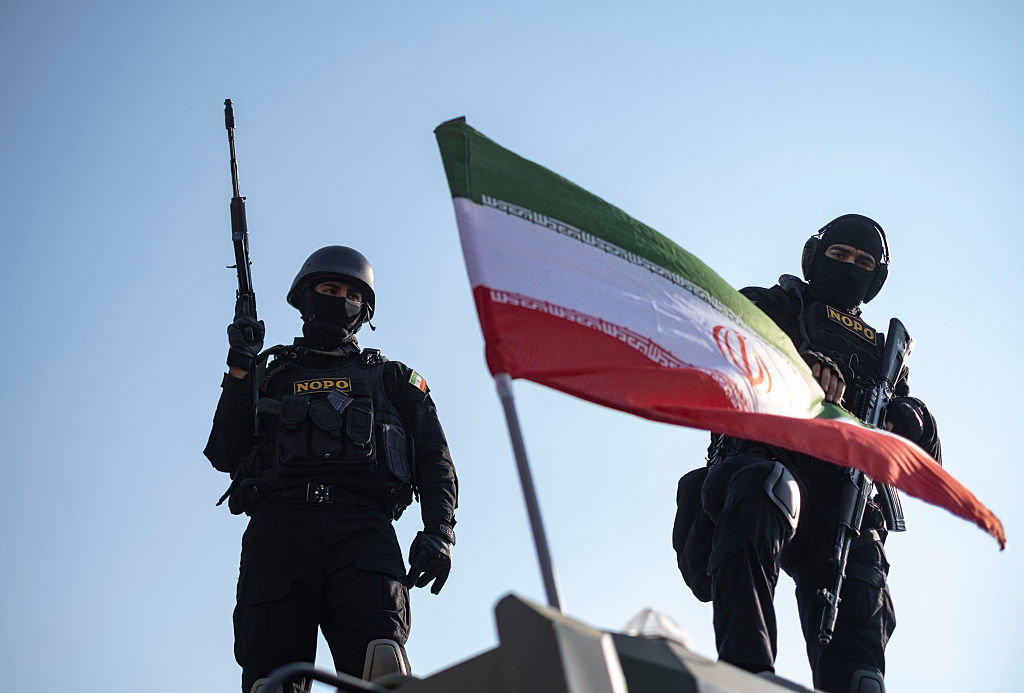
In over two weeks of protests, more than 2,000 people have been killed and almost 19,000 arrested by the Iranian state. But there is little sign that the revolts have weakened the state’s power. (Morteza Nikoubazl / NurPhoto via Getty Images)
After the bloodiest domestic crackdown in the history of the Islamic Republic, protests have died down since their peak last Thursday evening, the beginning of the Iranian weekend. Over January 8–9, violence erupted across the nation. Reuters reported on January 13 that two thousand protesters have been killed by Iranian security services, a number that is “close to reality” according to a senior Iranian political source, quoted by Amwaj.media. Iranians are currently in a state of shock. They are stuck between two fears: fear of life under the ruling order, and fear of the void that might replace it.
Information is currently extremely difficult to access, owing to the ongoing internet blackout and rife disinformation online. Despite this, footage has emerged of Iranian security services firing at protesters and even women shot in the head; state media has for the first time broadcast video of its repression. On January 13, a broadcast aired from a forensics facility south of Tehran showing scores of filled body bags laid out on the floor of a large hall.
An identification system was set up near screens displaying photographs of the faces of the dead for family members to identify bodies and take them away to bury. Tehran claims some protesters committed attacks of widespread arson and shot security personnel. Several prominent clerics and officials blame Israel. The foreign minister has suggested Benjamin Netenyahu was instrumentalizing the protests to “drag the U.S. into fighting wars on its behalf.” Meanwhile, state television has released CCTV footage that appears to show protesters with handguns or large knives, or throwing improvised bombs at burning government and military buildings and mosques. Former heads of the intelligence services in both the United States and Israel have claimed that their governments pursued “influence operations” within the protests.
The head of Iran’s judiciary said that it would swiftly pursue trials against arrested protesters found guilty of terrorism. Human Rights Activists News Agency (HRANA), an US-based human rights group, reported that 18,434 people had been arrested over the weekend. Executions have already been scheduled, according to family members of the condemned (although Donald Trump claims to have averted them).
On January 13, two days after the protests had been repressed, Trump called on Iranians to renew their antiestablishment protests. “KEEP PROTESTING — TAKE OVER YOUR INSTITUTIONS!!!” he wrote in a social media post. Reza Pahlavi, the son of the former king of Iran, who fled into exile in 1979 and is working with the country’s diaspora groups in the West to win his crown back, said that state-run media buildings were “legitimate targets.” “Government employees, and the armed security forces, have the opportunity to join the people,” he wrote on X on January 11.
The protests, which started on December 28 among electronic goods traders in Tehran’s central bazaar, are principally about the economic conditions of everyday Iranians, who accuse the government of mismanagement and corruption.
Iran is prone to currency spikes, such as those that occurred at the start of this crisis. It is almost impossible to overstate how devastating sanctions have been to life in the country. They have all but cut off from the global market a state that is highly dependent on export markets, particularly oil but also copper, carpets, and foodstuffs.
Isolation has put pressure on Iran’s economy, which is characterized by the mobilization and leveraging of welfare by the country’s elites, particularly through Tehran’s bonyads: vast, opaque charitable foundations whose endowments are used to intervene in the market economy. Elites in Iran do not just use this cash for patronage but have traditionally competed with one another to intervene in markets to foster favored industries and parts of the service sector.
The political economy of the current Iranian state began to take its present form during the Iran–Iraq War, when the government created a welfare program for the families of the martyrs. It has since expanded this model to the Iranian working class in general, with more privileges granted to members of the Islamic Revolutionary Guard Corps (IRGC) and the Basij paramilitaries.
In short, welfare was the means by which society could be mobilized by the elites in pursuit of their economic, social, or military projects. The problem now however is that the sanctions-driven shocks have resulted in mass downward social mobility — doctors are driving taxi cabs, and Iran’s working class has been pauperized.
Staples once taken for granted, such as chicken, lamb, and eggs, are now unaffordable for millions of Iranians. Young people, who are often unable to make a life outside of their parent’s homes, have been particularly affected. “People, especially the young people, are sick and tired of being this outlier, something between North Korea and Cuba,” said the Iranian writer Hooman Majd in an interview with Jacobin. Meanwhile a tiny elite, plugged into patronage networks linked to state-backed smuggling, have access to international goods and a higher quality of life than the rest of the population. This has bred a society-wide resentment of the country’s elites.
President Masoud Pezeshkian is attempting to get a pro-poor budget passed amid a crisis in public financing. Reelected in 2024 as the reformist candidate, Pezeshkian is probably the weakest president in the history of the Islamic Republic. His reformist bloc, which supports détente with the West, is discredited among Iranian elites because of its failure to win the Islamic Republic sanctions relief during the nuclear talks with the United States (Trump exited the Iran deal in 2018 and reimposed sanctions that had been lifted by Barack Obama in 2016).
Worse, Iran’s most famous reformists, Hassan Rouhani, president from 2013–2021, and his foreign minister Mohammad Javad Zarif, the negotiator of the Joint Comprehensive Plan of Action (JCPOA), are reported by hard-liners in Iran to have been arrested. Pezeshkian’s proposed budget significantly raises taxes and for the mobilization of state resources to public subsidies for lower-income households. As political commentator Tariq Ali wrote recently, the president was in a battle with an “extremely corrupt Islamic oligarchy constantly in search of more money.”
The Iranian elite has no answers to these intractable problems and are distracted by the necessities of the survival of the Islamic Republic. It is fighting a war against Israel and the United States, following strikes in June against these two states on Iranian military and civilian facilities, which involved the assassination of cadres of senior IRGC officers, civilian nuclear scientists, and over two thousand civilian casualties.
Iran is wary of another attack. “Let us be clear: in the case of an attack on Iran, the occupied territories [Israel] as well as all U.S. bases and ships will be our legitimate target,” said Mohammad Bagher Ghalibaf, a former commander in Iran’s elite Revolutionary Guards. Israel appears to be pursuing a policy not of regime change but of regime collapse to eliminate Iran as a geostrategic rival. Whether Israel is in a position to launch another war is hard to know. It is dependent on expensive US-supplied weapons, both for offense and for its air defenses, which Iran penetrated in June, particularly in the closing two days of the Twelve-Day War.
This makes the future radically uncertain. Most Iran analysts believe that the country’s ruling order will hobble on, a shrunken version of itself. The reasons for this prognosis are the success of the repression, which, for now, has worked as it did in 2009, 2017–18, and 2023. The scale of the repression in recent days has however dwarfed that of previous rounds of protest. In 2009, for example, when the Green Movement augured another existential crisis for the Islamic Republic, between thirty and seventy were killed.
But the impasse is also a product of the failure of the protests to coordinate and develop leaders. Nearly fifty years on from the revolution, Iran lacks any credible alternative leader from outside the ruling order with a path to power. Prospective political figures for any transitional government that might be amenable to Iranians (and the United States) such as Mostafa Tajzadeh, a former journalist and interior minister under Iran’s socially liberalizing president Mohammad Khatami (1997–2005), and Narges Mohammadi, a human rights activist, who — while she has expressed no desire to lead — is spoken about both inside Iran and in some of the diaspora abroad as a credible figure. Both are in a dangerous position, imprisoned in the political wing of Evin Prison, which was the target of a particularly lethal attack by Israel on June 23.
Amid this chaos and uncertainty, Trump, despite his dramatic escalations, assassinations, kidnappings, and even bombings, seems averse to meaningfully pursuing regime change as it would inevitably cost US soldiers and his standing in MAGA’s America First camp. This leaves repression and the reassertion of elite rule as the most likely outcome of the protests.