As Protests Engulf Iran, Israel Sees an Opportunity
The protests sweeping through Iran are not the first of their kind. But the threat of a continuation of the Israel-US war has led Tehran to see them as an existential threat.
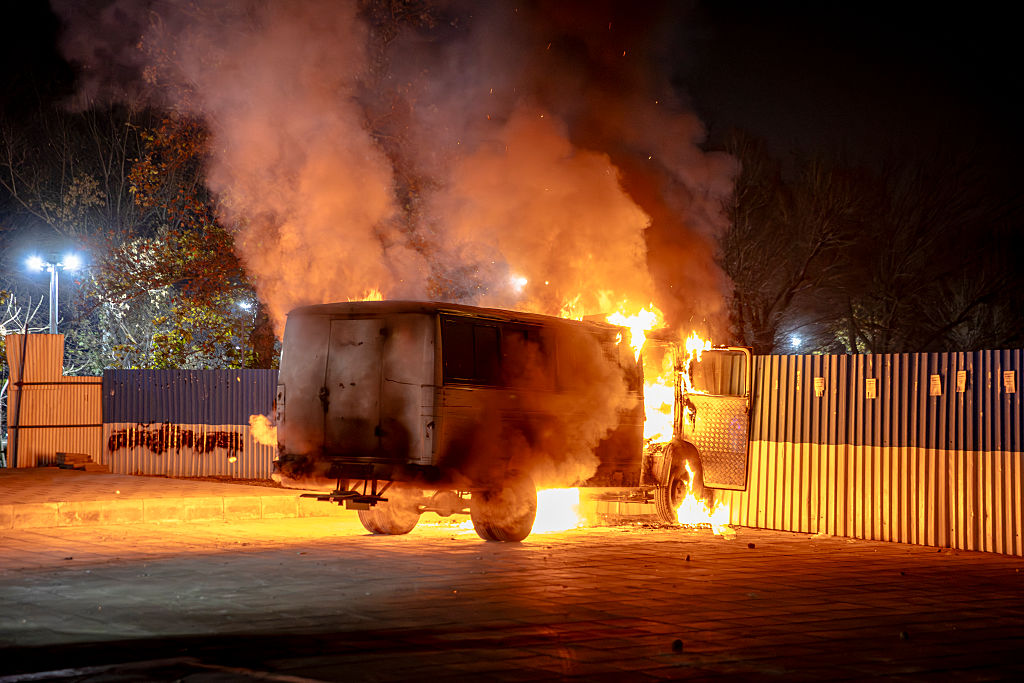
Iran has experienced mass protests before, but never at a time of what it describes as “total war” with Israel, the United States, and Europe. The current wave risks becoming a new front in this war. (Khoshiran / Middle East Images / AFP via Getty Images)
Antiestablishment demonstrations across Iran escalated this weekend as reports emerged of large-scale violence by protesters and security services alike. Over half of the country’s thirty-one provinces are convulsed in protests, which first erupted on December 28 in the electronics section of Tehran’s central bazaar.
Traders had come out onto the streets in response to a sudden 16 percent crash in the rial, whose value has dropped 84 percent over the past year. Iran’s currency has experienced severe volatility since US sanctions, which have cut its oil revenues and deprived its central bank of access to much of the revenue it still retains, were imposed in 2011. Economic ruin has destroyed much of Iran’s middle class and plunged around a third of its citizens into poverty. Rearmament spending following Israel’s June attack has only made the crisis more acute.
This is the sixth time the Islamic Republic has experienced significant mass uprisings in its history. Each time the fuse has been lit by a set of economic and cultural issues. The current protests are on the scale of many previous episodes. But they are unique in that they are occurring at a time when Tehran is engaged in what it describes as “total war” with the United States, Israel, and Europe.
Within Iran there is a growing sense across the political spectrum that a turning point has been reached. Ahmad Naghibzadeh, a retired politics professor at Tehran University, said that the system (the Farsi shorthand for ruling order) has in fact disappeared and the void that remains is reminiscent of that which existed in the dying days of the shah.
In recent days, video has emerged of thousands of Iranians marching peacefully against government corruption and mismanagement. In Abdanan, a poor provincial capital with a Kurdish majority, protesters stormed a branch of a supermarket chain linked to the Islamic Revolutionary Guard Corps (IRGC), Iran’s powerful paramilitary force, scattering rice in the streets.
Tehran at first attempted to mollify the protests. “People are dissatisfied, we are at fault,” said Iranian president Masoud Pezeshkian on January 31, “do not go after America as someone to blame.” But on January 8 violence erupted. State buildings, police cars, and mosques were set on fire.
The mayor of Tehran said that on that evening alone more than fifty banks and thirty mosques were set ablaze. A nationwide internet blackout was imposed while state TV broadcast collective funerals of members of the security services. Through the blackout, grisly footage of lifeless protesters in Iranian hospital wards was uploaded, possibly by Starlink, which Elon Musk has enabled. A report by Time magazine stated that a doctor in Tehran said that hundreds of young people had been killed by gunshot wounds.
Supreme Leader Ali Khamenei held Friday prayers in Tehran and said foreign agents had infiltrated the protests and pointed to “widespread vandalism” across Iran. The Iranian government has blamed the United States and Israel for the violence.
As evidence, Abbas Araghchi, Iran’s foreign minister, cited a January 2 tweet from former CIA director Mike Pompeo: “Happy New Year to every Iranian in the streets. Also to every Mossad agent walking beside them. . . . ” Screenshots from an Israeli Telegram group popular among former officials and think-tank types, show feverish discussion of Israel’s role in the protests: “Israel should assist but not in a direct way, but rather indirect — media support, financial aid, and even transferring means such as weapons.” The government has released unverified CCTV footage of people within the crowd firing weapons and throwing improvised bombs at official buildings.
It would be odd if Israel was not provoking violence among the protests. On January 2, Trump tweeted “If Iran shots [sic] and violently kills peaceful protesters, which is their custom, the United States of America will come to their rescue. We are locked and loaded and ready to go.” Israel, which is eyeing a resumption of its war against Iran, would like to be joined by the United States and would therefore strategically benefit if Tehran crosses Trump’s red line, as it has now done.
At the outbreak of its “twelve-day” war with Iran, Israel revealed that it had over a hundred agents in the country, some of whom had used drones to attack Iran’s air defenses. While the Islamic Republic has said that it has apprehended Mossad cells across the country, it seems unlikely Israel does not have boots on the ground ready to become agents provocateurs.