Prediction Markets Are Bookies With Venture Capital Funding
Backed by Silicon Valley–aligned venture capital and legal loopholes, prediction markets are creeping into every corner of life. They turn everything from measles outbreaks to government resignations to famine into opportunities for predatory speculation.
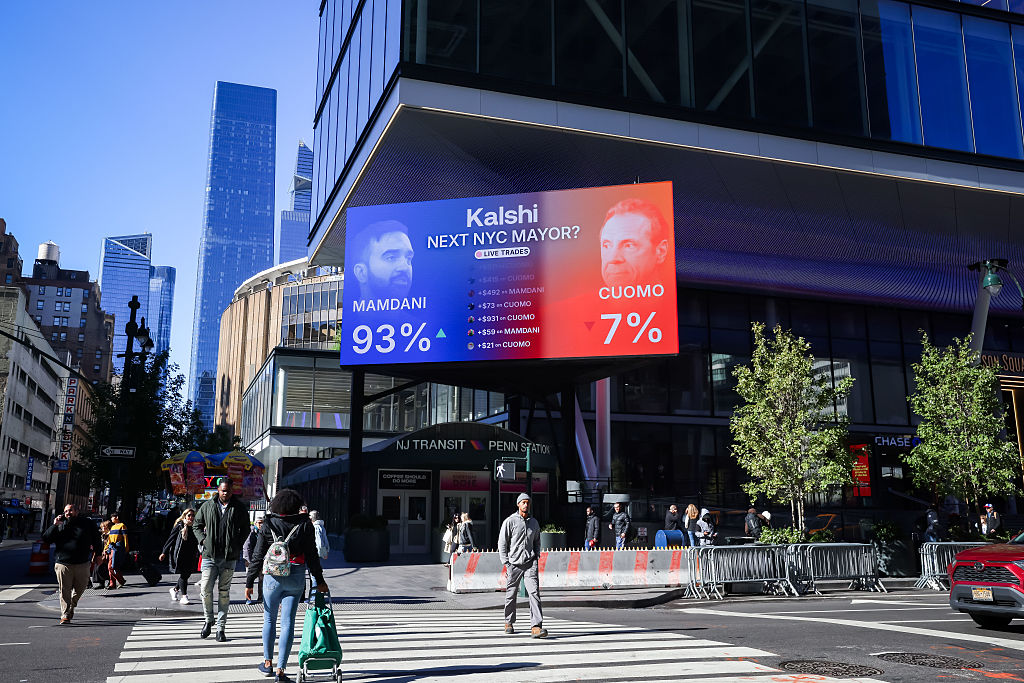
Kalshi enjoys the protection of a legal loophole that classifies it as a financial trading platform rather than a casino or gambling operation. (Michael Nagle / Bloomberg via Getty Images)
The prime directive of contemporary technology companies is simple: if you can do it, you should do it. A corollary follows: if you can make a profit from it, you must try. Any consequences, damages, or negative externalities are secondary concerns, if they are concerns at all.
The rise of “prediction markets,” and their creep into every facet of existence from sports to politics and pop culture, illustrates the point. These platforms, backed by big money from venture capital funding, let individual or institutional bettors wager on potential outcomes through contract exchanges: who’ll get elected, who’ll win an award, who’ll break their ankle walking into the stadium. If you can imagine it, you can wager on it — or, as proponents of the markets might prefer, “predict” it. It’s a gloss on the old idea of putting your money where your mouth is. You think Taylor Swift’s album is a lock for best of the year? Why not put a cool $100 on it? The Cowboys are going all the way this year? Does your wallet agree, tough guy?
On X, a user laid bare the nature of these newfangled exchanges, writing “name a better rebrand than gambling becoming prediction markets.” The insight is spot-on. Prediction markets are casinos that facilitate online gaming at scale. They’re bookies. They claim otherwise, but that’s what they are, even if they function differently from the bookies of old.
Unlike traditional gambling, today’s online bookies, rebranded as prediction markets, enjoy a scale, reach, and network effect that presents their operation as a mechanism to “aggregate” public opinion, preference, and expectation — and then commodify it in one of the worst ways imaginable. Any position one might take becomes something to package and trade, a new financial instrument that can earn or lose a fortune overnight. It’s a demented form of day-trading, which is itself a grotesque mutation of investment. And it gets worse.
From Sports to Gaza: Degeneracy in a Time of Famine Futures
The recent proliferation of online sports betting is a function of deregulation, technological development, legal loopholes, and an appetite for corporate predation. Massive ad campaigns during every game in every arena and stadium and in countless online and offline spaces are designed to lure in spectators, to make them “part of the game” — responsibly, of course!
The rise of sports gambling at scale is normalizing betting well beyond sports. People have been wagering on football, baseball, hockey, and more for years, but the combination of pervasive online sports gambling and prediction markets opens the door to brave new worlds of degeneracy. And the moneyed interests behind the shift are raking in profits, whether the poor saps placing bets win, lose, or draw.
Last week, Luana Lopes Lara displaced Lucy Guo and Taylor Swift to become the youngest “self-made” woman billionaire. Lopes Lara is the cofounder of Kalshi, a prediction market that bills itself as “trading for the future.” At the time of writing — markets move fast — the front-page Kalshi is taking “predictions” on who’ll be the first to leave Donald Trump’s Cabinet.
If health is more your speed, you can bet on how many cases of measles the United States will see this year — above 1,950 cases or below 1,925 cases — or whether the world will see another pandemic by December 31. If betting on disease and death feels declassé, you can always wager on whether 2025 will be the hottest year ever, a bet that repeats annually. Prediction markets have also allowed customers to place bets on Gaza — on whether it would be ethnically cleansed or suffer a famine.
Kalshi enjoys the protection of a legal loophole that classifies it as a financial trading platform rather than a casino or gambling operation. Polymarket, another leading prediction-market platform, operates under similar pretenses. For all commonsense intents and purposes, it’s a distinction without a difference. Defenders argue that the platforms are investments because users can research, hedge, and manage risk, unlike casinos designed for the house to win. Users aren’t placing bets per se, they say, but exchanging contracts.
But any reasonable person can tell that the exchange is a de facto bet on a real-world outcome, and bets are gambles. That prediction-market contracts look and feel a lot like other market investments, such as stocks, doesn’t prove that Kalshi and Polymarket aren’t gambling sites; it suggests instead that stock and other investment markets themselves can function as casinos.
Commodify Every Opinion
In 2022, Lopes Lara argued that opinions ought to be tradable. “You have a conviction or have an opinion on an event and you should be able to have a trade on it directly and it should be accessible to everyone, not just the Bridgewaters and Citadels of the world,” she said. The logic is stark: every opinion, every take, is inherently a commodity — or at least carries the potential to be commodified. It’s the latest expansion of an ever-growing universal marketplace.
CNN and CNBC have jumped on the bandwagon, commodifying the news further. The outlets will feature the prediction market on their channels as part of a “data integration” partnership that pairs real-world events with bets — “predictions” — on those events. The news outlets expect the partnership to drive engagement while Kalshi, no doubt, expects it to generate more contracts. The sports betting analogy is apt: Watching the news and wagering on global events will now resemble watching a game and betting in real-time on whether the kicker hits a field goal — except now the bets will be on famine and war.
Even setting aside the obvious and prevalent opportunities for insider trading (or insider betting) that will only multiply as prediction markets become ubiquitous, the mainstreaming of Kalshi, Polymarket, and similar platforms is a quantum leap in mass commodification. The study and understanding of world events will now be filtered for millions through the lens of gambling. Bettors will hold financial stakes in particular outcomes, including some of the most heinous events imaginable. It’s a fundamentally cynical and dehumanizing turn.
The answer to this problem is simple: make the exchanges illegal through federal and state law. Legal loopholes give platforms cover that they don’t deserve. Like Uber and others before them, these companies lobby, skirt regulation, and proceed with the force of an entity that knows that if it moves fast and breaks things, as the saying goes, the state won’t be able or willing to keep up. The companies will, effectively, write the laws themselves.
It’s a slap in the face to democracy and the rule of law. And in the case of Kalshi and its competitors, it’s also a threat to public well-being. History is full of dystopian turns. What kept them from becoming permanent was the willingness of societies to sanction and limit the forces that caused inordinate harm. An omni-betting society will test the social capacity, solidarity, and values amid the broader struggle against predation through endless commodification. It’s a battle that we must win.