Resource Competition With China Lay Behind Trump’s Iran War
The US war on Iran may have seemed like an irrational move by a president who is as reckless and impulsive as he is destructive. But there was a geopolitical logic behind the attack, based on Washington’s desire to deny China access to vital resources.
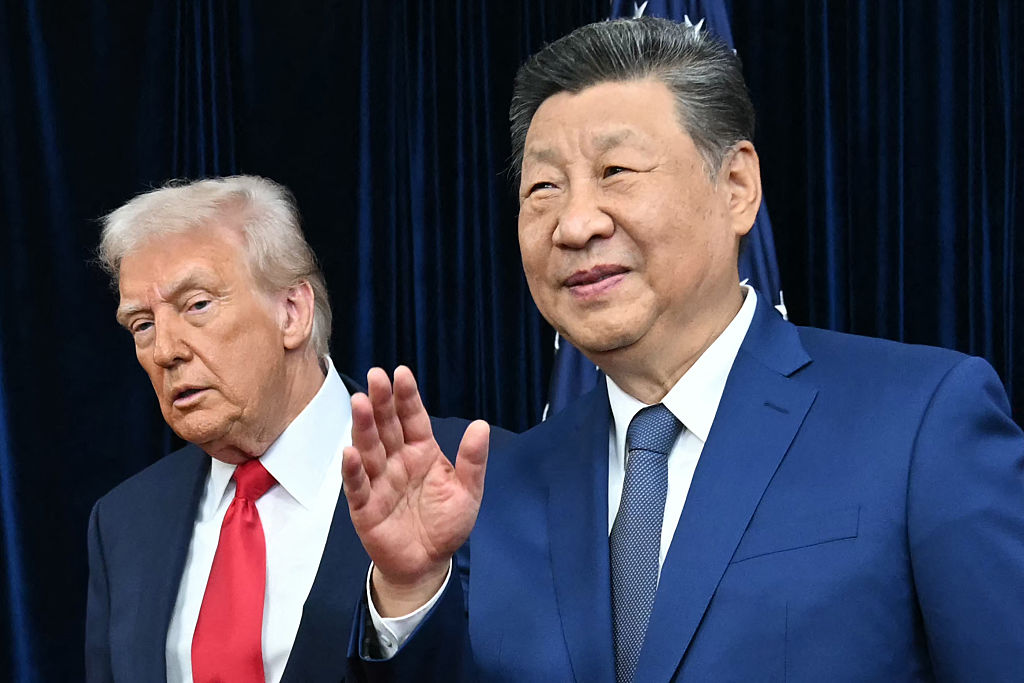
The resource wars between the US and China have accelerated the determination of both sides to escape their dependencies on each other. The two great powers are dismantling the integrated economy they spent fifty years building together. (Andrew Caballero-Reynolds / AFP via Getty Images)
On the morning of February 23, 2026, Benjamin Netanyahu called Donald Trump from Jerusalem with intelligence that would change the course of their war on Iran. Senior Iranian officials, including Supreme Leader Ali Khamenei himself, were scheduled to gather at a compound in Tehran that Saturday, vulnerable to a single airstrike. Trump was at Mar-a-Lago when the call came through.
Two weeks earlier, Trump and Netanyahu had met in Washington for three hours in a session described by those present as grave and grim, planning a coordinated operation in great detail. Even before the two leaders met, Trump ordered a massive deployment of troops to the Middle East following an uprising in Iran that its leaders drowned in blood. The president was certainly thinking about attacking Iran, but he had not made up his mind about the timing.
Following his telephone conversation with Netanyahu, Trump instructed the CIA to verify Israel’s intelligence. It checked out. Three days later, his envoys Jared Kushner and Steve Witkoff called from Geneva. Negotiations with Iran were going nowhere, they claimed. Now it all came together for Trump: the plan, the operational opportunity, the diplomatic deadlock. The result was Operation Epic Fury, a joint American and Israeli surprise strike that killed Khamenei and triggered the war.
However, the clash between Iran and the United States did not start with that phone call, or even with the enriched uranium deep underground at Isfahan. It began eight years earlier, when Washington and Beijing entered a silent existential struggle over the physical architecture of the future. This was a fierce war of position that was buried in dreary trade ministry announcements about minerals most people have never heard of. To understand why American and Israeli aircraft struck Tehran on that Saturday morning, we need to travel not to the Persian Gulf but to the cancer villages of Inner Mongolia.
Cancer on Mongolia
At the Bayan Obo mining district in Inner Mongolia, 150 kilometers north of Baotou, the earth gives up the minerals that make the modern world run. More than 80 percent of China’s rare earth reserves are concentrated there, at the edge of the Gobi Desert.
Production did not take off until the 1990s, when Western governments made a quiet calculation that the extraction of these minerals was too dirty and too toxic to inflict on their own citizens. Better to let China do it. Between 1990 and 2000, Chinese output rose 450 percent. The West shuttered its own mines and looked away.
What it looked away from was the toxic and radioactive waste produced by the smelting plants that poured into open pits and unlined reservoirs, seeping toward the Yellow River, the main source of drinking water for much of northern China. The villages around Baotou became known, with grim matter-of-factness, as “cancer villages.” Investigators documented waves of orthopedic disorders and birth defects. Children inhaled radioactive dust simply by playing in the street.
The technologies to extract rare earths with less devastation do exist, but they cost more. Beijing chose the cheaper method. The demolished remains of the cancer villages still lie scattered among rusting pipes and abandoned warehouses.
China did not stumble into its position of dominance by geological luck alone. Rare earth elements are found across the world, but seldom in deposits rich enough to mine efficiently and almost never in forms easy to separate from one another. Breaking the chemical bonds that bind them in nature can require more than a hundred stages of processing and vast quantities of powerful acids.
Since the 1980s, Beijing has poured billions into mastering that process, subsidizing every stage of the supply chain until it controlled not just the mines but the chemistry. Today China mines roughly 70 percent of the world’s rare earths and refines 90 percent of the global supply, including nearly half of American ore, which crosses the Pacific to be processed and returns as finished material.
The uses are not exotic; they are everywhere, from electric motors to smartphone screens to jet engines. But the military ledger is what kept Pentagon planners awake at night. Rare earths are embedded in the backbone of American war-fighting: F-35 fighters, Virginia-class submarines, Tomahawk missiles, Predator drones.
By late 2025, the United States had no operational source outside China for several of the most critical heavy rare earths. The hidden skeleton of the modern world, it turned out, had a single owner. Beijing would soon press its advantage.
Announcement 61
Throughout 2025, Trump had been ratcheting up tariffs on Chinese goods in a series of escalating blows. China had responded each time with calibrated countermeasures. However, while the tariff war was painful for Beijing, the technology war was existential. We can trace the roots of China’s fury back beyond “Liberation Day” in April 2025 to 2018, when the first Trump administration launched a quiet diplomatic campaign to prevent China from acquiring ASML’s most advanced chip-making technology.
ASML, a Dutch company and the sole manufacturer of the extreme ultraviolet lithography machines without which cutting-edge semiconductors cannot be made, had been on the verge of shipping a $150 million machine to a Chinese customer. However, Secretary of State Mike Pompeo personally lobbied Dutch Prime Minister Mark Rutte, and the machine was never shipped.
What began as a targeted block on one sale metastasized, through the Joe Biden years and into Trump’s second term, into a structurally entrenched technology blockade targeting not just the machines that make advanced chips but the chips themselves, creeping steadily down the technology ladder, adding companies to blacklists. The logic was straightforward and brutal: deny China the advanced chips that power AI, and you deny it the commanding technology of the next generation.
For Beijing, this was not merely a trade dispute. It was a strategic encirclement, a deliberate attempt to freeze China in a permanent state of technological second-tier status, just as it reached the threshold of global primacy. The ultimate insult was that Washington was blocking Chinese access to technologies refined from the very rare earth minerals Chinese workers were poisoning themselves to extract from the ground around Baotou. China was good enough to dig up the dirt. It was not to be allowed to benefit from what the dirt made possible.
In April 2025, Beijing’s patience snapped; it imposed export restrictions on several key rare earth products, a shot across the bow aimed directly at American defense manufacturers. It was simultaneously a protest against Trump’s triple-digit tariffs and a response to seven years of escalating semiconductor restrictions.
The threat worked well enough to produce a ninety-day truce agreed in Geneva in May, which rolled tariffs back to 30 percent and suspended the mineral controls. But three months were not enough to resolve anything. In October 2025, with the Geneva arrangement fraying, Beijing reached for the rare earth weapon again, this time with far greater ambition and far less restraint.
Announcement No. 61 of the Chinese Ministry of Commerce was dry in its language and devastating in its implications. It extended export controls to twelve of the seventeen rare earth elements, and imposed licensing requirements on any magnet containing even a trace of Chinese-origin material — regardless of where it was manufactured.
This meant that if, say, a German company used even a tiny amount of Chinese rare earth elements to manufacture a product, it had to ask for permission from Beijing to export it anywhere else in the world. Announcement 61 also barred exports of rare earths for any military application outright. The legal architecture was borrowed almost verbatim from Washington’s own playbook: the foreign direct product rule, a mechanism the United States had long used to restrict China’s access to advanced semiconductors, now turned back on its inventors.
Washington was unnerved. Its access to the lifeblood of its most advanced industries was dramatically curtailed. Treasury Secretary Scott Bessent declared that Beijing had “pointed a bazooka at the supply chains and the industrial base of the entire free world.” Trump’s response was volcanic. He announced an additional 100 percent tariff on Chinese goods, on top of the 30 percent already in place, threatened sweeping controls on critical software, and called off his scheduled meeting with Xi Jinping in South Korea. But the fury did not last.
Within days of Trump’s Truth Social eruption, both sides were quietly looking for an exit ramp. On October 30, Trump and Xi met on the sidelines of the Asia-Pacific Economic Cooperation summit at Gimhae International Airport in Busan, South Korea. The deal they struck was a careful restoration of the pre-October status quo dressed up as a breakthrough.
Washington trimmed tariffs considerably, and it also suspended rules restricting the export of semiconductors and chip-making machines to Chinese-linked firms. Beijing, for its part, paused Announcement 61 for a year. The rare earth minerals crisis was temporarily shelved. But the bazooka, as Bessent called it, was only returned to its case. It was still there for Beijing to use.
Trump told reporters he would rate the meeting with Xi “a twelve” on a scale of zero to ten. Other observers did not buy that sanguine interpretation. Scholar Jin Canrong declared that Busan demonstrated China and the United States had become “equal great powers.” Chinese elites drew the lesson that resolute counterthreats worked, and that Washington could be backed into a corner.
However, Trump drew a different lesson. He had been humiliated by the existence of a chokepoint he did not control. The question was whether he could find one of his own. He already had a candidate in mind: the refineries of Shandong province.
The Teapots of Shandong
Along the coast of Shandong province, an industrial landscape stretches for hundreds of kilometers: storage tanks, cracking towers, and refinery stacks rising above fishing villages. The independent refineries clustered there, known as teapots for their modest original scale, began receiving import licenses only in 2015, when Beijing broke its state monopoly on oil purchases.
Within a decade, they had become a quarter of China’s entire refining capacity, the engine of a provincial economy worth nearly ¥10 trillion, with hundreds of thousands of jobs running from the plant floor through logistics, chemicals, and ancillary services. Shandong’s refinery complex plays a crucial role in the Chinese economy, yet it runs on a very particular kind of fuel.
The secret was sanctions. When the United States cut Iran and Venezuela off from Western buyers, it inadvertently created a supplier class selling at steep discounts to whoever would take delivery without asking too many questions. The teapots asked none. Iranian and Venezuelan heavy crude arrived relabeled as Malaysian, Omani, or Indonesian, rebranded after ship-to-ship transfers in international waters by tankers running with their transponders dark.
By 2025, US-sanctioned crude from Iran and Venezuela accounted for roughly 17 to 18 percent of China’s total oil imports. China’s state-owned giant refineries kept their hands clean and their distance. The teapots handled the dirty work, nominally private but woven into the Chinese state through partnerships with state-owned companies. Beijing supplies the port access and the studied indifference that made the whole system possible.
The very features that made the teapots competitive — dependence on discounted heavy crude, shadow logistics, sanctioned suppliers — made them acutely vulnerable to anyone willing to hit the supply end of the chain rather than the refineries themselves. Trump seemed to notice and began to target Shandong’s suppliers.
The New Cold War Comes to the Caribbean
On the night of January 3, 2026, American special forces seized Nicolás Maduro from his residence in Caracas and transferred him to New York to face narco-terrorism charges. For Washington, it was a law enforcement operation. For Beijing, it was something closer to a catastrophe.
Venezuela was not merely a trading partner for China; it was the single largest recipient of Chinese state-backed lending in Latin America, with 106 loan commitments totaling over $100 billion, the vast majority structured as oil-backed repayment arrangements. China Development Bank had essentially bet the house on Venezuelan crude as collateral. With Maduro gone and Washington announcing it would take control of Venezuela’s oil exports, that collateral was now in American hands.
Beijing expressed “grave concern” and demanded Maduro’s immediate release. The Trump administration did not bother to reply. The proceeds from the first Venezuelan oil sales — half a billion dollars — were routed to a Qatari bank account, placed carefully beyond the reach of the creditors, Venezuelan and Chinese alike, who had claims on that revenue stream.
What followed was a demonstration of how energy can be weaponized with surgical precision. Venezuela had been supplying Cuba with roughly thirty-five thousand barrels of oil a day, which were critical for the island, whose power grid ran almost entirely on petroleum. Trump severed that flow immediately, threatening tariffs on any nation that stepped in to replace it. Within weeks, Cuban power plants began failing. By March, the grid had collapsed entirely, triggering an island-wide blackout. Street protests broke out in a country where unauthorized demonstrations carry jail sentences.
The strategic logic behind the strangulation was spelled out in Trump’s own executive order: Cuba hosted Russia’s largest overseas signals intelligence facility at Lourdes, a sprawling antenna complex near Havana that had been eavesdropping on American military communications since the Cold War. It also had four Chinese listening posts, including the installation at Bejucal, whose satellite dishes peered through tropical forest toward the headquarters of Central Command, which oversees the Middle East, not to mention Trump’s own Mar-a-Lago residence and the only American training range capable of simulating combat in the Taiwan Strait.
Trump made clear that his condition for lifting the oil embargo on Cuba was regime change in Havana. Once that happened, presumably, Russia and China would be blinded.
For the teapot refineries of Shandong, the seizure of Maduro was a supply shock for which they had not prepared. Venezuelan heavy crude had been the feedstock around which their entire business model was engineered: sulfurous, technically demanding to process, but discounted $10 to $15 below Brent Crude (or simply “Brent,” the trading classification for this type of petroleum), which was enough to make the complexity worthwhile.
Within weeks of the operation, exports to Asia collapsed by 67 percent. Chinese buyers, who had taken three-quarters of all Venezuelan crude the previous year, found that the rules of the game had changed. Trump made clear they would pay world market prices, eliminating the discount at a stroke.
The Shandong refineries now faced a stark choice: find an equivalent substitute or watch their profits collapse. Analysts and traders were unanimous about where they would turn. Iranian heavy crude was the cheapest available alternative, trading at discounts of around $10 below Brent. Beijing expected the substitution to be straightforward. Netanyahu and Trump had other plans.
Trans-Arabian Dreams
Even as American and Israeli aircraft were striking targets across Iran, Trump and Netanyahu were thinking about oil. What Israel wanted from the war went beyond the elimination of the Iranian regime. Netanyahu had a regional architecture in mind. The closure of the Strait of Hormuz — which Iranian forces mined and blockaded within days of the opening strikes — was, from the Israeli perspective, not simply a crisis to be managed but an opportunity to be exploited.
For decades, Gulf oil had flowed east and west through Hormuz. An alternative had been proposed before: the Trans-Arabian Pipeline, known as Tapline, built in the late 1940s by American corporations to carry Saudi crude overland across Jordan and Syria to the Lebanese port of Sidon. Back in the day, it was one of the longest pipelines in the world. However, Arab politics and regional conflict rendered it defunct by the mid-1970s.
Netanyahu’s vision was a revival of that concept, but with Israel as the terminus. Netanyahu’s original proposal from 2017 envisioned a seven hundred -kilometer pipeline route from the Saudi port of Yanbu through Jordan to Eilat, and from there through the existing Eilat-Ashkelon pipeline directly to the Mediterranean, bypassing Hormuz and Bab-el-Mandeb entirely. The usage fees — estimated at hundreds of millions of dollars annually — would flow to the Israeli treasury, while the oil would flow to Europe.
The first Trump administration had loved the idea, but the Saudis had responded to it coldly. The 2026 Hormuz crisis gave it new urgency, and Netanyahu used the occasion to publicly present the plan. He even argued the new Yanbu-to-Eilat pipeline could be built in three years.
The geopolitical logic ran deeper still. A pipeline regime routing Gulf oil to Mediterranean ports rather than through the Strait of Hormuz would reshape the economics of the entire US-China competition. Oil traveling overland to Ashkelon and onward to European markets would cost more for Asian buyers and less for European ones, redirecting energy flows away from China and toward America’s allies.
One consequence Netanyahu may have anticipated — or even welcomed — was a fragmented yet radicalized Iran, one whose hostility toward the Gulf monarchies would make those states feel constantly threatened. Gulf states would be left with a stark conclusion: only Israel could protect them.
By late March 2026, United Arab Emirates diplomatic adviser Anwar Gargash had confirmed what Netanyahu had wagered: Iran’s missile and drone strikes on Gulf states had cemented Tehran as the primary regional threat, forcing Arab nations to rethink their alignments. “We’re not seeing two thousand Israeli missiles and drones targeting us,” Gargash observed, “we’re seeing two thousand Iranian missiles and drones targeting us.”
Strait of Trump
Trump, sensing the moment, called on Saudi Arabia in late March to join the Abraham Accords. But whereas Netanyahu was eyeing the pipelines, Trump wanted to capture the oil fields. The model he had in mind was already operating in Caracas.
Delcy Rodríguez, Maduro’s vice president, had stayed in place after her boss was seized, becoming Washington’s compliant interlocutor for Venezuelan oil. Trump wanted the same arrangement in Tehran: a pliable successor regime that would cooperate on production and pricing. “It’s all about installing someone like a Delcy Rodríguez,” an administration official told reporters. Trump himself told the Financial Times at the end of March: “To be honest with you, my favorite thing is to take the oil in Iran.”
If diplomacy failed, there was a harder option. Kharg Island, the terminal through which roughly 90 percent of Iranian crude exports flow, sat in the northern Gulf within reach of American forces. “We need about a month to weaken the Iranians more,” a source familiar with White House thinking said, “take the [Kharg] island and then get them by the balls and use it for negotiations.” Trump explained later that if the United States took Kharg, “It would also mean we had to be there [in Kharg Island] for a while.”
On March 26, Trump floated another option: that the Strait of Hormuz would be controlled by “me and the ayatollah.” One day later, he went further, referring to the Strait of Hormuz as “the Strait of Trump.”
The through line from Caracas to Tehran was not accidental opportunism. It was the visible outline of a strategy, articulated most clearly by Michael Every, a strategist at Rabobank. For decades, China had outmaneuvered the United States by using industrial and trade policy as geopolitical weapons: building monopolies, controlling supply chains, turning economic dependencies into leverage. However, China depended on commodities flowing from every corner of the world to feed its industrial machine, and the logical American response was to use the one instrument China could not yet match.
“We have an army and a military which can project power globally,” Every argued. “China will have one in ten or fifteen years. It doesn’t for now.” The play, as he described it, was to seize control of key commodities before that window closed, ensuring resources flowed to American supply chains, remained priced in dollars, and arrived on the other side of the Pacific more expensively, if at all. Venezuela was the proof of concept. Iran was the next move.
Helen Thompson, a political economist at the University of Cambridge, approaching the same question from the perspective of energy geopolitics rather than military statecraft, arrives at a darker conclusion: “If we go back to that strategic security report from last autumn, it is clear that energy abundance, as the Trump administration likes to call it, is both an aim and it is also a means of engaging in geopolitical competition.”
The United States was energy independent, the world’s largest liquefied natural gas (LNG) exporter, insulated from the consequences of a closed Strait of Hormuz in ways that China, the world’s largest energy importer, simply was not. As Thompson sees it: “if there are problems in the Gulf in this way, the country that is least impacted by it is the United States . . . in principle, then it can be a beneficiary of it,” because the United States would get higher prices for the LNG it exports.
Conversely, a prolonged closure of Hormuz would hit China like a slow hemorrhage: higher import costs, squeezed industrial margins, headwinds for an economy already under strain. Trump himself, asked in late March about the Hormuz closure, was blunter still: “We don’t need the Hormuz Strait. We have so much oil, our country is not affected by this.” It was, almost word for word, Helen Thompson’s thesis stated as policy. But Trump’s chokepoint strategy ran into a chokepoint of its own.
Tehran’s Tollbooth
Within days of the onset of hostilities, the Islamic Republic of Iran achieved something that would have seemed impossible a decade ago. Without a navy capable of challenging American carrier groups, it has effectively closed the world’s most important maritime chokepoint. The weapon was the drone — cheap, expendable, and devastating to the calculus of maritime insurance.
Daily traffic through the strait had averaged 138 ships a day but was now reduced to a trickle measured in single figures. Those vessels still willing to transit were funneled into Iranian territorial waters, where Iranian Revolutionary Guard units checked manifests, screened cargo, and — in at least two documented cases — collected payments of up to $2 million per crossing, settled in Chinese yuan.
The whole operation seemed to challenge the dollar’s global primacy. Since the 1970s, it has maintained its reserve currency status because Persian Gulf countries priced their oil in dollars. If a country didn’t have dollars, it found its access to oil circumscribed.
Washington’s side of the bargain was the security umbrella: American guarantees, American bases, American carrier groups in the Gulf. The United States was prepared to go to war to defend the Gulf monarchies and did so during the 1980s and ’90s. But suddenly, due to the crisis in the Gulf, the petrodollar, as it became known, was in danger of being eclipsed by the petro-yuan.
Except that it wasn’t — not really. The yuan accounts for roughly 2 percent of global foreign exchange reserves, against 57 percent for the dollar. The reason for the disparity is that the yuan isn’t yet sufficiently liquid, reliable, or available to replace the dollar. For all Beijing’s ambitions, the yuan is not ready for primetime, and a tollbooth in the Strait of Hormuz, however dramatic, cannot change that arithmetic.
The deeper irony was visible not in the shipping lanes but in Tehran itself. While the regime was extracting yuan-denominated transit fees from supertankers, its own citizens were pricing everything from pizzas to apartment contracts in dollars. Inflation above 70 percent had done what no American sanctions fully managed: it had made the dollar the currency of daily life inside the Islamic Republic.
The regime that had just demonstrated asymmetric mastery of drone warfare and maritime chokepoint control was simultaneously too weak to maintain confidence in its own money. And yet, in the end, even the tollbooth turned out to be negotiable. Under the terms of a two-week ceasefire reached in early April, the United States and Iran agreed to pause hostilities while negotiations continued.
Trump, characteristically, immediately began improvising. Asked about Iran’s plan to charge vessels a fee for transiting the strait, he announced he was considering turning it into a “joint venture” with Tehran. “It’s a way of securing it,” he told reporters. “It’s a beautiful thing.” What looks like a contradiction actually underscores Trump’s consistency. After so much war and bloodshed, he was still focused on finding the Iranian Delcy Rodriguez who would allow him to control Iran’s oil; if not through Kharg, then through a “joint venture” at the Strait of Hormuz.
Decoupling Together
For China, the war exposed with brutal clarity what strategists had long warned about in private: roughly 40 percent of its oil and 30 percent of its LNG imports passed through the Strait of Hormuz, a chokepoint it could not defend and did not control. The answer was overland pipelines that no American carrier group could threaten.
China’s latest five-year plan, released in early March, calls for advancing “preparatory work for the central route of the China-Russia natural gas pipeline,” a diplomatic term for Power of Siberia 2, a 2,600-kilometer pipeline from Russia’s Yamal Peninsula to China via Mongolia that had been stalled for years over pricing disputes. The war changed the calculus, and it seems China is now ready to increase its energy dependence on Russia.
Simultaneously, in a high-security compound in Shenzhen, Chinese engineers working under false identities and restricted phone access are testing a prototype of an extreme ultraviolet lithography machine. The machine, built by former ASML engineers recruited with signing bonuses of up to $700,000, fills nearly an entire factory floor. It has not yet produced working chips, but it may do that by 2030. The direction is unmistakable: China wants the United States, as one source put it, “100 percent kicked out of its supply chains.”
Washington is running the same race from the other end. The Trump administration convened fifty-four countries at a Critical Minerals Ministerial in February, signing bilateral frameworks with eleven nations and mobilizing over $30 billion in loans, investments, and loan guarantees for domestic and allied rare earth projects.
The Trump administration invested $1.6 billion in USA Rare Earth, an Oklahoma firm controlling deposits of the heavy rare earths most critical for defense technologies. As Commerce Secretary Howard Lutnick explained: “This investment ensures our supply chains are resilient and no longer reliant on foreign nations.”
The resource wars between China and the United States have accelerated the determination of both sides to escape their dependencies on each other. These tensions force the rest of the world to absorb the disruption of two great powers dismantling the integrated economy they spent fifty years building together.
The cost is paid by the children inhaling radioactive dust around Baotou, by the Cuban families navigating a blackout, by the sailors stranded in the Gulf waiting for great powers to finish their argument. Furthermore, resource wars require authoritarian consolidation at home to manage these social costs. That consolidation is visible in Beijing and Tehran, in Tel Aviv and Caracas, and increasingly in Washington itself.
The Left’s task is not to pick sides in this war but to name it for what it is: a struggle between states for control of the materials that power the next industrial revolution, conducted at the expense of the people who live nearest to those materials and furthest from the decisions about how they are used.
The mines, the pipelines, the chokepoints — these are not the property of the governments that claim them. They are the common inheritance of everyone who lives on the planet that contains them. That is not merely a slogan — it is the only practical alternative to the world this essay has described.