Trump’s St Patrick’s Day Party Will Be a Celebration of War
Ireland’s taoiseach, Micheál Martin, will be paying homage to Donald Trump on St Patrick’s Day. Irish public opinion is strongly opposed to the US war on Iran and the Gaza genocide, but Martin and his allies are anxious to stay on Trump’s good side.
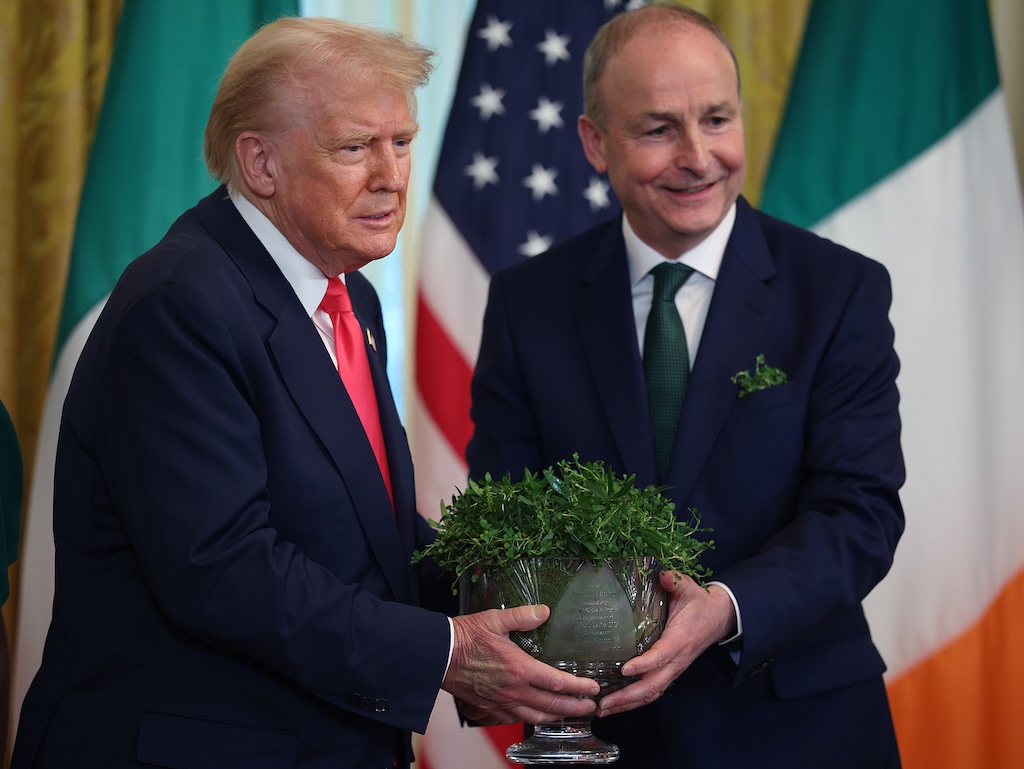
Irish Taoiseach Micheál Martin presents Donald Trump with a bowl of clover during a St Patrick’s Day event in the East Room of the White House on March 12, 2025, in Washington, DC. (Kayla Bartkowski / Getty Images)
Another humiliation awaits Ireland’s premier Micheál Martin in the coming days at the hands of the Trump administration.
At last year’s St Patrick’s Day event in the White House, an annual jamboree of Irish groveling and American paddywhackery, Donald Trump charged the Taoiseach and his “beautiful island” with stealing the US pharmaceutical industry while openly fretting about the loss of the “Irish vote” if he “drained” the country in retaliation. Right on cue, Martin curled up in Trump’s lap, obediently pointing out that his government had, in fact, fought the EU’s tax-avoidance case against Apple in the European Court of Justice.
The meeting took place less than two months into Trump’s second, more radical administration, when he was already revealing a desire to dismantle the international order on which the hyper-globalized Irish economy relies for its booming budget surpluses and eye-watering corporate tax receipts. In 2024, 46 percent of Irish corporate tax was paid by three American multinationals: Apple, Microsoft, and Eli Lilly.
Within weeks, Trump had unleashed a battery of global tariffs, causing one onlooker in an American investment–reliant Irish town to worry about the local economy being “blown to bits.” In MAGA circles, Ireland’s export surplus with the United States was being talked about with increasing regularity and intensifying venom. Shortly after Martin’s obsequious display, Howard Lutnick, the US Secretary of Commerce, described the Irish economic model as his favorite “tax scam.”
In the Irish tax haven, we have since seen a minor reevaluation of American leadership, although it is difficult to tell at this stage whether this is temporary or permanent. One can discern a tactical softening in the government’s line on China with regard to trade and security, and support in some quarters for the goal of European industrial autonomy.
The Irish Times editorial board recently gestured toward a redefinition of the Ireland-US relationship. Another commentator called more explicitly for a partial decoupling from “excessive dependence” on the United States in favor of “deeper integration with the EU.”
Sentimental Attachment
Just as the transatlantic alliance frays, however, Irish political elites seem to be latching onto both the geopolitical ambitions of the EU and the imperial prerogatives of NATO. In their comfort zones, they have delivered cautiously critical statements on Gaza and Greenland, yet Martin happily condones Washington’s kidnapping of Venezuelan president Nicolás Maduro and refuses to condemn the illegal war on Iran. These “FDI nationalists” — meaning foreign direct investment — know what side their bread is buttered on.
With global neoliberalism in deep crisis, and the United States violently retreating from its informal empire, we seem to be entering an era defined less by a clean form of multipolarity than by a messy state of non-hegemony, with multiple power centers struggling for control over “financial, trade, production, energy, and technological networks.” Some of this struggle is beginning to take shape in Ireland, threatening to militarize the domestic economy, liquidate neutrality, and drag the state ever closer to the heart of the European and American security establishments.
In the most recent US National Security Strategy, the Trump administration singled out few specific countries except Ireland and Britain, declaring that “America is, understandably, sentimentally attached to the European continent — and, of course, to Britain and Ireland.” This invites the question: What is Ireland’s new position in the world system?
Whether Britain or the United States held global primacy, Ireland has long been something of an “intermediating periphery” in what the worlds-system theorist Denis O’Hearn once dubbed the “Atlantic economy.” Yet Ireland’s semi-peripheral position in the world system is mutating. Already a global profit-shifting center for US tech and pharmaceutical giants, it now appears to be becoming, as Patrick Bresnihan, Patrick Brodie, and Rory Rowan have stressed, a “strategic, infrastructural frontier” between the United States and Europe in this age of geopolitical competition for supremacy in technologies like AI and semiconductors.
Stigmatized as a defense laggard, a security freeloader, an economic leech, the southern Irish state is under sustained rhetorical attack by European, British, and American elites. This small country on the edge of Western Europe has no option, the argument goes, but to embrace the new world disorder.
The Irish government has signaled its intention to bring forward plans to abolish the triple lock, which requires overlapping mandates from the United Nations, the government, and the Dáil to send more than twelve Irish Defence Forces personnel overseas. It recently placed the country’s critical infrastructure on a “war footing” due to unevidenced and highly exaggerated “warnings” of Russian sabotage (and Chinese espionage) during the state’s upcoming EU presidency. Following the lead of war hawks in Brussels, it plans to fortify European militarization by enhancing the EU-NATO relationship.
In its first Maritime Security Strategy, released in February, the government laid out measures to protect Irish waters and subsea infrastructure, the majority of which concerned increased cooperation with Britain, France, and NATO. This includes working through the framework of the UK-led Joint Expeditionary Force (composed of ten NATO members). Plans are also afoot to deploy the country’s first defense attachés to Washington, Paris, and London: Ireland’s most important “strategic partnerships.”
FDI Militarization
In a one-sided debate that is increasingly pitched in a paranoid register, politicians and pundits are selling these moves against Irish neutrality to the Irish public not as choices but acts of necessity and as preventive measures against Russian imperialism in particular. Bresnihan, Brodie, and Rowan rightly see such actions as part of a wider process that they refer to as “FDI militarization.”
This political-economic shift, as undemocratic as it is reckless, has two key characteristics: the securitization of Ireland’s expanding green and tech infrastructure, and a related push for greater geopolitical alignment with NATO and the EU militarization project to protect against these “vulnerabilities.” This conveniently presents further economic opportunities for American capitalists and investors.
Those pushing this agenda present Ireland’s military neutrality and comparatively meager defense spending not merely as obstacles to “security” but also as hindrances to economic growth and the flow of foreign direct investment from the United States. This is a bleak vision of Ireland as a dual-use exporter, defense tech–hoster, and NATO-collaborator: a notionally neutral proxy in the Atlantic doing its bit to fight the West’s enemies (phantom or real) and protect US tech infrastructure. Why shouldn’t Ireland, the European outpost of Silicon Valley, share in the spoils of ReARM Europe and other EU defense spending initiatives?
Keen to turn Ireland into a better-armed tech protectorate of sorts, the Irish business lobby is loudly demanding increased defense spending to achieve what is euphemistically called “strategic resilience.” Having identified “sectors of interest” (air defenses, cyber, radar, space, cryptology, satellite communications, maritime, chemical), the government is mulling the removal of legal barriers that prevent Enterprise Ireland from participating in contracts of “primarily military relevance.” In another break with Irish political precedent, it is considering setting up a new national security agency to clear sensitive defense contracts.
An economist for one of Ireland’s largest banks suggests that the rising popularity of weight loss drugs (a new staple of “Irish” exports) could “offset some of the negative effects of US tariffs in other sectors.” The Irish government and the bullish Industrial Development Authority (IDA), the semi-state agency in charge of chasing FDI, also hopes to lure more semiconductor companies, scale up AI investment and data center infrastructure, and liberalize the Irish financial services regime.
As the Financial Times reported last summer, some small Irish tech companies, mostly in the fields of radar, AI, and surveillance tech, are also seeking to take advantage of European rearmament. One tech executive, a founding director of the Irish Defence and Security Association (IDSA), an arms lobby group, asserted that Ireland “could be the leaders in the area of dual-use technology.” Could we see the development of an Irish Palantir?
The online news outlet The Ditch has consistently reported on the more clandestine aspects of this FDI militarization. Last year, it unearthed internal IDSA documents that revealed plans to lobby politicians and change the minds of a people largely uninterested in the arms industry and defense spending.
It has also shown how international arms lobbyists held a secret meeting with Department of Defence officials in 2024. The following year, the Department of Enterprise, directly responsible for screening FDI, met the IDSA in a “strictly confidential meeting” at a private members’ club.
British Intrigues
At home, the professed goal is to strengthen security against an amorphous Russian-Chinese menace, and against Russian hybrid threats in particular. Yet very little evidence exists that Russia has anything but a cursory interest in Ireland. Across the Irish Sea, though, MI5-linked think tanks, figures in the British defense establishment, and warmongering members of ascendant right-wing parties are talking openly of reclaiming Ireland in geostrategic terms.
Speaking at a lobbying event held by a pro-union think-tank, Chris Parry, a retired Royal Navy admiral and failed mayoral candidate for Nigel Farage’s Reform UK, hinted that NATO should conduct naval exercises in Irish waters without Irish approval. Ed Arnold, a senior research fellow at Britain’s Royal United Services Institute, recently remarked that “Ireland’s position in the Atlantic has always made it pretty critical to British defence.”
In 2024, the Policy Exchange think tank released a report that made the case for a renewed focus on Ireland as a British security priority, including the resurrection of British naval and air bases in the north. In unfashionable language, it declares that the preservation of the “strategic unity of the Union is an inextricable component of British grand strategy,” presenting “British military draw-down” after the Good Friday Agreement as a regrettable mistake.
A more recent Policy Exchange report similarly concludes that the UK needs to reject Irish reunification out of hand. Disappointingly for Britons who strive for a more independent role in the world, the report insists that the Irish example should demonstrate to the UK that it (somehow) needs to shackle itself even more tightly, in both economic and geopolitical terms, to the United States. Dublin’s track record supposedly involves a loss in influence in Washington caused by foreign policy “activism,” slack security, and low defense spending.
While it may be difficult to imagine a more self-subordinated UK, a descent down into this level of servility would be unsurprising given the proud “imperial lackeydom” of the English political and media class. Where the United States walks, Britain usually runs. But why should Ireland follow their destructive paths?
Post-Atlanticism
In one sense, an inchoate militarized FDI regime in Ireland is, as Bresnihan and Brodie observe, a “radical transformation of Ireland’s position in world affairs.” Yet one can also see it simply as a rebrand of the old economic growth model, updated for this volatile era of tariffs, sanctions, genocide, and rearmament.
A blitz of propaganda about cyberwar and hybrid threats has had little effect on Irish public opinion. Polls continue to show strong support for the current policy of neutrality and plurality backing for the triple lock, even when the wording of the question is transparently loaded to encourage opposition to it. A whopping 71 per cent of respondents also said they support enshrining the current model of neutrality in the constitution.
With his eye fixed on obtaining a post-government sinecure in Brussels, as is the case for most senior politicians in Ireland, Martin quickly shot down this proposal by claiming that a referendum could “straitjacket the government democratically forever” on matters of defense and security. Pro-neutrality activists would counter that, in a notional republic, democratizing foreign policy is precisely the point of such a move.
A truly independent foreign policy and a reimagining of Ireland’s role in the world system require a reckoning with the current economic model. These are not separate phenomena, and pro-neutrality activism is not a distraction from anti-capitalist politics.
But the broad Irish left, including its radical socialist groupings, sometimes struggle to offer an alternative vision of the Irish economy. It, too, is afflicted by a sort of “tax haven realism.” A radical reunification, one that abolishes both existing statelets, develops a new, sustainable economic model, and breathes new life into Irish democracy, is perhaps one way Ireland could begin to plow a more independent path in world politics.
Strategic Crossroads
There is no doubt that the country faces a strategic crossroads. Does it double down on FDI flows and further embed itself within the imperial transatlantic order, or retain its neutral ethos to fight for a peaceful multipolarity, argue for transformative reforms to the EU, and promote some kind of “critical integration with China”? As the decaying American empire convulses and lashes out, can it embrace a post-Atlanticism, a new internationalism rooted in global solidarity and truer to its native anti-imperial traditions?
Someone who understands this tension well is Irish president Catherine Connolly, who is coming under fire from her own government for allegedly overstepping the political boundaries of her ceremonial role. While some have praised Spain’s Pedro Sánchez as one of the only European leaders to condemn the US-Israeli onslaught in Iran, Connolly really does stand alone as perhaps the sole elected leader on the continent to consistently and unconditionally oppose creeping EU militarization and US-NATO warmongering.
In her inauguration speech, she laid out a positive vision for Ireland’s role in the world. “As a sovereign independent nation with a long and cherished tradition of neutrality and an uninterrupted record of peacekeeping since 1958, Ireland is particularly well placed to lead and articulate alternative diplomatic solutions to conflict and war,” she said, tapping into the republican-tinged anti-imperialism that still strikes a note in Ireland. Indeed, she continued, the Irish experience of colonialism and anti-colonialism “gives us a lived understanding of dispossession, hunger, and war and a mandate for Ireland to lead.”