Britain’s Rulers Have Been Partners in the Gaza Genocide
Tory and Labour governments in Britain have provided every conceivable form of support for Israel’s genocidal project in Gaza. Peter Oborne, an independent-minded conservative journalist, has now provided us with a definitive record of their complicity.
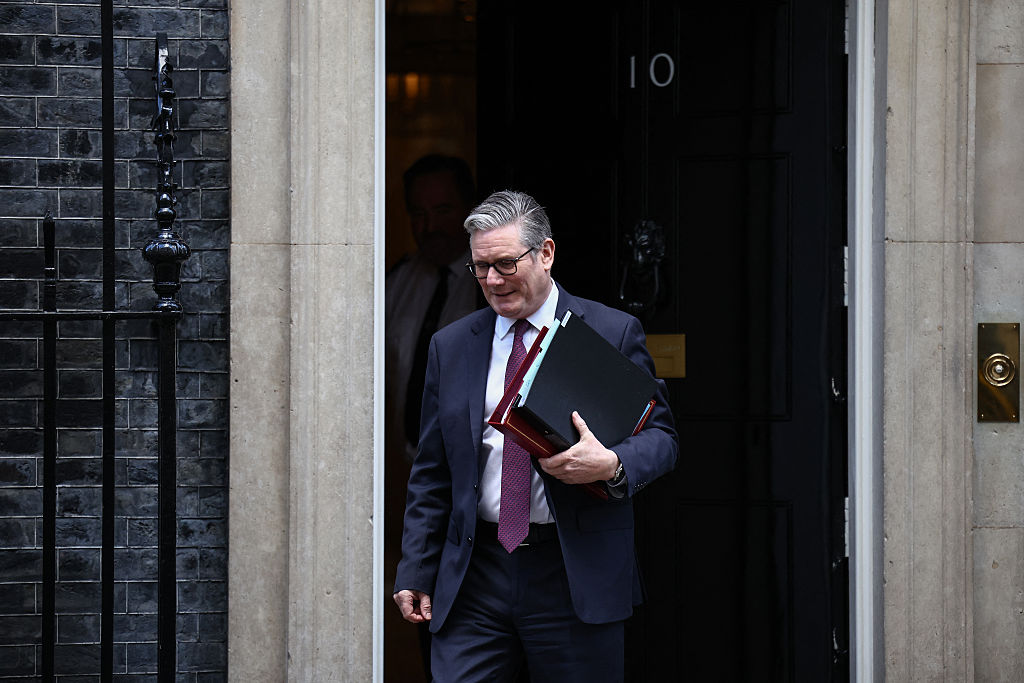
For well over two years, Britain’s government, its official opposition, and almost the entire media have accepted a constantly evolving defense of Israeli actions and Western foreign policy in support of a state committing genocide against Palestinians. (Henry Nicholls / AFP via Getty Images)
“We need to make sure that the story is told properly so that when the history books write this (sic), they don’t write about the victims of Gaza.”
These are the words of Mike Pompeo, secretary of state in the first Trump administration, in January 2026. They were greeted with applause by his audience.
Though spoken brazenly, they announce the secret hope of the transatlantic political and media classes. They know, as Pompeo does, that if history is recorded accurately, it will damn them for all time.
These fears must only be growing after Canadian prime minister Mark Carney told the 2026 Davos summit that, of course, the supposed values of the international system were largely a mirage: “We knew that international law applied with varied rigour depending on the identity of the accused or the victim.”
The Gaza genocide formed the indubitable backdrop to Carney’s remarks. No admission less stark than this would have been plausible in its bloody wake.
The First Draft
Such trepidation is nowhere greater than in the United Kingdom, the successor state of the empire that helped give life to the Israeli colony, and which in recent decades has only become more indulgent of its crimes.
Peter Oborne’s endeavor in his book Complicit is to set down the role of the UK in the destruction and slaughter of Gaza, and its deforming effects on British politics and society. He brings to this reckoning the neglected craft of traditional, long-form current affairs journalism.
Oborne gives the actors in the savage drama the right of reply, though they seldom use it, and the possibility of the most humane interpretation of their motivations, though it is never deserved. Only one participant in this carnival of cynicism mutters an apology. Appearing alone in a landscape of desolation, it is crushing.
Besides offering the first draft of a history that will be angrily denied, as all genocides are, Complicit also gives us cause for reflection on the direction of both the world of imperial violence, and British society, at a time of historic change.
It has long been the claim of the Palestine solidarity movement that the freedom and dignity of this assailed, stateless people is the cause of universal humanity. The oppressions endured by them will have profound consequences. This faithful record of recent years makes clear the terrible wisdom of that insight.
The British Consensus
Oborne, a man of the British right with experience across its flagship publications, has gained a particular vantage over the dying world of the British center. He is quick to identify the cardinal feature of its politics during the Gaza genocide: the rapid closing of ranks across parties and major institutions.
For well over two years, the government, official opposition, sundry smaller parties, the street-level far right, and almost the entire media have accepted a more-or-less muted and evolving defense of Israeli actions and Western foreign policy in support of a state committing genocide. The fish rotted from the head down, and the stench was most apparent in and around the “Mother of Parliaments” of which British elites boast.
Taking one example of many from the opening months of the slaughter: then foreign secretary David Cameron claimed before Westminster’s Foreign Affairs Committee that he simply could not remember if Foreign Office lawyers had advised him whether Israeli actions in the strip had breached international humanitarian law. The official opposition, naturally, failed to follow up on such professions of staggering incompetence.
It was later the turn of the Conservative Party to play dead when Cameron’s successor, Labour foreign secretary David Lammy, flatly lied about the provision of Royal Air Force intelligence to the Israeli armed forces. This would, in any ordinary walk of life, be grounds for resignation. But the mutual solidarity of the British political class would not permit punishment of its own on such questions.
Oborne acutely recounts the sabotage of a Scottish National Party (SNP) “opposition day motion” of February 2024, which called for an immediate ceasefire in Gaza. As the third-largest parliamentary group, the Scottish nationalists were supposed to have priority in bringing such motions — the sort of sacralized proceduralism usually makes political correspondents blubber. However, parliamentary authorities tore up the rule book in pursuit of foreign policy unanimity.
After a meeting between Keir Starmer, soon to become prime minister, and House of Commons Speaker Lindsay Hoyle, Labour was allowed to table a spoiling amendment that removed the SNP’s condemnation of Israeli actions and the collective punishment of Palestinians. Hoyle overruled his own clerks in his haste to derail a vote on a popular measure. In that month, polls showed 66 percent support for a ceasefire, with just 13 percent backing a continuation of war.
Journalists defended the squalid maneuver by suggesting that votes by British MPs would change nothing in any case. To cover his tracks, Hoyle concocted a moral panic about supposed threats to MPs from the public, and his claims were repeated without evidence down the chain of British institutional life.
Every Possible Avenue
In this and dozens of other incidents, British politicians were aided by a media that has sunk beneath mere incompetence. A general failure to carry out its basic democratic function was foreshadowed in the torrid case of the Israel Defense Forces (IDF) massacre at Al-Shifa Hospital.
In November 2023, and again in March the following year, Israeli forces laid siege to the largest medical complex in the Gaza Strip. Along with medical personnel, large numbers of patients and refugees were sheltering in and around its buildings. The Israeli attack began with the bombing of ambulances, with many killed and injured. The IDF then began to bombard the hospital buildings themselves, including the maternity ward.
All it took to beguile much of the Western media were Israeli assertions that one of the projectiles used in the now days-long attack was a misfiring Palestinian rocket. The hospital ran out of fuel, leading to the deaths of babies in incubators. Emaciated stray dogs had begun to eat the mounting corpses. Finally, after almost two weeks, IDF forces stormed the complex on November 15. Doctors Without Borders attested that its staff members were attacked even as they fled.
Immediately after the raid, on November 16, the BBC toured the complex with the occupying IDF soldiers, uncritically passing on their claims it was a major Hamas base. Many of the assertions about the supposed tunnel network linked to hospital buildings would later be debunked. The BBC’s heavily armed chaperones, fresh from the assault, refused the broadcaster any access to the victimized staff and patients. CNN went one further in this anti-journalism, relaying the Israeli line that the siege had simply never occurred.
The attack on Al-Shifa would be followed by the devastation of nearly all medical facilities across Gaza. The obsessive-compulsive checking with Israeli official sources that marked the misreporting at Al-Shifa, dressed up as hardheaded journalism, continued long after this campaign of destruction made the practice laughable.
We could go on relentlessly, and the book does. Oborne has documented dozens of the most tawdry episodes ever to disgrace British public life. It is worth having a copy of Complicit if only as a reference guide to the worst of this catalog, at a time when the mainstream media is desperate to move on and leave the Western record in the blur of fast-moving international events.
Britain’s political class pursued every possible avenue of complicity with the Gaza genocide. Starmer gave direct legitimacy to the targeting and collective punishment of a civilian population. Cameron sought to obstruct the International Criminal Court (ICC) arrest warrants for Israeli prime minister Benjamin Netanyahu and defense minister Yoav Gallant. Both Tory and Labour governments maligned and criminalized public dissent while keeping up a steady supply of UK armaments and deploying British forces to the Middle East to guard the Israeli state.
The British establishment’s defense of the most direct Israeli perpetrators of the genocide thus became an iron necessity. Any attempt to hold Netanyahu accountable would threaten to incriminate Rishi Sunak and Starmer too. An organic solidarity of the guilty parties came to bind the British and Israeli governments.
Feeding the Far Right
What Oborne describes as the “cross-party cartel” extended to the far right. He notes the importance of this dovetailing of traditional parties, not only with Reform UK — whose would-be free speech defender in chief Nigel Farage joined other hypocrites in calling for marches to be banned — but also violent street-level reactionary mobs.
This common front developed early and explicitly when then Tory home secretary Suella Braverman published a November 2023 article in the Times asserting that Gaza solidarity marches were a front for “Islamists” with “links to terrorist groups” who were now threatening to sully Armistice Day (in fact, the march organizers had already chosen a route that avoided London’s war memorials). Braverman even claimed that there was support from within the police force for this view.
This clear signaling to the radical right received its answer at the march days later. Drunken mobs of racists turned up around the supposedly inviolable Cenotaph and promptly ran amok, violently attacking police in a bid to get near the protesters, whose target was the US embassy, several miles away. The Gaza demonstration was massive and peaceful despite the provocations, and Braverman was sacked in humiliation two days later.
This signature victory for the Gaza solidarity movement indicates much of the changing structure of British politics in recent years. Even those parliamentary allies the movement could count on were stifled by the defacement of Westminster rules and tradition. Meanwhile, the far right proved that its current ideological preoccupations limit its supposedly antiestablishment credentials.
The street far right around figures such as Tommy Robinson, which has grown in both scale and propensity for violence since, is partly a response to the antiwar movement. But it is also a response to US ideological and political influence. Elon Musk became a major amplifier of the movement through X, and both Donald Trump and his vice president, J. D. Vance, have shared its bovine rhetoric.
Inheriting decades of anti-Muslim animus, and now fronting US propaganda attacks on the UK, this force has become a fifth column, not only against the extant political order but against all forms of British independence from US policy. Though it wears the Union Jack, it is overtly anti-national, except where the nation serves as a device to separate the British population ethnically into loyal and undesirable elements. It has no use for the political nation or democracy and scorns the rights of speech and assembly.
A Changing Relationship
The through line from Westminster to street reaction is clear: US foreign policy. Although it would be easy to think that the UK’s relationship with Israel has been static over time, Oborne traces subtle changes that help us understand our historical moment as relational to the United States.
Long after the British Empire’s messy handover to the self-declared Israeli state in the 1940s, a degree of ill-feeling remained. As late as Margaret Thatcher’s administrations, the UK government still made salutary complaints about excessive Israeli action and imposed restrictions on arms sales. Although this approach remained within the boundaries of general adherence to US-led Cold War policy in the region, it nonetheless separated the British stance from that of Washington by degrees.
The unipolar moment largely collapsed such distinctions. Oborne notes that US officials and Israeli diplomats have expressed amazement at the extent of Labour’s obsequiousness. Like a well-trained dog, the party has learned to anticipate commands from Washington even before they are made.
Even in opposition, Labour MPs were told, according to one ITV report, that “party policy on Gaza will simply follow the White House.” Complicit is admirably clear in emphasizing that it is this Atlantic lobby, far more than the (very real) Israel lobby, that determines British state orientations on the Middle East.
This relationship assures future British humiliations. With the United States operating what it hopes will be an orderly (but still violent) retreat from the old neoconservative forward strategy in the Middle East, and seeking retrenchment in the Americas and Western Europe, the British tail will be swiped this way and that, with little regard to domestic stability.
This was confirmed in January 2026, when Starmer supported US enforcement of its Venezuela blockade with the seizure of a tanker near the UK itself. A week later, Trump threatened the UK and other European countries with a slew of new tariffs for not immediately acceding to his claims on Greenland.
The British establishment’s complicity in the Gaza genocide was essentially an act of coordination with the United States. The mass graves and torture camps; the denial of aid to precipitate starvation; the systematic leveling of neighborhoods and targeted killing of children, journalists, aid workers, and medical personnel: support for all of this was meant to secure the UK’s position as a key US lieutenant.
Instead, it has weakened all future UK claims against US encroachments on the sovereignty of itself and other NATO underlings. Britain’s political class have paid with their very souls only to receive a slap in the face. Caught between the resurgent far right and US power, they may pay still higher costs.
The New Mode of War
While showing us the future of the UK’s subjugation to the United States, Gaza also grants us the clearest view yet over the new landscape of war. Perhaps no other conflict has so clearly demonstrated the dynamics described by scholars such as Mary Kaldor as representing a new form of war in the post–Cold War era, now radicalizing in conditions of heightening international state competition.
These characteristics included the targeting of civilians, the displacement of people, and the sowing of terror as distinct military objectives, relatively unmoored from the territorial-strategic objectives in conventional wars of the past. Kaldor’s thesis held that such conflicts derived from the new conditions of globalization, which set a premium on the political control of populations.
These conflicts require new forms of ideology. When populations and their political, ideological, and even psychological statuses become the direct strategic objectives, traditional programmatic ideologies give way to identity politics. The Gaza genocide was notable for the outspoken racial contempt with which it was mobilized and publicly presented.
Oborne’s record is, again, damning by mere presentation. Yoav Gallant infamously stated that the IDF were “fighting human animals” against whom it was permissible to abandon “all the restraints.” He was backed by Ghassan Alian, the head of Israel’s military government in the occupied territories, who demanded that the “human animals are dealt with accordingly.” In spite of some later attempts at obfuscation, these statements were directed at the civilian population.
Israel Katz, Israel’s current defense minister, likewise declared the Gazans to be “a people of child killers and slaughterers.” This was in defense of the policy of denying the civilian population water and fuel. Heritage minister Amihai Eliyahu said that Israeli forces “must find ways for Gazans that are more painful than death.”
In short, Israel’s political leaders declared the people of Gaza to be inferior racial enemies, suitable for destruction. They then proceeded to destroy them. This included characteristic acts of genocide, such as the targeted destruction of life-supporting institutions and the effective liquidation of the journalistic estate, many of whom were murdered with their families. It involved the destruction of houses of worship, schools, and hospitals, and the mass movement of civilian populations attacked in transit.
Denying Genocide
British politicians and commentators angrily denied expert testimony and the evidence of the words and deeds of the génocidaires alike. The worst of the British media dredged up the most depraved apologias. In denying the Gaza genocide, Scottish pundit Iain MacWhirter carried the argument to its logical conclusion by effectively denying the category of genocide itself and most of its instances in history.
Genocide, MacWhirter asserted, “means the deliberate, systematic elimination of an entire race” — a view he misattributed to Raphael Lemkin, the jurist who codified the concept. In fact, Lemkin defined genocide more broadly to include “disintegration of the political and social institutions, of culture, language, national feelings, religion, and the economic existence of national group.”
In this tradition, the world’s legal and historical experts have overwhelmingly backed the definition of Israel’s crimes in Gaza as genocide. Oborne again provides a nonexhaustive yet staggering list of the experts who have endorsed this view: Amos Goldberg, Omer Bartov, Raz Segal, William Schabas, John Cox, Barry Trachtenberg, Daniel Blatman, Martin Shaw, Lee Mordechai, Avi Shlaim, Alfred de Zayas, and many more.
Against this expert witness panel from the defendant’s worst nightmares, Britain’s know-nothing columnists and politicians can only mumble pathetically. At least one of these figures knew the definition of genocide very well. Oborne quotes what Keir Starmer said in a presentation to the International Court of Justice (ICJ) in 2014, when he accused Serbian forces of genocide against Croats in 1991: “The destruction of a group, or part of a group, does not require extermination of all the members of the group, or even . . . a substantial part of it.”
Acknowledging the genocidal nature of the attack on Gaza has more than a moral significance. It registers the changing nature and objectives of massive violence in the international system. A nexus is developing between the racialist devaluation of human life, the reorganization of great power and regional influence, and emerging forms of international capital accumulation.
In the United States too, military doctrines increasingly reflect these trends. The first Trump administration formally reduced its recording of civilian casualties. This reflected recent years of practice, with a spreading plague of US drone strikes blurring the lines between war and peace. It also represented a now familiar ideological rejuvenation: such killing of civilians is now the expected outcome, rather than being defined as collateral damage to be apologized for, however perfunctorily.
The enormous growth of private military contractors (PMCs), with their notorious record for attacks on civilians, represents another instance of this privatization and informalization of extreme state violence. The reappearance of such elements in Gaza as a supposed alternative to the violently suppressed aid agencies is a striking example of these shifts.
Dark Parodies
The Gaza Humanitarian Foundation (GHF) was a joint US–Israeli operation of largely mysterious origin. Operated by heavily armed mercenaries who filmed themselves mocking starving Palestinians massed into barbed-wire pens, the GHF was a dark parody of the aid functions of the United Nations. Recruiting from the shady world of PMCs and partly led by Johnnie Moore, a Christian evangelical businessman and broker of the Abraham Accords who is close to Trump, the GHF highlights the postmultilateral and postliberal turn of US foreign policy.
Trump’s “Board of Peace” is another innovation, linking these dynamics to new developments in the breakdown of the liberal international order. The board charges a fee for membership from states and boasts an executive of powerful cosmopolitan players like Tony Blair, private equity capitalist Marc Rowan, and World Bank president Ajay Banga. It abjures traditional multilateral formations like the mauled UN for something openly tailored to US interests.
The Gaza genocide is replete with similar examples. Israeli forces sponsored the Popular Forces, squads of desperate thugs recruited from Gaza’s criminal underworld to attack aid supplies and facilitate the genocide. The UN’s humanitarian affairs agency accused these gangs of being responsible for “the real theft of aid since the beginning of the war . . . under the watch of Israeli forces,” which the Israeli government had sought to blame on Hamas.
This was merely one wedge in a general approach to eroding the fabric of Gazan society. As Oborne quotes an Israeli journalist: “Israel actively cultivates Gaza’s collapse by empowering criminal militias, fragmenting authority, and dismantling every pillar of Palestinian social infrastructure.”
A hybrid array of state, private, and transnational forms are being marshaled in pursuit of a US vision for the reorganization of regional politics. These are lawless, ad hoc developments to which British policymakers and commentators, along with their liberal peers around the world, have for the most part responded by ignoring them or by soft-pedaling what is happening after the fact. They are largely a conjoined, nonautonomous part of the process.
Even before Carney’s speech, phrases like “international rules-based order” were greeted only with derision. It is impossible to predict where these changes will lead. But as with past genocides that registered changes in the structure of international state power, Gaza is a way station on the road to new crimes.
The Future of a Movement
What are the forces arrayed against these new world horrors? One of the most impressive features of Oborne’s account is the importance he assigns to the Gaza solidarity movement. The British institutional consensus behind US policy on Israel during the genocide left popular opinion the only major vector for opposition.
As an outsider from the Conservative political tradition, Oborne is sympathetic rather than stalwart in his perspective on the movement. Yet he sees few ultimate solutions emanating directly from popular action. He views the solidarity activists as having been unfairly maligned in a demonstration of the antidemocratic tendencies degrading British political life. The ultimate proof of that is the lack of representation for the protesters and indeed wider public opinion in the halls of power.
He places more practical hopes in the future revival of international legal rigor, perhaps through the vehicle of the Hague Group of nations. Its members banded together at the height of the genocide to insist upon the ethos of the international liberal order so openly abandoned in the West.
Those who have joined the Gaza solidarity movement of recent years should not ignore the dimension of legal challenges, national or international. Few, at the start of the genocide, would have predicted the staunchness of the actions taken by the ICC and ICJ, or the sharpness of the breach between the United States and its allies and bodies like the UN.
At the same time, we must not accept the role of the righteous defeated for the street-level movement. Without it, legal initiatives are bound to be mute and defenseless against the various forms of persecution that the US (with support from Britain) have visited upon the UN and the ICC’s prosecutor, Karim Khan. However impactful the issuing of arrest warrants for Netanyahu and Gallant, the course of the genocide is itself proof of the limitations of international law.
For many activists in Britain, the antiwar movement is something that has existed for as long as they can remember. From the founding of the Stop the War Coalition in 2001, shortly after the 9/11 attacks in the United States, the movement has dominated the extraparliamentary left of British politics. Its almost quarter-century of protest has supplied the well-spring of practically every meaningful national political project of the left, from Corbynism to the campaign for Scottish independence and much else besides. There is a danger that it is taken for granted.
Some used to hold that the antiwar movement was too attached to “A-B marches” — a line of argument that has faded in view of the wide range of tactics that are now (and in truth, always were) being deployed. The crucial importance of national and local marches to the movement’s political impact has also become clear. It is time for the debate about the future of the antiwar movement to move away from tactics and toward more substantial matters.
The movement has always been international in scope, and this has taken a further step forward with the major role it played in establishing the 2025 Paris peace conference, which will be followed by another event in London this year. Another challenge is to deepen the movement’s links in unions and workplaces. The importance of this front has been amply demonstrated by the spur that the Gaza solidarity movement gave to the revival of the workers’ movement in Italy. But some union leaders in the UK have tacked hard toward support for the government’s rearmament strategy.
The Emerging Order
Both of these upgrades in capacity imply the need to more intensively politicize at least a core of the movement. One would need to be inhuman (or a British media pundit) to be unmoved by the moral squalor recorded in the pages of Complicit. But righteous anger is not enough. Nor is it sufficient to contain Palestine as a “single-issue” matter. There is an obvious gulf between the scale and commitment of the Gaza solidarity movement and the failure of much of the Left to confront the reality of the war in Europe.
These fronts, and many besides from Latin America to the North Atlantic and the Pacific, are not separate but intrinsically linked by changes in the structure of the global system. They are all, in significant measure, the consequences of Washington’s managed decline from the peak of its global influence. As Trump’s National Security Strategy has made official, such retrenchment will result in new forms of competition and domination.
The Gaza genocide is not a conflict from the depths of the past — it is a sign of this emerging order. The defaced verities of the “rules-based order,” the targeted slaughter of civilians as an object of war, and the rise of civilizational and racialized ideologies to account for spheres of interest: these are not unique to the Gaza genocide, even if it constitutes the single worse example of such trends so far this century. We will need to raise the sights of the antiwar movement still higher if we are to avert a century full of such horrors.