Svalbard Could Be the Arctic’s Next Geopolitical Flashpoint
While Donald Trump’s bid to grab control over Greenland from Denmark has been attracting all the headlines, the focus on the Arctic is also making Norway anxious. Its northern territory Svalbard could become another bone of geopolitical contention.
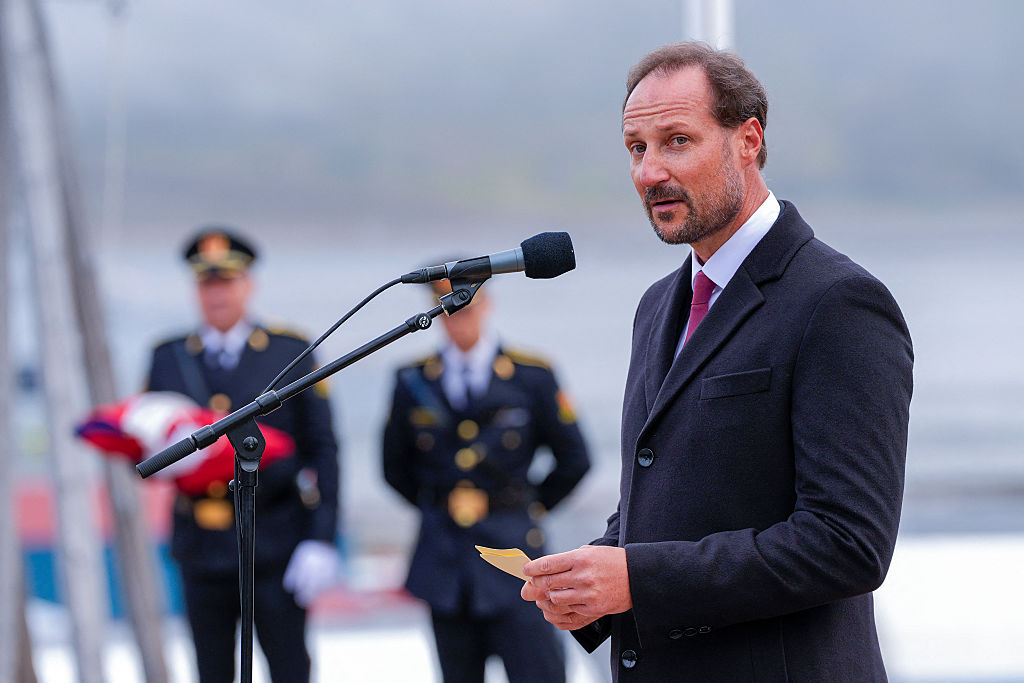
Norway’s crown prince, Haakon, speaks at the monument at Skjarringa as he visits Svalbard on August 14, 2025, marking the one-hundredth anniversary of Svalbard becoming part of the Kingdom of Norway. (Lise Aaserud / NTB / AFP / Getty Images / Norway OUT)
“Let them take Svalbard” was the headline on January 13 for the Norwegian tabloid VG.
This was actually a distortion of comments by Croatian president Zoran Milanović, giving the misleading impression that he was offering Donald Trump an alternative territorial conquest to Greenland. But it reflects an underlying Norwegian anxiety about the future of its northern islands.
Milanović had labeled Greenland “useless” in comparison to the Svalbard archipelago in a press conference four days earlier that the Norwegian press picked up on. Much of the water around the latter, a Norwegian territory governed according to a unique 1920 treaty, is ice-free all year round thanks to the warm waters of the Gulf Stream.
This fact, along with its location between the North Pole and the Russian and Norwegian mainland, makes Svalbard arguably more important for Arctic security than Greenland. Milanović’s efforts to highlight this drew the attention of the Russian ambassador to Norway, who labeled his comments “very provocative in the current conditions.”
On the immediate point, Russia and Norway are aligned. Neither wants to see greater US involvement that might threaten their respective Arctic interests. But more broadly, there are significant tensions between the two major players on Svalbard, with mutual distrust around interpretations of the Svalbard Treaty.
These disputes may not lead to anything serious, and Svalbard is unlikely to be “taken” any time soon. However, as wider interest in Arctic geopolitics grows, Norway is becoming increasingly twitchy.
An Economic History
With no indigenous population, the date of Svalbard’s first human settlement is contested. On an expedition in 1596, two Dutch ships commanded by Willem Barentsz had sighted the northwest coast of the island they called “Spitsbergen” (pointed mountains), but Russian Pomor hunters may have already been living there for months at a time fifty years prior.
From the early seventeenth century onward, whaling in the Arctic boomed. Svalbard became a center for Dutch whalers, who established the soon-defunct settlement of Smeerenburg (“blubber town”) near the point that Barentsz first sighted. Around this time, Pomor trappers set up the first of what would become dozens of trapping stations.
Gradually, the Pomors were outcompeted by the Norwegians, who had to travel shorter distances to the archipelago and therefore had an advantage in accessing trapping areas. Norway increased its foothold over the following fifty years, until in 1906 the American businessman John Munro Longyear’s Arctic Coal Company began commercial coal mining. It took advantage of a free-for-all competition for territorial claims that included Swedish, British, Russian, and Norwegian companies.
Longyearbyen, the town founded by its namesake as Longyear City, emerged as the first true settlement on Spitsbergen as the coal industry grew. After the signing of the Spitsbergen (Svalbard) Treaty in 1920 by fourteen states (not including Russia, which eventually ratified the treaty in 1935 as the Soviet Union), the Norwegian state took control.
The treaty affirmed full Norwegian sovereignty over the archipelago while allowing citizens of signatory countries the ability to live and work there freely. We can see its implications today in the continued existence of two Soviet-era settlements, Barentsburg and Pyramiden, though the latter has since been abandoned.
It is difficult to find reliable statistics for Barentsburg, particularly since the Russian invasion of Ukraine in 2022 precipitated a cooling of relations and the departure of a number of Ukrainian workers. However, it seems clear that the archipelago’s population hovers around three thousand people.
The vast majority live in Longyearbyen, where the population no longer fluctuates with the seasons as much as it once did thanks to year-round tourism chasing the aurora borealis in winter or opportunities for polar bear spotting in summer. The presence of almost three hundred of the latter means those who wish to leave the city limits must carry a rifle and flare gun.
Enforcing Control
While the treaty is clear in affirming the “full and absolute sovereignty of Norway over the Archipelago,” it leaves the precise expression of sovereignty open to interpretation. The Norwegian government is now trying to encourage noncitizens to leave, considering its authority to be threatened by the sustained Russian presence.
The local government no longer offers Norwegian-language lessons. In 2022, the Norwegian authorities changed the voting rules for Longyearbyen Local Council elections, with eligibility for non-Norwegian citizens now requiring at least three years of prior residence on the Norwegian mainland.
The treaty specifically distinguishes Svalbard for tax purposes, making taxes lower on the islands as they are only used for funding specific local government functions. Foreign residents were unhappy at being denied a say in most decisions on how this money is spent.
This relative hostility to foreign residents contrasts with the internationalization of Svalbard’s industries. Upon the closure last year of the final Norwegian coal mine, tourism and scientific research became the archipelago’s main sources of income.
Both tourism and science are international by their very nature. Numerous cruise ships call in Longyearbyen every year, and the northern research station of Ny-Ålesund is home to Arctic research institutions from eleven countries, including the UK, India, and China. Svalbard is highly valuable for science as it has been relatively undisturbed by human activity.
Norway has tolerated the international presence at Ny-Ålesund for more than half a century. In April 2025, however, the Norwegian authorities took exception to two lion sculptures outside the Chinese facility, which had guarded it without incident for around two decades. Shortly afterward, Svalbard’s only higher education institution announced that it could no longer accept Chinese students, as Norwegian security concerns had meant that past students were unable to access some field trips or company visits.
These incidents show a direction of travel, toward disengagement with states Norway views with suspicion, that had already become apparent to Yury Trutnev, one of Russia’s deputy prime ministers, in early 2024. In a meeting of the Russian commission aimed at maintaining a Russian presence on Svalbard, he drew parallels between Russian combat forces in Ukraine and the need to protect “the rights of Russia and Russians” in Svalbard.
The report of the same meeting mentioned Russian plans for a new research station of its own, to be located in the old mining town of Pyramiden. This center remains an idea rather than a finalized project. But the decision of the Russian state-owned coal company Trust Arktikugol to fly the Soviet flag atop hills and cranes in both its settlements shows that relations are no longer as cordial as they once were.
“Warlike Purposes”
One of the ambiguous articles of the Svalbard Treaty is the ninth one, which prohibits the use of the archipelago for “warlike purposes.” Exactly what this means for Norway and Russia in a time of uncertainty and hedging against future threats is unclear.
In 2021, Russia complained about Norway’s satellite infrastructure on Svalbard, considering the Svalbard Satellite Station (SvalSat) station a “dual-use” facility with potential military uses, in violation of this requirement. The drafters of the treaty in 1920 would have done very well to account for this possibility.
Notwithstanding such ambiguities, Norway is prohibited from building explicitly military installations on the islands. But with the exception of a recent statement from the leader of a minor Norwegian party, there are no indications that it would necessarily want to. Instead, Norway’s center-left government has been far more preoccupied with ensuring its future control offshore.
In January 2024, the government approved plans for commercial deep-sea mining in the waters between Svalbard and the island of Jan Mayen. Disputes with the Socialist Left Party, which the Norwegian Labour Party’s successive minority governments relied on to pass their budgets, led to the postponement and subsequent abandonment of those plans until at least 2029. However, the fact that such an idea was considered feasible reflects Norway’s contrasting military and economic attitudes to Svalbard.
Meanwhile, Russia has enhanced its military presence on Franz Josef Land, a Russian territory to the east of Svalbard that is even closer to the North Pole. It constructed a new air base there in 2021, with the commander of the Russian Northern Fleet telling the BBC that NATO military activity in the Arctic was a provocation given the location of Russian nuclear weapons on the Kola Peninsula, bordering Norway and across the Barents Sea from Svalbard.
Russia has so far shown no desire to occupy Svalbard. Given Svalbard’s status as an undisputable part of Norway, and therefore NATO, such a move would still be extremely dangerous. It would certainly not be as simple as claiming ownership and sorting the details out later.
It may be a mistake, therefore, to read too much into the claims of Russian figures who don’t go by the name of Vladimir Putin. Sergey Mironov, leader of a Russian “opposition” party that in practice has tended to agree completely with Russian foreign policy, last year raised the prospect of renaming various Arctic landmarks, in line with the US government’s efforts to popularize the term “Gulf of America.” In a Telegram post, he suggested Svalbard should henceforth be known as “the Pomor islands,” in honor of its former Russian settlers.
For now, while Trump’s rhetoric on Greenland remains just that, Svalbard will remain Norwegian. But to assume that the Svalbard Treaty will remain the governing force indefinitely, as the facade of the “rules-based global order” comes crumbling down, may not be such a safe bet.