Keir Starmer’s Weakened Position Opens the Door for the Left
Britain’s Labour prime minister is severely wounded by his disastrous appointment of a Jeffrey Epstein–associated US ambassador and could soon be ousted. But the party needs more than a makeover.
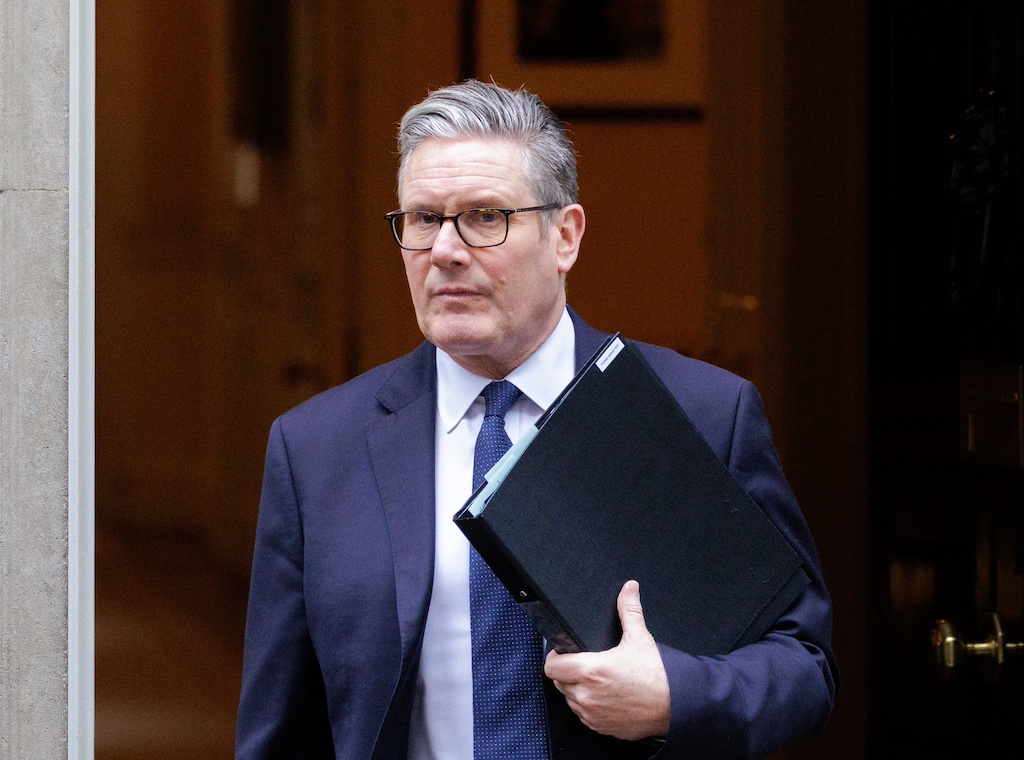
Keir Starmer’s appointment of Peter Mandelson as Britain’s ambassador to Washington was itself a reflection of how beholden he was to the disgraced peer. (Jason Alden / Bloomberg via Getty Images)
When struggling football managers get a vote of confidence from their board, it often comes with an unspoken “for now.” In a similar vein, the clock for Keir Starmer is definitely ticking, despite pledges of support from politicians eager to replace him as prime minister. The bigger issue, however, is whether or not any of those likely to succeed him have the desire or ability to challenge the system that produced this crisis.
The Epstein files have provided a rare window into the parasitic world of the people who rule Britain and the United States, the two countries that in succession have dominated most of the rest of the planet for nearly two centuries. This world has been exposed as one in which money has become increasingly detached from the productive forces that give it value and a political class has emerged that is in thrall to those who control the financial system.
This is personified by a yet unscathed character in the saga, Jamie Dimon, the long-standing chief executive of JPMorgan, a bank with $4 trillion of assets under management. In 2009, Dimon telephoned Britain’s then chancellor, Alistair Darling, to threaten punitive action over plans to tax bankers’ bonuses. The Epstein files reveal that this course of action was treacherously suggested by Darling’s cabinet colleague Peter Mandelson. Despite this bullying already being on the record in Darling’s book, Back From the Brink, it does not appear to have done Dimon any harm: in the seventeen years since, he has been a regular visitor to Downing Street under successive prime ministers and only four weeks ago, jointly hosted an event at Davos with Rachel Reeves, the current chancellor.
Apart from snippets in memoirs, we do not usually get to know how we are ruled until government papers are released thirty years later and most of the protagonists have long left the stage. In this case, the problem for Starmer is that Mandelson was not only still on the stage, he had also chosen most of the cast and written much of the script.
Starmer’s appointment of Mandelson as Britain’s ambassador to Washington was itself a reflection of how beholden he was to the disgraced peer. After firing him from the role over his links with Jeffrey Epstein last September, he might have weathered criticism of his judgement. But Starmer faced renewed outrage two weeks ago when files were released that showed Mandelson providing Epstein with market-sensitive information and advised Dimon to “mildly threaten” Darling.
It is a measure of Mandelson’s previous influence that, within days, Starmer’s chief of staff, Morgan McSweeney, and director of communications, Tim Allan, had resigned because of their close association with him. Briefly, it seemed that Labour lawmakers were ready to oust the prime minister too. Starmer’s moment of greatest jeopardy came last Monday when Labour’s leader in Scotland, Anas Sarwar, called on him to stand down. But no further dominoes fell: Wales’s first minister, Eluned Morgan, declined to back Sarwar, and Labour members of the British Parliament gave Starmer a stage-managed standing ovation at their weekly meeting that evening.
Yet Starmer’s position remains precarious. On February 26, Labour could lose a Westminster by-election in Gorton and Denton, a constituency in Greater Manchester that it won comfortably in 2024. On May 7, there are also elections for the Scottish and Welsh parliaments and some local councils in England in which a Labour meltdown is a serious prospect. Labour has been in power in Wales since its parliament was established in 1999 but polls suggest it is set to come in third in May behind Plaid Cymru and Reform. In Scotland, Labour governed for the first eight years of the parliament’s life but lost to the Scottish Nationalist Party in 2007 and has been in opposition since.
Sarwar wanted Starmer gone to give Labour a chance of a comeback in Scotland, but those looking to succeed him would not have relished facing the electorate so soon. As veteran left-wing MP Diane Abbott put it: “I think the idea is let (Starmer) stay there and take responsibility — we’re going to have catastrophic elections anyway.” Another factor behind the apparent closing of ranks is that one of the main leadership contenders, Angela Rayner, needs time for a tax investigation into her property dealings to be settled; and another, Wes Streeting, is a protégé of Mandelson’s for whom a delay provides an opportunity to reinvent himself.
Streeting’s first move was to publish WhatsApp messages between him and Mandelson in which he said, “Israel is committing war crimes before our eyes.” But this backfired immediately with former Labour leader Jeremy Corbyn saying that, if he knew that, “why did he keep serving in a government that was arming them?”
The other politicians widely considered as front-runners to replace Starmer include former Labour leader and current energy secretary, Ed Miliband, and the home secretary, Shabana Mahmood. The Greater Manchester mayor, Andy Burnham, would have support but he is not an MP and was blocked by Starmer-allied officials from being the candidate in Gorton and Denton. A further name being touted by the right-wing media is the defense secretary, John Healey, whose hard-line stance on arms spending and “war readiness” aligns with theirs.
Disastrous election results alone would be enough to trigger new demands for Starmer to go, but any one of the other controversies dogging him could equally end his premiership. Each day brings something new, but the top four at present are: the awarding of a £240m military contract without a tender to Palantir, the producer of surveillance software for Israel’s slaughter in Gaza, after Starmer visited their offices with Mandelson last year; Starmer’s decision to proceed with appointing a former aide, Matthew Doyle, to the House of Lords even though he knew he had publicly campaigned for someone charged with — and subsequently convicted of — child sex offences; the ongoing fallout from the separate police and parliamentary investigations of Mandelson; and revelations that Labour Together, the party faction that orchestrated Starmer’s leadership bid in 2020, had hired a public relations firm to identify and find “leverage” over the sources used by journalists investigating hundreds of thousands of pounds in undeclared donations. The latter is now the subject of an inquiry by the Public Relations and Communications Association, the professional body for the industry.
If there is a leadership election, Labour members and members of affiliated unions will have a vote, but candidates will need to be nominated first by 20 percent of Labour’s 405 MPs. That threshold was raised from 10 percent in 2021 to preclude a repeat of what happened in 2015 when Corbyn secured enough MP nominations to get on the ballot and was then comfortably elected.
Absent their own candidate, left Labour MPs are likely to join those dubbed “soft left” in coalescing around either Rayner or Miliband, both of whom have something of a checkered history. Rayner served in Corbyn’s shadow cabinet but distanced herself from him after winning the contest for deputy leader when Starmer was elected in 2020. She had to resign from that role and as deputy prime minister last year after her property tax issues were revealed.
Miliband was leader when Labour was in opposition from 2010 to 2015 and, to his credit, inflicted a surprise defeat on David Cameron’s conservative government in 2013 when he instructed Labour MPs to vote against Britain joining a US-led military intervention in Syria. However, a year after Corbyn was elected to succeed him as leader, Miliband backed moves to oust him and supported Owen Smith, the unsuccessful rival candidate, in a second leadership contest.
Miliband denies having any ambition to be leader again, but his recent interviews have made a pitch that he knows will be popular with the party’s grassroots. While saying he supported Starmer continuing, he called for the situation to be “a moment of change” and said Mandelson should never have been appointed because it undermined Labour’s mission of “standing up for the powerless and not the wealthy and powerful.” In his role as energy secretary, he also announced plans to spend £1 billion on community-owned green energy schemes. Using language echoing Corbyn, he said the scheme was “answering the call for a different kind of economy that works for the many.”
Miliband or Rayner could well defeat a candidate from the Right, but their much bigger challenge would be to deliver meaningful change. In trying to do this, they will face two major obstacles.
Firstly, the powerful big business circles that the Epstein files have shed light on will resist fiercely. The Financial Times has already signaled this by claiming that there is no mandate for a leftward shift, and the Corbyn years demonstrated how even modest proposals for public ownership and taxing the wealthy will come under ferocious fire. There is popular support for such policies — as shown by the Greens being ahead of Labour in some polls — but Labour’s link with the unions would also need to be revived to give a left-leaning leader organized backing. Corbyn had strong support from the largest private sector union, Unite, but was undermined by Unison, the public services union. With Unison now having elected a left-wing general secretary, Andrea Egan, both big battalions could weigh in behind progressive policies.
The second obstacle would be a lack fiscal headroom unless Labour ditches plans for a massive increase in arms spending. As it stands, Britain is set to increase its military budget from 2.3 to 3.5 percent of GDP by the 2035 with a further 1.5 percent being spent on infrastructure and civil preparedness. Each percentage point adds about £30 billion annually to government spending. Last year, Starmer handed the job of justifying this to Lord Robertson, who was Tony Blair’s defense secretary and then NATO’s secretary-general at the time of the invasions of Iraq and Afghanistan.
Media coverage of Robertson’s defense review focused on the possibility of war with Russia, but his report also prioritized the Middle East and the Indo-Pacific and said 8,500 military personnel stationed should continue to be based as far away as Oman, Kenya, and Singapore. This issue will be a defining one: a new leader will not be able to invest significantly more on the National Health Service, education, and other services to benefit “the many” unless they revisit plans to ramp up arms spending, which, in turn, would involve a radical change of foreign policy.