Sócrates Showed Us the Best Way to Bring Politics Into Sports
Today would have been the birthday of the late, great footballer Sócrates, who challenged the military dictatorship in his native Brazil — an example needed today on the eve of a World Cup designed to be a Trumpian propaganda showcase.
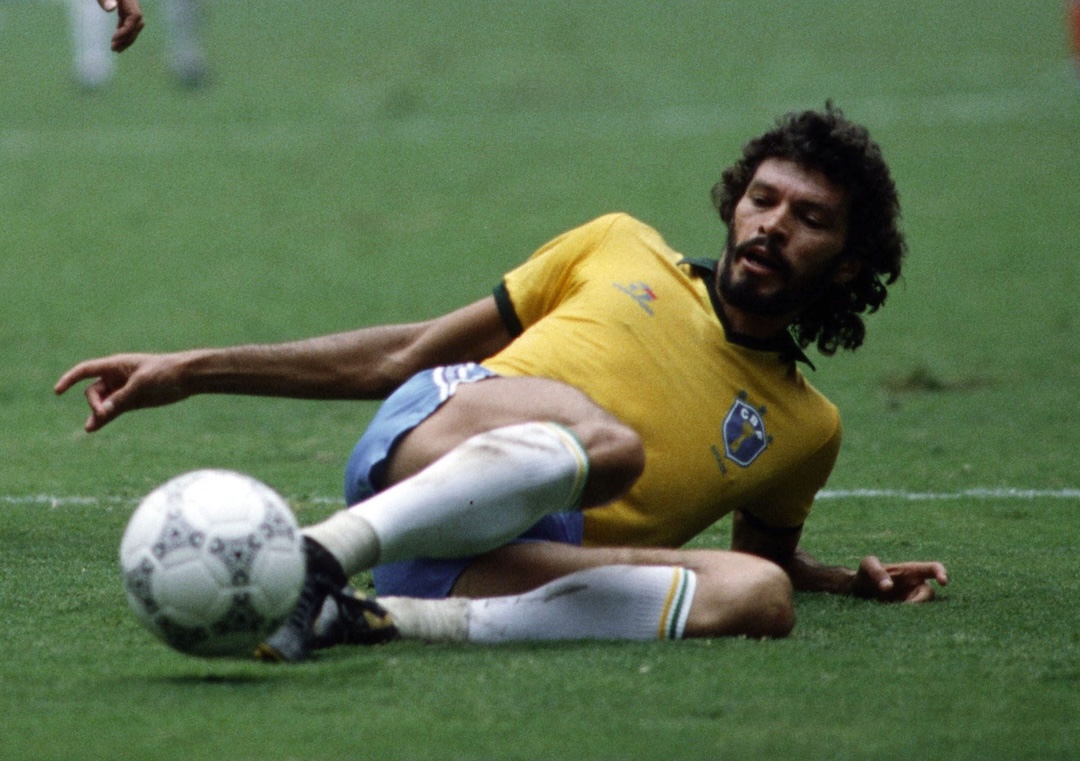
At a time when the US is preparing to host a World Cup set to make the tainted tournaments in Russia and Qatar seem almost quaint in comparison, football players should channel the political spirit of the Brazilian master Sócrates. (Bongarts / Getty Images)
Sócrates Brasileiro Sampaio de Souza Vieira de Oliveira never won a World Cup. He never reached a final, never lifted football’s most prestigious trophy, never secured the kind of immortality that usually defines greatness in the game’s official mythology. And yet decades on, the Brazilian footballing legend remains one of the most important figures in World Cup history.
Hundreds of players have won the tournament, but there has only ever been one Sócrates. His legacy endures not because of awards or even his boundless ability but because he understood something football’s institutions would rather forget: that playing the game is itself a political act. Athletes, whether they like it or not, occupy a stage with enormous social power.
The Anti-Athlete
Tall, bearded, and cerebral, often likened to Che Guevara, Sócrates cut an unmistakable figure on the pitch. He was a master of space and time, a player who saw passes before they existed, threading long balls with surgical precision and dismantling defenses with his trademark no-look backheels.
But even at the height of his playing career, he resisted the idea that football should consume him entirely. A qualified medical doctor — which earned him the nickname “Doutor Sócrates” — he embodied the contradiction that unsettles the sport’s narrow expectations: an elite athlete who read voraciously, spoke politically, and refused the puritan discipline demanded by professional sports. “I am an anti-athlete,” he once said. “You have to take me as I am.”
The Belém-born playmaker did not believe footballers existed outside society, nor that their only responsibility was to entertain. “While I was a footballer, my legs amplified my voice,” he reflected, cutting through the liberal mythology about apolitical sports. He used that amplified voice to speak against injustice not only in Brazil but internationally too, most famously by donning headbands emblazoned with political messages at the 1986 World Cup in Mexico.
Those messages included “The People Need Justice,” “No Violence,” and “Yes to Love, No to Terror” — the latter a direct rebuke to the US bombing of Libya a little over a month earlier. These gestures were not merely performative statements or vague calls for unity. They were explicit, confrontational, and internationalist, challenging empire in no uncertain terms.
Football Democracy
Sócrates was not born a radical. Early in his career, he echoed the reactionary common sense of his environment, praising Brazil’s military regime and dismissing the idea that sports should mix with politics. What changed him was education and proximity to reality.
In 1978, when he started to play for Corinthians, the historic club where Sócrates spent most of his monumental career, he came face-to-face with the violence and repression of a US-backed dictatorship that had ruled Brazil since overthrowing the democratically elected president in 1964. He began asking questions and reading more.
When he understood what was really happening — the disappearances, the censorship, the crushing of organized labor — he changed his positions, publicly. This willingness to unlearn, to break with earlier beliefs, is central to his political legacy and offers an important reminder to all people of conscience to never relent in questioning the systems of oppression that surround us.
It was at Corinthians that his politics found their clearest expression. In the early 1980s, amid a perpetually tightening despotic climate, Sócrates became a central figure in Democracia Corinthiana — an extraordinary experiment in collective self-governance within one of Brazil’s biggest football clubs. Under his captaincy, decisions were made democratically, with players, coaches, physios, kit men, and staff all given an equal vote.
Everything, including training schedules, team rules, and even whether the bus should stop for a toilet break, was decided collectively. In a country where the right of democratic participation had been violently stripped from the population, a football club became a site of worker control and political imagination, and eventually expanded, becoming hugely significant in the struggle against the dictatorship.
Democracia Corinthiana positioned itself directly against the military regime, aligning with the wider Diretas Já movement, which demanded the restoration of democratic elections. Sócrates used his platform explicitly at a time when dissent carried real risk; he did not hide behind euphemism or neutrality. Football, he understood, was one of the few spaces where mass attention could not be easily extinguished.
Sócrates died aged fifty-seven, on December 4, 2011, the same day Corinthians secured the Brazilian league title — a poetic ending for a man whose life had been inseparable from the club and its people. By then, he had long since retired from football, but not from politics. He practiced medicine, wrote, lectured, appeared as a pundit, and remained committed to radical change, openly supporting Luiz Inácio Lula da Silva and the Brazilian left. His activism did not end when the cameras moved on.
The Politics of Silence
Today, as the United States accelerates toward fascism and intensifies its imperialist crimes against Latin America and beyond, and as the Fédération Internationale de Football Association (FIFA) bends itself entirely to Donald Trump, we need players to channel this spirit of Sócrates — when the US is preparing to host a World Cup set to make the tainted tournaments in Russia and Qatar seem almost quaint in comparison.
Everything Sócrates embodied cut against the comforting liberal fiction that politics enters sports only when an athlete “chooses” to speak. Sports do not suddenly become political when they wear an armband, take a knee, cover their mouths, or make a statement. There is politics in omission too. Everything about football is political because the game itself is embedded in power: in nationalism and capital, in imperial spectacle, in the structures designed for profit and prestige.
Modern sports work tirelessly to obscure this reality, which is why players are encouraged to “focus on the game,” to remain neutral and understand politics as something external, disruptive, and dangerous — a threat to harmony rather than a response to injustice, unless, of course, the “politics” in question is nationalistic or militarist.
When athletes challenge power, they are rewarded only insofar as their interventions are vague, symbolic, and easily absorbed into the marketable language of “values.” Anything sharper is treated as a breach of contract. Therefore, silence is not the absence of politics but its most obedient form.
Sócrates recognized this long before social media reduced political expression to personal branding. His activism was not a matter of individual conscience alone; it was collective, structural, and openly antagonistic to power.
Democracia Corinthiana was not about visibility — it was about redistributing decision-making power and institutional changes and, in doing so, exposing football’s relationship to wider struggles over labor and democracy. This is what distinguishes radical political action from the empty gestures that now dominate elite sports.
Sports and Spectacle
That distinction is important to make, especially today, because the language of “speaking out” has done profound political damage. It suggests that injustice can be addressed through expression alone, rather than through organization, solidarity, and confrontation. It reduces politics to performance and dissent to marketability.
In football, this has produced a generation of players whose public personas are meticulously managed. Their opinions are filtered through sponsors and agents, and their rare moments of conscience are quickly folded back into the spectacle.
The consequences of this are visible beyond football as well. In cricket, one of the world’s most widely followed sports, silence reigns over India’s occupation of Kashmir, over anti-Muslim pogroms, and over the consolidation of authoritarian power under Narendra Modi.
The Indian cricket authorities, dominated by allies of Modi, have now barred Bangladeshi cricketers from participating in the sport’s biggest league, having already excluded their Pakistani counterparts. The International Cricket Council presents itself as neutral, while operating in lockstep with state power and corporate interest.
From Pakistan to Australia, players are warned, both implicitly and explicitly, that political engagement threatens their careers. Of course, this is not the case when it comes to capitalist interests — such as Australia refusing to play the Afghan cricket team “in solidarity with” Afghan women when it is commercially unfeasible to do so, but not at major tournaments.
Refusing the Lie
Against this backdrop, figures like Sócrates, or even Argentine legend Diego Maradona, stand out for refusing the lie of neutrality. Maradona’s open support for the Cuban Revolution, his solidarity with Palestine, and his hostility to US imperialism placed him firmly outside the boundaries of acceptable celebrity politics. Like Sócrates, Maradona embodied the idea that footballers are not merely entertainers, but workers whose labor generates wealth and whose visibility confers political weight.
Today the contrast is stark. Cristiano Ronaldo pathetically poses with Donald Trump, while Neymar lends his support to Jair Bolsonaro. When the world’s most influential players openly align with reactionary politics, there is little criticism, even as institutions insist that football must remain above politics. This contradiction reveals that sports are not depoliticized, but rather selectively politicized; eager to accommodate power, but allergic to resistance. Silence is demanded only from those who might disrupt the prevailing order.
Even the much-lauded gestures of recent years now appear threadbare. At the Qatar World Cup, some European teams, most notably Germany, staged carefully choreographed displays of “values-led” protest, which were symbolic, restrained, and ultimately toothless. But even those gestures were curtailed by FIFA with no resistance.
The spirit of Mexico ’86 — of football as a site of overtly political dissent — feels impossibly distant forty years on, even as thirteen of the 104 games are scheduled to take place in Mexico. Yet it is precisely that spirit that the coming World Cup demands. If FIFA insists on staging the bulk of its flagship tournament in the heart of a collapsing empire, amid intensifying repression, militarized borders, and permanent war, then neutrality is no longer an acceptable position, if it ever was.
Fighting for the Game
As the US accelerates toward authoritarianism at home while underwriting mass violence abroad, the world’s most-watched sport prepares to fall into line. This silence is the product of a sporting culture and economy designed to suppress resistance before it can coalesce, with players encouraged to see themselves as brands rather than workers while national teams become vehicles for soft power.
It does not have to be this way. Footballers are not powerless individuals trapped within an unchangeable system. Their labor sustains a global industry, their visibility commands mass attention, and their collective action could meaningfully disrupt business as usual. When he helped build Democracia Corinthiana, Sócrates demonstrated that even under a dictatorship, football could be reorganized along democratic lines.
Crucially, this responsibility does not rest solely with players. Fans, too, are political actors. Supporters’ groups, unions, journalists, and grassroots movements all have a role to play in refusing the sanitization of empire through sports. Boycotts, coordinated protests, and sustained pressure can force uncomfortable questions into spaces designed to exclude them.
The sustained movement to exclude Israel from competing in international events may not have led to change yet, but it has undoubtedly shifted the bounds of what is considered possible. German club Fortuna Düsseldorf’s decision to cancel the transfer of Israeli player Shon Weissman in response to sustained fan pressure over his endorsement of the Israeli army’s war crimes is one example. There is no reason why similar coordinated and collective campaigns cannot be waged against the United States.
There are still flashes of solidarity. Figures like Gary Lineker, Pep Guardiola, and Anwar El Ghazi have shown that it is possible to refuse the demand for silence. But isolated courage is not enough. What made Sócrates so beloved was not just his activism but his commitment to collective struggle.
To invoke Sócrates’s legacy today is not to mythologize the past, but to issue a challenge to the present. If football could be politicized against a US-backed military dictatorship in 1980s Brazil, then the claim that resistance is impossible today rings hollow.
The coming World Cup will be sold as a festival, a spectacle, a distraction. Whether it becomes something else — a site of confrontation and solidarity — depends on whether those who truly love the beautiful game are willing to fight for it.