Palestinians Have the Right to Return to Their Homeland
After Human Rights Watch blocked a report on Israel’s denial of the Palestinian right of return, its Israel-Palestine team resigned. One team member, Omar Shakir, spoke to Jacobin about why rights NGOs fail to confront the issue.
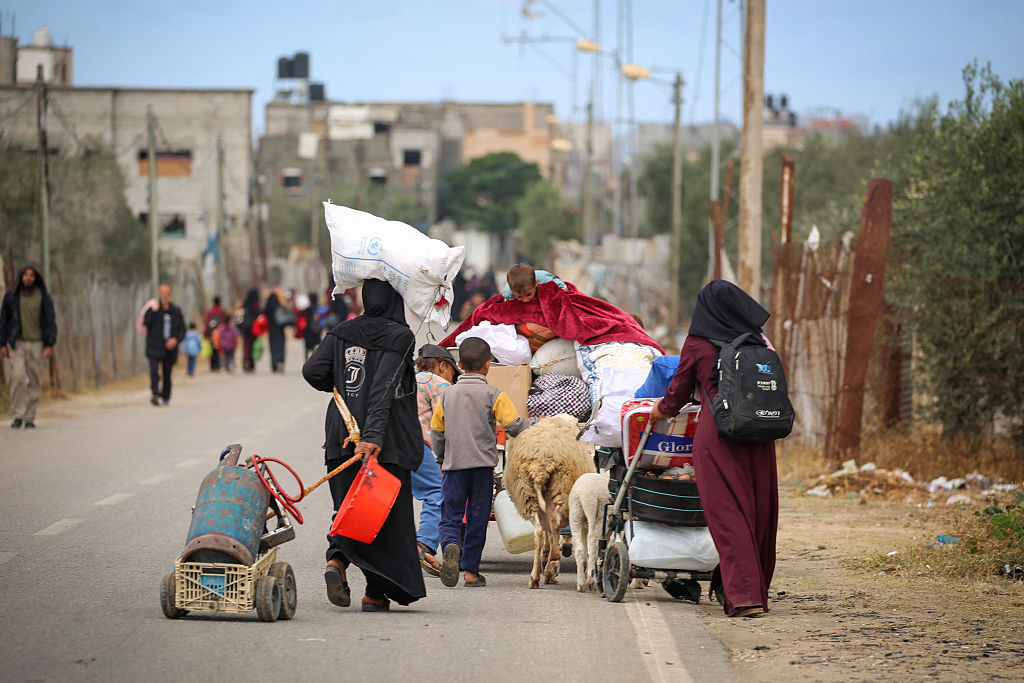
The Palestinian right of return continues to be contentious in international human rights work. (Contributor / AFP via Getty Images)
- Interview by
- Hanno Hauenstein
After Human Rights Watch blocked a report concluding that Israel’s denial of the Palestinian right of return constitutes a crime against humanity, two senior staff members — Omar Shakir and Milena Ansari — resigned. Together, they made up Human Rights Watch’s Israel–Palestine team. The organization says the report has merely been “paused.” In this interview, long-time Israel–Palestine director Omar Shakir explains why he considers that claim untenable — and why the right of return continues to be contentious in international human rights work today.
Hanno Hauenstein
You recently stepped down from your position as Human Rights Watch’s Israel–Palestine director, a role you held for over a decade, after a report on the Palestinian right of return was blocked by Human Rights Watch’s leadership. Would you say this this episode damaged the organization’s credibility?
Omar Shakir
Human Rights Watch does incredible work. I’m proud of our work on Israel–Palestine. The staff is extraordinary. But yes, this does raise serious questions about the new leadership’s fidelity to our methodology: to publish the facts and to consistently apply the law. The world needs a courageous and principled Human Rights Watch. I’m speaking out because our primary duty is to the victims of human rights abuses. I’ve spent a decade attesting to the organization’s integrity; I have a duty to acknowledge when we get it wrong.
Hanno Hauenstein
How did the report actually come about?
Omar Shakir
For about a year, we had been working on a report examining the impact of the denial of return on Palestinian refugees. In the context of mass displacement and ethnic cleansing in Gaza and the West Bank, the aim was to bring together different but connected trends: the erasure of refugee camps in Gaza; the displacement of Palestinians outside Gaza; the emptying of camps in the West Bank; the attacks on UNRWA [the United Nations’ Relief and Works Agency for Palestinian Refugees] — alongside the ongoing denial of return by the Israeli government.
We conducted dozens of interviews with refugees across the region. The evidence showed that people suffered greatly as a result of the denial of return: Palestinians in Gaza and the West Bank are now being displaced again — most of them are already refugees — and there is also the cumulative harm experienced by Palestinian refugees in Syria, Lebanon, and Jordan over decades.
Hanno Hauenstein
What is the report’s core legal assessment?
Omar Shakir
It shows that there is a right to return, but it goes beyond that: it found that the scale of harm caused by the denial of return amounts to a crime against humanity.
Hanno Hauenstein
This assessment was shared and approved within Human Rights Watch?
Omar Shakir
The report went through the regular review process: divisional review, program review, legal review. It was scheduled for release in October, but we were told we needed more time to “socialize” it internally, so it was delayed. Then it was finally set to be published December 4. It was finalized, translated, and coded to the website. A press release and a Q&A were ready to go. We briefed external partners and donors. Toward the release date, a new executive director was hired. We were told to brief him on the report. In that meeting, some senior colleagues lobbied for it to be delayed again.
The new director called me on November 25 and told me he had decided to halt publication. He didn’t give reasons beyond saying that senior staff were concerned. I asked what the process would be for releasing it. He said he couldn’t tell me and suggested I consider a way to salvage the report. Then there was a meeting on December 3 to discuss this. In it, management said they were concerned about the strength of the report’s conclusions.
The legal department said we had applied the law correctly. We were told management would decide on a way forward. We were eventually told the only option was to narrow the scope of the crimes against humanity determination to refugees in the West Bank and Gaza — something I believe has no basis in law and fact.
We made another offer, since the report had two crimes against humanity findings. We offered to base it only on the second one, persecution, which is more straightforward. Management said that it still didn’t address its concerns around advocacy. When I was told that, I said I would resign.
Hanno Hauenstein
Human Rights Watch’s leadership says the report was merely paused due to high editorial standards — a position expressed by the new director, Philippe Bolopion, in a recent press conference. What do you make of that?
Omar Shakir
It’s true they haven’t formally killed the report. They did offer a way forward. But I didn’t think that way had a basis in law and fact, as it would have included narrowing the scope of the report. Their most recent offer is to go back to the drawing board. But there is no need for that. The report was signed off on. If there are concerns, allow edits. That’s not something they seem amenable to.
Hanno Hauenstein
Former Human Rights Watch director Kenneth Roth wrote on X that, in his view, suspending the report was justified because it relied on a novel legal theory.
Omar Shakir
The idea that this is a novel legal argument is incorrect. The ICC [International Criminal Court] said in the Myanmar context that denial of return of Rohingya refugees could amount to a crime against humanity. Human Rights Watch’s Chagos Islands report in 2023 found denial of return amounted to a crime against humanity. Several Human Rights Watch publications use this framework. It builds on established case law. To not reach this finding in Israel–Palestine would be to apply a separate legal standard.
Hanno Hauenstein
Human Rights Watch and other organizations use legal frameworks such as apartheid and genocide to assess Israel’s actions in Palestine, something that would have been hard to imagine a few years ago. Why do you think the Palestinian right of return continues to be a third rail?
Omar Shakir
It does remain a third rail. Human Rights Watch has a position on return, but we’ve never done a stand-alone, holistic assessment of it. I think people fail to see the connection between what is happening in Gaza and the West Bank today and the denial of return for refugees in Jordan, Lebanon, and Syria. Part of what the report tries to show is that if what we’re witnessing now is described as a second Nakba, then we need to reckon with the lessons of the first Nakba.
The fate of the refugees wasn’t sealed in 1948 but in the years after, when the legal infrastructure of denial of return was built. That’s the reality we are in today. With Donald Trump’s plan and all these discussions about Gaza’s future, having a report that makes clear the importance of these historical lessons is critical. At the same time, I think what’s been internalized is this fear that addressing the issue of return amounts to challenging the Jewishness of the Israeli state.
Hanno Hauenstein
What do you make of this claim — that implementing the right of return would erode the Jewish-majoritarian character of the Israeli state? Is it a smoke screen?
Omar Shakir
Maintaining a Jewish state is a political preference that cannot trump the fundamental rights of a people. The right of return is a fundamental right under international law. Whether you see this as a smoke screen depends on what future vision you have. If the vision entrenches the supremacy of Jewish Israelis over Palestinians, then yes, the right of return does challenge that.
There’s now a consensus view in the human rights movement about apartheid. Dismantling that apartheid regime is obviously critical for the realization of the basic rights of all people. But there’s no way to do that without recognizing the right of return. Once those fundamental rights are recognized, many political constellations are thinkable. What you can’t do is maintain rights denial in order to preserve a particular political preference.
Hanno Hauenstein
Why was it crucial to include refugees displaced in 1948 and 1967 in the report, rather than focusing on those displaced in recent years?
Omar Shakir
The report had four objectives that required this holistic lens. First, to connect the different factors: the erasure of camps in Gaza, the emptying of camps in the West Bank, the attacks on UNRWA and its status, and the defunding of UNRWA across the region. Taken together, they amount to a coordinated assault on the Palestinian refugee status.
Second, it used the denial of return after 1948 and 1967 as a cautionary tale for the present — if Rafah isn’t reopened and the more than 100,000 people currently outside Gaza are not allowed to return, or if residents of West Bank refugee camps aren’t allowed to return. The report shows how these decisions risk reproducing permanent displacement.
Third, it opens a pathway to justice. It’s hard to seek justice for what happened in 1948 at the ICC because it predates the court and much of the legal framework. But denial of return is an ongoing crime against humanity.
And finally, there’s no credible way forward in Israel–Palestine without addressing the plight of refugees and recognizing their fundamental rights. That issue has never been properly put on the table. Human Rights Watch has published smaller reports but never on the root issue itself: the denial of return.