NYU’s Full-Time Contingent Faculty Are Poised to Strike
After trying to bargain a first contract for over a year, the union for 1,000 full-time contingent faculty at New York University is voting on authorizing a strike. Contract faculty say NYU is refusing to budge on pay raises and job security protections.
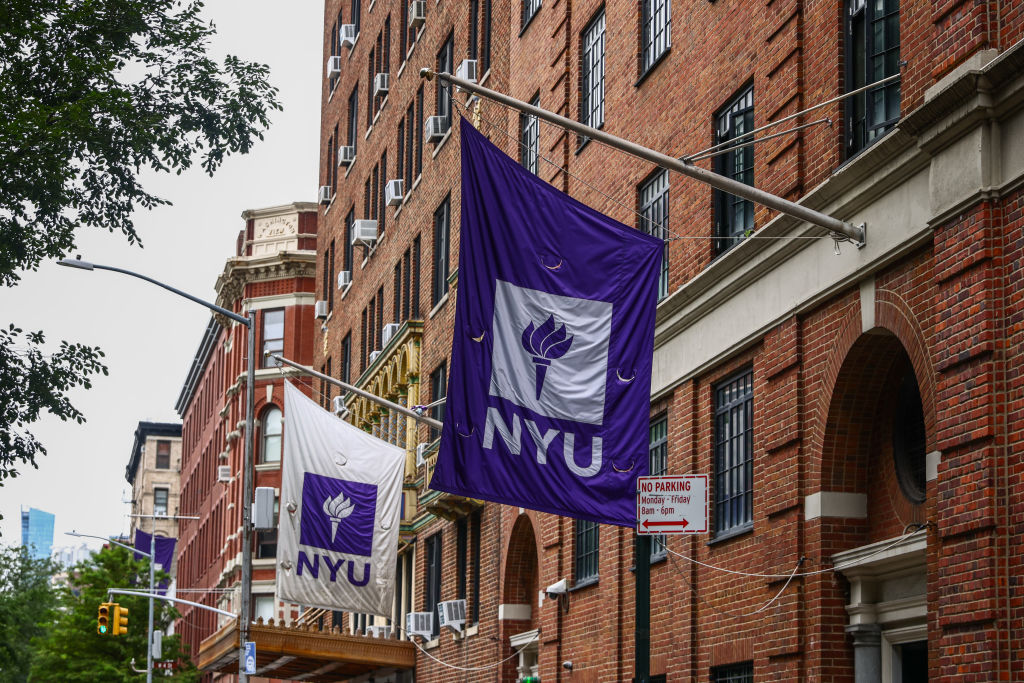
The strategy of American higher education is to mimic the private sector and reduce labor costs. (Beata Zawrzel / NurPhoto via Getty Images)
- Interview by
- Sara Wexler
In February 2024, New York University’s (NYU) “contract faculty” — the non-tenure-track instructors who make up about half of the university’s full-time faculty — voted to form a union, Contract Faculty United–United Auto Workers (CFU-UAW) Local 7902. The roughly thousand-member-strong union began negotiations with NYU for a first contract in November 2024. More than a year later, however, contract faculty say that the administration is dragging its feet in bargaining, and that workers and management are still far apart on key issues including pay and job security. On February 9, CFU-UAW began holding a strike authorization vote, which will conclude on February 20.
Jacobin contributor Sara Wexler earlier this week sat down with Elisabeth Fay, a clinical associate professor in the Faculty of Arts and Science at NYU who teaches first-year writing, and Fanny Shum, a clinical associate professor in the mathematics department at NYU’s Courant Institute School of Mathematics, Computing, and Data Science, both members of the union’s bargaining team; they were joined by rank-and-file CFU member Brendan Hogan, a clinical professor in liberal studies at NYU who teaches political philosophy. They spoke about what organizing for a first contract has looked like and why the union is weighing a potential strike.
We are half the full-time faculty at NYU in the eleven schools where our members work. It’s half tenured faculty, half contract faculty. In a lot of places, we are doing the same work as tenured faculty, but we are earning on average 36 percent less, and we are teaching on average a third more than they are. So we’re starting from a very unequal position.
For several decades, the NYU administration has been replacing tenured faculty with contract faculty in many schools, programs, and departments. Again, we were not always half the full-time faculty; in the Faculty of Arts and Science where I work, our numbers have grown by 1,000 percent since the turn of the century. There used to be thirty of us. Now there are over four hundred. So we see these contract negotiations as a way to improve our own working conditions but also as a way to pull the emergency brake on this process of casualization that has been happening at NYU for several decades.
We are fighting to make this university more secure and to protect the integrity of the research we do and the education we offer. Because when half the full-time faculty doesn’t have job security, they also don’t have meaningful academic freedom. Job security is absolutely crucial because it’s one of the major differences between us and our tenured colleagues. So that is a core priority. Our low salaries, especially given our very high workloads, is another core priority.
We are fighting both for bread-and-butter issues — like many of our members struggling to live anywhere near where they work — but we are also fighting for things like shared governance of the university, our full participation in academic decision-making. So we have a blend of traditional contract priorities and then contract priorities that are unique to our position as full-time non-tenure-track faculty. Sitting on committees, making academic decisions — we think that is an important part of our work and we want our contract to also protect that.
We are also fighting for protections against the abuse of artificial intelligence by our employer. Many of us who work at universities, not just NYU, have watched in confusion and horror at the way our administrations have approached generative AI and its integration into the systems that we use to teach. Other workers, like the Writers Guild of America, also fought for strong AI protections. I think we are correct to be very concerned about the way our bosses are embracing this still-emerging technology. It is something where they’re essentially saying, this doesn’t matter, and we don’t have to talk to you about it. We think it does matter, and we think they do have to talk to us about it.
It is clear the strategy of American higher education is to sort of mimic the private sector and reduce their labor costs, all the while shooting tuition through the roof and then claiming they don’t have money for our salaries. This adaptation of a private sector corporate ethos. . . I think we’re seeing across the country the failure of that model. It shows up in the working conditions that we faculty have in terms of our livelihoods, in terms of the things Elisabeth was mentioning.
But it’s really important to stress that faculty members’ teaching conditions are students’ learning conditions. One of the great contradictions of all this growth of universities — their competition with each other, adopting this corporate ethos for what is essentially one of the most essential human endeavors, to educate the young so that they can solve the problems we have in the present and think for themselves — is a fiasco.
Elisabeth mentioned academic freedom. I’ve taught in a tenure position before I came here, and it is night and day in terms of the attitudes and ethos of the faculty who are on renewable, fire-at-will contracts versus people who have academic freedom and who can stand up and say, because I have job security, I think this is wrong, without any sort of consequence for speaking their mind. That’s essential to an educational institution.
And when we practice that as faculty, our students see that, and then they can go out into the world and say, you know what? You can disagree with power. You can try and organize for yourselves and become more autonomous and live up to whatever ideals of a democracy you might think you ought to pursue. So I think there are a lot of large consequences for what we’re seeing in the nitty-gritty in these bargaining sessions that comes from this larger push to reduce labor costs.
What have negotiations been like?
It seems like the administration is slow-walking a lot of proposals. From my perspective, [they have often failed to respond] to the inquiries we make for information to have what we’re bargaining for open and between us on the table.
When I see what’s going on with faculty around the university, it is clear to me that there’s an overall approach the admin takes toward us as contract faculty that has only emboldened my judgments about our labor situation. I wouldn’t want to ascribe bad faith to the administration, but it’s very typical from what I’ve learned about labor-management struggles to slow-walk, to delay, to try and diffuse the energy and solidarity of the workers so as to weaken their position.
It has backfired, because the untenable character of some of the contract disputes we have, specifically around salary, is only getting people more emboldened on our side and in collective bargaining. Just to give an example: yesterday we had people give testimony about how long they’ve been at NYU and what they’re making versus somebody hired a couple of years ago; they call it compression. And it was just astonishing to me [how much more people who are hired more recently are making]. Everything I learned about the salary situation through this process has shown me that it’s worse than I thought it was.
The administration, I think, is very protective of their ability to control that. And that’s reflected in some of the stalling from their side.
In negotiations, when the bargaining members bring in proposals, often the lawyers and the administration don’t bring us the same number of proposals. And when we come in with questions for them, it takes a long time for them to answer those questions. We need that information and answers to those questions to help make adjustments or build our own proposals in response. When the administration is not coming to us with explanations for why they are not accepting our articles, that makes it hard for us to work toward an agreement.
On February 9, the union began a strike authorization vote. What led to that decision? And how are you all feeling about it?
We sent out ballots to all of our members on February 9; voting will remain open until February 20. We were really happy to see that in the first twenty-eight hours that voting was open, over half of all contract faculty at NYU cast ballots. And we’ve been seeing steady progress in the time since. We want all of our members to vote; we want to show the NYU administration that contract faculty are really united around our demands. We’re working hard to reach our members, so that Fanny and I know that we’re going back to the table with a really strong and clear mandate.
When did it become clear that you were going to have to call a strike authorization vote? What did that decision look like, and what has the organizing for a potential strike been like?
It’s been impressive for me to see faculty who I didn’t take to be the most engaged in governance and these types of things, when seeing what the administration is bringing to the table and seeing the way they were approaching negotiations, come alive and engage in all sorts of activities together to say we are a unit, and this is about our futures and livelihoods and the education of our students. People have been phone banking, flyering, talking with students, reaching out to different student groups to explain the situation and let them come to a judgment for themselves.
That’s really been emboldening, because students are in a tricky situation. Because the tuition is so high, it seems like on the one hand, they’re encouraged to think like a customer — you want to get your money’s worth. But the sense from students when they see our salaries compared to that of other faculty and what it means for us to be teaching 50 percent more than a tenure-track line and how much more work that is. . . I’ve been very emboldened, heartened, by student support as well.
We’re doing open bargaining, so anyone in our union can come and observe negotiations, and we usually make an effort to try to turn people out. We find that the administration is more responsive if we have a packed room. It’s also easier to stay in touch with members and to bring people in even if they haven’t been following closely.
We have been very conscious of the importance of transparency. All of the proposals that cross the table, both ours and the administration’s, are up on our website. We probably communicate with our members more and at greater length than they might prefer, but we really try to bring as many contract faculty into our negotiations as possible.
I think more than half of our members have come to observe a session, and we’re hoping that those numbers go up. One of the things that has become clear is that when members come and sit in the room and listen to what we’re proposing — and as Fanny said, the administration dodges questions or dismisses our concerns or refuses to provide the information that it’s legally required to give us — that is often really galvanizing for people who have been checked out of the process. Because the demands we’re making are not unreasonable. They are not pie in the sky. So to see the administration adopt this really dismissive attitude often helps us bring more people into this campaign and helps our organizing.
Being on the collective bargaining committee is another maybe four-fifths, maybe full-time job on top of teaching. When you go and observe and see how professional, ready, articulate, intelligent, and reasonable the collective bargaining committee is — the faculty across the table from corporate lawyers making ten times what we’re making — the texture of that experience really stays with you.
And Elisabeth is right: more people going into the room changes the dynamic, but the people who get to observe bargaining get it once they see what’s happening. That’s been one of the most pedagogically important aspects of this process of forming solidarity.
How has the university responded since you announced the strike authorization vote? Have you seen any movement?
Before the vote on February 9, we did an update in the bargaining session before, saying that we would be opening up the SAV vote. After that was made public, [NYU president] Linda Mills pretty much immediately sent a university-wide email. Talking to my colleagues, they were shocked by Linda Mills’s claim that our average salary is $120,000. A lot of my colleagues were asking, is that true? Are we being paid under the average? Our average salary is nowhere near $120,000. After that, reading the rest of the email, they felt like this was so disingenuous.
There were a bunch of statistical glosses in there that people were legitimately confused by. Mills touted that the administration had offered us a 20 percent raise to the salary floor. So a lot of members, too, were like, have we rejected a 20 percent raise in bargaining? When we crunched the numbers, we realized that floor-minimum raise that they were referencing would’ve affected nine people in the unit. So yes, they’ve offered a 20 percent raise in one little corner that will lift up our nine most junior colleagues.
The general thrust of the email was very intellectually dishonest and clearly designed to drive a wedge between contract faculty and other faculty at NYU. This is a message that went out to all NYU faculty and staff. I think the intent was to offend the tenured faculty — “Look how much these presumptuous contract professors are asking for” — and also to scare our members, to suggest to them that our demands were unreasonable. And the president was now here to say that they were not going to listen to us.
I think that email had the opposite effect than intended. We are long-term employees in a way that makes us a little different from workers represented by a lot of the other academic unions. Our colleagues here in New York City — the median length of service in our union is thirteen years. We are long-serving faculty at the university. We tend to be slightly more conservative in terms of risk-taking, perhaps, than graduate unions. So I think when that email came out, we were all a little nervous, is this going to scare people? By and large, it made people angry. Once people managed to wade through the confusion and figure out that they were not being paid under some imaginary $120,000 standard, that they were not getting this 20 percent raise, people were uniformly pissed off.
I think it actually had a similar effect on tenured faculty. So that was heartening. But I also know that there are going to be many more emails like that. We got another one about the budget the other day that attempted to paint NYU as really strapped for cash, struggling to make ends meet. I would imagine there’s more of that coming.
I also read that the administration wants a mediator, and it tried to cite the request for a mediator as showing good faith.
The administration has been constantly asking for mediation. For some of our members who don’t understand what mediation is, we’ve been getting a lot of questions: Why are we not doing this? We responded trying to make sure it’s clear to people what mediation really means for us. It doesn’t make sense to do mediation because we are very far apart on things. Mediation is more appropriate when we’re coming closer and trying to close up some articles.
But the issue with mediation is, it’s just another stalling tactic. First we have to schedule a time with the mediator, which takes forever. Then, after we do schedule a time, we have to again present all of the information all over again. We’ve already been negotiating for over a year, and now we add in mediation — who knows how much longer that’s going to add to the timeline?
What would you say the next steps are, now that the SAV is open? What have your internal conversations been like?
Right now, we are solely focused on making sure that everyone in our union knows that they’ve got a ballot and that they should vote yes, to send us back to the table so that we can actually begin making progress with the NYU administration.
It’s been really helpful to be doing this work in a city like New York, where we can point to so many other academic unions who have also done this. As I said, the median length of service in our unit is thirteen years; our median age is about fifty-two. We are a group of older folks, potentially more risk averse. So it’s been incredibly useful to be able to say, look, this is not something scary or radical. This is now a normal part of collective bargaining, especially at universities where our administrators are trying to radically change and, in some cases, in some ways, destroy the work that we’re doing here. If we want fair terms, we have to be ready to fight for them. Other workers across New York City — at Columbia, at the New School, at Mount Sinai, at Weill Cornell, at all of these places — have done this.
So we are really focused on our strike authorization vote, but then I think we are going to be bringing as many faculty as we can into planning savvy escalation tactics as we head toward a strike deadline. One of the things that has been great about this is that over the past couple of months we have seen so many more people join our efforts, really buy in, and take responsibility for organizing work. I think that is going to continue.
One of the things that I’ve found really interesting, which I had to learn through this process, is that with the strike authorization vote, we have faculty who under these conditions deliver an incredible education. They love their students, they love teaching, and they don’t want to put their students in a situation where they’re not in the classroom. But with the strike authorization vote, I’ve seen colleagues become aware that if they don’t want to strike, they need to vote yes for the strike authorization vote.
It’s sort of counterintuitive, but it’s like game theory. You show unity, and that brings the other side to the table. That’s a message I’m hoping really gets to some of the faculty who naturally have these feelings of, “I’ve got these seniors; I’ve got all these things,” and they want to stay in the classroom and keep teaching. The best way to keep teaching without a strike is to vote yes for the strike authorization vote.
Is there anything you’d like to share about what you’ve learned after two years of organizing, since voting yes on a union?
Although we voted to win our union in 2024, we actually started organizing this union in 2017. Two years feels like a long time, but we’ve been working toward this for much longer. It took us seven years to win the right to vote in that election, in large part because full-time faculty, like us, have very weak collective bargaining rights under US labor law. We are like tenured faculty in many ways, presumptively disqualified from participating. So we fought for seven years to win voluntary recognition outside the National Labor Relations Board from NYU so that we could keep our unit complete and whole, and so that we could protect all the different kinds of work that we do.
I’m glad we did that even though it took a really long time. And yeah, I would want other full-time contingent faculty at private universities in the United States to organize their colleagues. It’s hugely important, and there’s lots more that we can win.
One of the big surprises for me was how organizing with others in your same condition generates a lot of the goods we’re alienated from in our competitive society. It’s hard to describe, but the connection you have to others, the nonalienated ways of relating, it’s something I didn’t count on because I’ve never been in a union organizing effort before. But it shouldn’t be discounted that what you learn when you work with others toward a common goal is a lot more than how to get that common goal. You learn a lot about who we are and what we’re fighting for and how much we have in common with each other. That’s been really instructive for me, and I think it is for everyone who fights together for a just wage and just working conditions.
I was slightly part of the fight back in 2017, and I think we learned from all these years how big NYU was, how siloed every department was, and we had not realized how many contract faculty there were and under so many different titles — and then we realized that there were so many of us, that we were all under the same conditions. It was great to connect with people and realize our strength in numbers. Before, because we were so alienated in our own departments, we felt small, and we didn’t think we could speak up about what was going on. Finding out about everybody else in the same situation made us feel more confident in voicing our opinions and trying to get that protection.
Anything else to add?
When I look at what the administration is offering in terms of salary raises, I think of my colleagues who have kids, who have to pay for childcare and these types of things. I know how strapped I am; I don’t know how they’re doing it, and I cannot imagine teaching under those types of conditions. And when I see the salary offers, I’m reminded of an old union sibling who ran the operations of our philosophy department at the New School, Claire Martin. And she said, in her Tennessee drawl, “Brendan, you can’t make chicken salad out of chicken shit.”
That’s what NYU is offering us, and they’re calling it chicken salad — but we’re not eating it. I really think that the issue of salary is what’s going to bring us together, and I look forward to a more reasonable offer.
What are the main issues that you are bargaining over? What do you want to see in the contract?