Why America Never Got a Labor Party

Vivek Chibber

In Europe, labor unions and socialist parties marched together and won massive reforms. In the United States, they were divided. Vivek Chibber explains how that split still shapes US politics today.
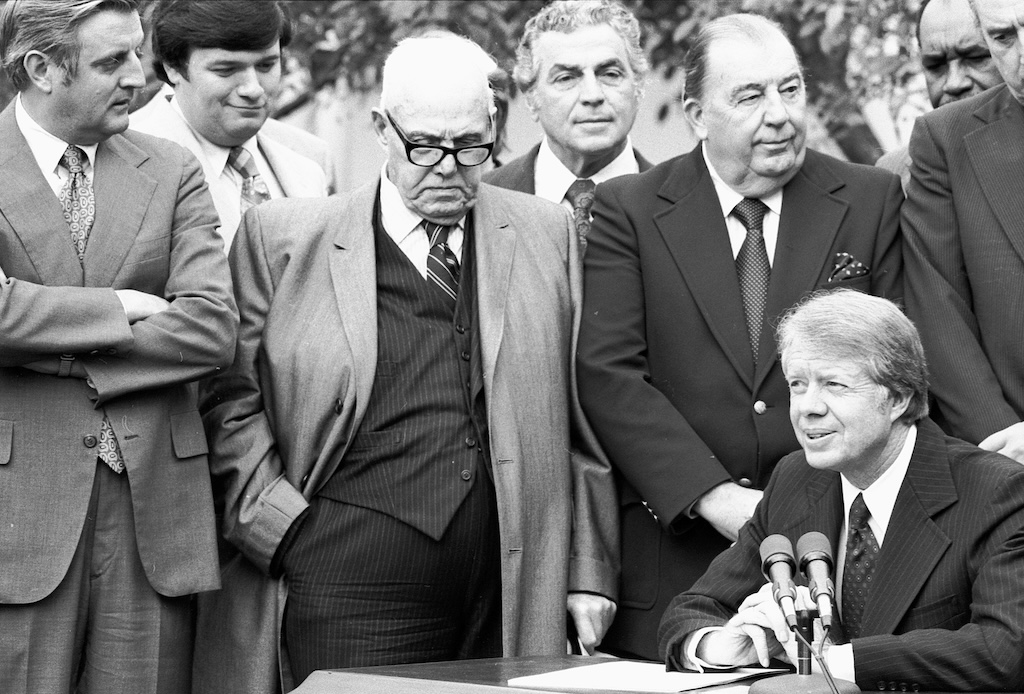
President Jimmy Carter signs the Minimum Wage Bill in Washington, DC, on November 1, 1977. Among those standing behind him (second from the left, in glasses) is George Meany, president of the AFL-CIO. (Diana Walker / Getty Images)

Interview by
Melissa Naschek

While European labor movements established foundations for their welfare states in the late nineteenth century, it was not until the New Deal that the United States began instituting policies like unemployment insurance and old-age pensions. But although working-class struggle was also key to this success, several unique factors in American history proved an impediment to more egalitarian policies.

In this episode of the Jacobin Radio podcast Confronting Capitalism, Vivek Chibber and Melissa Naschek continue their deep dive into the history of social democracy. Together, they look at the impacts of craft unionism, mass immigration, racial tensions, and employer violence in explaining American exceptionalism.

Confronting Capitalism with Vivek Chibber is produced by Catalyst: A Journal of Theory and Strategy and published by Jacobin. You can listen to the full episode here. This transcript has been edited for clarity.


Melissa Naschek

Today, we’re continuing our series on social democracy. In the first episode, we took a broad view to discuss what social democracy is, and in the second episode, we followed up on the circumstances that led to its flourishing in the postwar period, what it accomplished, and the many challenges the movement faced.

We’re going to switch gears a little bit today to look specifically at social democracy in America. I don’t think most people really associate social democracy with American politics. So, to start us off, can you talk about whether America actually had a period of social democracy?

Vivek Chibber

Yeah, it did. Remember when we tried to define the goals of social democracy, we said there was a minimalist and a maximalist agenda. The minimalist agenda was to try to tame capitalism and to give people some necessary goods as a matter of right rather than as a matter of privilege, goods that the market gives them only if they have the money to do so. And so, what social democrats said was “No, as a functioning member of society, you should have as rights not only political freedoms, but also certain economic freedoms and economic guarantees.”

The maximalist agenda, of course, was to use legislative means to try to move beyond capitalism toward socialism. So the minimalist agenda was to tame capitalism and make it less inhumane. The maximalist one was to go beyond it.

Well, where does the United States fall on the spectrum, if at all? It did manage to institutionalize some version of the minimalist agenda starting in the 1930s with what is famously called the New Deal, which Franklin Delano Roosevelt implemented. And this had two components to it. There was a welfare state of some kind, which really hadn’t existed to any serious extent before. And that welfare state meant people got certain nonmarket access to goods and services.

Melissa Naschek

Things like unemployment insurance and government pensions.

Vivek Chibber

Yes, and Social Security. And then over time, what came to be known as Medicare, which is medical care for people over a certain age, was added.

Melissa Naschek

Right, although that didn’t get enacted until the 1960s.

Vivek Chibber

Right. That was a deepening of the New Deal. And the two pillars of American welfare today are still Social Security and Medicare, with Medicaid a more recent entrant, and its expansion under Obamacare to something quite large. These are real aspects of a welfare state.

The second pillar of American social democracy was the legalization of union rights and the institutionalization of unions within the political economy. And during the heyday of American social democracy, which was from the 1930s into the 1970s, unions had a real voice inside the Democratic Party. Not anything to the extent of what you had in their European counterparts, but it was still an institutionalization in which the Democratic Party took the unions very seriously and passed legislation knowing that the unions had to be placated, and that they had to cooperate with them.

Melissa Naschek

When you say that labor rights suddenly had a place in the state, what was the before and what was the after?

Vivek Chibber

Labor rights really became institutionalized in what’s called the Second New Deal. And the hallmark of this was the Wagner Act, named after Senator Robert Wagner of New York and passed in 1935.

What existed before 1935? Well, the Wagner Act made collective bargaining mandatory for American employers in situations where a majority of workers in an establishment voted to join a union. So if a majority of workers said they want to be in a union, the employer was legally obligated to negotiate with them in good faith around what’s called a contract. And that contract would then govern pay scales, work relations, the pace of work, and such things.

What was there before that? There was essentially nothing. Technically, unions were not legal. That doesn’t mean that if you tried to organize a union, you’d be thrown in jail.

Melissa Naschek

Right. Because there’s a long history of the nineteenth- and early-twentieth-century American labor movement.

Vivek Chibber

Exactly. But employers were not required to bargain with their employees if they formed a union. So employers could just sit it out. People could come and say, “We want to form a union,” and employers could say, “Well, I’m firing you. I’ll just bring in new workers,” or “I’m going to lock you out, and I’m going to wait for you guys to give up.” That’s what changed. And with the Wagner Act, you saw an explosion of union membership.

In Roosevelt’s first term, you get both of these things, which are real hallmarks of social democracy. You get a real welfare state, anemic though it is, and you get the institutionalization and the empowerment of unions, weaker though they are than their European counterparts. Once that’s in place — and every scholar of the issue agrees with this — I think the United States had some kind of social democracy.

But it was, however, a much  weaker, more anemic, less developed social democratic enterprise than you had anywhere else in the capitalist world. Whether it’s Europe, Australia, Canada, or New Zealand, the United States was the weakest of all of them.

American Exceptionalism

Melissa Naschek

We’ve talked before about the fact that American social democracy is much weaker in comparison to other Western social democracies. Why is that the case?

Vivek Chibber

There are several factors that explain why the American case is the way it is and why it’s weaker than the European, Australian, and Canadian counterparts. It all largely falls under the rubric of what’s called “American exceptionalism.” American exceptionalism is basically the question of why America is so different from all the other countries.

Well, different how? Typically, the question is, why isn’t there a socialist party in the United States? But it also kind of boils down to some subsidiary questions, all connected to this. Why is the union movement so weak? Why was there never a serious communist party in the United States? Things like that.

So let’s just ask the question in its broadest form, which is, why is American social democracy so much weaker than elsewhere? Two things are really crucial for this. Compared to Europe, the union movement, even at its peak, was much smaller than in most other Western countries. I think the only other country where union density remained as low as in the United States was probably France.

Melissa Naschek

When you say smaller, do you mean numerically or proportionately?

Vivek Chibber

Proportionately. Because Sweden is a tiny country. It has a population smaller than California’s. So in absolute numbers, even if everybody in Sweden were in a union, it would still be quite small compared to, say, the West Coast.

What we’re talking about is the proportion of the labor force that’s in unions. And the concept that’s used to capture that is union density. Union density captures the proportion of your employed labor force in trade unions. Now, in the United States, at its peak, it was around 35 percent. This would be from about 1944 to the mid-1950s.

Melissa Naschek

What was union density like leading into the New Deal?

Vivek Chibber

When the New Deal really takes off, density is actually still quite small. But the point is, it’s growing. In 1932, union density was around 12 percent. That’s small. But by 1945, it’s gone from that number to 35 percent. So it explodes. Now, compared to Europe, though, that’s still quite small. When you look at European countries at the same time, they’re over 50 percent. And they grow. From the 1950s into the 1970s, they kept growing their union density.

Melissa Naschek

Why was the United States so much less dense?

Vivek Chibber

Well, that’s the question. And I’ll address that in a minute.

The second aspect of American social democratic weakness, though, which is the core of the question of American exceptionalism, is that there has never been a mass socialist party in the United States.

Now, in the previous episode, you had said that one of the hallmarks of the New Deal was that there was no labor party in office, whereas when social democracy took off in Europe, there were labor parties in office. And we had said that that’s what made it so much more difficult for American unions to really capitalize on their organized strength, because American unions didn’t have a friend, a partner inside the state who would try to leverage union power to get whatever they could out of government. So the question then becomes, why wasn’t there a socialist party in the United States?

Melissa Naschek

Right, especially when you look at other countries. In France, their labor party was formed in 1880. In Sweden, their labor party was formed in 1889. And in the UK, their labor party was formed in 1900.

When we look at America, there’s no labor party. But there were other developments toward an independent political movement in the late nineteenth century.

Vivek Chibber

Right. The key period here is 1890 to 1910. That’s when this partnership between labor unions and socialist parties blossoms in Europe.

And it didn’t always come from the same direction. In cases like England, the unions formed the Labour Party. But in other countries, it was the labor parties or socialist parties that created union federations. Who initiated it is less important than the fact that, in all these countries, there was a very, very tight partnership between the two entities.

At that same time, you see, this is where the divergence with the United States comes up. There are some attempts for socialist parties and unions to partner up in the United States, but they don’t really come to anything. And so, this is the moment when the divergence between Europe and the United States takes place. And the question is why?

Early Democratization

Melissa Naschek

So maybe we should look a little more at what’s going on in the labor movement at this time, and then move into how that affects their political actions. So what is happening in the American labor movement broadly in the lead-up to the New Deal?

Vivek Chibber

Yeah. The question is, why doesn’t the labor movement either create its own labor party, or why doesn’t a labor or socialist party come to the unions in the way you had in Europe? There are a number of factors that go into this, and it’s a matter of judgment which ones you prioritize.

In my opinion, one of the most convincing points the scholarship makes on the fundamental contrast between how and when labor parties rose in Europe and the United States is the fact that, in the very early nineteenth century, the United States was unusual in that it got very close to full enfranchisement for white men across the class divide.

This is what’s called early democratization in the United States. Women still don’t have the right to vote, and of course the enslaved black people in the South had no question of any right to vote. But it’s quite significant that in the North, white men got the right to vote. And even in the South, if you’re a property-owning white man, you’ll have the right to vote. In Europe, this is just not on the agenda. They don’t get full enfranchisement for a hundred years after that. Now, why should that matter?

The reason that matters is that, in the United States, because white men have the right to vote, political parties, which are all elite-dominated, need their votes. And so parties incorporate and co-opt these working-class white men into political networks, even before the trade unions are ever formed. So, in order to advance their economic interests, much of the white working class now has a political outlet without relying on unions.

In Europe, that’s simply out of the question. There, when the working class really started to develop in large numbers — after 1850 — it found itself completely shut out of the electoral system. It had no voting rights. So in Europe, industrialization came before democracy. In the United States, you had democratization before industrialization.

This had huge implications. As their numbers grow, European workers are confronted with needing both political rights and economic protections. So they struggle for trade union rights and for a political party to fight for them at the same time. Because they don’t have any access to politics, all existing parties are dominated by employers and by landlords. So that means, in order to have political representation and political leverage of any kind in an era where they have no real political rights, they have to create parties of their own.

And because the European ruling class has its own parties, and the middle class has access to them, the parties that workers create are by default workers’ parties. They have to be workers’ parties. And because they have to cater to these workers’ needs, they’re not only staffed with workers, their agenda becomes a working-class agenda. And topmost in that agenda is the right to vote. They are demanding the right to vote.

Workers found that their labor parties were fighting for three things: economic protections, legislation that would protect them and allow them to form unions, and representation within the state.

So when the unions came around in the late 1880s and ’90s, it was natural for them to ally with these parties because the parties were already doing the work of fighting for workers’ rights. There’s a natural alliance between unions and labor parties because both of them are shut out of the system.

Both of them came from the same constituency, and that constituency had two kinds of interests: political and economic. And it finds that a political party is the best way to advance its political interests. No other party will do it. And the unions were the best way to advance their economic interests because, of course, employers wouldn’t do it. That’s what’s going on in Europe at that time.

What happens in the United States is that, because they had democratic rights before they could even have unions, when the working class had economic demands, they had some institutional entrée into the state, even though it’s elite-dominated and comes through bourgeois parties.

So American workers didn’t have that same imperative to create their own party. Instead, they formed networks with existing parties and were patronized by those parties to get something out of it. So, over the nineteenth century, through the 1880s and ’90s, the desire, the imperative, the need to form their own party was tremendously weakened. The motivation isn’t there because they already had some kind of access to political institutions. That’s a fundamental difference between Europe and the United States, and the Americans never recovered from it.

Craft Unionism, Immigration, and the AFL

Melissa Naschek

What was going on in the American labor movement at this time?

Vivek Chibber

On the labor side, there’s also something very different, which is that, between the 1880s and ’90s, the United States was the target of the largest wave of immigration that we’ve seen in the modern era. There was wave upon wave of European immigrants.

Early on, they were all coming from Northern and Western Europe — Germany, Sweden, England, and Ireland — and many of them were Jewish immigrants as well. Later on, at the turn of the century, Southern Europe began sending many people, with Italians playing a very big role.

Why is this important? This is the moment at which industrialization really takes off in the United States. And that should be a moment when workers start to organize, because when industrial employment is rising really fast, workers become a lot more emboldened because it’s easy to get jobs, and you’re less worried about being fired if you’re organizing a union.

Melissa Naschek

Right, the question of how tight the labor market is has always been important in the labor movement.

Vivek Chibber

Exactly. In fact, that moment could have been a propitious one for unions coming together. The problem was that the obstacles to unionization weren’t just legal but also cultural.

It’s just very basic: to have a union, you need to be able to talk to people. In the 1910s, something like three-fourths of American workers in the manufacturing sector were first-generation immigrants, and they were all speaking different languages. They often had cultural hostilities toward each other. This makes it exceedingly difficult for them to organize, especially compared to the Europeans.

That wave upon wave of immigration created obstacles on top of the legal obstacles, the political obstacles, and the fact that there was a lot of violence that employers were using, which made organizing these unions all the more difficult.

Now, layered on top of that, there was another issue: in Europe, by the early 1900s, a new form of unionism was making union growth easier. They switched from what’s called craft unionism to industrial unionism. Craft unionism refers to organizing people on the basis of their particular specialization, the craft that they’re deploying, rather than the fact that they’re wage workers.

Melissa Naschek

Right. So their actual job, their role in the workplace.

Vivek Chibber

Yes. And this meant that the same workplace, with different jobs, would have many different unions, right? So you will have carpenters, machinists, and tailors all in different unions.

Melissa Naschek

Right. And just to be clear, craft unionism still exists today, and many unions are still organized along craft lines.

Vivek Chibber

Yeah. But today, it is more of a minority stream within the union movement. Most unions are called industrial unions. And in industrial unions, you brought together workers of all different occupations and specializations into the same union. So instead of having many different unions in one auto plant, you would have all the auto workers in one union. That’s called industrial unionism.

Melissa Naschek

So, regardless of your role in the workplace, everyone is in the same union because they work at the same location.

Vivek Chibber

An interesting contrast between these two kinds of unionism is that industrial unions are also much, much more interested in political agitation and mass politics.

Melissa Naschek

Why is that?

Vivek Chibber

Because they have a much more offensive strategy. Industrial unions don’t intrinsically have as much leverage as craft unions do. The reason craft unions can be successful is that they have tended to predominate among more highly skilled workers. And because they’re highly skilled workers, they are more scarce. They’re more difficult to replace. So they rely on what’s called an exclusionary strategy: they attempt to limit the people entering the trade or craft so that it’s harder to replace them. The focus, therefore, becomes controlling the labor market, controlling economic institutions, and entry and exit from the labor force.

Melissa Naschek

So, keeping the labor market tight in order to maintain your leverage?

Vivek Chibber

Not just the labor market, but also keeping that segment of the labor market tight. You want to make sure there are only so many electricians and so many machinists, right? That’s why crafts have apprenticeship programs. Apprenticeship programs are a way of controlling entry into a job. The union controls the entry. So the craft union’s focus is on the labor market and economic institutions.

With industrial unions, they don’t even try, because everybody’s a wage laborer. Everybody’s entering the labor market. They’re much more interested, therefore, in legislation to protect workers as a whole, rather than their particular craft.

Melissa Naschek

And what sort of strategies involve protecting workers as a whole?

Vivek Chibber

Industrial unions want protective legislation, for example, on union rights, pensions, and unemployment insurance. Traditionally, craft unions kept the state at a distance, saying, “We are going to be the ones doling out unemployment. We’ll be the ones doling out pensions. We want to control it as unions.”

In Europe at the turn of the twentieth century, the rise of industrial unions made it natural to also form a political party that would fight for your economic and political imperatives within the state. European craft unions were also suspicious of political engagement and of mass politics. But the shift toward industrial unions made the marriage between labor parties and unions a lot easier.

In the United States, craft unionism wasn’t displaced until the 1930s. That meant these unions were much more hostile to mass political organizing, which was carried out through the European socialist parties.

So on top of the ethnic problems of immigration, you had the problem of craft unionism. And the thing is, they reinforced each other. And because these immigrants often brought very specific skills from their European backgrounds, they would then get jobs for one another through their immigrant networks. Those jobs tended to be in the same line of work. And once you’re in the same line, you would enter the same craft union.

So these unions were not only different in terms of their skills and the economic groups they were organizing but also culturally very different from each other. Going back to our example, machinists would all speak one language, carpenters another, and they tended to live in ethnic neighborhoods.

Here’s the interesting thing. The switch to modern capitalist industry threw all these workers together, creating the material basis for a common identity. They then formed industrial unions, which institutionalized that common identity, and created labor parties that fought for that common identity.

In the United States, that progression was stalled. The Americans didn’t go from craft unionism to industrial unionism until much later. The issues of craft unionism were overlaid by these ethnic and linguistic differences, which were so much greater and deeper than anything you had in Europe. And on top of that, there’s the problem of indigenous racism.

So, in sum, by the 1910s in Europe, workers were coming together to fight for their political rights through parties. And those parties partnered up with unions. That partnership was made easier by the fact that European workers were switching to industrial unionism. Mind you, that switch was oftentimes initiated by socialist parties, because these parties were ideologically committed to a vision of unionism that was an industrial union vision. They reinforced each other.

In the United States, in contrast, craft unionism endured for a long time. Workers were sucked into elite parties and didn’t have the same motivation to form their own parties. What’s the result? The parties fought along ethnic, linguistic, and religious lines, and not along economic lines. The parties said to them, “Okay, you’re coming in as Irish workers or Catholic workers, and you live in these segmented neighborhoods, so we’re going to mobilize you along these identities rather than a class identity.”

This meant the United States had a working class split along ethnic and linguistic lines, and a union movement that catered to very narrow craft interests rather than class-wide ones. So by the 1910s, you’ve got two very different cultures of class politics on the two continents. And underneath everything is the fact that in the United States, democratization came before industrialization, whereas in Europe, industrialization occurred first and democratization later, once the working class started fighting for it.

Melissa Naschek

You mentioned that the 1930s were when the American labor movement started to really embrace industrial unionism. I think we should take a step back and look at the institutions of the American labor movement that perpetuated the craft union strategy before the industrial union strategy took over. Can you talk about the institutions of the American labor movement before the 1930s?

Vivek Chibber

From the late nineteenth century into the 1930s, the main union federation in the United States was called the American Federation of Labor (AFL). And this was a craft union federation. It was basically a collection of unions organizing workers along particular craft lines.

The AFL was famously led by Samuel Gompers. And Gompers himself was America-First, ethnocentric, and very racist. He embodied a lot of these components of craft unionism that I’d mentioned, which reinforced ethnic and cultural divisions within the working class because they overlapped with skills.

The AFL had two noteworthy components. One was that it was this very elitist, exclusive craft unionism. But the other was that it was pretty suspicious of, and you could say hostile to, politics, to actually trying to engage the state — trying to have political campaigns, trying to get candidates into office who were friendly to it. The AFL dabbled with this early on, but it never really took the project on in any serious way, which further distanced the labor movement from forming a political party the way its European counterparts did.

Now, the AFL in its own way could be quite militant at times. It fought very hard for workers’ rights and for craft unionists, but it remained small because, of course, it never tried to organize the unskilled or the unemployed, who were always a majority of the working class and were in fact quite hostile to them. That meant that as new waves of immigrants arrived, as long as they were not sucked into prized, highly skilled craft positions, not only did the AFL not organize them, but the immigrant workers were also pretty hostile to these unions because they saw them as elitist and exclusionary. This created a horizontal split within the working class as well.

Melissa Naschek

It’s very strange to think of a movement of workers as having an elitist outlook, given their position in the economy.

Vivek Chibber

It has to do with the way in which the modern working class was created. The very earliest urban working class was created by bringing various artisans into warehouses and putting them to work together —simply working side by side, each doing their own labor, but under one roof. This was before mass depeasantization, in which peasants streamed into cities. We’re talking about the early 1800s, the 1790s through the 1820s.

These were craftsmen who were being brought into new economic locations, and they didn’t see themselves as workers per se. They saw themselves as craftsmen. They had a disdain for the unwashed masses, for the toilers, for the unemployed, for the people who were looking for jobs out in the streets. They saw themselves as a labor aristocracy. The unions organized around that identity and ideology were imbued with this sort of elitism, which was only broken down in the late nineteenth century, when crafts were essentially broken down.

The late nineteenth century is a moment when de-skilling actually occurs, when the exclusivity of these skills is broken down as modern mechanization takes over industries. And as this mechanization proceeds, instead of highly skilled workers deploying their tools in a very careful way, what happens is machines start deploying workers. The workers become appendages to machines. And that is the moment at which you get the material basis for a new workers identity and a new kind of unionism as well.

Melissa Naschek

Right. And what you’re talking about is what Karl Marx talks about in Capital, in which, in order to increase efficiency, production is organized by increasing cooperation, getting workers together, getting them to make the same product at a similar quality. And then, when that’s no longer enough to keep raising profits, technological developments are introduced, which de-skill or proletarianize workers, as Marx would say. And the story goes on.

Vivek Chibber

That’s exactly right. And these early decades, when they’re being brought together, they’re being brought together as craftsmen. And in the nineteenth century, worker struggles in Europe often involved craftsmen trying to hold onto their jobs as they were displaced by machines.

Melissa Naschek

Right. Sound familiar?

Vivek Chibber

Well, they had real skills. They actually knew how to make something. This is a topic for another day, but this is where many conceptions of socialism come from, in which workers have control — workers’ control — and overcome their alienation from the product, becoming one with the product again. It’s a kind of romantic notion that comes from an era when workers were trying to recapture the autonomy and connection to the products they had when they controlled everything.

Racial and Ethnic Working-Class Divisions

Melissa Naschek

We’ve said a lot about the particular aspects of the American labor movement and their impact on politics, but there are other very salient divisions. You talked a little bit about ethnic divisions, but there are also significant geographic divisions, particularly between the North and South, and, of course, racial divisions. How did racial divisions play into all this?

Vivek Chibber

I brought up ethnicity first because the parts of the country that could be unionized and were unionized were all in the North. The South remained a primarily agrarian economy well into the 1940s and ’50s. And it had two distinguishing characteristics.

One is that there wasn’t a lot of industry there to organize. It’s not that there wasn’t any; the American South had mining and textiles. But compared to the North, it was far less organized. And the second thing is that in the North, where there was the possibility of organizing, the black population was very, very small. It was 2 percent or less in most of these industrial cities. So the main obstacle to working-class formation could not have been race between the 1890s and 1910s.

Melissa Naschek

This was before the Great Migration.

Vivek Chibber

Exactly. So, in this period, the impediment was ethnicity. And so we should look at race and ethnicity as working together with different weightage at different moments.

In the late nineteenth century, I think ethnicity in the North mattered more than race did. In the South, of course, race is everything. And that matters if you’re looking at the mining industry or textiles. And there, of course, the division between white and black workers is just overwhelming. So when you put those together, they both functioned in ways that made the growth of trade unionism much more difficult in the United States than in Europe. And that plays into this American exceptionalism.

So the irony is, where race didn’t matter, ethnicity stepped in. Where ethnicity wasn’t an issue, race stepped in. But the labor movement was really held back by one or both of these in a way that the Europeans just weren’t.

The Knights of Labor and Employer Violence

Melissa Naschek

We established that craft unionism was dominant at this time. But were there any efforts toward industrial unionism?

Vivek Chibber

Yeah. This is where counterfactuals become really interesting. There was an organization in the latter half of the nineteenth century called the Knights of Labor, and they were committed to industrial unionism — and, I should say, multiracial unionism. They had it in their constitution that they would not make distinctions between black and white workers. They believed in workers of all ethnicities coming together. And they had a lot of success in the Northeast, including New Jersey, Pennsylvania, and other parts of the eastern seaboard.

This is where the peculiarities of American history add some contingency. There could have been a world in which they grew, and they linked up with a socialist party the way you had in Europe. And in fact, there was something called the Socialist Party in the United States, famously led by Eugene Debs. And Debs was very hostile to the AFL and very friendly to some kind of industrial unionism.

The world in which that partnership grew never came about. And it mostly has to do with the incredible violence that was unleashed on the Knights of Labor in the various cities where they were growing.

Melissa Naschek

Did that violence come from employers or from the state?

Vivek Chibber

Both. And this is a peculiarity and a puzzle. I have to say right here, I haven’t seen a good answer to this question. Let me lay out the question and I’ll give you a hypothesis of some kind.

The question is, why is there so much more violence toward unions in the United States than in Europe? It’s a peculiarity.

Most labor historians, I think, acknowledge that the United States, even though it never had a big union movement, nevertheless had an incredible wave of employer violence. You would think that since there wasn’t much of a union movement, elites wouldn’t be as panicked. And, on the other hand, in Europe, when there is a big labor movement developing, why isn’t there more violence? Why weren’t employers even more freaked out in Europe?

Melissa Naschek

And it’s interesting how long the violence toward the American labor movement lasted.

Vivek Chibber

Absolutely. It lasted well into the 1930s.

Melissa Naschek

Yeah. During the New Deal, even as the state formally recognized the right of unions to organize, there were horrible, deadly clashes between the state, employers, and union organizers.

Vivek Chibber

In mining towns, they unleashed state militias. In West Virginia, they bombed the mines.

Melissa Naschek

Yeah, they often brought in the National Guard. It’s crazy. I read this story about how they were bringing cannons into the street.

Vivek Chibber

I think it has a lot to do with the very, very decentralized character of the American state. It’s a lot easier for employers to buy up and wield control over government when local government has all the power over police, over labor legislation, and over the way in which employment relations are governed. But that’s just a guess.

The fact of the matter is, there was a lot of violence. And it’s not just that capitalists had control over the mayor, had control over city hall, had control over the cops. They also had their own private militias.

Remember the Pinkertons, who are often portrayed as private detectives. The Pinkertons were a mercenary mob. They were essentially guns for hire to be used against striking workers, and they would just come in and slaughter workers.

So the Knights of Labor were subjected to this in a way that the AFL just wasn’t, and they never recovered.

Now, in the 1910s and ’20s, you could have had a socialist party in a prime position. But ironically, after 1910, the Socialist Party also went into terminal decline. Partly it was because of its opposition to World War I. And while it was heroic in many ways, that opposition set them up as anti-American in the public image and they never came back from that.

And by the 1920s, they became a very sectarian party. And while they had some success in local government — Victor Berger in Milwaukee, George Lunn in Schenectady, socialists in Reading, Pennsylvania — the national party was often indifferent or hostile to these efforts because it saw them as insufficiently revolutionary.

American Socialism, Communism, and the CIO

Melissa Naschek

Can you discuss the roles of both the socialist and communist movements in American politics at this time?

I think it’s important to underscore here, in current politics, if you call yourself a socialist as opposed to a communist, it’s often just a way of signaling how radical you are. But in this time period, to call yourself a socialist or a communist had very heavy political implications about what parties you were affiliated with and what you were advocating for.

Vivek Chibber

At a very high level of generality, the Socialist Party can be characterized as ideologically very committed but fairly sectarian, and as having much weaker connections to the American labor movement than socialist parties in Europe had to their labor movements. And these characteristics tend to be mutually reinforcing.

Labor movements have a way of disciplining political parties and calming them down because unions are very practical institutions. They are charged with governing and overseeing the lives of millions of workers. They can’t engage in empty sloganeering and ultraleftism the way a party that’s a collection of small intellectuals might be able to do.

And very early on, in the nineteenth and early twentieth centuries, you saw European socialists and party members remarking that the Socialist Party in the United States was kind of strange. It was very shrill, very sectarian, very absolutist, very puritanical. And it’s true, they were.

One reason they were was that that nascent partnership with the Knights of Labor was destroyed early on, and they never were able to reinitiate contact with any other mass labor movements. There was the AFL, but Gompers hated them, and Eugene Debs hated Gompers. It was mutual. But the key thing is that the Socialist Party was hostile to them.

Melissa Naschek

I think your comments about how labor movements approach politics differently are important. And while I wish that the Left today were a bit more grounded in reality and in the labor movement, on the flip side, I think it’s important for the labor movement to have a relationship with socialists because socialists bring a different perspective to class war, which is essentially what unions are engaged in.

Vivek Chibber

That’s exactly right. A union without a political perspective can just kind of put its head down and do what its essential function is, which is to negotiate for a better price — the price being the price of wage labor. And that’s easy to do.

If you want to have a more ambitious class-wide strategy of taking on employers, that takes ideological commitment because it involves a much more ambitious agenda and much greater sacrifices, for which you need to be committed ideologically in order to come up with what that strategy will be, and how you’ll get members to commit to it.

So, as I said, the Socialist Party became much more sectarian and distant from the labor movement. But in the 1930s, membership in the Communist Party USA grew enormously. The Communist Party began growing in the late 1920s but really took off during what’s called the Popular Front era. And importantly, this was the moment at which communists, socialists — the Marxian left broadly — actually became embedded in the labor movement. It occurred primarily through the newly formed Congress of Industrial Organizations (CIO), which is an industrial union federation unlike the AFL, which was composed of craft unions.

It’s through the CIO that you get the Communist Party embedding itself in the working class. And it’s huge. It could have really had a very, very direct impact. But here again, because of its connection to the Communist International (or Comintern) and the Soviet Union, it entered a predicament after 1941, when the Soviet Union entered the war, where everything became subordinated to defending the Soviet Union and keeping employers happy so they would keep the war effort going. And during that wartime period, employers unleashed a wave of very demanding conditions on workers. And the Communist Party was torn because of this.

Melissa Naschek

So when this deeper connection between the Left and the labor movement was established, why wasn’t it leveraged to create an independent political party?

Vivek Chibber

There was talk about it. And, interestingly, within both the Socialist Party and the Communist Party, there was some talk that maybe this was the time to strike out and form a party of our own. Because, of course, in the United States, there were two bourgeois parties and no labor party. And they were in a moment when it looked like the working class was up, mobilizing, and organizing. And this seemed like the moment to establish a proper labor party. The communists and socialists would have had some grounds for saying, “We need another party, and we’ll transplant or push aside one of these parties.”

Melissa Naschek

Right, that would have mirrored the exclusion that you talked about in Europe.

Vivek Chibber

Exactly. The problem was that the Democratic Party, at this very moment, seemed to be fighting for workers.

Melissa Naschek

Say more about why that was a problem.

Vivek Chibber

It was a problem because Roosevelt actually ended up being very friendly to unions and willing to take on the employers. So you see this debate occurring within the Socialist Party and the Communist Party. The Communist Party basically says, “We cannot at this moment go up against Roosevelt because we will lose.”

Norman Thomas, the leader of the Socialist Party, actually says, “No, I think we should run against Roosevelt.” And he does so in 1932 and 1936, and gets clobbered each time. And after each one of his presidential campaigns, the Socialist Party membership hemorrhages. Not only did party membership hemorrhage, but the leaders of unions with links to it opposed Thomas and the Socialist Party’s strategy and eventually left the party.

So the problem was kind of an incarnation of the early democratization problem you had in the nineteenth century. Early democratization meant that workers had other avenues for advancing their interests. What happens now is that the Democratic Party suddenly opens itself up to unions and to the Left. And the Left was faced with a choice: Do we urge workers to reject the very party that seems to be fighting for them and form a new party? Or do we enter that party and try to take advantage of whatever we can get inside it?

Those people who were in favor of urging workers to form a new party actually tried it, and they got clobbered; they lost.

The Barren Marriage

Melissa Naschek

We’ve established some of the historic reasons why American social democracy is so much weaker than European social democracy. But now we’re talking about how one of the parties, the Democratic Party, actually embraced an alliance with workers. Why did they do that, and what did that concretely look like?

Vivek Chibber

They did it for two reasons. One is that, in the parts of the country where the workers were really being mobilized, which were the eastern seaboard and the Midwest, they didn’t have much of a choice. The union movement was growing so fast and so strong that Democratic political leaders had to give them something, or they would be displaced. That’s why they did it.

Now the question is, to what extent did they do it? It was very limited. And the reason for that is, remember I’d said, you really have two economies inside one nation state. There’s the South and there’s the North.

In the North, you get some kind of opening, and it happens through historical accident. Roosevelt happened to be somebody who learned, who grew with this. And I really think that if you had looked at him in, say, 1928, you would have never guessed that this guy would end up being a beacon for American welfare state advancement.

Melissa Naschek

Yeah, even his 1932 campaign was not that aggressive.

Vivek Chibber

That’s right. It was not. It is just true that he learned. He grew, and he was open to it. And because he had that class confidence that comes from being a blue blood, he hated the fact that these capitalists and these bankers would stand up to him because he was like, “Who are you to stand in my way?”

Melissa Naschek

Well, I think the other thing is that Roosevelt wanted a strategy for handling the Great Depression that would have the state play an active role in fixing the economy. And every time he tried to implement something that was in some way telling capitalists what to do, they pushed back.

Vivek Chibber

Well, every time it entailed giving something to workers. It’s important to remember that the National Industrial Recovery Act (NIRA), the first response to the Great Depression, was a regulatory response, and capitalists are perfectly happy with more regulations as long as they can control the regulations. It’s when Roosevelt shifted to the left that they really started taking those regulations on.

That’s a positive element. Then there’s the fact that half the party, the real stronghold of the party, was located in the South, and Southern Democrats were uniformly reactionary. They hated the labor movement. They hated the communists, they hated the Left, and Roosevelt could not get around them. This is another reason why the welfare state remains weak.

So there are two basic reasons why American social democracy remained weak during the New Deal period. One is that there was no labor party as a vehicle for the working class to maximize its economic leverage. Instead, workers had to rely on a bourgeois party. That’s the Democrats. That party happened to be somewhat open at the time because of Roosevelt, but it’s still a bourgeois party.

And then, in that party, there was a fundamentally reactionary element. It’s like the Junkers inside Prussia in the early twentieth century. It’s these Southern planters and the representatives of those planters, and they are basically outright antidemocratic. I don’t want to call them fascists, but they’re antidemocratic oligarchs. They opposed the New Deal, and they held senior positions within the party that allowed them to block much of the legislation.

So when you put these two things together, this is why not having a labor party in the United States really hurts. Not only are the Democrats a bourgeois party, they are a bourgeois party with a significant chunk that is not just bourgeois, but antidemocratic, agrarian, oligarchic, and which has a fundamental interest in pushing back all the New Deal legislation.

So workers were having to fight not twice as hard, but three times as hard. They had to fight to drag a bourgeois party toward welfare state legislation. And within that party were people who didn’t want to see any kind of union legislation at all, which were the Southern Democrats. And this ended up holding back whatever leverage they might have had.

Now, how much leverage might they have had? Well, there’s the fact that even at their peak, American labor never came anywhere near what the European labor movements were able to get to in terms of union density and in terms of real presence within the economy.

So you have a working-class movement that’s structurally weaker and smaller than in Europe, in a political system where they don’t have a party of their own, and where the party that is friendly to them has one wing that is not just hostile but would like to destroy that labor movement. When you think about it that way, it’s pretty impressive that they were able to get anything at all.

Melissa Naschek

So what are the long-term implications of all of this?

Vivek Chibber

First of all, the United States did acquire a welfare state, and it was a huge leap forward for the ordinary lives of American workers of all races, ethnicities, and genders. But even though it was a huge leap forward, it remained both weaker than the Europeans and on precarious footing because, ultimately, all social democracies rest on the organized power of labor. And as labor gets weaker — everywhere you’ve seen this happen — as labor gets weaker, the welfare state shrinks.

So even at its peak, the American welfare state rested on a precarious footing. But the influence of the South was the real kicker because, after 1945, you see European social democracies growing. I said in a previous episode that because European capitalists were flat on their back and because the Left had its prestige and its organizational level enhanced, social democracy was successfully pushed forward.

In the United States, the end of the war marks the point at which you see a retreat in the labor movement. The Taft-Hartley Act was passed in 1947, which undid a lot of the benefits the Wagner Act had provided. But on top of that, the union movement starts to shrink within a decade. It doesn’t grow, it shrinks. Why? It’s because the South was never organized.

And because the South was never organized by the unions, it was a union-free zone. And as early as the 1950s, you see capitalists from the Midwest and the eastern seaboard start to migrate to the South to get out of these union shops. And because of that, a weak union movement became weaker and weaker as they started hemorrhaging jobs that went to the South in these union-free zones.

Melissa Naschek

When you say the US labor movement didn’t organize the South, was it because they didn’t try, or because conditions were so hostile there?

Vivek Chibber

It was definitely both. Now, conditions are hostile everywhere all the time, but there’s a difference in the gradient of hostility depending on the kind of industry you’re dealing with and the kind of profit horizons that they have.

In the South, most industries were very labor-intensive. That means the wage bill is very high as a proportion of the total cost structure. And they were also not on the cutting edge of global technology. They were somewhat technologically backward. This meant their profit margins were quite low. So for them, a fight over unionization would be a fight to the death. Contrast this with the North, where by the 1930s, the economy was made up of the most productive firms in the world, quite large, very capital-intensive. And even though they hated unions, at the end of the day, they could live with them. Among Southern capitalists, they had the view that if their shops were unionized, they’re just going to go under. And for many of those firms in the textile and mining industries, that would have been true.

Now that said, it doesn’t mean that you couldn’t have organized them. It just meant more resources. George Meany, who was the head of the AFL-CIO, came out and basically said, “I’m not going to organize the South.” It’s true he put some effort into it, but you could view effort in two ways: It’s a token effort where they’re doing it for the sake of doing it, or they’re doing it in a way that they’ll actually win. And the way you make that judgment is, given that employer hostility would have been so much greater, given that workers’ racism was so much greater, you know that you’re going to have to pour a lot of resources into it. They poured some, but I think they knew that it wouldn’t be enough.

The way I would put the situation is this: The landscape was much more hostile, and had the labor movement had the commitment, it would have had to pour huge resources into doing so. But by not putting those resources into it, they signed their own death warrant. And I think they knew that.

And one reason that they didn’t do it was that by 1945, you’ve already seen a retreat of the Left within the CIO. And Meany represented the more conservative forces within it. Had the communists and more radical elements been able to wield sufficient influence in the CIO, they would have, in my view, committed those resources because everybody knew what was at stake. When Meany said, “I’m not going to organize the South,” he was issuing a prayer: “Maybe things will work out for us.”

Melissa Naschek

Right. And when you look at statements from communists at that time, so many of them emphasized how important it was to organize black workers, that this was a huge division in the American workforce that was being used against the labor movement.

Vivek Chibber

Yeah. And we often think that McCarthyism was the moment when the Left is pushed out of the labor movement. But in fact, in the late 1930s and through the 1940s, the right wing of the labor movement was already allying with the Roosevelt and Harry Truman administrations to push back the communists and the radical elements in the CIO. And those were the most committed anti-racist elements, and also the ones who would have put all the effort into going into the South.

So, not organizing the South was a result of a political battle within the unions. And it essentially gave the employer class a gift in these union-free zones. The long-term implication, therefore, was that Americans got a social democracy, but its foundations were not only weak to begin with but grew weaker and weaker.

And the two parties, which are bourgeois parties, were so much more easily captured by capital than in Europe, because one of them was never friendly to labor — which is the Republicans — and the other one, the Democrats, which was friendly to labor for some time, became friendly in a very grudging fashion. And by the mid- to late 1970s, as union density declined, as unions became more conservative, the Democratic Party was ripe to move to the right much faster and with much more consistency than the Europeans did.

So the United States was late coming to social democracy, and it was early exiting from social democracy into neoliberalism.