Southern Italy Is Still Not Italy
Cyclone Harry devastated infrastructure and caused billions of euros of damage across Southern Italy. Drawing scant media coverage and an inert official response, the disaster showed the depth of Italy’s divide, with events in the South all but ignored.
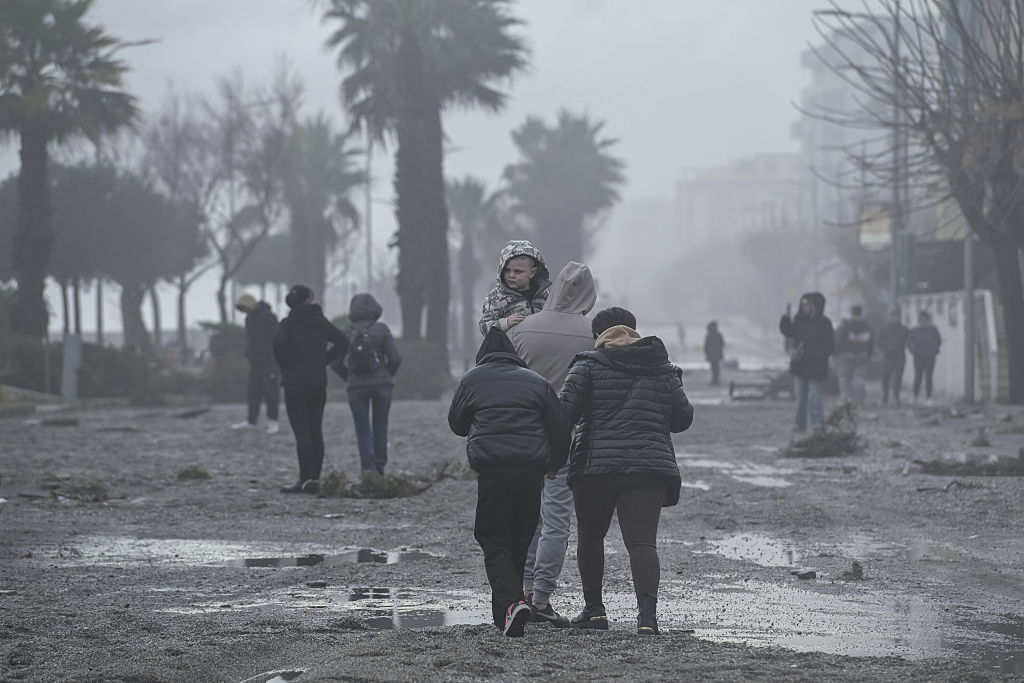
A family seen on the waterfront after the Storm Harry reaches Catanzaro Lido with waves exceeding 5 meters in Catanzaro, Italy, on January 21, 2026. The storm caused severe flooding of houses and local shops. (Valeria Ferraro / Anadolu via Getty Images)
From January 19 to 21, Cyclone Harry moved from the central Mediterranean toward Italy’s coasts, striking southern Italy and Sicily in particular — and devastating infrastructure and roads for hundreds of kilometers. Large sections of the eastern Sicilian coastal road network and the railway system have been fractured at multiple points. Two weeks after the cyclone, estimates of losses still vary, but they now consistently point to figures exceeding billions of euros. The destruction of roads, structures, and water and electricity networks have been concentrated along the seafront, the zone on which the greater part of Southern local economies depend. The consequences are not just material but systemic. In already economically fragile territories, such a concentration of damage raises fears of a prolonged period of economic decline.
Beyond the sheer scale of the damage, another less material but no less unsettling element emerged in the aftermath of the cyclone.
The production and circulation of information about what happened in southern Italy came almost exclusively from people on the ground, local media outlets, and municipal administrators. For many long hours, soon turning into days, the major national print and broadcast media ignored the event. Despite the magnitude of the disaster, national outlets remained silent, to the astonishment of local populations. Only the mobilization of local communities succeeded in briefly, albeit marginally, redirecting media attention toward the unfolding crisis.
Thus, beyond its physical destruction, the cyclone exposed a long-standing Italian problem, updated to its 2020s version: the divide between the South and the rest of the country. Today this divide no longer operates solely through material economic inequalities but also through unequal access to the circuits of attention that structure public visibility. Southern Italy occupies a disadvantaged position within national networks of information circulation spanning social media, television news, and written journalism. Within this ecosystem, it emerges not as a peripheral part of Italy, but as a space external to it altogether.
Because politics increasingly chases visibility and attention, such exclusion from dominant information flows produces a democratic imbalance: some territories are simply less able to enter public debate and thus less able to force political and institutional actors to respond.
Fleeting Mentions
The bipartisan absence of interest made clear that the South continues to be regarded as an internal “other,” a space where events do not fully enter the nation’s self-narrative. This estrangement of the South became unmistakable in the days following the cyclone. Scrolling through the websites of Italy’s leading news outlets, many Sicilians hoped to find explanations and updates about the unfolding disaster, only to discover that news of the cyclone and its devastation had been displaced by crime reports, sports coverage, and even details around the funeral of fashion designer Valentino Garavani.
On the evening of January 24, once the cyclone had finally passed, people in the three regions most affected, Calabria, Sardinia, and Sicily — home to roughly 14 percent of Italy’s population — did what people always do after such a disaster: they sat down in front of the television, waiting to see their predicament conveyed to the country. What they found instead were only fleeting mentions. The first three national evening newscasts devoted just 173 seconds, 157 seconds, and 167 seconds, respectively, to the damage caused by the cyclone.
The substantial media silence brutally revealed a cleavage separating Italy not only as an economic space but, more dangerously, as a social community. For any community to exist, its members must be aware of one another’s existence and conditions. This awareness is not spontaneous: it depends on the circulation of information across space. When information does not circulate evenly, parts of the country effectively fall outside the shared national horizon. In Italy, long-standing attitudes that portray the South as somehow “less Italian” shape this circulation. As these attitudes enter and inform the media system, they have a self-reinforcing effect.
That the South is penalized by this situation is obvious. What many may fail to grasp is how deeply this worldview penalizes Italy as a whole. Cyclone Harry was a disaster that caused billions of euros in damage to infrastructure that belongs to all Italians, and which will ultimately have to be paid for by everyone. The fact that this news went largely unreported is humiliating for those living through the hardship. But it also symbolizes a broader and persistent information deficit affecting Italians in general, who are deprived of accurate and consistent reporting on a significant part of their own national territory.
In the postwar decades, the so-called Southern Question, in its many forms, was a central axis of Italian political life — sometimes fragmented, sometimes instrumentalized, often unresolved, but impossible to ignore. A rich and hard-fought debate gradually converged on the idea that anti-Southern discrimination and the structural underdevelopment of Southern regions constituted a major obstacle to building a stronger and more cohesive Italy.
Over the past three decades, the Southern Question has faded from view, gradually disappearing from the political horizon. This gave rise to the illusion that it had been resolved, if not on the economic plane, at least in its most explicitly discriminatory dimensions. Cyclone Harry has now swept that illusion away.