Minneapolis City Councilor Robin Wonsley on Fighting ICE
Democratic socialist and Minneapolis City Council member Robin Wonsley was reelected and elevated to minority leader just days before ICE escalated its raids. We spoke to her about fighting immigration repression alongside city residents.
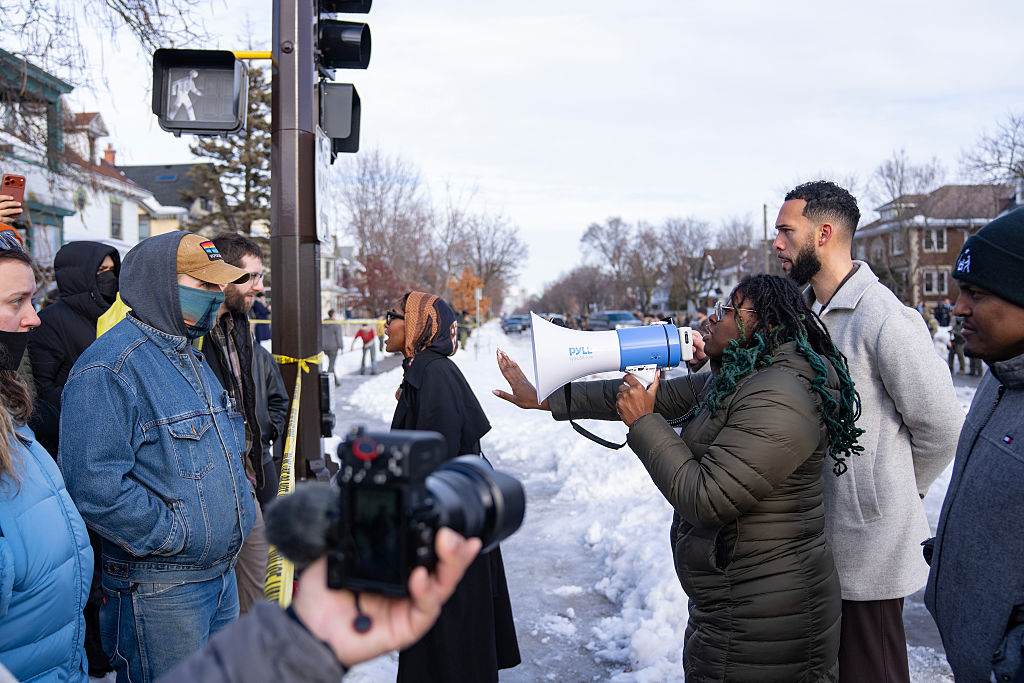
Minneapolis City Council member Robin Wonsley speaks to a crowd of bystanders near the scene where federal agents shot and killed Renée Good earlier on Portland Ave. in Minneapolis, on Wednesday, January 7, 2026. (Alex Kormann / The Minnesota Star Tribune via Getty Images)
- Interview by
- Trey Cook
Robin Wonsley is the Minneapolis City Council member for Ward Two, the council’s minority leader, and leader of Minneapolis’s Democratic Socialist Caucus. Her reelection made her the first city council leader to represent a bloc of democratic socialists in the city’s history, just days before the full onset of the Trump administration’s occupation.
Jacobin recently talked with Wonsley about the ICE deployments in Minneapolis and how cities can help protect community members from ongoing federal brutality and overreach.
How do you understand the relationship between Project 2025 and immigration enforcement?
MAGA has always made it very clear what it intended to do under Project 2025. And MAGA leaders have bombarded the general populace with several issues to try to drive wedges and divide working-class people from having solidarity with each other. All to create these deflection points from looking at how they’re moving massive amounts of wealth out of the pockets of working-class people into the hands of some of the wealthiest people in our society. We’re talking about corporate entities, CEOs, shareholders — consolidating wealth among the wealthiest. And we saw that happen under the Big Beautiful Bill.
You won’t have access to key public benefits like SNAP [Supplemental Nutrition Assistance Program] or be able to access assistance to cover your bill. Or if you live in the South and you’re experiencing a natural disaster, which has become common there because of climate change, you won’t get access to aid that would support recovery efforts, because those initiatives have been defunded under the Trump administration.
But to keep you from being angry about that, MAGA messaging encourages you to think your immigrant neighbor or your trans coworker is the problem. They’re the reasons why you don’t have a job; they’re the reasons why your communities are less safe — not austerity that’s been orchestrated by all levels of government under both the Democratic establishment and also under the Republican establishment. No, no, no — it’s your immigrant neighbors who are the problem.
And to really test this out, they honed in on Minneapolis. They started, under the guise of stopping fraud, of going after government waste and corruption. As if Trump is not one of the most corrupt and felon-decorated presidents in our history. But they went in under the guise of tackling fraud. And that immediately expedited and culminated in an immigration operation that targeted Somali residents here. And then we’ve seen it escalate to picking up two-year-olds, five-year-olds — and also leading to the killings of US citizens, [including] white US citizens and nurses.
They have used immigration enforcement as a catch-all for circumventing state sovereignty — to create buffer points from the federal government but also to trample over basic rights. We’re seeing people’s constitutional rights and human rights being completely ignored. Especially with the shooting and killing of, most recently, Alex Pretti, where they’re saying somehow a man filming them while doing legal observation warrants being shot multiple times and ultimately killed.
So we’re seeing the testing of these practices and tactics in an urban setting. I think it’s important to highlight that federal immigration authorities have been doing this across borders, all around the United States, for decades. They use the same tactics that they used on Renée Good and Alex Pretti at the border in Texas, on immigrant neighbors there. But the murder of Pretti and Good in Minneapolis has really shown how egregious and violent and racist these federal practices are.
The goal for Trump is to normalize what’s happening here and then carry that on to the next city and to then further expand the horrors they’ve carried out — and then to the next city after that. So we understand that there’s a goal. I think what they didn’t anticipate was that Minneapolis would be the catalyst for shifting public opinion around immigration enforcement because of the diligent and militant organizing around resistance happening here.
They’re killing people who are simply going around with whistles and phones, protecting their neighbors. They didn’t anticipate that their actions would lead to one of the largest general strikes in recent history. And they didn’t anticipate actually losing out on public or popular support because of what they’re doing in Minneapolis. That’s why we’re now seeing shifts where they’ve had to remove certain head figures, like Greg Bovino, and bring in a more “palatable” fascist leader from Border Patrol to try to calm things down.
We’re seeing growing support for the abolition of ICE across the country as a result of its actions in the occupation. And we’re seeing fractures among their base — among the Proud Boys and other factions that are part of the MAGA universe. After seeing Alex Pretti murdered, they were like, “What are we doing here?”
So I’m very proud and also sad. I’m proud that we’ve been able to rise to the occasion and hopefully provide a playbook to other cities that’ve already been wrestling with this — or that soon will be — showing how they can resist and grow national and international solidarity around a larger resistance to fascism in general.
Dem Failures
Compare and contrast the siege in Minneapolis to similar operations in LA and Chicago. Was it the bald-faced murder of a white woman that created the conditions for a more militant uprising in Minneapolis?
I’ve talked to elected leaders in cities that were earlier targets of the Trump administration’s immigration operations, Los Angeles, and Chicago, my home city. That’s why it feels urgent to study what they’ve been able to get away with here and how far they’ve been able to push things.
In those cities, local leaders came out early and drew clear lines: if ICE did X, they would respond with Y. They deployed initiatives meant to protect residents. They made it unmistakable that you would not come into their communities and separate families, violate constitutional rights, and carry out these operations without consequences. That created a kind of container where the Trump administration realized it could still do awful things but not at the scale or with the impact it wanted.
Here it didn’t face that kind of resistance from elected leaders — from our governor or our mayor — in any meaningful, concrete way. That lack of action gave them room to accelerate the aggressiveness of their immigration operation under Operation Metro Surge.
We saw an early test on June 3, when there was a massive operation, an immigration raid, in one of our largest immigrant communities. That community is still being heavily targeted. People mobilized quickly because we have strong grassroots organizing here. But in response, local media and local leaders demonized residents for showing up and calling it what it was: an immigration operation. We had council members on the scene saying, “I’m taking a picture — this is an ICE agent,” and we had elected leaders insisting, “No, this wasn’t an immigration action. Everything is fine.” The mayor originally claimed it wasn’t immigration enforcement, and that police weren’t escorting anything, just doing “crowd control.”
That inaction, and the lack of political will to say, “No, this is what it is,” amounted to complicity. It helped create the conditions we’re in now. They looked at Democratic leaders with weak spines, leaders who won’t actually confront the administration, and decided: this is a great playground for us.

I’ve seen some posts from conservatives saying this siege is brilliant because it could “ruin Antifa’s supply lines. They can’t move around in the snow and get all their supplies and equipment out.” But it’s just regular people. It’s not a hostile, organized army.
It feels like what they’re really fighting for is a way of life in Minneapolis that treats people with respect and dignity. A way that is butting heads with the new order the Right is trying to establish.
What are you seeing from elected leaders? How do you feel about them enabling, suppressing, controlling, or quelling the popular movement against ICE?
There was a demand for Gov. Tim Walz to call a state of emergency and an eviction moratorium so that people could shelter in place.
Our president is a domestic terrorist who is actually not interested in negotiating in good faith. He smells weakness. He feels emboldened by his perception that he got Walz to drop out of his gubernatorial race after pushing fraudulent charges for several months and building a public narrative around that. He smelled blood in the water and said, “Let me go for the full KO.”
Since then, we’ve seen Walz waffle on actually protecting residents while we’re experiencing this occupation. And that does not just mean deploying the National Guard. There are a number of tools he could be using — tools we saw him use in 2020 during the COVID-19 pandemic, when we needed to protect residents, also against a deadly virus. Instead, we’re seeing him not enact an eviction moratorium so that people can find a shelter.
He even said himself that what working-class people are experiencing is like Anne Frank — that people are afraid to go outside because doing so means risking their lives. If you see that, why are you still forcing people to go outside when they don’t have to? To go to work, to go to school, and then to do patrols? It’s not law enforcement that is protecting civilians. Civilians literally have to go out with their own bodies — and phones, and cars — and patrol communities. That’s not a responsibility being taken up by the National Guard or our police department, state patrol, or county sheriff’s office.
People are disappointed because the state has options, and it’s refusing to use them. Instead of a rent moratorium so people can shelter in place, we get the political version of a boss’s pizza party: symbolic comfort and no material protection.
Why does Minneapolis call it a “separation ordinance” instead of a “sanctuary city” policy?
Once you get into the legal side of it, “sanctuary city” isn’t a formal legal category. The term came out of movement practice — sanctuary hubs, churches, and safe spaces where people could be sheltered from targeted enforcement, especially during Donald Trump’s first term. But there was never a legal precedent built that defines what a sanctuary city is.
What we do have is the separation ordinance, which has legal grounding. It’s aligned with constitutional boundaries between the city and federal government. Immigration enforcement is a federal function. It’s not within the city’s jurisdiction. The ordinance is a way to set the terms of that relationship, define boundaries, and clarify what the city will and won’t do in coordination with federal agencies.
It’s less about symbolism and more about legal structure.
I get that, but it still feels there’s a symbolic difference. The bigger, denser places we talked about earlier, where leadership resisted Trump’s ICE surges more directly, still call themselves sanctuary cities. Minneapolis, both in the wording and the posture, reads more like: “We respect your authority; we’re separate,” not “we’re trying to keep people safe.” It can feel like a way of letting it happen.
I hear you, but I think this can turn into a distraction. “Sanctuary city” is the movement slogan. Because it doesn’t have a legal definition, it’s also what Trump’s people use in lawsuits and threats, saying they’ll pull funding from sanctuary cities. If there’s no legal definition, that’s part of the fight, because it undercuts the justification for those punishments.
If you’re talking about a separation ordinance, that’s a clearer legal claim. I do think some Democrats also retreat from the slogan because they’re trying to avoid provoking the administration. You hear it constantly: “Don’t say anything that will trigger the Insurrection Act,” all of that.
But that caution becomes political paralysis. People worry that an eviction moratorium would escalate things when thousands are already being abducted, and we don’t even know where they are. We’re past the point where playing it safe protects anyone.
On the topic of the specifics of the brutality, another story I heard took place at Roosevelt High School. ICE agents were chasing someone, they were trying to arrest him, and that chase ended up in front of the school at dismissal time — when parents and students and teachers were leaving for the day. According to one of the students, the agents then threw tear gas into the school. Is that something you’ve heard about, those sorts of actions happening near kids?
Yeah, during the week when Renée Good was murdered, is when I believe that incident happened. And it actually propelled Minneapolis Public Schools to cancel the remaining week of scheduled classes. And they’ve had to move toward extending remote learning opportunities for families who are afraid after seeing how things were playing out at schools. People are saying, “I’d rather stay at home. I’d rather keep my kid at home. Or, “If I know I’m one of the people that ICE is on the lookout for just because I’m brown or whatever, I’m definitely not leaving my house.” They’ve been picking up parents taking their kids to school.
ICE Raids as Distraction
You mentioned earlier that the immigration raids, the spectacles, are meant to distract from the real economic harm we’re all dealing with. Do you think it’s working? Are people taking the bait?
I think there’s an effort to do that. But what I think is really profound about the resistance here in Minnesota, and Minneapolis, is that people are calling out corporate rule and corporate interests.
There have been a lot of hotel demonstrations, for instance — these are major corporate players, often tied into larger corporate networks, who benefited from the Big Horrible Bill. And people are calling out the fact that these same companies are complicit in housing ICE agents in our communities.
Just also a couple of days ago, Fortune 500 companies — and Minnesota has one of the largest concentrations of them in the country — put out a weak, soft letter saying, basically, “Turn the temperature down. This is bad for business and is messing up our bottom line.”
I do appreciate that our movement has been more proactive in naming who’s actually responsible for these conditions. These corporations were also complicit in the first phase of the Trump tenure this time around and just completely capitulated when Trump demanded the rollback of civil rights protections and related measures. All these corporations said, “Yeah, we’re cool. We’re fine with that.”
So I do think that parts of Minneapolis are trying to make a clear connection: you don’t get to be a corporate interest that largely benefits from this administration, from the version of capitalism we’re living under, and then be complicit with fascism as well. That’s something that still needs more fleshing out nationally. And I think that’s where the Democratic Socialists of America, as a socialist organization, has a pivotal role to play in drawing those connections.

This is why I also advocate for an eviction moratorium. Because we know sheltering in place puts the class interests of working-class people — who are being directly attacked by a fascist agency like ICE — into a confrontation with the landlord class, the property-owning class. And we’re already here in opposition to them. Their response is, “No, unless this comes with a subsidy for us — and even then — we don’t really want to do this.” And it’s like, wait, what?
I think it’s important for us to bring demands forward that make those class interests very clear and that make the connections of how these actors are being complicit. Fascist operations are manifesting under these immigration raids. When we talk about abolishing ICE, we need to connect that demand to rollbacks on provisions for corporations that help fund and benefit from these attacks. They don’t get billions of dollars to funnel into ICE without extracting that from us.
ICE Is a Public Health Hazard
Are you seeing new divisions and new coalitions forming out of this? It seems like big businesses are largely working with Trump, but a lot of small businesses have been proactively organized and have in some cases been brought into the popular movement. Could you talk about that, about the cross-class coalition politics that seem to be emerging?
Yes. This is why the corporate class even felt moved here locally to put out that very weak letter — like, “We don’t like this.” It’s because they don’t have the buffer of small businesses, which they usually send out to be the face of their oppositional issues. After all, it doesn’t look good when a Fortune 500 company says something. It carries more credibility if it’s a small mom-and-pop shop or minority-owned business.
This occupation has hit the small-business sector the hardest, especially in immigrant communities. But even businesses that aren’t minority-owned or in an immigrant community have been economically paralyzed by this occupation, losing up to 90 percent of their revenue. Many of them have to permanently close.
And losing that base created an opportunity for us. We saw that with the “ICE Out of Minnesota” action, where we were able to bring them into the fold’ we could also bring demands forward that related to their needs. We understand that, in addition to rental assistance — to support our big moratorium — there also needs to be business assistance. People need help making payroll so that workers can keep their jobs. Right now, it’s touch-and-go because businesses are not getting customers.
This has created opportunities for collaboration with the small business class. I think that is what’s creating fissures with the larger corporate class, where they’re feeling like, “Oh, we kind of have to say something then.”
I hadn’t thought yet about the similarities with the pandemic — the idea of this being a second Trump pandemic, where people can’t go outside, and the ways that the government has to respond to that.
ICE is a deadly virus. If you come in contact with it, it can end your life — either literally, or by completely uprooting you, abducting you. From a public health standpoint, why would we want anyone to come in contact with an agency like that?