In France, the Far Right Has Its Martyr
French far-right activist Quentin Deranque has died from injuries sustained in a street battle with anti-fascist activists. Conservative media is using his death to whip up a moral panic about France Insoumise, painting it as a violent insurgent threat.
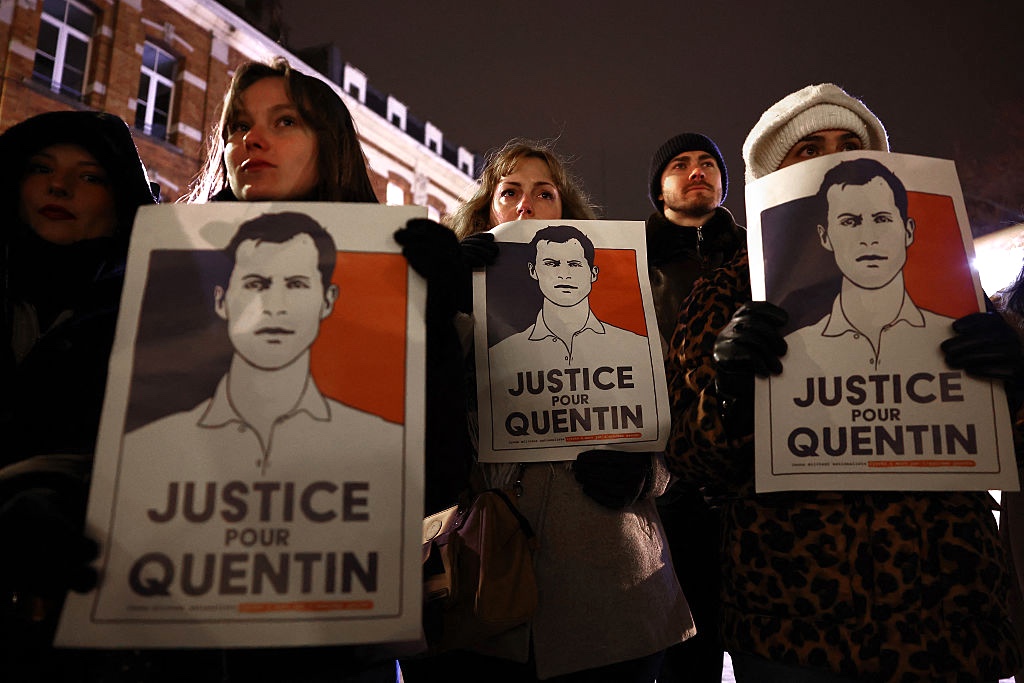
Much of France’s right-wing political and media ecosystem has sought to lionize Quentin Deranque as a nationalist martyr. (Sameer al-Doumy / AFP via Getty Images)
A French far-right militant was pronounced dead on Saturday morning at a hospital in Lyon, succumbing to injuries inflicted during a street battle last Thursday with anti-fascist activists. Twenty-three-year-old Quentin Deranque was part of a contingent of local neofascist militants that gathered to oppose a talk by a prominent left-wing MP at a university campus in France’s third-largest city. Their counterprotest quickly escalated into clashes with left-wingers, in the latest episode of political violence in a city that has long been a hotbed for ultraright gangs.
This time, however, the confrontation proved fatal. In the days since, Deranque’s death has rapidly morphed into a national scandal revealing the French far right’s growing cultural and political clout.
The chain of events last Thursday was set in motion by the scheduled appearance at Lyon’s Sciences Po campus of Rima Hassan, a Franco-Palestinian MP of the left-wing party La France Insoumise. That afternoon, activists of the so-called Collectif Némésis, a group that purports to fuse feminist and nationalist politics, assembled outside the school venue to picket the left-winger. Hassan is a frequent target for the French right given her unequivocal defense of Palestinian political rights and her condemnation of the French state’s backing for Israel. Némésis spokespersons now claim they had requested protection from male members of Lyon’s ultraright scene, in anticipation of a standoff with attendees of the conference.
What precisely occurred in the lead-up to Deranque’s fatal assault remains unclear. The conference at Sciences Po was able to proceed uninterrupted in a campus auditorium. Outside, a handful of Némésis militants — a group that regularly disrupts left-wing events — was confronted by individuals in proximity of the elite Lyon school. Initial footage shows individuals throwing punches at the women participating in the counterprotest, resulting in moderate injuries.
But the most serious confrontations last Thursday took place several hundred meters away. Near an elevated train underpass just south of the Sciences Po campus, some fifteen far-right militants clashed with a similarly sized group of anti-fascists.
In footage that surfaced last weekend, masked activists chase away the neofascist militants, while others surround and beat what appear to be three men who were unable to escape — including Deranque. At a press conference on Monday afternoon, Lyon’s prosecutor announced that his death was being investigated as voluntary homicide.
Another video released on Tuesday evening provides a bigger picture of the clashes. Presumably showing what took place just before the scenes captured in the clips released over the weekend, two large groupings face off in this new footage, trading punches and blows. A militant among the black-clad far-right activists hurls a smoke grenade toward the left-wingers, while another brandishes a metal crutch as a weapon. These new images complicate the narrative of a targeted hit operation put forward by Némésis and its allies — and relayed by broad swaths of the press and political class since last Thursday.
The scenes captured on those videos are estimated to have taken place at around 6 p.m. on Thursday. Later that evening, Deranque was picked up by first responders about two kilometers away, having been evacuated from the original scene of the clashes by a friend. Taken to the hospital, he was declared to be a in a life-threatening coma.
A Devout Catholic?
Much of France’s right-wing political and media ecosystem has sought to lionize Deranque as a nationalist martyr, one savagely “lynched” by left-wing ultras. The obituary of the young Deranque published by Le Figaro, France’s leading conservative daily, borders on hagiographic, describing the young militant as above all driven by an abiding “integralist Catholicism,” gravitating toward a friend group that mixed “religious engagement and politics.”
Deranque’s trajectory is ultimately quite typical of that of a young French man mixed up in the dark underworld of neofascist street gangs. Enrolled as a data science student at Lyon 2 University, Deranque frequented the city’s dense royalist, neofascist and radical-catholic scenes. Action Française — a legacy royalist organization and long-standing umbrella group on the ultraright — claimed that Deranque had participated in its activities in Deranque’s hometown south of Lyon. In 2025, Deranque attended the ultraright’s annual May 9 demonstration in Paris, which commemorates the 1994 death in a police chase of a neofascist militant. Deranque likewise reportedly cofounded in 2025 a neofascist collective, Les Allobroges, in his home region.
Lyon is the uncontested epicenter of ultraright organizing in France, with a strong anti-fascist presence developing in response. The city’s neofascist scene sells itself as a muscular defense force for white Frenchmen, yet it regularly sets off on hit-and-run attacks targeting persons of color, LGBTQ individuals and activists, and the city’s left-wing community. Lyon has seen a series of legal battles over the ultraright’s brick-and-mortar implantation in so-called “identitarian” bars and social spaces, often used for boxing practice and other martial arts training.
On a national level, Deranque’s death is only the latest violent incident in what has been a steady escalation of hostilities between far-right and far-left militants — violence that, according to all available data, is overwhelmingly instigated by the former. Perhaps the closest parallel to Deranque’s killing is the 2013 murder by skinheads of Clément Méric, a nineteen-year-old anti-fascist activist in Paris.
Recent years have also seen a steady clip of targeted racist murders. In August 2024, Djamel Bendjaballah was killed in the outskirts of Dunkirk by a neofascist militant. Aboubakar Cissé, a Malian man, was stabbed to death last April by a far-right sympathizer. According to one tally, 90 percent of the fifty-three “ideologically motivated murders” recorded in France between 1986 and 2021 were the work of far-right actors.
A “Common Front”
Only a complete investigation will be able to clarify the full circumstances — and the precise responsibility — for Deranque’s killing. As of February 18, eleven individuals have been taken into police custody for questioning.
What’s less clear is if the facts will be able to dissipate the hysteria that has already set in. Since last Thursday, the prevailing response has been that of concerted and stilted attack on France’s far-left scene, particularly militant anti-fascist groups and La France Insoumise. Minister of Justice Gérald Darmanin has declared that “the ultraleft has unquestionably killed,” going on to accuse France Insoumise of “indulgence” for anti-fascist violence.
The backlash is reminiscent of the American right’s offensive against “antifa” movements in the wake of the Charlie Kirk murder last September. Deranque was even honored with a moment of silence in the lower house of France’s parliament on Tuesday, an unprecedented tribute for a neofascist activist — and one that stands in stark contrast to the scarcity of such gestures for the numerous victims of far-right violence. Before ceding to the political pressure, National Assembly president Yaël Braun-Pivet resisted holding a moment of silence following the murder of Cissé last April.
There is a real risk that tensions escalate. Alleged members of the Lyon’s anti-fascist scene have been singled out on social media by far-right influencers, a doxxing campaign that has resulted in the harassment of both them and members of their family. France Insoumise constituency offices have been vandalized across the country in recent days. The party’s Paris HQ was temporarily evacuated late Wednesday morning following a bomb threat.
Driving the onslaught against France Insoumise are allegations that a parliamentary assistant affiliated with the party was part of the group involved in last Thursday’s clashes. The assistant in question, Jacques-Elie Favrot, worked under the France Insoumise MP Raphaël Arnault, who founded the Lyon-based anti-fascist group La Jeune Garde in 2018 before winning a seat as an MP in 2024. Favrot is among the list of potential suspects arrested in recent days, at least four of whom were also members of La Jeune Garde.
On February 17, Arnault confirmed that Favrot had ceased “all parliamentary activities,” as France Insoumise denies any coordination with the anti-fascists who confronted the far-right militants.
Last June, then–interior minister Bruno Retailleau ordered the disbanding of La Jeune Garde, a decision currently under review by France’s highest administrative court. That dissolution order was accompanied with the state-ordered disbanding of Lyon Populaire, a far-right gang. Arnault, for his part, has been designated for special surveillance monitoring by French intelligence services. In 2022, the future left-wing MP was first convicted to a four-month suspended prison sentence for violent assault during a 2021 counterprotest against a far-right march in Lyon.
Few political sequences have revealed France Insoumise’s — and the broader left’s — growing political isolation like the national uproar seen over the last week. Even ostensibly left-wing figures have joined the melee. After Deranque’s death, liberal-left presidential candidate Raphaël Glucksmann warned left-wing parties from any attempts to revive a left-wing coalition on the lines of the 2024 Nouveau Front Populaire, arguing that in the wake of the killing, an alliance with France Insoumise was “unthinkable.”
Jordan Bardella, the official party president of Marine Le Pen’s Rassemblement National, called La Jeune Garde the “armed branch” of France Insoumise, urging the formation of a “common front” against the left-wing party in the municipal elections scheduled for this March. Le Pen has used Deranque’s killing to call for the French state to designate “antifa” as a terrorist organization, along the lines of the Trump administration’s executive order issued last fall.
There are weeks when the deep shifts going on in France reveal themselves in full force. This was one of them.