The Fallout Series Hits Close to Home
While streaming on Amazon is a little on the nose, the Fallout television series admirably embraces the anti-capitalist critique of the original video game franchise. Its apocalyptic alternate America feels less far-fetched every day.
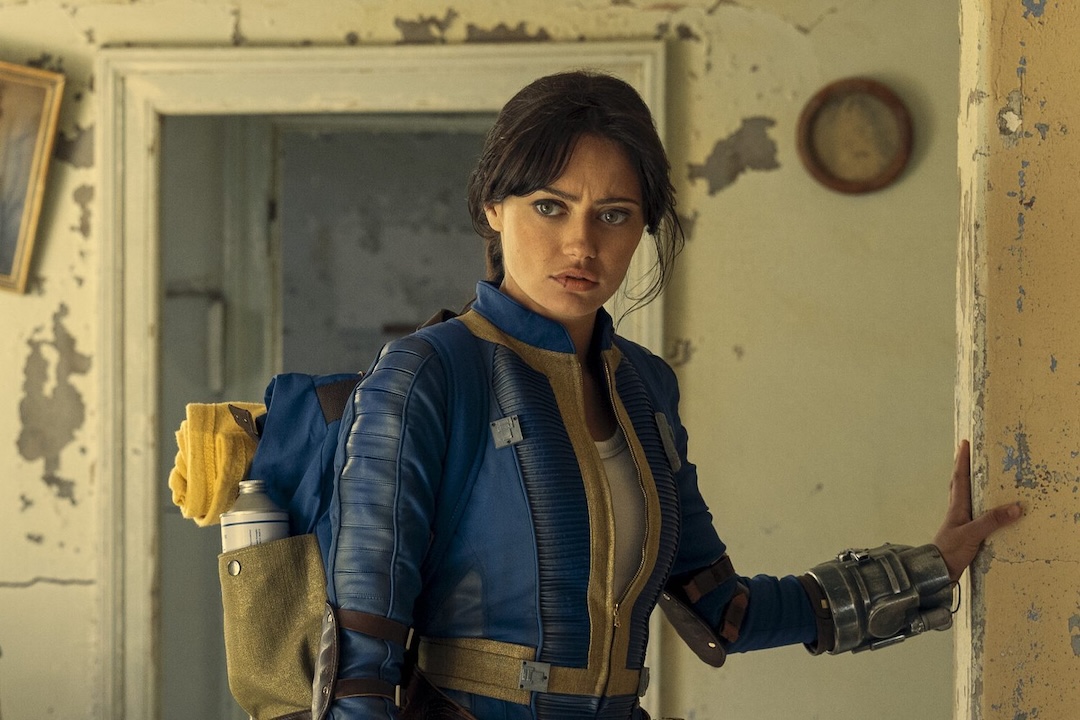
Ella Purnell stars as Lucy MacLean in Fallout. (Amazon Prime Video)
Since 1997, the Fallout video game franchise has imagined an alternate America in the shadow of nuclear annihilation. Players wander the Wasteland, trying to survive and piecing together how things went so horribly wrong. They eventually discover that, having captured Mexico in 2072, the United States annexed Canada as part of an oil war with Communist China, ultimately leading to the Sino-American War and a civilization-ending nuclear exchange — an event that lasted two hours and obliterated most of the planet’s population.
Amazon Prime’s TV adaptation of Fallout, now having completed its second season, has brought that premise to millions of new viewers. Unfortunately, the satire is aging a little too well, as American politics swiftly catches up to the hyperbole and cynicism of the Fallout universe. An alternate timeline in which hyperaggressive anti-communism and resource instability spur the United States toward oblivion doesn’t feel as far-fetched as when it debuted nearly thirty years ago.
Of course, the paradox of apocalypse is that it can never be depicted. Just as there is very little drama or comedy to be derived from Mars rover footage, the cessation of all living things is boring. Apocalypse media is therefore never about the true end of days so much as about our world dressed up as the Wasteland — a costume for contemporary politics, modern anxieties, and important warnings. Accordingly, a big theme of Fallout is that prewar hypercapitalist America was never trying to avoid self-destruction. In fact, many desired a nuclear war, happily prepared for it, and saw an irradiated holocaust as an opportunity for profit.
Watching Fallout on Amazon Prime in 2026 is especially uncanny. From Steve Bannon to Stephen Miller, the real world is populated with characters who seem straight out of the Enclave. Brexit is “just the beginning,” billionaire sex trafficker Jeffrey Epstein wrote to billionaire lethal-surveillance-technology investor Peter Thiel, citing the “return to tribalism” as a good thing, a counter to globalization with the potential for “amazing new alliances.” It’s easier to find “things on their way to collapse” than it is to find the “next bargain,” Epstein reasoned, calling to mind the Wasteland and its various sects.
I’ll go out on a limb here to argue that the end of civilization is bad, and that a sane society would organize itself in such a way as to make the apocalypse unprofitable. Yet corporations like ExxonMobil, Raytheon, and Amazon — whose streaming service hosts the Fallout show — are structurally incentivized to seek profits no matter how bad the ecological crisis gets, or how geopolitically destabilized we become, or how corrosive wealth inequality is to democracy.
In Fallout, that criticism has always been couched in cosmic horror, which is also a big part of why it’s fun to explore the perverted, blasted, sun-drenched wastes. It’s our world, but through a glass darkly, and it’s hitting increasingly close to home.
Into the Vaults
I failed two classes freshman year because I was absorbed in Fallout 3’s endlessly expansive world, which was littered with clues and hints as to what terrible thing had destroyed the world. Throughout the game’s Washington, DC, postapocalyptic wasteland, game designers planted dramatic vignettes, orchestrated using simple set-design and voice recordings. The juiciest stories came from finding the vaults themselves and interpreting how things had gone terribly awry in the underground bunkers. Some were built to contain a hundred vault-dwellers, while others contained a village of a thousand.
In the prewar Fallout universe, 122 doomsday vaults were built into mountains, valleys, and cities across North America and advertised as a consumer product. “Prepare for the Future! Space Available — Sign Up Now” advertisements are still spread across the Wasteland’s billboards, shredded and bleached by both sun and radiation. The vaults were constructed in a cooperative agreement between the mysterious Vault-Tec Corporation and a robotics firm called RobCo Industries, helmed by an eccentric Las Vegas billionaire named Robert House.
In the Amazon series, Ella Purnell plays Lucy MacLean, a naive vault dweller who quests into the Wasteland for the first time, exiting Plato’s cave but at the cost of witnessing the Hobbesian brutality of civilizational collapse. As Annabel O’Hagan’s character, Stephanie Harper, notes, citizens of the prewar era felt they had a better chance of surviving the future with a spot down in the vaults. Everyone was economically incentivized to abandon civilization and brace for impact.
That’s one way out of what theorist of capitalism Mark Fisher called the “slow cancellation of the future.” With the future now at an end, capitalism found a new market: pay your way through the bottleneck. Those who did manage to reserve a spot underground didn’t purchase safety or happiness; they purchased the end times, and it was delivered.
Of course, the vaults are also literal traps. Lucy MacLean’s underground home was not built to survive Armageddon so much as host a grand, perverse, social experiment. The vault experiments were conducted by shadowy overseers, who then reported to a sort of stay-behind network of mysterious executives. The vaults become societal microcosms that replicate class dynamics while testing the limits of cruelty. In one, hundreds of dwellers are packed inside their doomsday bunker with food and water, but no entertainment. What they do have is a working cloning machine, and all the player discovers when exploring the ruins of Vault 108 is a number of hostile clones running around in the dark. The clones are all named Gary, and they can only speak their own name, like a Pokémon: “Gary? Gary. Ga-ary.”
Vault 92 was designed to save the most talented musicians of the prewar United States, but once the gear-shaped blast door was sealed, the Vault designers programmed the speaker system to emit white noise with subliminal messages, which implanted combat suggestions into the musicians’ heads. The soundscape drives the inhabitants into a murderous rage — something out of a Richard Matheson Twilight Zone episode or a Shirley Jackson short story.
Clues about what happened in the prewar era are scattered throughout the subterranean metro tunnels of Washington, DC, and the outskirt ruins of Las Vegas, putting players in an end-times gumshoe role. A Canticle for Leibowitz by Walter M. Miller Jr, On the Beach by Nevil Shute — the Fallout franchise assembles a collage of literary and science fiction references, with players coming across a town that is having “The Lottery” done to it by a fascist Wasteland sect called Caesar’s Legion.
At its best, Fallout conveys cosmic, existential horror at the revelation that we’ve underestimated society’s fragility and the mind-shattering terror on the other side. I expected the Amazon Prime series to shy away from this and the latent anti-capitalist criticism embodied by Vault-Tec and RobCo. To my surprise, Fallout seasons one and two grapple with the nihilistic profit-seeking of gigantic, hyperpowerful, A-to-Z companies and the insane billionaires who make civilizational decisions on our behalf.
In the games, what exactly happened to create the end of the world is secondary to the aftermath politics of the Wasteland. But throughout the TV series’ second season, the plot revolves around the question, “Who really dropped the bombs?” It’s hinted that it was genius-billionaire Robert House, or that Vault-Tec itself believed a nuclear holocaust would be profitable. Embedded in these explanations is a horrific eugenics plot, where the “best and brightest” are packed into the vaults, ready to seed humanity with a preferred DNA set — the kind of thing Jeffrey Epstein was into.
Town Burns Down
In this franchise, the “slow cancellation of the future” is both literal and figurative. Deep in the Fallout lore, in the alternate timeline, it’s revealed that after World War II, there was no invention of the integrated microchip. The franchise’s mid-century modern aesthetics became a permanent part of life in America, with the only technological innovation coming from a mix-and-match of analog and nuclear technology. This nonetheless yielded innovations like robots, lasers, and plasma rifles.
The MacGuffin of the Amazon show is cold fusion energy. In traditional video game fashion, this is depicted as a glowing blue chip inside a little glass vial, but what it metaphorically embodies is utopian: free, clean energy. Despite the dire oil crisis of the prewar era, Mr House and the Vault-Tec Corporation sabotaged cold fusion, which puts Walton Goggins’s Hollywood cowboy character, Cooper Howard, in the middle of an espionage plot.
Goggins starts out as an unenthusiastic spokesman for Vault-Tec, literally selling the end of the world on television and billboards. An archetypal American cowpoke, Cooper gets wise to the perverse system he’s caught up in. Dallas Goldtooth’s character argues to him that Vault-Tec has a fiduciary responsibility to investors, which makes it logical for the corporation to sabotage peace talks with China. Goldtooth plays Cooper’s Native American sidekick in a series of prewar Westerns and in one scene draws an analogy from their cowboy roles: What happens when the cattle ranches become more powerful than the sheriff? What happens when the capitalists have more power than the government, let alone the people? “Town burns down” is the answer.
In the first season, Cooper is skeptical, but by the end of season two, he attempts to save the world and his family by delivering the cold fusion chip to the well-meaning technocrat, Congresswoman Diane Welch, played by Martha Kelly, who promises to use the technology to give free energy away to everyone. Of course, she and Coop end up betrayed. Cooper Howard ends up a Wasteland ghoul, and Congresswoman Welch ends up with her severed head in a jar, wired up to a vast RobCo computer system designed for mind control.
A lot of affluent, powerful characters in Fallout end up with their brains in jars. It’s a recurring theme that the rich and powerful of the prewar era exchange their bodies for eternal life as robots. A think tank compound called Big Mountain hosts several scientists who have all lost their minds after giving up their corporeal form and hover around as robots. The goal of Big Mountain was to help humanity through scientific innovation, but these scientists spend eternity experimenting with sonic emitters and DNA hybridization, resulting only in scorpions that shoot lasers.
Fallout’s scientists all seem to subscribe to a philosophy that goes nowhere — and when they do innovate, they only create new, perverse weapons of war and systems that threaten free will and sanity.
Still, most of the prewar Fallout elites end up down in the doomsday bunkers. As Douglas Rushkoff’s Survival of the Richest: Escape Fantasies of the Tech Billionaires discusses, this is a very real, widespread, and completely illogical desire among our contemporary elites. As Rushkoff writes, “Their extreme wealth and privilege served only to make them obsessed with insulating themselves from the very real and present danger of climate change, rising sea levels, mass migration, global pandemics, nativist panic, and resource depletion. For them, the future of technology is about only one thing: escape from the rest of us.”
Every bunker is both a safe haven and an underground prison. While some Vaults are civilizational seeds — which can technologically return life to the Wasteland through the Garden of Eden Creation Kit (or G. E. C. K.) — they are mostly tombs. Mark Zuckerberg’s Hawaiian doom island probably doesn’t have a G. E. C. K., and even if it did, that wouldn’t matter, as the most magical part of the Fallout series is that any life survives in the Wasteland at all.
The streaming series is great but suffers from soap opera plot-staggering. Many scenes in the second season last a few seconds, inching one of the many plot lines forward, only to rotate to another vignette — no doubt a strategy to make the show more clippable for short-form video, but it’s a headache if you’re trying to be in the scene.
This is a shame because the set design, costumes, and writing all work well. Kyle MacLachlan excellently portrays a deranged Vault overseer. Frances Turner plays an icy, ethically troubled Vault-Tec manager. Johnny Pemberton is fantastic as a hapless son of the Boneyard, and Jon Daly, who plays a Wasteland snake-oil salesman, combines talents with Chris Parnell as a cyclops doctor to dish out comic relief. That part is important: Fallout is funny. It uses humor and the grim threat of nuclear annihilation to accentuate its criticism of technology, war, and the corporate elite. Its deployment of the absurd suggests that these systems are not as perfect and all-powerful as they seem.
Moises Arias fantastically plays the lore-obsessed computer kid, which hits close to home, and when the Products of Inbreeding Support Club insists on wasting Vault 33’s water, Leslie Uggam as overseer cracks down on the inbreeding club’s cake party — a satisfying subplot.
Aaron Moten’s character is a bit lacking. Moten plays Maximus, Lucy MacLean’s love interest and a Brotherhood of Steel knight in shining armor, who embodies the player’s desire to smash things and shoot all these guys without agonizing over ethical questions. Moten and Purnell aren’t afforded much on-screen time together, and the show could stand to give Maximus more to work with. He’s not a talker; he’s a man of action, but that means he needs to communicate more through actions. The season two finale has Maximus in power armor squaring off against a herd of Deathclaws, which should be cool, but for some reason, the show producers have shied away from depicting the most iconic part of every Fallout game — the bullet-time Vault-Tec Assisted Targeting System (V. A. T. S.) targeting system. V. A. T. S. slows down time, allowing the player to select which body part of a foe they want to fire a rocket at. Downplaying it feels like leaving money on the table.
Still, the Fallout television series is remarkably good. Previews of season three center on a Las Vegas war between the fascists of Caesar’s Legion, headed by Macaulay Culkin, and the New California Republic, a flawed military democracy that nonetheless enforces liberal values on the Wasteland. If the first two seasons are any indication, the third will enrich our experience inside the fictional apocalypse, leveraging absurdity to ask deadly serious questions about the world that created it — a world that increasingly, and eerily, resembles ours.