The DOJ’s Top Antitrust Officer Has Left as Lobbying Surges
The head of the DOJ’s antitrust division has been ousted after clashing with Attorney General Pam Bondi over how aggressively to crack down on corporate crimes. Her removal lays bare a broader fight within the department over enforcement priorities.
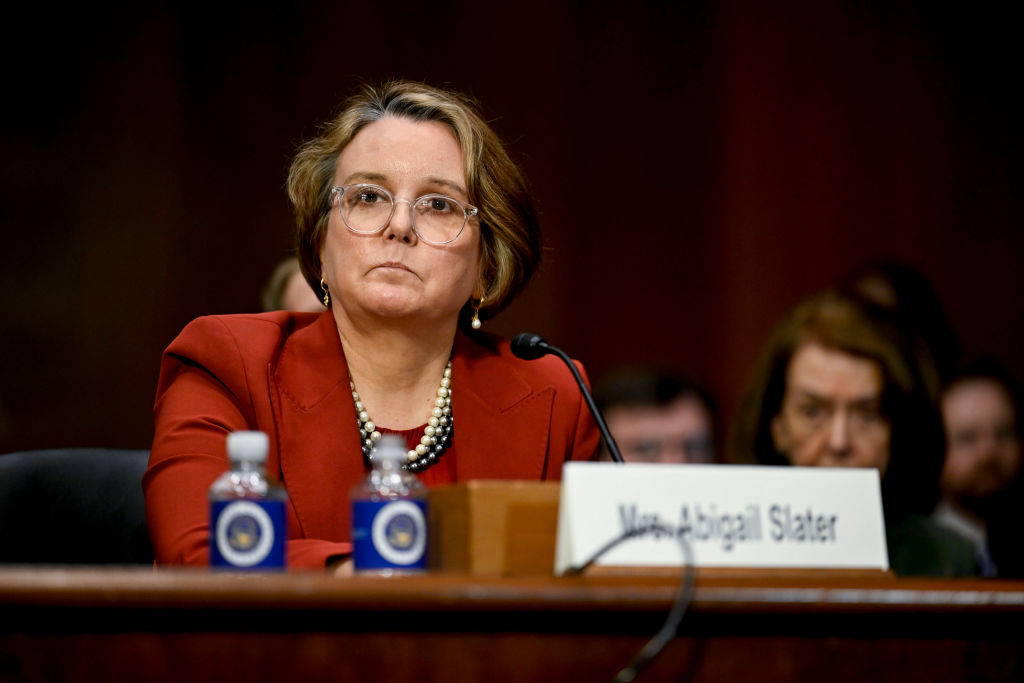
Democratic leaders are calling on the White House to release documents related to Gail Slater’s ouster. (Daniel Heuer / Bloomberg via Getty Images)
The Justice Department’s top antitrust cop has been ousted amid reports of growing corporate influence over the office and alleged internal divisions over whether to crack down on corporate crimes. The move jeopardizes the future of key antitrust cases against some of the country’s biggest companies, including lawsuits against Live Nation, Visa, and Apple.
Assistant attorney general Gail Slater, head of the Justice Department’s antitrust division, exited her position last week following reports of tension with Attorney General Pam Bondi over how aggressively to pursue antitrust matters.
Those tensions were evident only ten days into the second Trump administration, when the Justice Department filed an antitrust suit against Hewlett Packard Enterprise, temporarily blocking the company’s $14 million merger with Juniper Networks, a wireless network competitor. But after a scorched-earth lobbying campaign by Hewlett-Packard, Justice Department lawyers allowed the merger to proceed with limited divestiture requirements, a move Slater reportedly opposed.
Slater’s departure comes several months after the termination of two of her deputies last August. The staffers reportedly clashed with Bondi’s office over the influence of administration-connected lobbyists within the Justice Department. Slater’s preference for direct negotiations — and her resistance to outside consultants — reportedly upset business leaders, prompting complaints to the White House.
After the Hewlett-Packard merger, one of Slater’s fired deputies, Roger Alford, cautioned against “MAGA-In-Name-Only lobbyists” enabled by the Justice Department to “enrich themselves as long as their friends and supplicants are in power.” As Alford noted, under the Trump administration, “cases are being resolved based on political connections, not the legal merits.”
Live Nation saw its stock value spike in the hours following the news of Slater’s ouster. The company, whose antitrust case is set to go to trial on March 2, has deployed lobbyists in recent weeks to pressure the Justice Department for a pretrial settlement, but Slater was reportedly “sidelined” from those conversations.
In 2024, the Biden Justice Department sued Live Nation, alleging the concert promotion and ticketing giant — which controls 80 percent of ticket sales at major US concert venues — used exclusionary practices to stifle competition.
According to the complaint, Live Nation captures fees from fans and sponsors, uses that revenue to lock artists into exclusive promotion deals, and then leverages its live-event portfolio to secure long-term exclusive ticketing contracts with venues. Officials said they were seeking “structural relief,” meaning a breakup of Live Nation’s sprawling and “self-reinforcing” business empire.
One of Live Nation’s lobbyists, Mike Davis — a corporate “fixer” for mergers and acquisitions — reportedly “accelerated” Slater’s removal after criticizing her in a meeting with the president, according to Bloomberg. He also publicly attacked Slater online. Davis previously clashed with Slater while lobbying the Justice Department to allow Hewlett-Packard’s merger with Juniper to proceed.
Democratic leaders are now calling on the White House to release documents related to Slater’s ouster and the Live Nation case.
As a consultant, Davis reportedly earned about $1 million from Hewlett-Packard for his work on that merger and roughly another $1 million helping secure the Justice Department’s approval of a real estate brokerage merger between Compass and Anywhere Real Estate, according to the American Prospect.
Also at risk is the Biden-era antitrust case against Visa, which processes roughly 60 percent of US debit transactions and collects $7 billion annually in swipe fees. The Justice Department alleges the company uses its scale and central role in the payments system to impose exclusionary agreements on banks and merchants, allowing it to charge fees well above competitive levels.
Visa has also ramped up its lobbying in Washington, spending more than $11 million last year — a 43 percent increase from 2024 — as it has worked to fend off regulatory efforts to boost competition. That included a major push regarding the Credit Card Competition Act, which seeks to undermine the Visa/Mastercard duopoly by expanding the number of card networks large banks must rely on.
Slater’s exit may also affect another pending Biden-era antitrust suit that accused Apple of monopolizing the smartphone market through restrictive contract practices. Apple spent more than $10 million lobbying the federal government last year, a 27 percent increase over 2024 and the company’s highest annual total on record.