How China’s Counterculture Went Online
A new book by the journalist Yi-Ling Liu documents the rise and fall of emancipatory politics on China’s internet and offers insights into the limitations of struggling for change online.
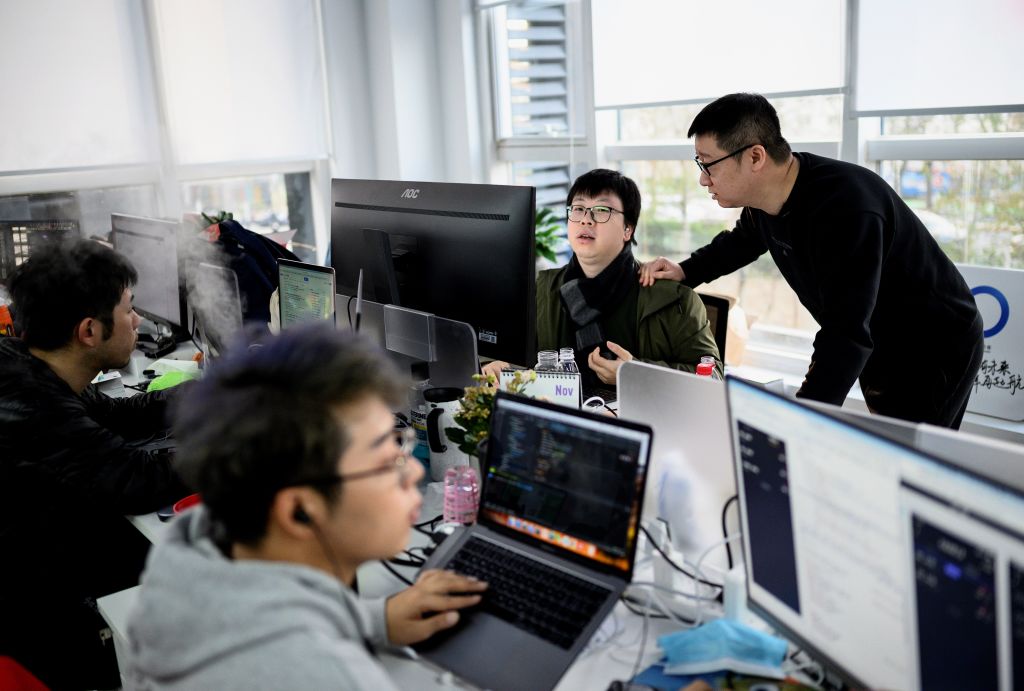
Bill Clinton once quipped that China’s attempt to censor the internet would be as successful as “nailing Jello to the wall.” He was wrong: the Communist Party of China has imposed a censorship regime that governments around the world are copying. (Noel Celis / AFP via Getty Images)
In 2000, Bill Clinton famously quipped that China’s attempts to control the internet were akin to trying to “nail Jello to the wall.” Twenty-six years later, it’s clear that China has succeeded in doing just that. Social media apps and news outlets used universally outside of the People’s Republic are almost nowhere to be found within the country; 1.4 billion people in China have eschewed Instagram, Twitter, and Reddit for WeChat, Weibo, and Rednote. The Communist Party of China has succeeded in creating a digital parallel universe shielded behind “The Great Firewall,” a vast system of online censorship and surveillance meant to clamp down on public dissent and filter out “dangerous” foreign ideas.
But even though China’s internet is today the world’s most ambitious mass censorship project, it was once considered a possible site of emancipation. In The Wall Dancers: Searching for Freedom and Connection on the Chinese Internet, Yi-Ling Liu documents the promises and perils of the Chinese internet from its hopeful beginnings in the 1990s to its present-day seclusion. Liu recounts the stories of five individuals in China, each of whom initially finds in the internet an opportunity for community and creative expression. From LGBTQ rights advocates and feminists to aspiring hip-hop artists, the internet became a place where minority views and subcultures could flourish free from China’s rigid cultural norms.
But The Wall Dancers is more than just a series of biographies. Liu weaves these personal narratives into the broader background of intensifying authoritarianism and censorship, demonstrating the impact of seemingly abstract political shifts on real individuals’ lives. While none of Liu’s characters initially see themselves as anti-government dissidents, they all come to learn that searching for self-realization through the internet will involve an unavoidable encounter with the state.
Private Capital and LGBTQ Rights
Clinton’s famous Jello quip was made in the context of a speech arguing for permanent normal trade relations (PNTR) with China, a hallmark free-trade agreement of the neoliberal era. Right before making his Jello comment, Clinton praised the emancipatory potential of tariff-free trade of information technology products, going as far as to claim “liberty will spread by cell phone and cable modem.” Clinton’s comments here were a part of a broader ideology that came to be known by a German phrase, “Wandel durch Handel”: change through trade. Free trade with China, the argument went, would also lead to a liberalization of its political system since free-market capitalism and authoritarianism were incompatible. According to this view, private capital and tech companies would be the harbinger of China’s liberal future.
One of the figures through which Liu tells this story is Ma Baoli. When we are first introduced to Ma, he’s a closeted gay man who views his sexuality as a mental illness. But during his first visit to an internet café, he finds an online discussion forum called “Chinese Men’s and Boy’s Paradise.” In it, Ma finds for the first time a refuge in which he is accepted and he can connect with others like him. Ma eventually starts his own gay website, Danlan, and enters the growing ranks of China’s tech entrepreneurs while operating in a legal gray zone. Despite homosexuality being functionally decriminalized in 1997, depictions of same-sex intimacy remain illegal, and Danlan was periodically shut down for “violating public morality.”
But this didn’t discourage Ma from working with the authorities. In fact, Ma saw collaborating with the government as his path to success. As China’s HIV/AIDS crisis grew in 2010, Ma offered his website as a resource for the government, providing knowledge about HIV transmission for China’s center for disease control. Ma’s efforts were initially successful — and lucrative — gaining him a meeting with China’s second most powerful government official and making him, alongside Alibaba founder Jack Ma, one of the country’s new tech elite. Ma’s gay dating app, Blued, even went public on Nasdaq. For a while, it appeared that he was on top of the world.
For Ma, the power of the internet and tech entrepreneurs like him could be a force for liberalization. Making money through a profitable internet tech company and advocating for LGBTQ rights were seen as the same endeavor. The one condition was that advocacy couldn’t bleed into political activism or collective action, a condition that Ma stringently held to. Ma thought that as long as he cooperated with the party, the interests of business and social liberation aligned.
But nothing could be further from the truth. Instead of Wandel durch Handel, tech companies happily became arms of party authoritarianism to protect their profits. American and Chinese tech firms alike collaborated with the Chinese government to enforce censorship and collect private information on dissidents. As part of Xi Jinping’s drive to tighten government control, the party made a series of moves to centralize the censorship bureaucracy and increase government cybermonitoring. In 2021, it implemented a crackdown on the tech industry and launched investigations into dozens of companies.
Ma and China’s LGBTQ community were swept up in this rising tide of authoritarianism. In 2016, censors banned TV depictions of “abnormal sexual relationships” like gay romance. A few years later, the party continued with a broader crackdown on LGBTQ groups in China. In November 2025, government authorities ordered the removal of Blued, the gay dating app founded by Ma, from mobile app stores (an order with which Apple happily complied). The attempt to link LGBTQ politics with the interests of profit-making companies had clearly failed.
Feminism’s Weibo Spring
In 2009, a male government official attempted to rape a waitress and was killed when she defended herself. Instead of seeing this as a justified act of self-defense, the local government arrested her and charged her with murder. In the pre-internet age, this case likely would’ve gone unnoticed. But a blogger picked up the story and made it go viral, inciting public outrage at such a blatant act of injustice. In response, the government was forced to back down and dropped the murder charges.
The case inspired the second of Liu’s subjects, Lü Pin, to demonstrate the internet’s potential in challenging China’s deeply patriarchal culture. Lü founded an online feminist magazine that rapidly grew a large following. China’s analogue to Twitter, Weibo, transformed it into a space for like-minded feminists. At the time, Weibo seemed like a groundbreaking new means of Chinese civic engagement. Several egregious cases of corruption and government failure were brought to justice thanks to viral uproars on Weibo. The optimism was so palpable that this surge of activity was even referred to as the Weibo Spring.
Unlike Ma, who attempted to collaborate with the state and rich companies, Lü saw Weibo as an organizing vehicle for provocative public action. Lü and feminists she met through her digital magazine organized public protests to raise awareness about domestic violence. Their public actions succeeded in garnering attention and trended on Weibo. The authorities’ initial response was bribing the feminists by offering them cushy government jobs if they stopped their activity. But Lü and her companions refused, deciding that public action would accomplish more than becoming part of the state. From 2013 to 2015, this oppositional strategy bore fruit. The government eliminated sexist gender quotas and passed domestic violence protection laws as attention to women’s rights issues became too widespread to ignore.
But the Weibo-driven feminist movement soon saw its limits. While Lü was in New York for a United Nations conference on feminist issues in 2015, security agents across China’s major cities made high-profile public arrests of feminist leaders. The women were later released after major international backlash, but China’s burgeoning feminist movement was forced underground as state repression intensified. On International Women’s Day in 2018, all social media accounts associated with Lü’s magazine were shut down.
While the government muzzled public dissent on Weibo, it weaponized the social media app by actively promoting hypernationalist “Little Pinks” and sexist incels. Lü never returned from her conference to China, and the online feminist movement is now a shadow of its former self. As Liu shows in her tellings of Ma and Lü’s stories, both the strategies of government collaboration and contestation failed to produce social liberation in the face of state power.
Chinese Clicktivism?
In the West, digital spaces are overcrowded with superficial “clicktivism.” Online petitions and suspicious donation links provide a lazy way for one to feel like they’re making a difference despite their political impotence. It’s easy to apply this framework to the online activism documented in Liu’s book.
But The Wall Dancer’s stories make the case for rejecting this dismissive reaction. In the West, online activism attracts maximum attention for grifters’ personal aggrandizement and fundraising by design. This form of online politics is a silly distraction because there are opportunities for real organizing in mass protests, elections, and unions.
But in China, the space for in-person political organizing is extremely narrow. In this context, the internet becomes the only venue through which people can broadly share political views and criticism of the status quo. In addition, online activism in China carries serious personal risk and offers very few rewards. This filters out grifters and makes internet activism a more genuine attempt to bring attention to social crises.
And when political views go viral on the Chinese internet, it’s for good reason. Online activists don’t pick up on narrow unrepresentative views but rather widely felt grievances. Lü Pin was able to garner such a large audience for her feminist magazine because of far-reaching discontent among young women with China’s patriarchal culture. Gen Z rapper Zhang Fangzhao’s song, “Factory,” circulated widely on Chinese video streaming platforms because it addressed the pollution and decay of China’s rust belt. Most famously, the internet meme “rùn” (润) has gained notoriety for expressing widespread pessimism about people’s economic opportunities. Unlike the ubiquitous slacktivism in the West, China’s internet deserves to be taken seriously as a meaningful space for social expression and political contention.
A New Language of Resistance
Despite its restrictions, China’s censorship has also been a font of creativity as activists find inventive ways to bypass restrictions. As the #MeToo movement against sexual assault spread to Chinese social media, censors quickly banned all uses of the term. In response, Chinese feminists quickly came up with a new phrase: “Rice Bunny.” In Mandarin, Rice Bunny is a rough homonym with MeToo and pronounced mitu (米兔). Emojis of rice kernels and rabbits quickly became the new symbols of China’s feminist movement. As “Rice Bunny” shows, the dance between censors and the censored continues to generate a new language of resistance to authoritarianism. Through the game of cat and mouse that netizens play with the Firewall has emerged a unique Chinese symbology that speaks to what Liu calls “one of the most basic human urges: to be connected to one another and to the world.” The Wall Dancers is such compelling reading because it provides deeply intimate portrayals of this universal yearning and the creativity of the human spirit in the face of repression.