Charity Is No Substitute for Economic Rights
The United States is a global anomaly in our collective delusion about the power of charity to address human suffering. A far better approach would be to guarantee inalienable economic rights and structure society around their fulfillment.
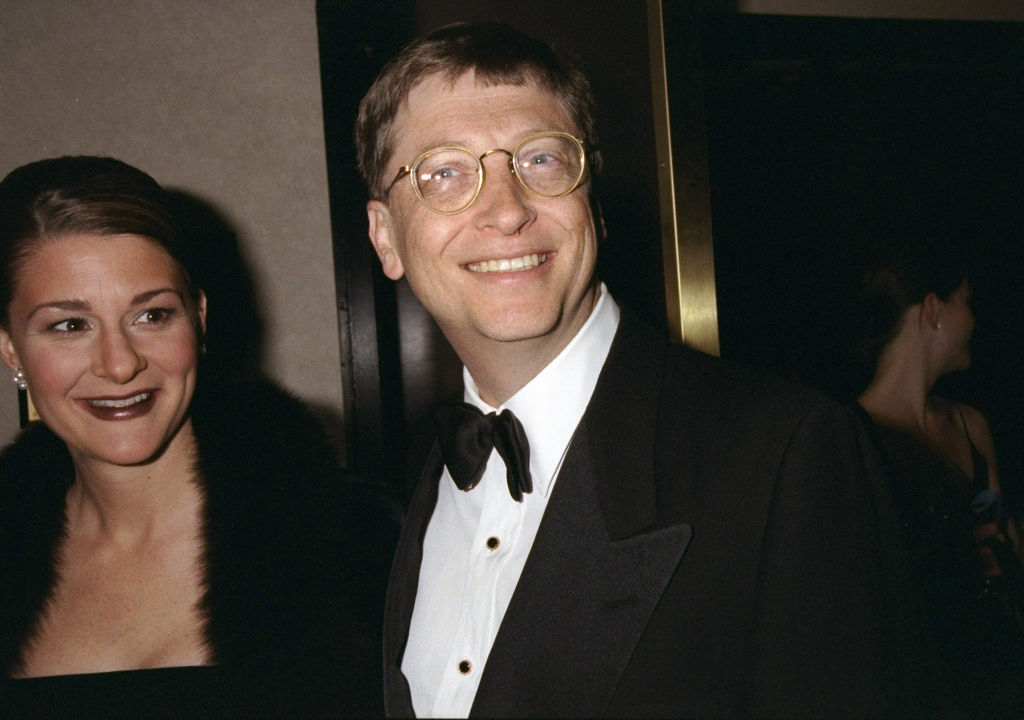
Then Microsoft chairman Bill Gates with then wife Melinda at a benefit for the charity "For All Kids" on December 2, 1998. (Richard Corkery / New York Daily News Archive via Getty Images)
For many years, my home state of Indiana provided very limited access to Medicaid, a deadly state of affairs that still exists in the ten states that have stubbornly refused to accept Affordable Care Act funds to expand the program. For many Medicaid applicants in those settings, their only path to health care is meeting an onerous standard for proving they are disabled. When residents of our state still faced that hurdle, our law school clinic often represented clients in appeals of Medicaid denials. They had severe illnesses and limitations, but their applications for help paying for prescribed medicine and care had been rejected by the state agency.
Once one of my colleagues helped a woman pull together reams of evidence about her chronic pain and her struggles to afford medication and therapy. Together, they presented it to a judge who was hearing the appeal of the state agency’s decision denying her Medicaid. The judge somewhat impatiently listened to all of the testimony, then promptly denied her request. The woman rushed from the courtroom in tears.
Her lawyer started packing up his files. The judge lingered for a moment and broke from his stoic demeanor. “It really is too bad what she is going through,” he said to my colleague. “Isn’t there some kind of program out there to help people like her?” Since he had just blocked her access to the government program designed to help her, it was clear the judge was referring to a charity program.
The answer was no. This woman, like millions of others, was in need of years of assistance with expensive medicines, provider visits, and procedures. Virtually no charity provides that level of support. But the judge is just one of many people in the United States who assume there must be a “program out there,” a charity that will meet the needs of those struggling to get by.
Alone among wealthy industrialized nations, the United States refuses to address our poverty crisis through enforceable economic rights. A big reason is that the United States is also a global anomaly in our collective delusion about the power of individual charity to address human suffering.
This is not a new trait. In 1835, Alexis de Tocqueville marveled at the American predilection for creating voluntary organizations to “to give entertainments, to found seminaries, to build inns, to construct churches, to diffuse books, to send missionaries to the antipodes; in this manner they found hospitals, prisons, and schools.” Modern day presidents from Ronald Reagan to Barack Obama venerated voluntarism and created institutions to promote it. Half of US households report donating to charity, and one in every ten US workers is employed by a nonprofit organization.
Even more significantly, every person in the United States de facto funds rich people’s charity. The indirect government subsidy of income tax deductions for charitable contributions is substantial, amounting to $52 billion in foregone government revenue in 2022, nearly all of it to the tax benefit of wealthy individuals. That is nearly twice the amount that US federal and state governments spent in the Temporary Assistance to Needy Families program that year.
The US tax code’s definition of charity is so broad that this subsidy is available for donations to college sports programs, political think tanks, and elite private schools where wealthy donors attended and/or their children attend. In fact, less than one-third of the money US individuals donate to nonprofits is focused on the needs of the economically disadvantaged. As Rob Reich, Stanford political science professor and author of Just Giving: Why Philanthropy is Failing Democracy and How It Can Do Better, concludes, “We should stop kidding ourselves that charity and philanthropy do much to help the poor.”
“A Moral Safety Valve”
Meanwhile, government entitlement programs like SNAP, Medicaid, and Social Security, even without meeting all basic needs, are credited with lifting forty-five million people out of poverty annually. Before the Social Security monthly benefit was expanded in the 1960s, more than one in every three US seniors lived in poverty. Expansion reduced the senior poverty rate to 10 percent. The child tax credit expansion in response to the COVID pandemic cut child poverty nearly in half.
By contrast, even well-meaning charitable efforts come up well short. In a Harvard Political Review essay entitled “Why Charity Can Never Be More Than a Band-Aid,” Emory Paul wrote that his experience leading a nonprofit assisting homeless people taught him a hard lesson. “We were able to supply people unhoused on the street with meals and backpacks,” he writes, “but we will never be able to truly address the myriad of societal issues — including systemic racism, affordable housing shortages, lack of government benefits, predatory capitalist practices, and policy failures — that led them there in the first place.”
Paul also highlights charity’s role in perpetuating inequality. Charity is rife with plutocratic bias, since tax policy gives free rein to wealthy individuals and corporations to choose projects that often serve their own public relations agendas more than community needs. Splashy announcements of billionaire and corporate donations are designed to distract attention from — and mute outrage about — the exploitation that created the mountains of privately held wealth, only a fraction of it given away.
In fact, observers from philosophers to social workers have long argued that philanthropy is not only ineffective at alleviating poverty, but it quite often exacerbates and justifies it. Vida Dutton Scudder, the early twentieth century socialist educator and activist honored with a feast day by the Episcopal Church, called philanthropy “a sedative to the public conscience.” Fundraising efforts only “squeezed a little more reluctant money from comfortable classes, who groaned and gave but changed not one iota,” Scudder said.
“The alms given to a naked man in the street do not fulfill the obligations of the state, which owes to every citizen a certain subsistence, a proper nourishment, convenient clothing, and a kind of life not incompatible with health,” said Montesquieu, the French Enlightenment-era judge and philosopher whose writings influenced the founders of the United States. Famously, St Augustine was more direct: “Charity is no substitute for justice withheld.”
Building on Vida Dutton Scudder’s metaphor about charity numbing the public to the injustice of inequality, sociologist Janet Poppendieck argues that widespread US charity deludes Americans into ignoring the poverty crisis. Even worse, charity often acts as what Poppendieck calls a “moral safety valve,” alleviating any sense of personal responsibility for the suffering that surrounds us.
When a majority of Americans report that they donate or volunteer for charity, it is not just a symptom of a society where the poor are forced to scramble for donated goods. It is a cause of that suffering as well. “The growth of kindness and the decline in justice are intimately interrelated,” Poppendieck writes. “This massive charitable endeavor serves to relieve pressure for more fundamental solutions.”
Donating to a fundraiser for homeless people or participating in a “day of service” allows many Americans to avoid confronting the immorality of a society where great wealth exists alongside grinding poverty. Charity does not alleviate long-term poverty, but it is quite effective at alleviating American guilt about it.