Keir Starmer Backs Trump’s Assault on Venezuela
The seizure of two tankers carrying Venezuelan oil is a further escalation of Donald Trump’s war policy. While British prime minister Keir Starmer denied involvement in the earlier attack on Caracas, this time Britain actively joined the operation.
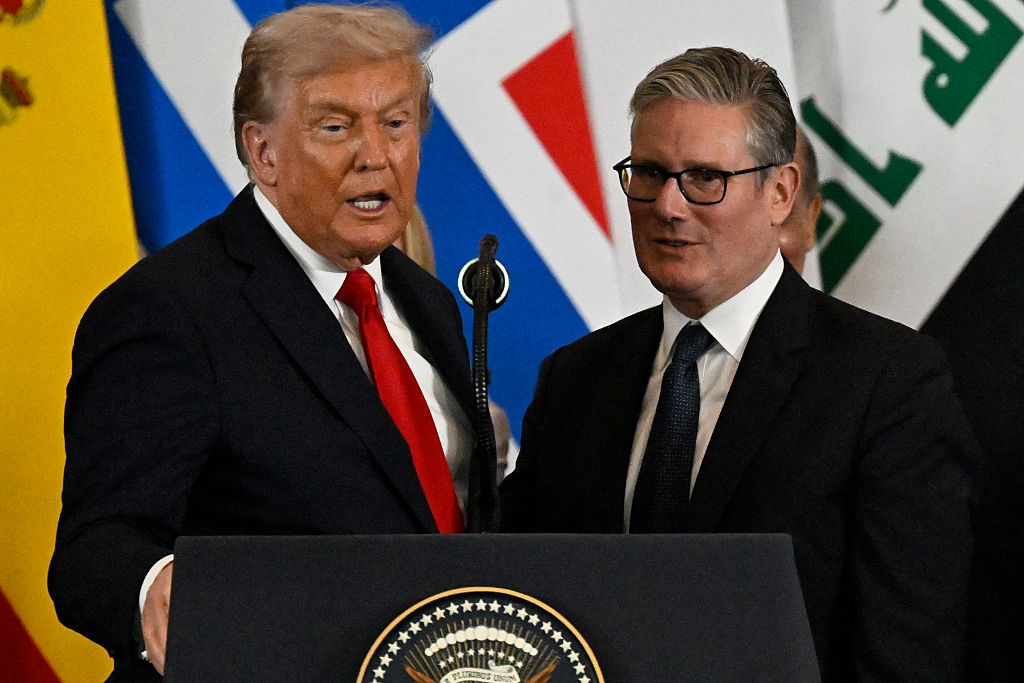
Donald Trump openly advertises his intention of seizing the Venezuelan oil industry. Britain is giving him active military support. (Photo by Khaled Desouki / AFP via Getty Images)
What began with the United States’ attack on Venezuela has now gone global.
Not content with the rendition of Venezuela’s president Nicolás Maduro and his wife, Cilia Flores, amid a firestorm of destruction in Caracas, the Trump administration has followed with the military seizure of two tankers carrying Venezuelan oil. The first, the Sophia, was in the Caribbean. The second, the Marinera, was thousands of miles away, in the freezing waters of the North Atlantic near Iceland.
The tanker was Russian-flagged, causing some to read this move as an assault on Moscow’s sanctions-evading “shadow fleet.” But while the Kremlin is unlikely to be impressed, Washington’s target was Venezuelan resources. It also seems plausible that with Ukraine negotiations ongoing, Trump may offer the Russian leadership concessions elsewhere, to encourage it to overlook the tanker incident. According to a former White House aide, Moscow has offered a quid pro quo on Venezuela and Ukraine before.
Another country inserting itself into the maelstrom is Britain. On Monday, ten US C-17 transport aircraft and two AC-130J ground-attack gunships were sighted arriving at RAF Fairford, carrying special operations forces, reportedly including veterans of the Caracas attack. Two days later, they took off to carry out the seizure of the Marinera, with Britain’s Ministry of Defence actively collaborating.
US spy planes also arrived, and this force was strikingly large for the seizure of a single vessel. So it seems that there may be more to come. As if that wasn’t enough, NATO diplomats are now discussing sending troops to secure Greenland from being invaded by US forces.
The fallout from events in Caracas suddenly spans three continents, and points to a world on fire. It reflects the searing crises of climate breakdown, the destabilization of capitalism, and the unfolding consequences of colonial extractivism.
A Pipeline to War
We might first spare a thought for the crews of the Marinera and the Sophia. They began their days working in harsh conditions on long voyages in an industry rife with exploitation — and ended with them being pulled into a geopolitical firestorm. The Marinera’s hasty switch from a Venezuelan to a Russian flag represented a frantic attempt to avoid being targeted. But their plight was probably not even the most significant development in the United States’ Venezuela plans that day.
Simultaneously announced was a US bid to directly take over the sale of Venezuelan crude oil, with President Trump later announcing that Washington’s oversight could last years. In response, critics reprised the old critique of the Iraq invasion, decrying “wars for oil.” In 2003, that attack perhaps stung a White House keen to present its war aims as rooted in humanitarian values. While US authorities painted the anti-Maduro operation as part of the War on Drugs, they have already started dropping their argument that he is some form of contemporary Pablo Escobar. All sides agree that this is an oil war.
A more interesting question is: why? Venezuelan heavy crude is expensive to refine, and not all refineries are set up to do this. The improvements needed to infrastructure and the security requirements of ramping up production are likely to make many investors skittish. Either the level of extraction would be relatively low, or the returns long-term.
The United States’ commitment makes more sense in the context of the administration’s broader fixation on controlling as many global fossil fuel resources as it can. Insofar as the “drill, baby, drill” rhetoric and the recent cancellation of billions in renewables funding has a strategic logic, it likely reflects an internal perception that maintaining fossil-fuel dominance is easier than winning a race with China for control of the transition. The US maneuvers in Venezuela form an argument — that even faced with declining oil demand, the United States can slow down the transition, maintain the preeminence of fossil fuels and win any competition over them.
Underlying this argument is colonialism. Students of geography or similar disciplines will have encountered the resource curse; the view that resource-rich countries are structurally doomed to chaos. But this is not true of Britain or Norway or the United States; it’s a curse that afflicts subjects of colonial predation.
The United States’ current approach is nowhere near coherent enough to be compared with serious colonial or neocolonial doctrines. But it’s a passable attempt at a tribute act. It is no coincidence that its boldest move to shape the future has been in a former European colony and a country over which the United States has long attempted to exercise dominance. And it is turning to another place that fits this description: Greenland.
The High Tundra Heats Up
For the ancient Greeks, the far north was a place of rumored abundance, the idyllic realm of Hyperborea. Then a succession of great powers explored it and found it cold, sparsely populated, and of limited strategic importance (although in 1933 eastern Greenland did become the setting for a landmark international court case over colonization rights.)
Today, Hyperborea is coming back. The frightening pace of climate change–linked Arctic sea ice retreat has opened up potential access to the region’s rich oil and gas reserves, and its massive stocks of critical minerals. The full gold rush has yet to happen. Yet, the last two decades saw huge increases in investment.
Geopolitical and military tension has also risen. In 2007, Russia planted a flag on the seabed base of the Lomonosov Ridge, attempting to stake a tendentious territorial claim to the resources therein. After the Ukraine invasion, every other state on the Arctic Council boycotted the institution in protest, effectively freezing Arctic cooperative governance. (While a member of the council, the indigenous Inuit Circumpolar Council has often found itself cut out of decisions.) States began reopening and expanding their Cold War–era northern installations.
Washington has marched into this already fraught environment with a basket of memes, state visits, and influence operations aimed at encouraging Greenland to seek independence from its former colonizer so the United States can colonize it instead. At first this seemed like an elaborate joke, another example of the Trump administration “flooding the zone” with stories so its opponents have no sense of what it is going to do next. But European capitals have been forced to confront the possibility that this may actually be real, and Germany and Poland are now attempting to lead on a joint European response.
Europe must now contend with an interesting new form of imperial boomerang. It has sponsored the breakdown of norms and rules elsewhere, and this is now coming home to roost. Denmark has been working closely with Britain’s Keir Starmer on a project to erode European human rights law. Europe has enthusiastically undermined norms through its failure to hold Israel to account and in its handling of refugee emergencies. On Venezuela, its initial responses to the attack ranged from empty to enthusiastic. Ironically, even some apparent ideological allies of Trump like France’s Marine Le Pen were bolder than most liberals.
Two questions now loom large. The first is whether the Greenland issue will sharpen Europe’s thinking and what that would look like. Does Europe have the nous to prevent a Pax Americana being imposed on it? The second question is where Britain stands. For a moment it looked as if Prime Minister Keir Starmer would be able to compartmentalize; remaining passive on Venezuela and more reactive on Greenland. But English soil becoming the launch deck for Washington’s system-upsetting war, for an operation in the North Atlantic not terribly far from Greenland, pushes the question of London’s role into stark clarity. Keir Starmer cannot hedge forever.
It is extremely difficult to predict what happens next, and all participants have some big questions to ponder. And often in times of crises, the actors involved find themselves reaching for answers in much older doctrines.
Resisting Fatalism
Supporters of the United States’ Greenland claim have invoked an interesting argument; that since Copenhagen has failed to effectively exploit the region, the Danes have lost the right to its riches.
Consciously or not, it resembles the Lockean case for colonial America; that the vast wealth of the New World belonged to Englishmen who would be more industrious in realizing its potential than indigenous people. This is not the only idea from the period bubbling to the surface. Debates around the tanker seizures might look familiar to Hugo Grotius, the Dutch theorist of international law who wrote an impassioned defense of his nation’s 1603 seizure of a rival Portuguese vessel bearing vast wealth, precipitating a Europe-wide scandal. And Hobbes’s grim view of international relations, developed against the devastation of the Thirty Years’ War — a world where might makes right, and all are against all — is enjoying a renaissance.
Connecting these old ideas and new tactics is a crude realism that the New Right is attempting to popularize; the inevitability and desirability of a world where the strong prevail and the weak suffer what they must. This view runs through attempts to ride roughshod over international humanitarian law, shrink labor protections, or reverse progress toward racial and gender equality. It’s a survivalist-style doctrine for surviving the crises that its inventors have caused.
It’s also the US government’s explicit view. The White House has followed up its week of aggression with a $600 billion increase in the United States’ already bloated war budget. Its strategy is clear; sabotage global climate action, seize world’s remaining oil reserves and belch them into the atmosphere, exploit the consequences through seizing the sea-lanes opened by melting ice, and militarize the future. I remain unconvinced that any of this actually demonstrates strength; after the Maduro kidnapping, I argued that unpredictable, stochastic aggression is how the Trump administration is managing an era of US decline.
But it’s certainly a threat. And while the Right’s opponents may not believe in the desirability of a world shaped primarily by force, many seem resigned to its inevitability. Liberals in government in Europe have spoken of their reluctance but nonetheless followed a Trumpian doctrine of ramped-up military spending, border violence, and jettisoning environmental and social welfare commitments. Meanwhile, leftists despairing at the futility of appeals to morals or even peremptory legal norms reach fatalistic conclusions.
Any antidote to such fatalism requires asserting a different kind of strength. Europe could defend and extend its much-vaunted tradition of rights and peace-building, rather than jettison it in a rush for short-term wins. European Council president António Costa took one small step in this direction, insisting that he “cannot accept violations of international law — whether in Cyprus, Latin America, Greenland, Ukraine, or Gaza.” It remains to be seen whether material actions will follow words. The British, meanwhile, could reject their assigned role as an oversized US aircraft carrier. As for the Americans, the New York mayor’s swearing-in speech with its line on the warmth of collectivism hints at what an actual “America first” agenda might look like; choosing health, education, environment, and infrastructure over another round of “forever wars.”
Such alternatives also require breaking with old doctrines of extraction, accumulation, and brute force as the only route to prosperity. And some inspirations exist in the places currently under attack. Greenlanders have long elected indigenous ecosocialists who have persistently resisted attempts to scale up extraction, choosing sustainable lives over the allure of short-term cash. Venezuela is today deeply troubled, and yet lessons can still be learned from the early Bolivarian Revolution’s transformative redistribution of wealth and power.
It’s been a worrying start to the year, to say the least. But with the stakes this high, such events should also reinvigorate movements for peace and environmental and economic justice, after many defeats.