Spain Shows Another Immigration Policy Is Possible
Spanish political leaders know that the economy relies on undocumented migrants and their labor. Rather than step up expulsions, Pedro Sánchez’s government has announced plans to regularize over 500,000 migrants’ status.
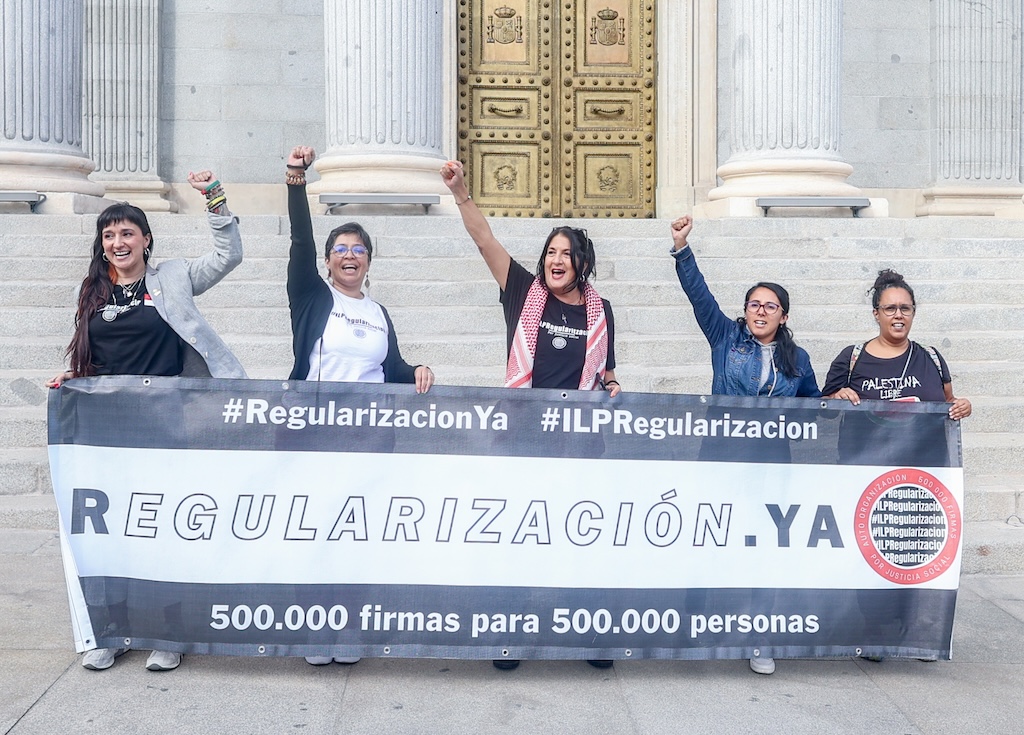
Spain’s broad-left government has announced regularization plans that could benefit over 500,000 migrants without legal status. While governments around Europe harshen anti-migrant measures, the Spanish example shows it’s not inevitable. (Ricardo Rubio / Europa Press via Getty Images)
The Spanish government has announced a regularization process for immigrants in an irregular administrative situation. It’s a move that could benefit more than five hundred thousand people currently living in Spain without legal status. With this measure, Pedro Sánchez’s broad-left government is swimming against the tide of Europe and the United States. The decision by the Spanish government, formed by his Partido Socialista (PSOE) and the left-wing Sumar, supposes a great success for the citizen-led campaign “¡Regularización Ya!” (“Regularization Now!”), driven by migrant and anti-racist groups, which has collected over seven hundred thousand signatures from Spanish nationals in favor of regularizing all undocumented migrants.
Decree
The regularization, which has been approved by decree in order to get around the government’s weak parliamentary position, will apply to foreign nationals who meet three conditions: They must have entered Spain before last December 31, prove a minimum stay of at least five months, and have no criminal record.
The government and the promoters of the “Regularization Now!” campaign estimate the decree will benefit over half a million people, although there could be over eight hundred thousand migrants in an irregular situation in Spain. In previous years, the government loosened the criteria to obtain working and residence permits, but it has not been enough to reduce this figure. Migration has quickly grown in recent years, particularly from Latin America, and almost 18 percent of Spanish residents today are foreign-born — the third-highest figure in Europe.
The extraordinary regularization process will run from April to June, and the government has promised that it will be simple. To prove that they have been in Spain for five months already, applicants will have to provide documentation such as a registration certificate from town hall, records of medical appointments, rental contracts, transport tickets, and so forth. They may thus gain a one-year, renewable residential permit.
The extraordinary regularization measure is an effective admission of the cruelty of Spanish immigration legislation. As in other European countries, the status quo condemns thousands of workers to irregular status for years, without access to basic rights and with the constant fear of being detained and deported. This could be called an efficient system, if the goal was indeed to maintain a precarious, cut-rate workforce to fuel the lowest-wage sectors of the labor market. In Spain, almost 30 percent of hospitality staff and 20 percent of construction workers are migrants, many in irregular situations, and most foreign workers with university degrees work in jobs below their qualifications.
Previous governments carried out similar regularizations. The largest were approved under the PSOE’s previous prime minister, José Luis Rodríguez Zapatero (over five hundred seventy thousand people in 2005) and even the staunchly conservative José María Aznar (over five hundred thousand people between 2000 and 2001). Both measures enjoyed broad political consensus at a time when the far right was negligible in Spain and rapid economic growth, fueled by the housing bubble, demanded a constant flow of low-cost workers. The regularization of immigrants also meant that these workers would begin to contribute to social security. Countries like France, Italy, and Belgium have also carried out mass regularizations in the past, but now European governments of various political colors compete to approve xenophobic regulations aimed at restricting immigration or, at least, sending the message that immigration is a huge problem. They do so with the backing of the EU authorities themselves, with the European Commission normalizing rights violations like deporting migrants to countries with which they have no connection.
Peculiar Context
The regularization approved by the Spanish government is not a spontaneous decision by Prime Minister Sánchez, nor is it solely a consequence of pressure from Podemos, whose spokespeople announced the agreement. The path to the January 27 decree began in 2020, when the social crisis caused by the pandemic hit people in irregular situations particularly hard. In response, anti-racist and migrant groups launched a campaign to bring a Popular Legislative Initiative for regularization to Parliament, using one of Spain’s few mechanisms for direct political participation.
In the following years, dozens of different associations joined the campaign, which managed to collect over seven hundred thousand signatures (with the added difficulty that only Spanish nationals could sign, thus excluding the people who might most directly benefit from the measure). In 2024, all parliamentary parties except the far-right Vox voted in favor of considering the proposed law. The conservative Partido Popular, despite having positions increasingly close to Vox’s, yielded on that occasion, due mostly to pressure from the Catholic Church, which supports the initiative.
For a year and a half, the PSOE kept the initiative blocked in Parliament, despite constant pressure from social movements, its government partner Sumar, and other left-wing parties. Finally, it was Podemos, which has only four members of the national Congress, who wrested the ruling Socialists’ approval of the measure by decree. Sánchez’s decision was influenced by a hellish political context for his PSOE, besieged by corruption cases, accusations of sexist harassment within the party, and the fatal train accident in Córdoba on January 18. With the regularization, Sánchez aims to mobilize progressive voters by reinforcing his anti-Trump image, at a time when the majority of Spanish public opinion is watching in horror the racist and authoritarian turn of Immigration and Customs Enforcement in the United States.
Vox leader Santiago Abascal who last year defended a “remigration” policy similar to that proposed by Germany’s Alternative für Deutschland and stoked racist riots in Murcia, has announced a legal challenge against the regularization. Furthermore, various far-right groups have called for demonstrations in front of the PSOE’s national headquarters. For its part, the Partido Popular has announced its intention to denounce the regularization to other European leaders. Its position is uncomfortable, as part of its electorate views Trump’s repressive turn unfavorably, while another part is moving to the further-right Vox, an ally which is now gaining in polls at the Partido Popular’s expense.
Actions, Not Just Words
The regularization approved by the Spanish government, which has had significant international media impact, is a breath of fresh air for European politics and beyond. Those who oppose the racist escalation in their countries can take it as a practical example that dismantles the anti-immigration propaganda spread by both far-right and centrist governments. If Spain regularizes half a million people and the effects are positive, how can migration be the root of all problems in France, Britain, or the United States? In this sense, Spain offers a welcome example.