Seattle’s New Mayor on Her “Sewer Socialist Mentality”
Ahead of her swearing in today, Seattle mayor Katie Wilson talks to Jacobin about the everyday pressures squeezing working-class people and why she’s a democratic socialist.
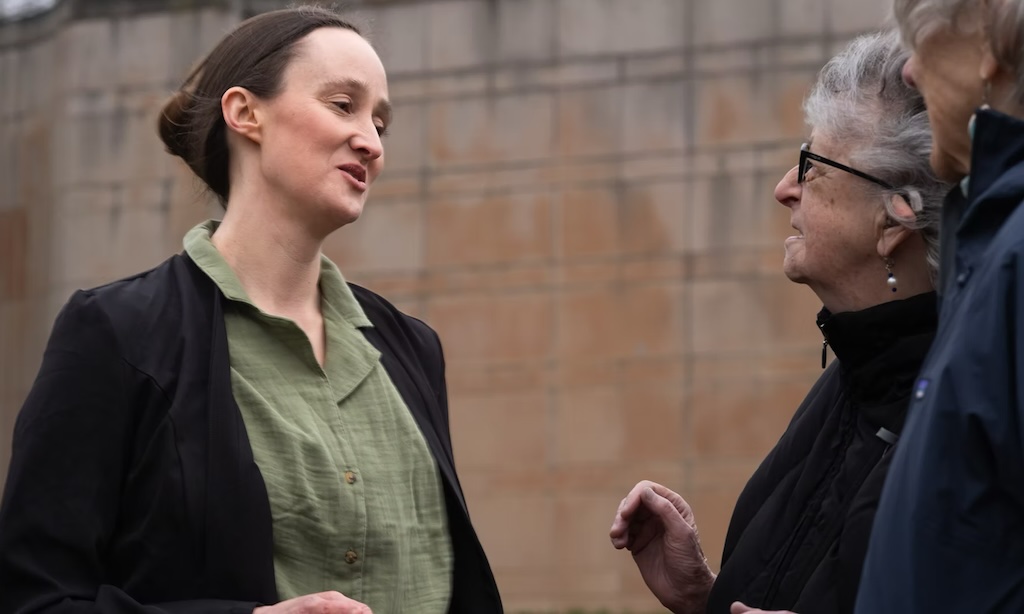
Katie Wilson, a self-described democratic socialist and longtime community organizer, narrowly defeated incumbent Mayor Bruce Harrell in November in a race that reflected deep public frustration with rising housing costs, homelessness, and economic inequality. (Photo by Sarah Kusz / courtesy of Katie Wilson for Mayor)
- Interview by
- Jordan Bollag
Katie Wilson is being sworn in today as the fifty-eighth mayor of Seattle, following one of the closest and most consequential mayoral contests in the city’s recent history. Wilson, a self-described democratic socialist and longtime community organizer, narrowly defeated incumbent Mayor Bruce Harrell in November in a race that reflected deep public frustration with rising housing costs, homelessness, and economic inequality.
Wilson’s path to City Hall was not conventional. A political newcomer in terms of elected office, she built her reputation over more than a decade as cofounder and leader of the Transit Riders Union, advocating for transit equity, renter protections, and progressive revenue measures such as the JumpStart payroll tax on large employers. Her campaign tapped into widespread dissatisfaction with Seattle’s affordability crisis — where many households spend a disproportionate share of income on housing — and offered a platform centered on expanding affordable and social housing, rethinking public safety approaches, and pursuing tax and spending reforms to shift the city’s policy priorities.
In a wide-ranging conversation with Jacobin, Katie Wilson discusses how her administration plans to confront Seattle’s affordability crisis, and what it would mean for a democratic socialist to govern effectively from City Hall. Wilson reflects on the limits of symbolic politics, the hard trade-offs of executive power, and the challenge of delivering tangible improvements in everyday life — while building a broader working-class coalition capable of sustaining change beyond a narrow electoral victory. The interview has been edited for length and clarity.
Jordan Bollag
What were the major issues that came up in your campaign, and what are your policy priorities for the city?
Katie Wilson
I campaigned on a strong platform and message of affordability. The issue that prompted me to get into the race was the vote in February on funding for Seattle’s new social housing developer. And I think among other things, that [ballot measure] showed that people really feel the affordable housing crisis is a top issue right now.
Coming out of the pandemic, we’ve seen enormous increases in basic cost of living, from the cost of rent to the cost of childcare and food and everything. And I think it’s at this point where not just the lowest-income households, but people who consider themselves middle class or who have decent jobs, are just looking around and wondering how much longer they can hold on in a city like Seattle. And so tackling the affordability crisis really was a core message in my campaign, and it’s going to be a core theme for me in office.
Of course, that’s easier said than done. But we need to do everything we can, pull all the levers we can at the city level to do something about the cost of these basic items.
Jordan Bollag
On homelessness, you’ve criticized your predecessor Mayor Bruce Harrell’s strategy of blanket sweeps without any next steps or support. But you’ve also had some interesting comments about how too often the Left has failed to put forward a response to this crisis. So how can we end the inhumane approach to homelessness that we see from the political establishment, but also give a positive left response rather than falling into a kind of libertarian hands-off approach?
Katie Wilson
During the campaign people would ask me, “What are your top three issues or your top three priorities once you’re in office?” And sometimes my answer to that was, “Homelessness, homelessness, homelessness.”
Back in 2015, Seattle first declared a state of emergency on homelessness and it’s just gotten worse since then. And particularly unsheltered homelessness. Seattle’s like a national outlier in terms of how many people we have sleeping unsheltered on the street, and it just can’t keep going that direction for so many reasons.
The homelessness crisis is going to be a major challenge for my administration. And [solving it] is not rocket science, in a sense. We have models that work. We know that the vast majority of homeless people who are living unsheltered, if they are offered a space inside that actually works for their needs and situation, they will accept it. And so, it’s a matter of creating those realistic pathways for people to get from the situation that they’re in to a place that is stable and where they have the supportive services that many people need.
But that’s hard for a lot of reasons. It’s hard for reasons of resources. It’s hard because some people, especially someone who’s chronically homeless and has complex needs related to drugs and mental illness may need a lot of support. And so, part of the question is just, where do the resources come from?
[There’s also the question of efficiency.] Right now, if you look at our homelessness response system, there are so many players, and often it ends up being really inefficient in the sense that we’re helping someone over here, but then they kind of fall off a cliff. So we’ve got the hospital that’s treating someone who is homeless and in crisis, and then they get discharged back onto the street. And it’s like, that is a moment where we should be helping someone inside. To some extent, it’s a matter of reorganizing the systems that we have so that we’re actually creating those realistic pathways for care.
On the Left, as radicals, we like to go to the roots, which is always good. And long-term social housing is an anti-homelessness policy.
We know that high housing costs and the affordable housing shortage are at the root of our homelessness crisis. That’s been established, if you look at jurisdictions around the country, and there’s a very direct relationship between housing costs and availability of affordable housing and homelessness rates. The results aren’t going to be immediate, but we obviously need the kind of upstream root-cause policies that support people and families so that they don’t become homeless in the first place.
In Seattle in particular, given our rates of unsheltered homelessness and, like you said, the policy of the outgoing administration which is just sweeping people from place to place, we need that short- and medium-term plan that both recognizes the tragedy that unsheltered homelessness is for the people living it, and then also takes seriously the public safety and quality of life issues that it creates for other people.
Sometimes [people] on the left have an attitude, and I’ve been guilty of this myself in the past, where we kind of look down on people who get frustrated about having to routinely see and interact with homeless people who are mentally ill or using drugs in public or whatever. And we think of them as lacking compassion or just not understanding the roots of the crisis. But I think we have to understand that that anger and the tendency to cast blame, whether that’s at the city or at homeless people themselves, it’s kind of a natural reaction.
And this is really a working-class issue too, right? If you’re rich and you just drive into the garage of your fancy condo tower or you live in a gated community — you’re mostly insulated from this homelessness crisis. But if you’re a working person who rides public transit and walks around your neighborhood, you probably are going to have some interactions that are disquieting and sometimes frightening. And if you work in a grocery store or a public library or you drive a bus or some other job where you interact with the public on a daily basis, that’s even more true. Lots of frontline workers are assaulted by people experiencing mental health crises that are exacerbated by being homeless. And during the campaign, I talked to many such workers, and often they’re young people with progressive left politics, but then their personal experiences at work lead them to what might sound like incongruous positions on homelessness and public safety. They’re like, “No, I want more cops around.” Or they’re like, “Yeah, some people need to be forced into treatment.”
I think that we need to take this really seriously on the Left and really understand the nuances of it. So we need short- and medium-term approaches that really start from these realities and these experiences, and then also take seriously the need for increased investment in drug treatment and mental health treatment, as well as shelter and housing. And also understand that there is a role for law enforcement. That people who are homeless and addicted to drugs are often involved in various kinds of illegal activity beyond just existing in public space and using drugs. And how we deal with the kind of hotspots that exist in certain neighborhoods in Seattle where there is active drug dealing and markets in stolen goods. That’s not easy, and there’s a role for police in that.
So anyway, it’s complicated and I know that I don’t have all the answers, but I really do think that this is something that we have to figure out. I’m sure it will not be without controversy and missteps, but, it’s definitely a very high priority for me to make progress on some of those really gnarly issues. And honestly, there are going to be issues, there are going to be policies that I put forward and issues that my administration champions that are going to put us at odds with business or certain parts of the business class. But I really think that homelessness is an area where my administration’s going to have to work closely with a lot of business interests and where there are honestly some very strong shared priorities. There might be differences of opinion about how we pay for stuff, but I can tell you that businesses small and large are desperate for real progress on the homelessness crisis.
Jordan Bollag
In your race, just like in Zohran Mamdani’s race, your opponent attacked you for previous support for defunding the police. I thought you were effective at acknowledging both where the movement was coming from but also the problems with the approach. Mayor Harrell ran on public safety, but did not really deliver, and he oversaw shortages and turnover at the Seattle Police Department. So what would be your vision on public safety and having an effective police response but also holding police accountable for overreach? There’s been discussion of the recent SPOG [Seattle Police Officers Guild] contract and your decision to keep [Chief of Police Shon] Barnes, and I’m wondering what you’re thinking about all that.
Katie Wilson
I mean, it’s funny reflecting on the total discrediting of the defund slogan, in terms of everyone just being like, “Oh yeah, defund failed.” But if you think about it, a big part of that platform was establishing an alternative response [to public safety] and civilianizing roles that police don’t need to perform. And those things remain extremely popular, right?
On the campaign, I spent a lot of time talking about like, yes, we need to expand our CARE Department, which is Seattle’s alternative response, and we need to make it effective and allowed to respond to more kinds of calls, and we need to civilianize other roles that the police don’t need to perform, like responding to non-injury traffic accidents and taking down reports of property crime. And all that stuff was totally part of the defund platform.
I don’t think we would have a CARE Department today if it wasn’t for the 2020 movement. The SPOG contract that you mentioned puts some unfortunate limitations on the kinds of operations of the CARE team in terms of the kinds of situations that they’re allowed to respond to.
I’m hoping that we can get creative, with leadership from the mayor’s office in coordination with the police department, with the CARE Department, and with our fire department, as well as with external service providers that have alternative response or street outreach teams and things. I think that we can actually do a lot more than we’re currently doing in terms of making sure that the right kind of responder arrives at crisis calls, and that we’re not responding with an armed police response when it’s unnecessary.
I’m really eager to get to work on that. And then in terms of policing, accountability is still an issue. We have this 2017 accountability ordinance which, while not perfect, also just still has not been implemented, largely because of the police contract. So there’s work to be done there, although, until the contract comes up for negotiation again, we’re a little bit limited in what we can do.
I do think that we need to focus on better policing, trying as much as possible to recruit officers from within the neighborhoods and communities that they’re going to be policing in. And we’re also very far from our goals in terms of hiring women officers. And I understand the kind of leftist response that says, “you can’t reform policing just by making the officers look like the diversity of the population.” But I do think there’s an importance to that. It speaks to the culture within the department.
We can make progress on all of that, and we need to, and then, obviously, there are all of the upstream things that we need to do to make crimes of poverty and desperation less likely. There’s a whole area of work around gun violence prevention and youth violence prevention, and how we can better support underserved youth and make sure that we have mentorship programs, job training programs, and places that youth can go where they don’t have to spend money, where there’s community and things for them to do.
All of that I think is really important. And then honestly, just making real progress on unsheltered homelessness is a big part of this as well. Police spend a huge percentage of their time on homelessness-related things.
Jordan Bollag
You mentioned that you launched your campaign in the wake of the victory of a ballot initiative to fund mixed-income, publicly owned social housing. But we’ve already seen delays and turmoil and funding delays and turnover at the social housing developer. So, how can we make sure that we actually build social housing at a large scale, so that it’s something that makes a real difference in people’s lives?
Katie Wilson
Yeah, I think this is so important. This is why I jumped into the race, and it’s so important to me that our social housing developer is successful. It’s going to be a big project to really get the social housing developer up and running so that it can build social housing at scale and also operate it.
This is especially important given the goals of the developer to have resident participation in the management of the buildings. It’s so important that we get it right and that it’s not seen as a failure. [But] like you said, it’s been slow going, and part of that is because of lack of support from the mayor’s office.
In the first half of this year, the revenue is going to start coming in from the new tax that was approved in February. And I think that’s anticipated to be about $50 million a year. I haven’t seen any updated revenue projections, so I don’t know if that’s changed. So it’s very important that we’re ready to receive that money and to begin putting it to good use. That’s going to be a very high priority for me.
Fifty million dollars a year is a lot of money, but not when it comes to developing and building new housing [at scale]. So we’re going to need to be creative about acquiring existing housing as well as developing new housing. And one thing I talked about on the campaign was exploring using the city’s bonding capacity. So I do think that that’s something that we should look at, to figure out if that is a good idea. There’s another idea that I’ve been thinking about that I know the folks over at Washingtonians for Public Banking have put forward, I’ve discussed with them a little bit, which is basically creating a public bank or a public development authority that could start as a revolving loan fund for the social housing developer using the city’s current assets.
So that’s kind of a potential alternative to issuing a huge bond that would have to be paid back with interest. The upshot is my administration is going to be doing some deep thinking about housing finance and how we can best use the money that’s coming in, and other ways that we can leverage the city’s assets and borrowing power to make sure that we’re able to get the social housing developer and build housing at scale.
That could also look like exploring partnerships with Seattle Housing Authority, with King County Housing Authority, and other entities. One of the cool things about the social housing developer is that it’s committed to union-built housing, which is somewhat unusual for the affordable housing sector, and I think there’s an opportunity there to build the political coalition that has an interest in doing this at scale, and coming up with the resources to do so.
And it’s an interesting time to be thinking about that, because we’re in a moment where the private housing market is flagging in terms of construction. Permit applications are way down, and there are lots of union workers out of work. So, can we get it together to build the political momentum to really get social housing going in a way that can be a significant investment in our economy, in a way that’s putting union workers to work in the coming years?
Our goal is to build affordable housing at scale, but there are also other models of nonmarket, community-owned, and community-controlled housing and space that the city should be doubling down on. Seattle already has land trusts, co-ops, and projects that create affordable housing for artists and other residents, and the city can be a much stronger partner in supporting and expanding those models.
Jordan Bollag
Fifteen years ago, you founded the Transit Riders Union, which has fought for a city that’s walkable, bikeable, and has reliable public transit. Now that TRU’s founder has been elected mayor, what does that mean for the transportation and the urban planning in Seattle?
Katie Wilson
I think that we deserve a world-class mass transit system in Seattle so I’m definitely going to be working on that. One way that I think about this is in terms of “mode shift.” It’s kind of an abstract way to look at it, but, from the point of view of the climate crisis, from the point of view of improving the quality of life in this city, how do we shift people away from single-occupancy vehicles and toward other modes?
The city has some rather ambitious goals around mode shift that we are just not anywhere on track to meet. So, the city can do a lot of things, and one is improving public transit.
We don’t directly control King County Metro, the bus system, but the city does buy a lot of bus service from Metro. We have a renewal measure coming up next year for some of that, so that’s an opportunity to think about how we’re doing that, possibly expanding that.
The city can do dedicated bus lanes. One of the issues I campaigned on was bus lanes on Denny, for Route 8. So things like bus lanes and bus shelters and the kind of infrastructure around the bus system that the city controls — I think there’s a lot more that we can do about that. I also will have a seat on the Sound Transit board, and there are a lot of critical decisions to be made — unfortunately mostly having to do with huge budget shortfalls — around Sound Transit.
A lot of the work that I did with the Transit Riders Union was around transit affordability, and winning free or low-cost fare programs. One piece of legislation that the Transit Riders Union was actually working on — that was interrupted by the pandemic — would have required large employers to pay for transit passes for their workers. That would be a first-in-the-nation thing as far as I know, and I still think that’s a good idea.
In general, free transit is worth exploring. There are some real trade-offs there just because money that you would spend making transit free can also make transit better, and if you make transit free, it becomes even more important to make it better because more people start using it and it kind of overtaxes the system. But I think that’s worth exploring, and that would be a conversation with King County because it would be in some ways hard for Seattle to do that alone.
And obviously, bike and pedestrian safety is really important. Another thing I’ll say is just that, transportation is one thing, but dense, affordable housing is also a transportation strategy and a climate strategy, because when people live near where they work, near where they do other things, it also becomes more feasible for them to bike, walk, take transit. So transportation can’t really be isolated from housing policy.
I’m inspired by what socialist mayors in Europe have done; so we’ve got Anne Hidalgo in Paris who has gone big on social housing and the “fifteen-minute city” concept and expanding bike lanes around the city. In Madrid, there’s Manuela Carmena, and she did a lot of public housing and these low-emission zones, which is a concept that’s been talked about here too, and then there are the “superblocks” in Barcelona that Ada Colau pioneered.
So there’s a lot of cool socialist left–urbanism kind of ideas that are inspiring, that we can look at in other cities.
Jordan Bollag
That brings me to another question, which is that relatively recently, you’ve been identifying yourself more often as a socialist, but it wasn’t necessarily a front-and-center label in your campaign. So what does being a socialist mean? What is the importance, or lack thereof, of the label?
Katie Wilson
First of all, I’ll say I’ve been a socialist for a very long time, since before it was cool to be a socialist.
I was a socialist when I moved to Seattle back in 2004. I don’t know how deep to go here, but one thing I’ll say that’s relevant and that ties to my career is just, as a socialist, I believe that the profound changes that need to happen in our society and our economy can only be accomplished through the organized power of working people.
I think that a major challenge for the Left in the twenty-first century is figuring out how we organize effectively and build real institutional power, and the labor movement has historically been a major vehicle of that. And obviously it’s critical to hold the line and build union membership as much as possible, but union density keeps falling, and there are structural reasons for that that are not easily overcome. So we also need to experiment with other forms of organizing and building power, and that belief has really guided my career.
I cofounded the Transit Riders Union as kind of an experiment in that vein, and we started out as this anti-austerity membership organization of transit riders during the Great Recession and grew into a multi-issue, economic justice organization that fights for higher wages, stronger renter protections, progressive taxes, and so on. That kind of emphasis on organizing and building power is a really important part of it for me and something that I plan to carry into the mayor’s office.
Using that office to encourage grassroots organizing, to put forward policies that folks on the outside can organize and build power around is really important to me.
If you’re asking what being a socialist means theoretically or something, I could talk to you about that for a long time, but right now the engine of our economy is the endless accumulation of private profit, and capitalism has been very effective at producing wealth and incentivizing certain kinds of creativity and innovation, but it also tends to concentrate that wealth in the hands of a few, and it rests on exploitation of workers and the natural environment and has at its core this self-undermining dynamic that in my opinion marks it out as a transitory phase in humanity’s evolution. I think that we can do better and that, ultimately, we’re going to have to figure out how to do better.
It’s tempting for me to use my mayoral platform to start a big conversation around socialism, but I don’t think that’s what I was elected to do. So yeah, I didn’t make being a socialist front and center of my campaign, but I also didn’t shy away from the label.
The other thing that I’ll say is in terms of how [being a democratic socialist] influences my mayorship: I have a very deep appreciation of how change happens, and that it comes from the bottom to the top, so using the office to encourage organizing and building power is important. But also, as a socialist, the more that we can move toward recognizing things that are public goods, and fund and provide them as such, the better, right? Childcare is an obvious example where, at least in the United States, we totally fail to treat childcare as a public good. Maybe a less obvious one is high-quality local news, and I have a proposal that I’m excited to roll out at some point around public funding for local news outlets.
So that’s thematically related to being a socialist — believing that we should be providing more things publicly, and in general, this moment with obviously Mamdani being the big example, I think we have this opportunity here in Seattle too. There’s this opportunity for socialists or people coming from the progressive left who are coming into executive positions like mayorships to really show that we can govern, right?
And if we’re socialists, we believe the government should be able to do big things. So if we’re trying to make the case for socialism, but then our government is failing to deliver basic services, that’s a problem, like, we’re not making our case very well. I just think that there’s an opportunity here to demonstrate that competence. I don’t want to minimize the challenges or ignore the deliberate undermining of government that’s happened in the context of neoliberalism, but I do think that there’s a lot that we can do at the local level. It’s a kind of sewer socialist mentality. But I think that there’s a lot we can do.
Jordan Bollag
Another important socialist mayor was Bernie Sanders, who won his first election by a mere ten votes, which is similar to you, really winning this election by a tiny margin. And in Bernie’s case, he won reelection by a much larger margin, really created a movement, and mobilized ordinary people against the city’s political establishment successfully. But there are also left-wing mayors who have lost support. We’ve seen in Chicago poor approval ratings for Mayor Brandon Johnson. In Seattle, a few years ago, we had a wave of more conservative candidates defeating progressive incumbents.
So, given that the business establishment, or what we might call the capitalist class, is going to try to crush you on many issues, how can we expand our base and turn this victory into a larger transformation?
Katie Wilson
That’s a great question. I think there’s a real opportunity here, partly because even though my victory was narrow, if you look at how I was attacked during the campaign, it wasn’t really about being a socialist or being on the left. They tried that before the primary, and it just didn’t work. There was a Seattle Times piece in the fall where they talked to the other side’s political consultants, and they said they’d tested different lines of attack in focus groups. The idea that I was “too far left” just didn’t resonate. So they ended up focusing almost entirely on me being inexperienced.
And I think that’s important, because it suggests that the vision and platform I put forward are actually more popular than the narrowness of the win might imply. There are a lot of people who were fine with the agenda itself, but who voted for Harrell because they were persuaded — by a couple million dollars’ worth of advertising — that I wouldn’t be able to carry [that agenda] out.
So what I think that means is that, if we show real effectiveness, a lot of those people will come around. There are plenty of folks who didn’t support me in the election but actually want me to succeed — they just doubted that I could do the job, in large part because they were getting mailers with my ten-year-old résumé on them or whatever.
Ultimately, people want to see results, and that’s going to be the key. In terms of certain elements of the business establishment, or the capitalist class, trying to undermine me, like yeah, sure, that’s going to happen. I do really think, and — we’ll test this out in practice — but I really think that homelessness and public safety are two areas where there is a lot of common ground, and where they want to see progress and everyone wants to see progress.
And so I think this is really a matter of, again, demonstrating results on issues that everyone cares about and being smart about picking your battles.
That’s really going to be the key, being smart about picking your battles, and then also being smart about how you conduct those battles. The big, ambitious, controversial things that I want to do, it’s going to be very important to build a coalition that can support them and to have a real strategy around organizing and building the public will and narrative that makes things that looked impossible become inevitable.
So there’s a lot of strategy involved there, and there’s going to be a lot of organizing and coalition-building that’s going to go into that. It’ll be interesting to see what happens.
Jordan Bollag
That makes me think about the role of grassroots organizing during your administration. Zohran emerged from the Democratic Socialists of America, while you come out of the Transit Riders Union. I’m curious how you see your relationship with progressive organizations going forward. In New York City, we’ve seen the launch of a new group, Our Time, meant to organize Zohran’s supporters around his agenda. Do you think something similar makes sense in Seattle, or do you expect to work primarily through existing organizations like TRU, DSA, or others?
Katie Wilson
I don’t think those two things are mutually exclusive, and, I don’t want to anticipate any announcement that we might make, but let’s just say there are discussions going on, there are plans afoot to perhaps create something analogous to Our Time.
I think that becomes important because there are all these people who got involved in my campaign and who are attached to the movement, so to speak, through that, right? And so you don’t want to lose those people. So we may be going in that direction. But in my mind, creating a new organization, it’s not going to be this fully-fledged membership organization in the way that TRU or DSA are, right?
I think that part of the function of that organization we would build would be to be a bridge between campaign volunteers and people who are kind of connected to my campaign or my administration, to organizations like DSA and TRU, that are organizing at a deeper level.
I anticipate that, as we take up specific issues, we’ll be looking for ones we can move on relatively quickly. One example I talked about on the campaign is rental junk fees. It’s a really good organizing issue because it’s broadly popular — no one likes hidden fees.
At the same time, what we’re able to win will exist along a wide spectrum, from legislation that’s watered down and not very helpful to something much more robust. Where we end up on that spectrum will depend heavily on the strength of the organizing that happens on the outside. I would expect to convene a group of organizations that do, or want to do, tenant organizing, and work together to develop both an organizing strategy and the legislation itself.
Jordan Bollag
How do you see your role in engaging beyond the city, in the county- and state-level reforms you will need in order to deliver for Seattleites?
Katie Wilson
I anticipate having a very close working relationship with our new county executive, Girmay Zahilay, on the many, many issues that cross the city and the county, and obviously transit is a big one of those. And homelessness is a big one of those too because the city and the county jointly fund and influence the King County Regional Homelessness Authority. Also public health is housed at King County, and then also our court system and King County Jail. There are all these issues where really close collaboration is necessary, and so I anticipate doing that. And then at the state level, there’s so much. We have our Seattle delegation, or our legislators from Seattle, and I also anticipate working closely with them. Tax reform, progressive revenue at the state level is very, very important right now.
We have this very regressive tax system in Washington State, still the second most regressive in the country, and so I think that the city can be a really strong voice and strategic partner in figuring out how we move our tax system in a more progressive direction. Taxing the rich and wealthy corporations instead of working and poor people. And that’s both getting more revenue at the state level for things that affect Seattle residents, but also getting more local options for tax authority.
That’s actually more important in the county than the city because the city already has more tax authority than the county does, for example. It would be great to have a progressive statewide income tax. So that’s a project to work on. A lot of the things that I’ve worked on in my career with the Transit Riders Union, like minimum wage stuff and renter protections, ideally that is stuff that would be done statewide.
So I think there’s an opportunity for Seattle to take a leadership role in convening progressive local elected officials around the county and the state in advancing policies locally that can help to create a statewide movement. For one example, on the junk fees thing, up in Bellingham, they passed legislation around rental junk fees, which has ended up not as strong as one might hope, but it’s cool that they did that. And I know the DSA up there was involved, and Jace Cotton, the council member up there who pioneered it, we were in touch with him at the Transit Riders Union. When one jurisdiction does something, I think it can inspire other jurisdictions, and it would be cool to have that happen more systematically and really link up progressive and leftist-socialist electeds around the state to do stuff that could then turn into statewide legislation.