Coupang, South Korea’s Amazon, Is Copying Its Worst Habits
The South Korean e-commerce platform Coupang has been engulfed by scandals over data breaches and dangerous work conditions. Having spent millions to lobby US politicians, the firm is now calling in their help to protect it from scrutiny by regulators.
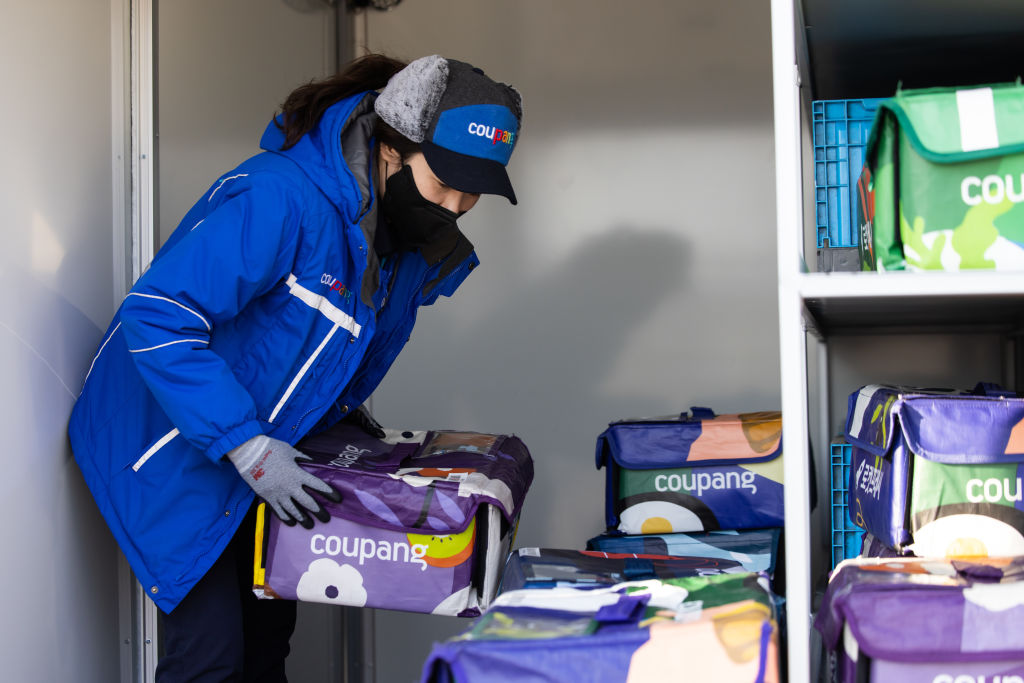
From ruthless pricing strategies to the aggressive elimination of competition, South Korea’s Coupang has emulated Amazon’s early expansionary phase. Above all, both firms have been taking advantage of the precarity of labor to expand their territory. (SeongJoon Cho / Bloomberg via Getty Images)
Coupang, an e-commerce platform that is listed on the New York Stock Exchange (NYSE), has been stirring public outrage over the past few months in South Korea, home to most of its colossal operations, amid revelations of massive data breaches and unsafe workplace practices.
What is happening to the South Korean multinational should reverberate beyond the country’s borders. The ways in which it has been shirking accountability and regulatory oversight, and resisting unionization efforts, speaks volumes about the future trajectory of global e-commerce platforms and their workers.
Coupang is South Korea’s answer to Amazon and Uber Eats combined. Its labor malpractices were already clear back in 2021, when the company went public on the NYSE. The past two months have validated the concerns expressed at the time.
In December, Coupang disclosed a massive data breach that exposed almost thirty-four million customer accounts. The national ID numbers and financial details of about three-quarters of South Korea’s population above the age of twenty are likely to have been compromised.
Public anger has brought the platform’s mistreatment of its workforce into focus. In 2025 alone, eight Coupang workers died of overwork-related conditions such as cerebral hemorrhages, with six of them working on a nighttime or predawn shift.
The Alphabet Soup of Exploitation
Bom Kim, a Korean American Harvard Business School dropout, launched the Coupang site for trading discount coupons in 2010. Over the next few years, it became a full-fledged e-commerce platform with more than one hundred fulfillment centers.
From ruthless pricing strategies to the aggressive elimination of competition, Coupang has emulated the early expansionary phase of Amazon. Coupang now controls about a quarter of South Korea’s e-commerce marketplace, which has become the world’s fifth-largest after expanding tenfold over the last decade.
The country’s sprawling and densely populated urban areas offered Coupang ideal terrain for rapid growth. The platform also capitalized on South Korea’s famous 24/7 urban life cycle by offering early-morning and late-night deliveries. However, despite strong revenue growth, Coupang has suffered from inconsistent profitability since 2022, when it turned its first-ever quarterly profit, largely thanks to pent-up demand during the pandemic.
Above all, both Coupang and Amazon have been taking advantage of the precarity of labor to expand their territory against both online and brick-and-mortar rivals. In the United States and South Korea, Amazon and its clone have helped reshape labor markets with their reliance on at-will employment. By 2021, Amazon lost about 3 percent of its hourly employees weekly, pushing the annual turnover to about 150 percent. Yet it remained among the largest employers, with one in every 350 Americans working for the firm.
With about ninety thousand workers on its regular payroll, Coupang is the country’s third-largest employer, trailing only Samsung Electronics and Hyundai Motor Group. The South Korean platform hires an equivalent number of at-will employees through short-term contracts or its smartphone apps.
In particular, Coupang Fulfilment Service recruits approximately ten thousand daily workers every day, according to Jeong Sung-yong, president of the Coupang branch of the National Warehouse Workers Union. The union is an affiliate of the Korean Confederation of Trade Unions, which has more than a million members in total.
“In recent years, HTP increased 1.5 times or even doubled,” Jeong told Jacobin. “HTP” refers to High Performance Throughout. Coupang substituted this acronym for “UPH,” Unit Per Hour, in 2021 after media exposés of the staggering work quotas in its fulfillment warehouses and delivery networks.
However, there was no reduction in individual workloads after the new label was adopted. Under HTP, each worker’s performance is measured in real time through a Personal Digital Assistant, or PDA, that they are required to carry, according to the labor organizer. “Overall, fewer workers are assigned to each fulfillment,” Jeong added.
Each warehouse recruits at-will workers based on its quotas. At-will employment also serves to obstruct unionization: Coupang mixed regular and temporary workers together on the same fulfillment lines. Jeong’s union has had more than eighty negotiations with management since August 2021 but has yet to reach a collective bargaining agreement.
Better Than Nothing
Coupang and other at-will employers have also altered the very concepts of jobs and job security. The normalization of precarity means that desperate local governments provide generous tax credits to Coupang for fulfillment facilities. Many young workers increasingly depend on the Coupang app to patch over short-term financial shortfalls.
In its latest impact report, Coupang Fulfilment Service boasted that 62 percent of its delivery drivers worked five days a week — the legally mandated workweek — without disclosing their average work hours. As the country’s third-largest employer, the platform does not provide its non-regular employees with contributions toward any of the so-called four mandatory social protections (national pension, health care, unemployment insurance, and workers’ compensation). By contrast, many large Korean firms extend such coverage, at least in part, even to contract workers for whom it is not legally compulsory.
It is little wonder that some young workers disagreed when labor and human rights activists called on Coupang to repeal its early-morning and late-night deliveries. For many, such at-will jobs are the only immediately available source of income, despite the health hazards and safety risks involved.
When asked whether the union called for repeal, Jeong replied, “As a matter of principle, these deliveries have to be abolished.” He acknowledged widespread concerns among current and prospective Coupang workers about potential pay cuts as a result, but insisted that “our demand to end midnight delivery has meaning.”
According to Jeong, guaranteed break time is a more urgent priority for the workers: “A twenty-or fifteen-minute break every two hours can ease the intensity of nighttime work.” At present, there is no mandated break time beyond a single meal break.
Divergent Governance
Coupang was among a few South Korean start-ups setting sights on an Initial Public Offering (IPO) in the United States. Long before its 2021 IPO, US nationals exclusively filled directors’ seats and named executives’ offices, making Coupang the country’s largest employer of simultaneous interpreters.
Its NYSE listing helps Coupang dodge accountability, according to Jeong. The company’s chairman and CEO Kim has used his US citizenship and Coupang’s US incorporation to resist answering a summons from South Korea’s National Assembly.
In December, when public anger surged over massive data breaches, Kim swiftly relinquished the post as representative director of Coupang Korea, the operation unit. He appointed CAO and legal counsel Harold Rogers as interim CEO of Coupang Korea, who later vehemently defended Coupang’s security and labor practices at a legislature hearing.
Kim’s departure from Coupang Korea was only a stratagem. Coupang Korea is wholly controlled by NYSE-listed Coupang Inc, in which he controls 74.3 percent of voting power through his privileged shareholdings.
What stands out in Coupang’s governance structure is its near-total detachment from the daily interests and needs of ordinary employees. Cash incentives for named executives are tied to talent retention, instead of individual or corporate performance. In simpler terms, certain executives receive cash bonuses to keep them from leaving. Other incentives come in the form of stock awards. Beyond shareholder value, there is no other form of incentivization, effectively severing executive priorities from shopfloor realities.
Amazon is more forthright about this. Its two-tier remuneration structure prioritizes stock-based compensation for executives and software engineers while fulfillment and delivery workers are paid in cash. The expendability of the latter is structural, because ordinary workers are not part of their employer’s big picture.
At both Amazon and Coupang, an army of precarious at-will recruits make this financialized governance possible. The separation between long-term corporate strategy and the interests of non-executive employees feeds (and feeds off) the financialization of the e-commerce platform industry. Jeff Bezos, founder of Amazon, was serious in his message to shareholders in 1999: “I constantly remind our employees to be afraid and to wake up every morning terrified.”
Full-Court Press
All in all, these platforms tend to treat questions of workplace safety and labor rights as reputational risks — liabilities that might dent stock prices. Managing public perception and relations with shareholders, consumers, and regulators often takes precedence over conditions on the shopfloor where they could substantially improve productivity through better safety measures and treatment of employees.
Ahead of its IPO, Coupang named Baek Suha, a former journalist, as vice president of communications. Baek gained notoriety between 2014 and 2018 while serving as an executive at Samsung Electronics, where he orchestrated a media campaign to discredit SHARPS, an advocacy group for occupational disease victims of the electrics giant.
Kong Jeong-ok, a physician and a founder of SHARPS, was scathing in her comments:
He has deeply hurt activists and victims although we won every single defamation lawsuit against the false press reports instigated by Baek. Baek effectively authored a corporate playbook to suppress industrial safety activism and investigative journalism. He is human trash.
Coupang has also hired dozens of former Labor Department officials and lawmaker aides to lobby regulators and politicians, according to local press reports. The Delaware-incorporated South Korean platform spends nearly $11 million annually on political donations and lobbying efforts in the United States. Its influence appears to have made its way into legislative discourse.
At a January hearing, Nebraska Representative Adrian Smith accused South Korean regulators of aggressively targeting Coupang. In addition, two US investors, Greenoaks and Altimeter, have asked the US Trade Representative to investigate South Korea’s probe of the company. They present the probe as unwarranted interference with an innovative platform that calls for “appropriate trade remedies, potentially including tariffs and other sanctions.”
The experience of Coupang and Amazon shows that financialization and labor precarity go hand in hand. This has become a global norm. In China alone, about two hundred million gig workers now depend on smartphone apps for their livelihoods.
Yet across the roughly $6 trillion global e-commerce market, many platforms find themselves unable to achieve consistent operational profitability. Instead, they rely on inflated stock valuations and relentless pressure on labor to stay afloat while making a handful of executives and directors rich.
This trajectory is unsustainable unless it further immiserates labor and accelerates the financialization of the industry. The Left and organized labor together need to respond to this global challenge in a global way.