Big Oil’s Motives Behind the US Attack on Venezuela
In an interview, investigative journalist and oil policy analyst Antonia Juhasz weighs in on what the fossil fuel industry really wants in Venezuela and how the current situation compares to past wars fought over oil.
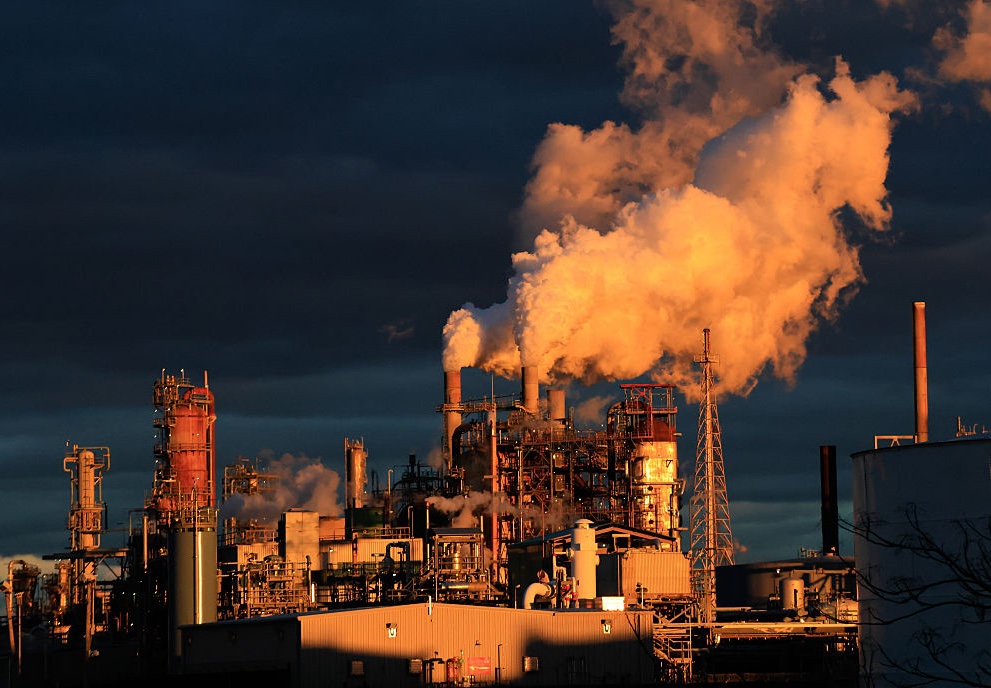
Donald Trump says that with his attack on Venezuela, he wanted to “take back the oil” that was nationalized by the Venezuelan government. (Kena Betancur / Bloomberg via Getty Images)
- Interview by
- Emily Sanders
President Donald Trump hasn’t minced words in his justification for the raid and capture of Venezuelan president Nicolás Maduro: he wanted to “take back the oil” that was nationalized by the Venezuelan government. Trump, who promised to fulfill Big Oil’s wishes in exchange for campaign donations, told reporters over the weekend that he met with “all” of the American oil companies before the raid and that “they want to go in so badly.” Such claims have led Senate Democrats to launch an investigation into these communications.
But even as their stocks ratcheted up in the wake of the raid, companies like ExxonMobil, ConocoPhillips, and Chevron are denying any involvement or advance notice of the invasion, albeit under the cover of anonymity, and industry sources are saying that Big Oil is actually hesitant to make the expensive and risky investment in Venezuelan oil infrastructure.
So what does Big Oil really want from Venezuela? How does the situation compare to past wars fought over oil? And what does it mean for the rest of us?
Investigative journalist and oil policy analyst Antonia Juhasz, who’s written several books on the topic of warmongering over oil, sat down with climate reporter Emily Sanders to explain what’s really going on — and what could come next. This interview was edited lightly for length and clarity.
Emily Sanders
What did you think when you first saw the news? How closely had you been following the attacks on Venezuela before this?
Antonia Juhasz
I’ve been following it pretty closely. It wasn’t that long ago that I was making the argument that Trump’s aggressive, illegal, deadly push against Venezuela was about oil. That was sort of pushing on the edges — he’s talking about supposed drug boats, but what this really is about is oil. And then suddenly, he started saying very clearly that it’s about oil.
It’s still unbelievably surprising. It’s still illegal. But I think the Trump administration has had a clear goal of removing Maduro and getting US oil companies back in on their terms. And now the administration is saying that out loud.
I’m very much of the opinion that primarily what is happening is a combination of US oil companies’ long-standing interests directing Trump’s actions, and then Trump being Trump, who’s a very difficult person to direct and control and contain. What’s happening in this administration versus the last one is that there are no guardrails, so Trump’s crazy talk becomes crazy action.
So I think there is a US oil industry thread that is playing out, ultimately the way they would like it to play out, while they’re also having to deal with and negotiate Trump’s “everything is about me” modus operandi. He is envisioning himself to be and aligning himself with Vladimir Putin and Mohammed bin Salman. That’s a difficult negotiation, I would imagine, for the US oil industry. But I also think that thus far, it looks like they’re going to get what they want, if they can contain Trump.
Emily Sanders
It’s really interesting to hear you say that the oil industry has a role here, because there’s been a lot of speculation that maybe this isn’t what they wanted at all.
Antonia Juhasz
I believe that the oil industry has been lobbying on this for a long time, and they’ve said as much outside of this immediate context. One of the things they do a lot around Trump is publicly protest too much and say, “Trump is pushing for deregulation, but that’s not what we are interested in.” They say in the media, “Just because Trump wants us to produce more doesn’t mean we’re going to.”
If the greatest lie the devil ever told was to convince us that he wasn’t real, the greatest lie the oil industry ever told us is to convince us that they don’t want oil. Where do we even begin to think about that as possible? They want to control when they produce it and how, and under what terms. They need to show a growing amount of oil that they can count as their reserves.
There are very few big pots of oil left sitting around anywhere unclaimed. The only way to get that is to increase technology, go into very expensive, technologically complex modes of production that face a lot of resistance. Venezuela is a country that [the big oil companies] were producing in not that long ago and making money in not that long ago and have wanted to get back into but on their own terms.
So I think when they protest publicly, one, it’s to distance themselves from Trump’s extremism, but two, it’s a great public negotiating tactic. They’re basically saying publicly, and the media is repeating it, “We wouldn’t want to operate in Venezuela. Oh, my God, it’s expensive, it’s technologically complex.” I actually think those are ridiculous things if you look where else they operate.
It helps their negotiating position with Venezuela, because ultimately, what this is about is: Will there be terms that will make it worth their while to go to Venezuela, and can those trust that those terms will carry into the future? Things like the cost of starting up Venezuela production, which is something that gets cited a lot.
Exxon was producing in Venezuela. So was ConocoPhillips. So was Chevron. When the Chavez regime changed the terms and took greater state control, Chevron accepted those terms. Exxon and ConocoPhillips did not. Exxon and ConocoPhillips operations were then expropriated by the Venezuelans. Exxon and ConocoPhillips believe that they are owed money, and my guess is that part of what’s being negotiated is the billions of dollars that they believe that they are owed, and then can they come back in under terms that they can trust and are favorable to them?
They [also] want greater access. Exxon is also operating in waters offshore Guyana that Venezuela and Maduro claim as theirs. Maduro has even sent military gunboats in to threaten Exxon. Marco Rubio was in Guyana in March and said we will defend Exxon from Maduro. This is a massive new production that Exxon started from scratch and has hardly cost them a penny, because Guyana is fronting the bill.
That’s what happens: the promise of production in the future entices governments to front-end the expenses for the wealthiest oil companies in the world at the start. Chevron has already said that they hope to help guide the development of the new era of Venezuela’s oil production.
This is all a negotiation. Now Chevron bought their way into offshore Guyana. [Oil companies are] also interested in offshore Trinidad and Tobago. They’re also interested in offshore Suriname. This is just one big pot of oil and gas. And what Trump has accomplished at the barrel of a gun is opening that door.
I think one of the things that the media has to be really careful with is not buying what the industry is spinning.
Emily Sanders
Trump has also talked about subsidizing the oil companies’ investments with US taxpayer money, and now, his administration is saying the US will control Venezuelan oil “indefinitely.”
Antonia Juhasz
He’s saying a lot of stuff! He also posted on Truth Social that he was directing about fifty million barrels of oil from Venezuela to the United States that he would make decisions about — he would sell it on the market and make decisions about the proceeds. According to Trump, some of those tankers were bound for China, but instead, he directed Venezuela to send them to the US. It’s just totally gangster. It’s just saying, “Give me this oil, or we will do worse to you than we did to Maduro.” It’s taking payment so that we won’t harm you.
I think he’s imagining the Venezuelan oil system to maintain a nationalized oil system, except with him at the top of it, deciding what’s going to happen.
Emily Sanders
At least initially, a lot of people were comparing this to the invasion of Iraq. It’s also part of a much broader history of US imperialism and resource extraction in Latin America. How does this compare or differ from other wars and conflicts over oil?
Antonia Juhasz
Trump has long said that he thinks that the Iraq War was a failure, that he would never repeat such a thing. And there are some misconceptions on that. The Iraq War was an illegal, horrific, unprovoked war, but it turned out great for the oil companies. All of the Western oil companies were shut out of Iraq, and as a result of the war, they all came in. They got huge fields and produced a lot of oil, and they continue to negotiate with the Iraq government. Obviously, it was a complete disaster for Iraqis and US soldiers and other members of the military who had to fight in that war.
Oil was the explicit reason for the first Gulf War, but in the second Gulf War, George H. W. Bush’s son, George W. Bush, a former oil man, learned the lesson, and denied that the war had anything to do with oil — which, of course, it did. The US has explicitly engaged in other wars for oil and other overt and covert engagements, but it’s rare for a president to say as much.
[Venezuela is] also different from Iraq, in that, I believe, from the Trump administration’s perspective, it’s over. They don’t care about remaking Venezuela. [The war in Iraq] was very driven by privatization and oil interests, but it had an imperial ambition. Trump, in his National Security Strategy and in his actions, has made clear he is concerned with a sphere of influence and other autocrats who he wants to be on a team with.
So Putin maintains his sphere of influence, and Mohammed bin Salman maintains his sphere of influence, and Trump gets his sphere of influence. And let’s just lay it out: These are all fossil fuel–based powers, right? Putin needs a world committed to fossil fuels to maintain power. Mohammed bin Salman needs a world committed to fossil fuels to maintain power.
Trump has joined that club, and to join that club, he needs to support their position. The United States is not dependent on fossil fuels at all, but US oil companies are. We don’t have to have that same agenda.
[That agenda has] broadened to now include Greenland, which I also ultimately think is about fossil fuels, since climate change is melting ice and creating more of the Arctic oil and gas accessible to drilling. It has repeatedly been called the next Middle East, the place where there will be wars for oil and the Arctic.
Emily Sanders
What does this mean for people on the ground, both in Venezuela and in the US, where more oil operations are going to occur, and what does it mean for the climate?
Antonia Juhasz
There was so much in that National Security Strategy document that had alarmed me, and somehow I had forgotten this particular line: “We reject the disastrous ‘climate change’ and ‘Net Zero’ ideologies that have so greatly harmed Europe, threaten the United States, and subsidize our adversaries.” So that is clearly the policy that this administration is advocating for domestically and internationally.
Venezuelan crude is heavy crude. It’s like Canadian tar sands. It’s much more harmful to the climate to produce and refine. Please read Adam Mahoney’s new article in Capital B, where he interviewed folks in Texas and Louisiana who are at the Gulf Coast refineries that refine the dirtiest crude in low-income black neighborhoods. Chevron refines its Venezuela crude in its Pascagoula, Mississippi, refinery. These are already extremely hard-hit communities of color that are going to face greater pollution and greater climate harms as a result of this agenda.
And anything that keeps us locked into a fossil fuel agenda reduces the time we have on our clock to avert the most disastrous harms of the climate crisis. This administration is taking time off of that clock as aggressively as it can.
For the people of Venezuela, we’ve already seen increased repression from the current Venezuelan government against any dissidents and journalists. This is an agenda that will further strengthen the hand of the US oil industry and the oil industry more broadly, and those who it supports. That is going to make it more difficult to address democracy anywhere.