Yemen’s Civil War Has Taken a Dangerous New Turn
A separatist group backed by the United Arab Emirates has seized power in Yemen’s two biggest districts. It’s part of an intensifying power struggle between Saudi and Emirati elites, with the people of both Yemen and Sudan suffering the consequences.
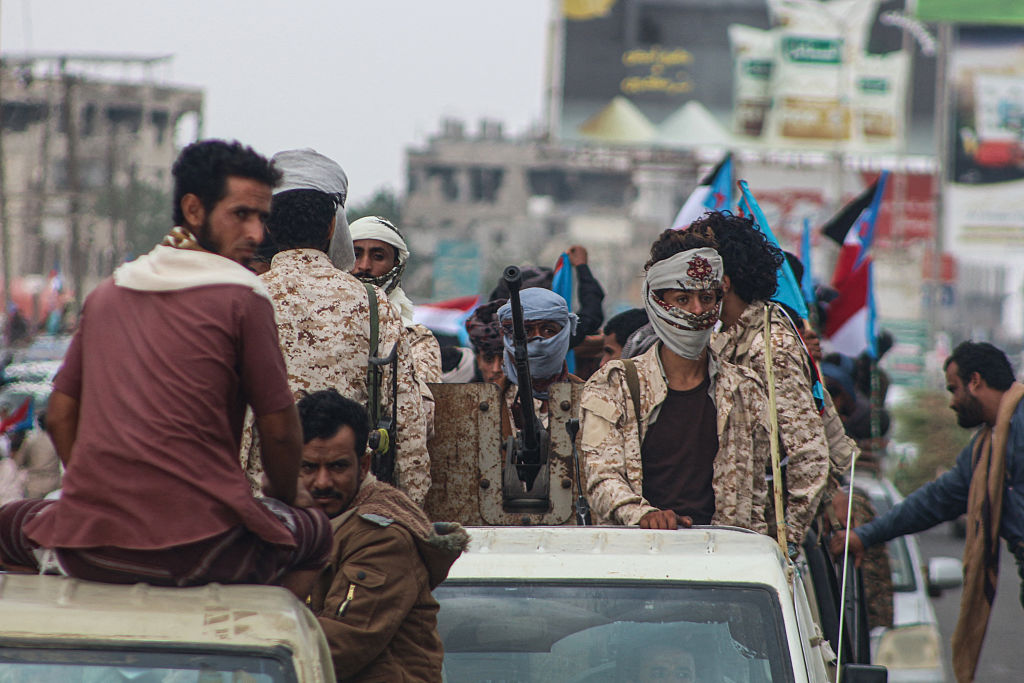
Members of the Sabahiha tribes of Lahj, who live along the strip between the south and north of Yemen, gather during a rally to show their support for the UAE-backed Southern Transitional Council (STC), which wants to revive an independent South Yemen. (Saleh Al-Obeidi / AFP via Getty Images)
Forces from the Southern Transitional Council (STC) have taken control of Yemen’s two eastern governorates, Hadhramaut and al Mahrah, to the dismay of both Saudi Arabia and Oman. The Saudi kingdom backs the Internationally Recognized Government (IRG), which had already lost control of Yemen’s capital Sana’a and much of its territory to the rival administration formed by Ansar Allah. Now the IRG is in further disarray.
The United Arab Emirates (UAE), which joined the Saudi-led military coalition fighting against Ansar Allah, has given its support to the STC. Saudi Arabia has withdrawn all its military forces to the border area, and diplomatic efforts to solve this major challenge to the IRG’s authority show little sign of success to date.
For the past three years, Hadhramaut has been the focus of a struggle between the separatist STC and the IRG’s pro-unity elements, with the former being stronger on the coast while the latter had their main base in the interior. STC control of almost all of Hadhramaut as well as al Mahrah has created chaos and instability in the one part of Yemen that had previously remained stable since the beginning of the conflict in 2015.
To understand the importance of this event and its likely implications, we need to take the specific history of the region and the wider international context into consideration — particularly the worsening rivalry between the UAE and Saudi Arabia.
Hadhramaut
Reports often describe Hadhramaut as Yemen’s largest governorate, referring to its geographical area, although they rarely mention its small population — about 2.5 million people from a total of nearly 35 million across the whole of Yemen. Thanks to oil production and export potential, it has become very important for Yemen’s national budget in recent decades.
Saudi Arabia’s lasting concern with the area stems from a long shared border and the historic relationship it has with some of the wealthiest Saudi business families, originally established by Hadhrami migrants a century ago. As a result, Hadhramaut has benefited from considerable Saudi investments in infrastructure, tourism, and industry, including fisheries, as well as easier access for labor migration to the kingdom.
The region has impressive potential for cultural tourism thanks to its topography and its mud-brick architecture. In colonial times, the interior’s three main towns, Shibam, Seiyun, and Tarim, were known respectively as New York, Paris, and Rome. Tarim also inspires comparisons with Rome thanks to its important role in international Sufism. Its most famous educational establishment, Dar al-Mustafa, receives international students, mainly from Southeast Asia.
During the British colonial period, both the Kathiri Sultanate in the interior and the Qu’aiti one on the coast were British protectorates. Neither joined the short-lived Federation of South Arabia that Britain set up in 1962, and they had almost no involvement in the struggle for independence that followed.
The National Liberation Front took over the Hadhramaut capital Mukalla in June 1967. This ensured that the region was included in the independent state formed on November 30, 1967, which promptly abolished all previous entities, including these two sultanates.
The People’s Democratic Republic of Yemen (PDRY) leadership was dominated by factions from a small area north of Aden. It engaged in a number of murderous internecine struggles (1969, 1978, 1986) during its twenty-three years of existence. However, those who were in charge made sure that Hadhramis held senior political positions, and these men avoided participation in these conflicts.
To understand present-day allegiances and divisions, the PDRY period and that of the unified Republic of Yemen that succeeded it are relevant. The PDRY’s egalitarian policies and hostility to ascribed elites were particularly divisive in Hadhramaut. In the early 1970s, many of those who belonged to privileged social groups emigrated to Saudi Arabia. The sada (descendants of the prophet, elsewhere known as Hashemites or ashraf), tribal leaders, and traders left the region as the PDRY nationalized land and gave it in usufruct to farmers in the interior who traditionally had a lower social status.
The social divisions between the landowners and those who received their land at this time involve caste-like inherited characteristics. When the two parts of Yemen unified in 1990, the former elites returned. Thanks to the policies of president Ali Abdullah Saleh, they re-established their privileges and regained control of their former lands. With the weakening of the Yemeni Socialist Party (YSP) after the 1994 civil war, many of those who belonged to lower status groups abandoned their previous allegiance to the YSP in favor of the Islamist Islah party, which also calls for equality of all before Allah.
Southern Separatism
Hadhramaut has not been a military front in the struggle between the IRG and the Houthis in the war that started in 2015. Hadhrami Sunni Sufis are resistant to Houthi ideological discourse. However, the rise of southern separatism since 2017, coinciding with the loosening of the Saudi–UAE alliance, started to put strains on the area.
Having taken Shabwa, the other governorate with oil reserves, in 2022, the separatists focused their attention on Hadhramaut and its oil-producing interior. Since then, the governorate has been divided between two main military forces: the STC, and Hadhrami Elite forces along the coast. The latter were originally created to fight against the local branch of Al Qaeda in Mukalla, with heavy direct involvement from the Emiratis and even the United States. In the interior, IRG elements supporting Yemeni unity were in control, assisted by Saudi political support as well as that of the lower-status communities aligned with the Islah party.
Over the past year, Hadhrami tribal forces led by Amr bin Habrish rose to face the increasingly aggressive UAE/STC rhetoric. They used control of the oil fields as a weapon, contributing to the dramatic electricity outages in Aden and elsewhere. Force had taken the place of political discourse, leaving the former governor and the central government unable to cope.
There has been an internecine struggle within the Presidential Leadership Council, the IRG’s executive, pitting the Saudi-backed pro-unity elements against the UAE-backed separatists and others. The Hadhrami population has not been consulted amid these disputes: if it was, it would choose either full independence or a loose association with whatever ruling faction dominates Yemen, whether in Aden or Sana’a.
In the far eastern governorate of al Mahrah, on the border with Oman, the STC take-over was even easier. But the population, even smaller and sparser than that of Hadhramaut, does not support the separatists, being more closely connected with both Oman and Saudi Arabia. Oman has threatened to close the border unless the separatist flag is removed, and local notables have expressed their solidarity with “northerners” whom the STC are ill-treating and expelling.
Causes of Conflict
Why did the crisis explode into armed conflict now? No doubt tensions were rising in recent months. Yet the situation had not reached a state of open conflict over the previous three years for two main reasons.
First of all, Hadhramis were (and are) not inclined to fight each other for the benefit of others, whether foreign or Yemeni. This is largely demonstrated by the fact that the STC troops involved in this offensive come from other southwestern governorates. Secondly, the main sponsors of the rival IRG factions, Saudi Arabia and the UAE, hitherto managed to contain their worsening rivalry and avoid military confrontation. However, this has changed in recent months.
After his appointment earlier this year, the IRG’s new Prime Minister, Salem Saleh bin Braik, started taking control of financial institutions, improving the exchange rate at the expense of some STC profiteers. The STC was also increasingly being blamed for power cuts and difficult living conditions in both rural and urban areas. On the ground, the newly formed tribal Hadhramaut Protection Forces that Saudi Arabia backed were getting stronger and might soon have been able to resist the STC’s offensive.
Since 2017, the Saudi–Emirati rivalry has been most visible in Yemen, but it has emerged elsewhere, too. On the domestic front, the strategy of Mohammed bin Salman (MBS) to develop a post-oil economy competes directly with the UAE for international (mainly US) investments in high-tech fields like AI. Both states seek international recognition as medium-strength powers with world influence. Both want to mediate in the Russia–Ukraine war, and they have conflicting interests in the Red Sea and Sudan.
During his recent visit to Washington, MBS asked Donald Trump to intervene in Sudan, posing a direct challenge to the UAE’s support for the Rapid Support Forces (RSF) and focusing attention on the RSF’s war crimes, most recently in Darfur. Even the United States accused the UAE-backed militia of genocide in January 2025.
MBS’s appeal to Trump may have contributed to the Emirati decision to bring the Hadhramaut crisis to a head. The UAE actively supported the STC offensive, ensuring a rapid military victory.
Prospects
Over the past week, a joint Saudi–Emirati delegation attempted to find a solution. The Saudis call for the withdrawal of STC forces from the Hadhrami interior and their replacement by the National Shield Force, a unit established with Saudi support in 2023 that is under the IRG president’s direct control.
It is unlikely that the UAE representative in this delegation gave more than lip service to this attempt at mediation. The Saudis have massed forces on their side of the border, while the Yemeni forces loyal to the IRG are on the Yemeni side.
The STC, having mobilized its supporters to call for independence, is likely to delay any formal declaration of statehood. It hopes to continue benefiting from UN and bilateral international aid and avoid complete international isolation. In a bid to earn US approval and a confirmation of its alignment with the UAE, the STC asserted that it would recognize Israel and join the Abraham Accords, which is unlikely to improve its reputation with the strongly pro-Palestinian Yemeni people.
Regardless of the ultimate outcome of this struggle, the brief military confrontation in the first week of December will leave deep wounds. Locally, the absurd claims by the STC’s Amr al-Bidh, accusing Hadhramis of being terrorists and Houthi supporters, stretch credibility beyond breaking point. The abusive language on social media from some STC soldiers will certainly encourage all Hadhramis to perceive this development as a hostile invasion and will stoke up lasting hatred for a group which Hadhramis have long despised.
Hadhramis are now left in limbo, their homeland under occupation. The STC forces are ill-treating and expelling those they call “northerners,” yet the Hadhramis consider them to be as foreign as any northerner, if not more so. To date, STC forces are refusing to withdraw from the positions they have taken in al Mahrah and the Hadhramaut interior.
Rashad al-Alimi, the IRG president, has held meetings in Riyadh with the ambassadors of most major states that are involved in Yemen, all of whom have called for a return to stability and support for the country’s territorial integrity. Saudi financial support, which has been the main source of income for the IRG (including its separatist elements), is likely to be withdrawn, probably sending the value of the national currency into free fall.
On December 17, al-Alimi met with the Saudi defense minister Khaled bin Salman. The Saudis have now appealed for US assistance to solve the problem, effectively confirming that it is now an issue between Saudi Arabia and the UAE. Given the pro-Israeli stance of the UAE and the earlier attempts by Saudi Arabia to negotiate peace with the Houthi movement, the United States could end up taking the UAE side in this conflict. This would lay the basis for growing rivalry between the two states and encourage Saudi Arabia to look elsewhere for support.
Meanwhile, the UN Secretary General has made a particularly weak statement, appealing to all sides to “exercise maximum restraint, deescalate tensions and resolve differences through dialogue.” The STC’s claim to have restored security in the area is precisely the opposite of the truth. In fact, it has brought warfare and instability to the only parts of Yemen that had previously escaped open conflict. In a final irony, the STC is flying the flag of the socialist PDRY, while totally rejecting any form of socialism.