Now That He Has No Power, Mitt Romney Says “Tax the Rich”
Mitt Romney recently published a New York Times op-ed arguing for higher taxes on the rich. When he was in a position to actually sculpt the GOP platform and the tax policy of the US, Romney was an ardent supporter of cutting taxes for the wealthy.
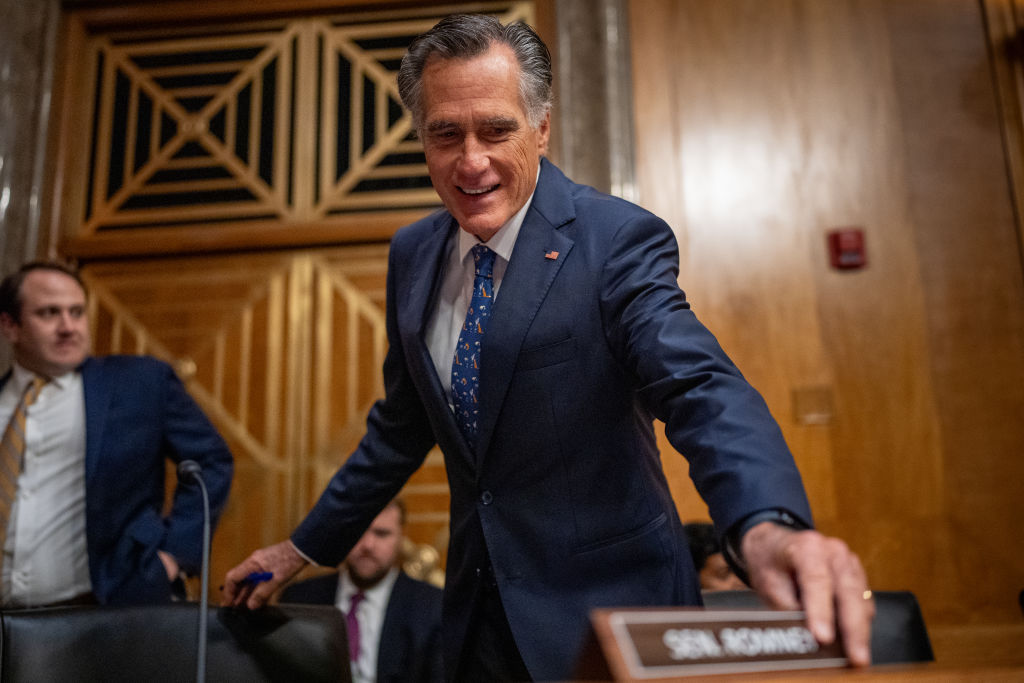
When Mitt Romney had real power, he fortified the rigged tax system that he’s only now criticizing from the sidelines. (Andrew Harnik / Getty Images)
Why is it that powerful people typically wait until they have no power to take the right position and effectively admit they were wrong when they had more power to do something about it?
We see this happen so often that it’s barely noticeable anymore. There were the Iraq War proponents renouncing their past actions. There was Barack Obama marginalizing single-payer health care as president and then touting Medicare for All after he left office. There was James Carville telling Democrats to play dead and then recognizing the zeitgeist and saying they should actually go populist. There’s the Lincoln Project founder who, when he had power, helped install John Roberts and Sam Alito on the Supreme Court — and who now casts himself as a leader of the resistance. There was Dick Cheney creating the tyrannical executive power for someone like Donald Trump to use and then Cheney at the tail end of his life becoming a big critic of Trump.
Now comes Mitt Romney — who campaigned for president on tax cuts for the wealthy — publishing a New York Times op-ed arguing for higher taxes on the rich.
The obvious news of the op-ed is that we’ve reached a point in which even American politics’ very own Gordon Gekko — a private equity mogul turned Republican politician — is now admitting the tax system has been rigged for his fellow oligarchs.
And, hey, that’s good. I believe in the politics of addition. I believe in welcoming converts to good causes in the spirit of “better late than never.” I believe there should be space for people to change their views for the better. And I appreciate Romney offering at least some pro forma explanation about what allegedly changed his thinking (sidenote: I say “allegedly” because it’s not like Romney only just now learned that the tax system was rigged — he was literally a cofounder of Bain Capital!).
And yet these kinds of reversals (without explicit apologies, of course) often come off as both long overdue but also vaguely inauthentic, or at least not as courageous and principled as they seem.
Reversals held until after people leave positions of power often seem less like genuine efforts to change policy and more like after-the-fact attempts to belatedly repair their personal legacies for posterity. Worse, our society so often rewards that not just with a “better late than never” welcome but with valorization — as if the political icon who was so wrong for so long actually has more credibility on the issue rather than the people who were right all along.
In doing that, we remove a deterrent against people doing horrible things when they have agency. They know they can use their power in all sorts of venal ways in the here and now — and then still be celebrated as principled truth-tellers when they are later given coveted space in fancy newspapers like the New York Times to fess up to their bad behavior and/or reverse their awful positions.
This is the standard legacy-washing playbook among America’s elite — and it works as a PR strategy, at least for a time. But real legacies — the legacy of what actually happened in history and who is actually responsible for those events — are forged not by what people say after the fact, but by what they actually do when they have power and when there are real stakes in their policy positions.
For example: John McCain’s legacy as a campaign finance reformer was earned not because he got singed by the Keating Five scandal, then retired, and then wrote some op-eds about how bad corruption is. He earned his legacy because he remained in the Senate after that scandal, changed his whole posture on corruption, and actually used his power to pass campaign finance legislation.
McCain stands out on that set of issues because he did the opposite of what we typically witness. So often when politicians have power — when there are real stakes and when they need to have courage — they don’t do the right thing and take the obviously correct/moral position. Instead, they champion the very policy they later try to cleanse from their brand.
Here the Romney example is illustrative: When he was in a position to actually sculpt the national political discourse, the Republican Party platform, and ultimately the tax policy of the United States of America, Romney decided to run for president on a tax cut plan that would “bestow most of its benefits on those with the highest incomes,” according to the Tax Policy Center. He also decided to portray the bottom 47 percent of income earners as America’s real tax scofflaws — not his fellow private equity tycoons, who get to exploit the carried interest loophole he exploited and that he only now criticizes in his op-ed.
And during his Senate tenure, while Romney did occasionally explore closing some loopholes, I don’t recall him using his platform to champion the tax-the-billionaires cause, and I don’t recall him cosponsoring the major bills to close the tax loophole that he and Wall Street tycoons benefited from.
In short, when Romney had real power, he fortified the rigged tax system that he’s only now criticizing from the sidelines.
Notably, Romney doesn’t explicitly apologize for any of that in his essay. He avoids apology not because he’s an archetypical American man who, like the Fonz, can’t bring himself to say “Sorry” or “I was wrong.” He doesn’t offer contrition because that might remind us of what he actually did when he had power and there were real stakes in his declarations about tax policy.
And so, when I think of that history and that context, I don’t find myself thinking “Wow, even Mitt Romney agrees we shouldn’t cut taxes for rich people, which means he’s courageous and principled, and means that only now is that tax position credible and serious.”
I instead find myself thinking: “Mitt Romney kinda looks like the hot-dog-guy saying he’s trying to find the guy who did this to our tax policy, and the real courageous heroes on taxes are those who had the guts to try to actually use their power in public office to push for a fairer tax system when it wasn’t cool to do so.”
Again, yes: Better late than never that someone like Romney is finally admitting what was obvious to most Americans over the last fifty years. And better late than never when anyone finally comes over to the right side of history on any issue.
But where is the courage from powerful people when they actually have power to do something? The answer is it’s often nowhere, because they derive their own power and prominence by fortifying other elites’ power rather than challenging it.
That is their real legacy, no matter what they say after the fact.