Mexico’s Successful Left Project Is Under Threat From Trump
Mexico’s hugely popular president, Claudia Sheinbaum, won massive reforms in 2025. But with the Donald Trump administration’s neocolonial interventions in Latin America, next year will be a fight for survival.
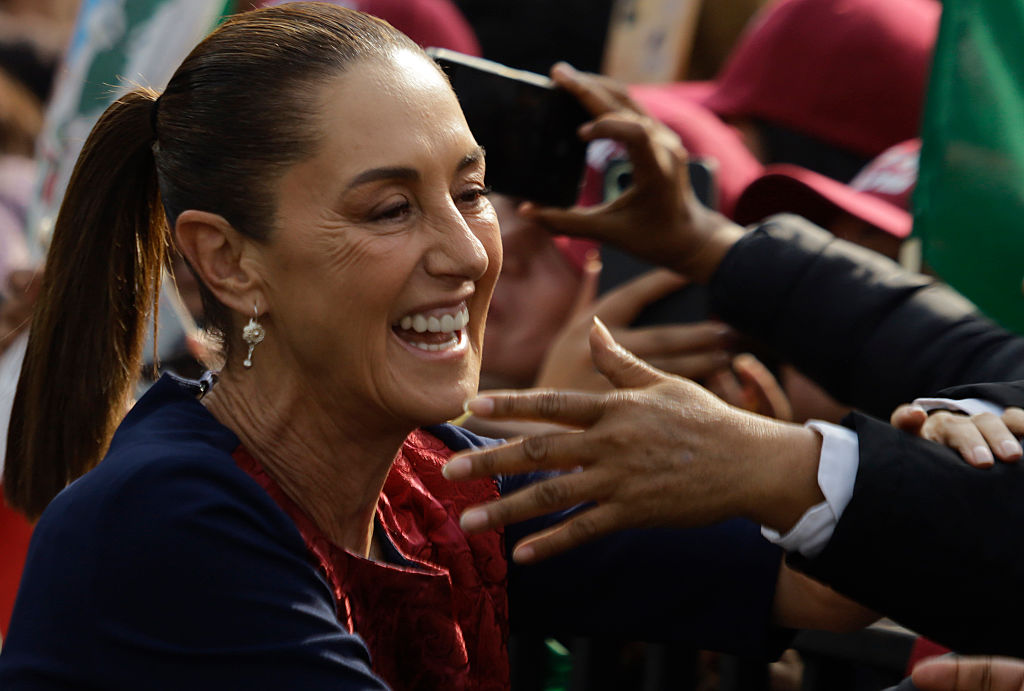
With the United States leveraging any pressure point to coerce or blackmail voters before they head to the polls, no election in Latin America appears safe. (Gerardo Vieyra / NurPhoto via Getty Images)
On December 6, the MORENA movement demonstrated its strong popular support by filling Mexico City’s Zócalo — the world’s second-largest public square — and the surrounding streets beyond capacity. According to the official count, some 600,000 people turned out to celebrate the seventh anniversary of its rise to power, with the election of President Andrés Manuel López Obrador (AMLO) in July of 2018 and his inauguration the following December.
In an hour-long speech, and with that historical moment in mind, AMLO’s successor, President Claudia Sheinbaum, began by making a clear demarcation with the past:
From that moment on, it became very clear that just as Church and State were separated in 1857 [with the Reform Laws], in 2019 the principal separation had to be that of economic power from political power; and so it has been, and so it must continue to be, for the good of the Republic. . . . Today it is clearer than ever before that the corruption and privileges of neoliberalism deeply damaged our homeland and our people; thirty-six years of that economic and political model left as a legacy poverty, inequality, the handing over of our natural resources to private interests both national and foreign, loss of sovereignty, violence, and corruption.
From there, she proceeded to rattle off a list of the movement-in-power’s achievements, including social programs, public housing, union reform and the curbing of subcontracting, labor protections for digital workers, the nation’s first judicial elections, and constitutional rights for indigenous and Afro-Mexican peoples. Even more impressively, all was accomplished with a stable currency, low inflation, and low unemployment. Among the most recent measures: a progressive decrease in the workweek from forty-eight to forty hours by 2030; a new water law to curb the worst abuses of the eve-of-NAFTA 1992 counterreform; a 13 percent increase in the minimum wage for 2026, building on annual increases over the seven-year period; and a 500 billion peso ($27.75 billion) increase in tax receipts without rate increases. In a pointed swipe at the Javier Milei model in Argentina, Sheinbaum noted that this additional tax revenue “is what Argentina is requesting this year from the United States, even more.”
A Show of Muscle
But the MORENA mobilization had a more practical goal — to flex some muscle in the wake of the “Generation Z” or “15N” anti-government march of November 15. Despite being orders of magnitude larger, MORENA’s December 6 march received virtually no attention from the foreign media, which couldn’t get enough of the 15N stunt. To that end, Sheinbaum declared:
Recent days have shown that, no matter how many dirty campaigns they pay for in social media, no matter how many bots and robots they buy, no matter how many alliances they forge with interest groups in Mexico and abroad, no matter how many communications consultants they hire to invent slander and spread lies in certain media, no matter how many attempts they engage in to make the world believe that Mexico is not a free and democratic country, no matter how many “commentocrats” or supposed experts invent fictional tales, no matter how many alliances they want to forge with national and foreign conservatism, no matter how much they do all that: They will not defeat the people of Mexico, nor their presidenta!
But once the dust settles and the signs and slogans are stowed away for the holidays, Mexico is facing a very challenging 2026. The most obvious source of tension, to the surprise of no one, is the United States. As part of its recently rolled-out National Security Strategy, the Trump administration has announced a “corollary” to the Monroe Doctrine, which envisions “a Hemisphere that remains free of hostile foreign incursion or ownership of key assets, and that supports critical supply chains.” This hemisphere is to contain governments that “cooperate with us against narco-terrorists, cartels, and other transnational criminal organizations,” and which also “ensure our continued access to key strategic locations.”
The effects of this regional pivot are plain for all to see — military buildup in Puerto Rico, the Caribbean turned into a parking lot for US ships and carriers, extrajudicial bombings of alleged drug boats (including the now-infamous “double tap” strike of September 2), and the ramping up of invasion threats against Venezuela, culminating — as of this writing — in the seizing of an oil tanker bound for Cuba and the imposition of a de facto naval blockade. Combined with Donald Trump’s on-again, off-again threats to bring drone warfare to Colombia and Mexico as well, it does not require a great deal of analysis to conclude that the neocolonial reboot does not bode well for the Americas.
More troubling has been the administration’s open interference in the internal affairs of these nations — already a high bar, given the history of US–Latin American relations. In July, Trump decried the conviction of former Colombian president Álvaro Uribe on bribery charges, a ruling since overturned. In the case of former Brazilian president Jair Bolsonaro, sentenced to twenty-seven years for plotting to overturn the 2022 presidential election, the administration went as far as to temporarily slap sanctions on the presiding judge, Alexandre de Moraes. In a region where trials of ex-presidents are already highly charged affairs, these interventions have had an incendiary effect.
Worse still has been Trump’s meddling in elections, converting the “preventive war” doctrine of the George W. Bush years into one of preventive fraud. Before Argentina’s second round of legislative elections in October, Trump not only endorsed the party of self-proclaimed anarcho-capitalist Javier Milei but also conditioned a US bailout package on his winning the election.
Then, in a grotesque attempt to boost the right-wing National Party in the November 30 presidential election in Honduras — at the time, running in third place in the polls — he resorted to pardoning former president Juan Orlando Hernández, the party’s standard-bearer. In a cruel mockery of the corollary’s supposed desire for the region’s governments to cooperate against “transnational criminal organizations,” Hernández was freed after being sentenced in a US court to forty-five years in prison for funneling some four hundred tons of cocaine into the United States. The Honduran election, meanwhile, was thrown into predictable turmoil, with widespread allegations of fraud and no clear winner.
Argentina and Honduras now stand as grim harbingers of the future. With the United States leveraging any pressure point to coerce or blackmail voters before they head to the polls, no election in Latin America appears safe.
The Ancillary Threats
In addition to the direct menace emanating from the White House and a Rubio-addled State Department, President Sheinbaum is going to have to deal with a series of ancillary threats in 2026 that are no less consequential. First of all, any tariff-fueled recession in the United States could tip over into Mexico, limiting the presidenta’s fiscal room for maneuver. Although her administration is busy attempting to build up domestic production capacity and supply chains through her Plan México, key elements of the plan will not yet be in place by next year. Meanwhile, over 80 percent of Mexican exports continue to flow to its northern neighbor.
Second, even without a recession, Trump’s escalating pressure in a range of areas, from water rights to the New World screwworm affair to Immigration and Customs Enforcement (ICE) abuses against Mexican migrants, risk draining attention away from Sheinbaum’s domestic priorities. Case in point: the ongoing revision period of the United States–Mexico–Canada Agreement (USMCA), in which the United States is reportedly demanding a raft of concessions as a condition for renewal, include deregulations to pave the way for US corporations and an effective veto on any nonpalatable foreign investment that would rival it, in this case China.
Third, a US attack on Venezuela, in tandem with Trump-induced instability in Honduras and elsewhere, would not only devastate local populations but also send waves of migrants northward. With the United States increasingly militarizing its border, the risk is that these waves could either get “stuck” in Mexico or lead to a corresponding crackdown on its own southern border, in an area that has already seen troubling historical examples of the treatment of migrants. In the absence, moreover, of a strong antiwar movement in the United States and the Democratic Party’s overall refusal to challenge the push for regime change, the sense of many in Latin America is that they will be facing this alone, as they have so often in the past.
Fourth, the election of more far-right leaders in the region — either legitimately or through a proliferation of preventive frauds — could isolate Mexico diplomatically and hamper efforts to craft the pan–Latin American response that is so urgently needed. Trump’s recent set of “victories,” moreover, could embolden the administration to be even more brazen in supporting the Mexican far right, including further destabilization attempts like the “15N” march. The idea would not be to win immediately but to wear Sheinbaum down over time.
Fifth, and perhaps most important, is the risk that the above conditions could induce voices within her government to advocate for a defensive, play-it-safe approach. This would be the ultimate error and only appease the bully in the White House. What the Sheinbaum administration needs to do instead is speed up, precisely in order to create the conditions of sovereignty necessary to fend off whatever combination of micro- and macroaggressions that are thrown at it. And in order, as well, to maintain the popular support that is able to turn 600,000 into the streets on short notice, without which none of this — the separation of economic and political power, the Plan México, the parrying of whatever destabilization machinations come next — would even be possible.
Mexico’s popular tigre, as the power of the masses is historically known, remains strong, but it will need every one of those people on board in 2026.