The Secret Plot to Raise Meat Prices
Analytics firm Agri Stats has quietly enabled major meat processors to coordinate price hikes and suppress wages for decades. Despite outcry over algorithmic price-setting, the companies are settling lawsuits over it without paying substantial penalties.
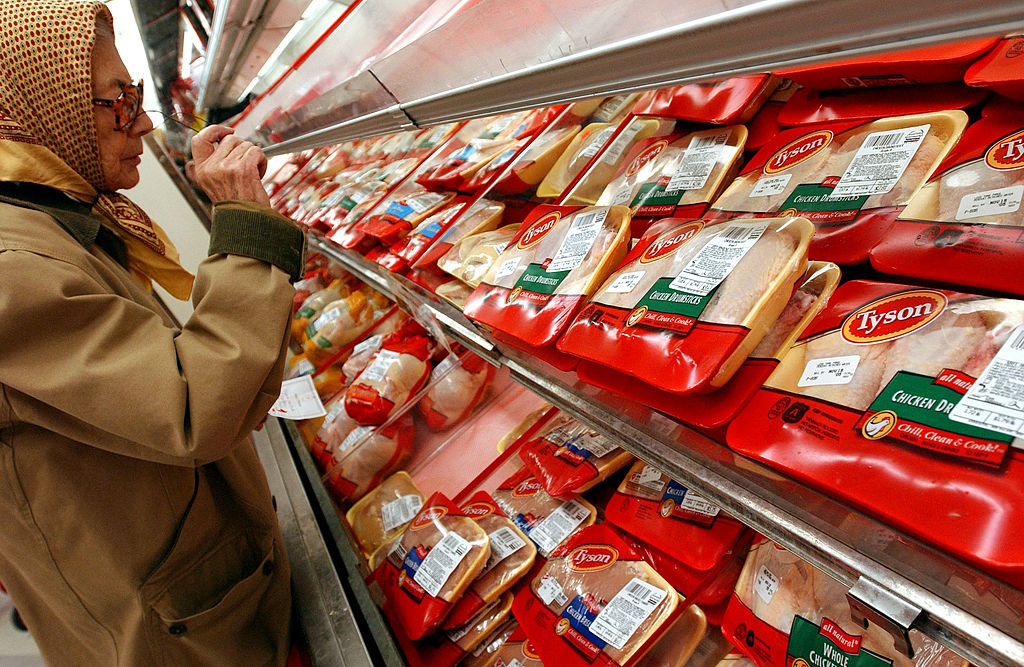
A Justice Department lawsuit alleges that Agri Stats allowed major meat processors to exchange competitively sensitive information through its detailed data reports. (Ramin Talaie / Bloomberg via Getty Images)
According to private and federal lawsuits, the country’s biggest meat processors have been using a secretive data company to share sensitive information, enabling them to hike up prices and suppress wages for decades.
The revelation comes as meat prices have increased precipitously, with rising chicken, pork, and turkey prices generating recent headlines. Meanwhile, meat-industry workers’ wages have largely stagnated.
Despite growing scrutiny and public outcry over algorithmic price-setting of consumer goods and services, critics say meatpackers are settling these collusion lawsuits without admitting guilt or paying substantial penalties, meaning they’re free to keep using the data analytics firm to fix prices and drive down workers’ earnings.
“[The meatpackers] win with their settlements, and never once do the packers have to admit guilt,” independent rancher Mike Callicrate told the Lever. “What’s happened is these law firms now have just gone around filing cases, knowing that they can take money out of the packer’s pocket, while the packer retains the ability to take it right out of the producer’s pocket and the consumer’s pocket.”
And while President Donald Trump has promised to crack down on price-fixing in agriculture, he’s financially benefited from some of the companies he’s criticized.
Agri Stats, a forty-year-old, Indiana-based data analytics firm, is named in four recent private lawsuits and a 2023 Department of Justice suit filed under former president Joe Biden, alleging anticompetitive practices by many of the company’s largest meat companies.
That includes a price-fixing class action alleging that eighteen poultry giants, including Tyson and Perdue, utilized data from the company to suppress their workers’ wages below fair market rates. Another lawsuit accuses major beef processors of similar Agri Stats–facilitated wage-setting. The two other private suits allege that meat companies used the data firm to share sensitive information to fix prices.
The Justice Department lawsuit alleges that Agri Stats allowed major meat processors to exchange competitively sensitive information through its detailed data reports, which often run thousands of pages and include production, processing, sales, and profitability metrics related to the chicken, pork, and turkey industries.
Price-fixing accusations are commonplace in agriculture, in part because of widespread consolidation in the industry. As the Lever has chronicled, the four biggest companies in the frozen potato industry, which control at least 97 percent of the market, have been accused of operating as a “cartel” to jack up prices.
“Once you get to markets where there are fewer competitors, either as buyers or sellers or both, knowing what the other guy is doing allows for all kinds of tacit collusion,” Peter Carstensen, professor at the University of Wisconsin Law School and a former antitrust attorney, told the Lever. “Because your incentive is to make money, not to behave competitively.” According to Carstensen, this collusive behavior results in a race to the bottom, driving down workers’ wages and raising prices for consumers.
Agri Stats did not respond to multiple requests for comment from the Lever.
“Just Make a Little Comparison”
Agri Stats was founded in 1985 by poultry feed salesman Jim Cox, who started the business “as a way to help chicken producers make informed decisions based on flock-level cost and performance data,” according to the company’s website. As a feed vendor, Cox would collect sales reports from his clients to determine what mix of feed and additives was most cost-effective.
Cox’s clients developed an interest in his reports. One approached him about sharing the data he collected, saying, “Well, you know, Jim, while you’re getting that, why don’t you just make a little comparison? Don’t tell us who else is on the report or anything. Just make a comparison of the companies so that we can see how we’re doing,” according to Bloomberg.
Cox’s data-sharing venture eventually became more profitable than selling feed. By the 1990s, after Agri Stats began contracting with Tyson, the company became a de facto industry standard.
Now, Agri Stats’s headquarters in Fort Wayne, Indiana, houses more than seventy employees who work to provide confidential data and customized reports to meat processors in eighteen countries, which, according to the company, allows its clients “to make informed decisions to improve their bottom-line profitability.”
It does this by collecting a “direct download of general ledgers and internal reports” from meat processors, analyzing the information, and creating reports that it distributes back to clients.
The company also creates a list of rankings, in which the processor charging the highest prices is ranked first, while the processor charging the least is ranked last. This is regardless of total profits, meaning companies that sell less at higher prices are rewarded with higher rankings.
These practices have made Agri Stats wildly popular among meatpackers, with the vast majority of poultry processors using the company’s services.
The companies using Agri Stats’ reports allegedly account for more than 90 percent of broiler chicken sales..
If It Walks Like a Duck. . .
In recent years, Agri Stats has found itself steeped in mounting legal troubles as critics have raised potential antitrust concerns.
Multiple lawsuits allege that Agri Stats helps companies improve their bottom line by colluding to share sensitive information that allows them to artificially inflate prices, suppress wages, and constrain supply.
This can give the companies an unfair advantage in the marketplace, ultimately leading to higher prices for consumers and potential violations of antitrust laws.
One 2016 class action alleged that between 2009 and 2019, major broiler chicken producers like Tyson, Perdue, and others colluded to reduce chicken production, inflating prices by nearly 50 percent.
The companies involved in the case allegedly control roughly 90 percent of the broiler chicken market, which accounts for 98 percent of all chicken meat sold in the country.
While, nearly a decade later, the case remains ongoing, a district court judgedismissed the claims against Agri Stats in 2023, finding that the plaintiffs had “not produced sufficient evidence for a reasonable jury to find . . . that Agri Stats agreed with the producer defendants to restrict supply and increase the price of [b]roliers.”
But other cases in which Agri Stats was named as a defendant, including the US Department of Justice suit, have proceeded.
Agri Stats, for example is a defendant in a case involving major pork processors, including Tyson and Hormel. Since 2014, pork producers have allegedly colluded to restrict pork supply in order to inflate prices, which, according to the complaint, has cost consumers millions of dollars.
Earlier this year, the judge overseeing the case denied Agri Stat’s motion for summary judgment on the antitrust claims against it, finding “there is sufficient evidence indicating that the Processor Defendants accepted Agri Stats’s invitation to participate in Agri Stats reports to target higher prices” and “there is sufficient evidence for a reasonable jury to conclude . . . that the following Defendants knowingly entered an agreement to artificially constrict the supply of pork and fix prices in violation of the antitrust laws: Agri Stats, Clemens, JBS, Seaboard, Smithfield, Triumph, and Tyson.”
Processors have so far paid more than $407 million in total settlements between the chicken and pork cases.
On top of its alleged use in price-fixing schemes, Agri Stats has also received blowback for making it easy to identify the companies referenced in its reports. The Department of Justice alleges that firms are easily able to uncover which competitors raise prices and when.
According to the federal lawsuit brought by the US Department of Justice, as well as six states alleging antitrust violations by Agri Stats, an employee from poultry producer Butterball once bragged that they could “pick the companies for rankings with 100 [percent] certainty” by using Agri Stats.
In May 2024, the federal court denied Agri Stats’ motion to dismiss the antitrust suit, finding that the allegations that Agri Stats had engaged in an unlawful “information-exchange conspiracy with major U.S. broiler chicken, pork, and turkey processors” could proceed. Following settlement discussions, a hearing is now set on Agri Stats’ motion for summary judgment in early 2026.
The company has also reportedly used raising prices as a selling point. When one processor considered unsubscribing from the company’s bacon report, the company allegedly suggested it could accrue an additional $100,000 in profits if it raised prices, according to the Justice Department.
Processors have also allegedly used Agri Stats’ sales reports to determine bonuses for sales staff. Because the ranking structure rewards prices over total profits, this encourages employees to restrict supply in order to drive up profits, the Justice Department alleges.
Attorneys involved in the various cases declined or did not respond to the Lever’s request for comments.
Slashing Wages
In addition to potentially driving up prices for consumers, Agri Stats also allegedly helped drive down wages for slaughterhouse staff.
One class-action suit alleges that since 2009, poultry giants including Perdue, Tyson, Pilgrim’s Pride (a subsidiary of JBS), and more than a dozen other producers conspired to suppress the wages of roughly 250,000 chicken-processing-plant workers.
Plaintiffs allege that the chicken processors, in addition to fixing wages through in-person meetings, exchanged timely and competitively sensitive wage data through Agri Stats and WMS, another survey company.
The same law firm filed another case brought by individual plaintiff-employees alleging that since 2014, beef and pork processors, including JBS, Tyson, Cargill, and their subsidiaries, used Agri Stats’ reports to conspire to drive down wages.
Agri Stats filed a motion to dismiss the antitrust claim, arguing, among other things, that because it only provided statistics on pork processors, it could not have harmed or affected the wages in the beef processing industry. But in September 2023, the Chief Judge for the District of Colorado denied that motion, finding that the pork-industry compensation data Agri Stats had allegedly shared was relevant to the “red meat” industry in general, even though “Agri Stats did not, on its own, affect the entire red meat industry.”
In early 2025, the court granted preliminary approval to a settlement with several of the meat processors named in the lawsuit. The case against Agri Stats remains pending.
Meatpacking plants are notorious for their difficult working conditions. Eighty-one percent of meatpacking workers are at high risk of developing musculoskeletal disorders, and poultry and meat companies remain some of the most dangerous to work for, according to data from the Occupational Safety and Health Administration.
Companies have also deliberately hired vulnerable groups to work in slaughterhouses. Norman Beecher, a former human resources manager for poultry giant Case Farms, explained in an interview with labor historian Leon Fink how his company recruited refugees from the Guatemalan Civil War.
“I didn’t want [Mexicans]. Mexicans will go back home at Christmastime. You’re going to lose them for six weeks. And in the poultry business, you can’t afford that,” Beecher said. “But Guatemalans can’t go back home. They’re here as political refugees. If they go back home, they get shot.”
Such circumstances have limited many meatpacking workers’ ability to demand better wages, despite the grueling conditions. While meatpacking was once one of the highest-paid manufacturing jobs in the United States, industry consolidation and the exodus of many slaughterhouses out of urban areas have resulted in jobs that now often pay near-poverty wages.
In 2023, the mean annual wage for slaughterhouse workers was $38,710, according to the Bureau of Labor Statistics. That year, the poverty line for a family of four was $30,000.
Meanwhile, meat processing companies and their CEOs, especially in poultry, have raked in record profits.
Last year, Tyson’s total annual operating income was $2.287 billion, up 26 percent from the year prior. Pilgrim’s Pride pulled in nearly half a billion dollars in the third quarter of 2025 alone, while its total operating income last year was around $1.5 billion.
Tyson CEO Donnie King made $22.77 million in total compensation in 2024, a 73 percent increase from 2023.
“It’s Totally Rational for Them to Continue Price-Fixing.”
Agri Stats has argued that its services benefit consumers by increasing efficiency and supply, thereby lowering prices for consumers.
“[The Justice Department’s] lawsuit alleges — contrary to the law and the facts — that Agri Stats reports result in higher prices and lower protein production,” the company wrote in a press release. “Since its inception in 1985, Agri Stats has played a vital role in the United States economy, helping to drive increased efficiency, improved innovation, and ultimately provide more chicken, pork, and turkey to consumers for less money.”
But these claims are contradicted by Justice Department allegations. An executive at pork processor Smithfield Foods testified to federal prosecutors that he could not recall a single instance of his company using Agri Stats to lower prices. A sales representative from Tyson testified similarly in the same case.
That might be because Agri Stats restricts access to its reports. While processors can identify which products are priced below their competitors’ and raise them accordingly, Agri Stats refuses to sell its reports to purchasers, such as grocery stores and restaurants, preventing them from shopping around for the lowest rate and ultimately charging lower prices to consumers.
“They very intentionally did not want meat buyers or chicken farmers or workers to have access to this information, so that also makes it different from a general industry report that anyone can buy and access and read,” Claire Kelloway, the food program manager at antitrust-focused Open Markets Institute, told the Lever.
In October 2025, Agri Stats agreed to settle the poultry-industry wage-suppression lawsuit filed by workers. Without any admission of liability and in lieu of a financial settlement, Agri Stats agreed to update its data reporting practices to prevent processors from coordinating on alleged wage suppression and to redact wage data from nearly fifty reports.
But some industry insiders worry that the settlement indicates a worrying trend, and that in many cases, it’s in the companies’ best financial interest to continue fixing prices.
“Sometimes [the settlements] are not even bigger than the amount these companies made in ill-gotten profits,” said Kelloway. “If they end up paying less than what they made in excess profits by engaging in the conspiracy, it’s totally rational for them to continue price-fixing.”
The Trump administration has claimed that it is attempting to rein in such alleged collusion. “I have asked the DOJ to immediately begin an investigation into the Meat Packing Companies who are driving up the price of Beef through Illicit Collusion, Price Fixing, and Price Manipulation,” Trump wrote on social media. He also alleged that majority foreign-owned meatpackers “artificially inflate prices, and jeopardize the security of our Nation’s food supply.”
But some experts are skeptical that there will be meaningful action — largely due to Trump’s financial ties to the foreign-owned meatpackers he’s decried.
JBS, a Brazilian company, donated $5 million to the Trump-Vance inaugural committee through its subsidiary Pilgrim’s Pride. Shortly after, the company was listed publicly on the New York Stock Exchange, which provided it access to significantly more capital.
“Your large donations and direct stake in federal policies and enforcement actions, and the Trump Administration’s series of actions that benefit your companies, raise serious concerns about a potential quid-pro-quo arrangement,” Sen. Elizabeth Warren (D-MA) wrote in a letter to JBS.
One former antitrust official told the Lever that while the administration has worked to “create tweets and a media campaign and the appearance that they’re looking into stuff,” it has “done nothing that is actually bringing relief to farmers and beef packers.”
In some cases, the administration has worked to chip away at laws meant to rein in price-fixing. Among other efforts, the Trump administration has paused the implementation of at least one Biden-era rule that aimed to strengthen the 1921 Packers and Stockyards Act, which prohibits the manipulation and control of prices.
Deputy secretary for the US Department of Agriculture judge, Stephen Alexander Vaden, justified the move, saying at the seventieth annual national Chicken Council Conference that it was “un-American” to “put a cap on innovation.”
Agri Stat’s legal scrutiny comes as concerns about price-fixing and data-sharing practices have proliferated. Regulators and state legislators have attempted to crack down on other price-fixing algorithms, such as those used by Texas-based property management firm RealPage, but the growing ubiquity and complexity of data-analytics operations threaten to complicate antitrust enforcement efforts.
While some states like California and New York have implemented updated antitrust laws to account for algorithms and third-party intermediaries, industry interests are pushing back. RealPage is asking a federal court to overturn New York’s law stopping algorithmic rent-fixing, arguing that the law is “a sweeping and unconstitutional ban on lawful speech.”
Agri Stats does not appear to directly provide any algorithms. But what happens to Agri Stats could be an indicator of whether regulators can police price-fixing in an economy that’s becoming increasingly dominated by opaque third-party intermediaries. To some experts, the clearest solution might be a complete overhaul of the business arrangement.
“That’s to me the interesting question,” said Carstensen at the University of Wisconsin Law School. “Think of it as, ‘I’m running a business that’s a criminal enterprise. Can I continue that business?’ I don’t think so.”
Editor’s Note: This story has been updated to accurately reflect the current implementation of Biden-era updates to the 1921 Packers and Stockyards Act.
The story was further updated to clarify that Agri Stats does not offer beef reports and does not offer an algorithm that assists processors in making price decisions.