Zohran Mamdani Can Reduce New York’s Dependence on the Rich
Time and again, New York City’s dependence on the rich and private corporations has led it into fiscal crisis. As mayor, Zohran Mamdani has the opportunity to start building an economic base that better serves the needs of the city’s working class.
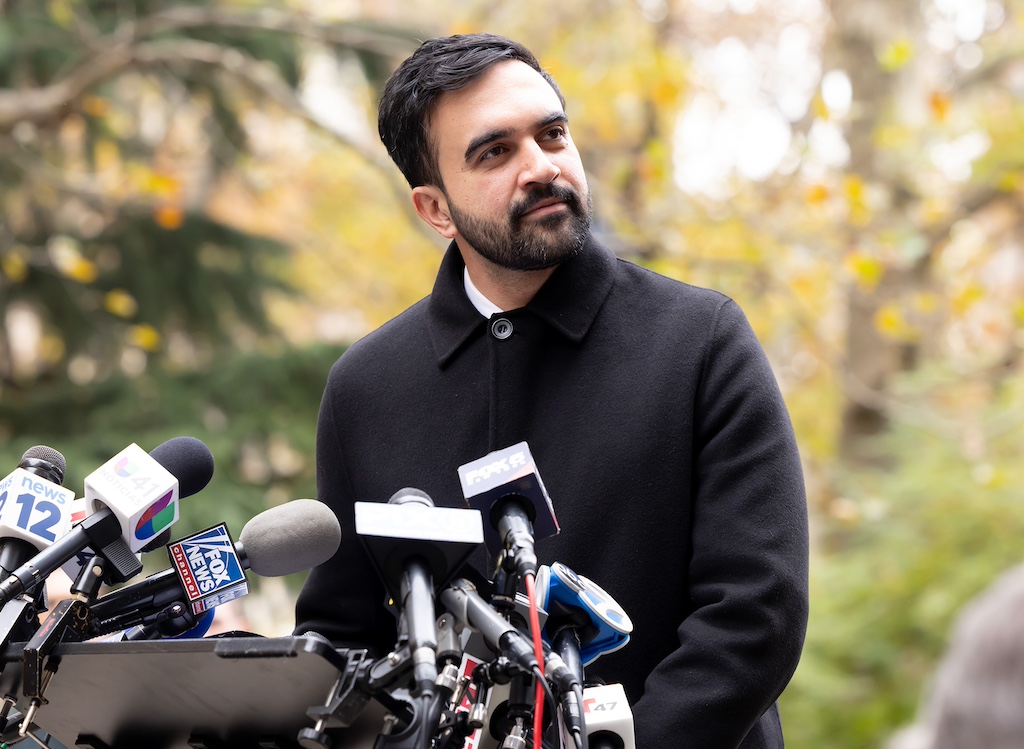
Zohran Mamdani can reveal the true costs of New York’s current economic development model, thereby building the political constituency for alternatives. (BG048 / Bauer-Griffin / GC Images / Getty Images)
Zohran Mamdani ran his campaign for New York City on two messages: making the city affordable and taxing the rich. This has been a winning formula for many progressive candidates for more than a century.
But history also reveals a more sobering lesson: you can’t finance progressive policies with a regressive economy. Social democracy in New York City and elsewhere has repeatedly learned this lesson the hard way. To be fiscally dependent upon the same wealthy individuals and firms who displace working-class residents, contest our policies, and undermine our public finances is profoundly self-defeating.
That’s why past progressives and socialists, from the Knights of Labor to the Wisconsin sewer socialists, didn’t just look to tax wealthy individuals and firms — they looked to diversify urban economies so they wouldn’t depend as much on the wealthy to begin with. By cultivating public enterprises and worker-owned firms, and by aspiring to build economies organized around the needs of working-class residents, these radicals tried to create cities that delivered affordability and justice. They recognized that letting the private economy produce ever more inequality, then trying to tax those at the top to redistribute sufficiently to everyone else to correct structural imbalances, was an impossible task.
For genuinely progressive economic policy to take root and succeed, taxes on the wealthy need to be paired with revenue from flourishing working-class economic sectors. Redistribution must be paired with predistribution. That’s the lesson we should take from New York City’s recent economic history, and it’s one that Mamdani must apply if he is to be successful.
New York Fiscal Crisis Blues
New York City struggled with a host of fiscal crises well before the 1970s. These crises weren’t the result of overspending on behalf of the city’s poor, as my book, The Menace of Prosperity, argues, but were largely due to the wealthy wrecking Gotham’s economy. During the 1870s and 1930s, for example, real estate speculation by banks and property owners repeatedly plunged the metropolis into debt. Landlords foisted the social costs produced by their slums — crime, sickness, pollution, fire — onto the public sector to clean up. High rents and low wages, along with price-gouging by utilities, increased poverty in the metropolis to an extent that taxation alone couldn’t make up for. As socialist Baruch Charney Vladeck declared in 1934, “One-third of the budget of the city of New York would be saved if New York had been built for the accommodation of its people instead of having been built for the accommodation of landlords and bankers.”
That’s why, during the late nineteenth and early twentieth centuries, a host of populist coalitions emerged in New York that aimed to reconstruct the city’s economy in the interest of its working people. Followers of Henry George (Georgists) declared that local fiscal policies should eliminate land speculation to better encourage productive enterprises and affordable homes. Labor organizations like the Knights of Labor established cooperative enterprises in which profits would flow to workers rather than idle rentiers. Parties such as the Municipal Ownership League argued that by seizing control of profitable franchises through public ownership, cities could deliver affordable goods and services while generating revenue for themselves.
Even public housing, a cornerstone of social democratic redistribution, was thought of by reformers as an economic development strategy as well. By building for the working class rather than the wealthy, housing reformers argued, cities could reduce the social costs of crime and health problems, lower rent burdens, and — through the device of the public authority — pay back housing costs. Instead of just relying on taxing the private real estate market, New York could reshape its economy in the interests of both fiscal stability and economic justice. As Vladeck put it, public housing was “not an expense but an investment, and [the] sooner we make that investment the better for the economic and social future of our country.”
But these radicals wound up being outflanked during the Progressive Era by a broader convergence among technocratic finance officers and city planners. Where Georgists had seen real estate’s “progress” as causing poverty, liberal officials believed taxing such progress would help reduce poverty through the new welfare expenditures that tax revenue enabled. This theory was promoted through economic textbooks and converted into abstruse budgetary practices, insulating economic development decisions from democratic oversight. And rather than support bold initiatives in public ownership of profitable enterprises, liberals preferred to leave profit-making to the conventional private sector.
Revenge of the Rich
The result was that, by the 1950s, radical economic alternatives in New York had been sidelined in favor of a trickle-down approach to welfare state financing. Liberal mayors like Robert Wagner and John V. Lindsay tried to both attract and tax corporate firms in the hope that they would pay for the city’s welfare state. A focus on economic alternatives was pushed aside by a desire to grow the public sector regardless of how it was financed.
But the contradiction between cultivating an economy for the 1 percent and sustaining a welfare state for the poor caught up with New York’s liberals. On the one hand, attracting and retaining white-collar industries cost the city heavily in the form of tax breaks, debt-financed infrastructure, and other subsidies. Economist William K. Tabb complained at the time that New York’s “capital budget debt . . . owes far more to the Banker-real estate developer agencies . . . than it does to helping the poor, more to subsidizing commuters than to helping the unemployed get jobs.”
On the other hand, the city’s high welfare costs were made necessary in the first place partially by the flight of well-paying entry-level jobs, a flight city officials had encouraged by expelling factories in the hope of making their city a corporate mecca. As Jane Jacobs complained in 1975, “A city can’t let its skills, manufacturing plants and suppliers plants wither away and then not suffer the consequences. . . . The notion that the city could live on financial and white-collar services was nonsense.”
All this suggests that relying too much on the wealthy to finance an affordable city is both economically and politically risky.
But that’s where we are now. According to the city’s Independent Budget Office, the top 1 percent of earners now contribute about 45 percent of all local personal income tax revenues, up from roughly 30 percent in the 1980s. Meanwhile, the city’s corporate tax base has narrowed, with fewer firms accounting for a growing share of total receipts. This gives the wealthy a good deal of fiscal — and hence, political — leverage over Mamdani’s platform.
At the same time, New York’s economy is starting to shift in ways that might threaten public finances more broadly. The share of New Yorkers employed by finance has shifted from 11.5 percent in 1990 to 7.7 percent in August. While wealthy people continue to flock to New York, wealthy employers are leaving it. Given the city’s currently high dependence on the wealthy for tax revenue, this could pose a fiscal threat to Mamdani’s agenda.
Building a Better Base
For both political and fiscal reasons, therefore, Mamdani needs to diversify New York’s tax base in a way that can help him deliver on his affordability agenda. This doesn’t mean doing away with taxes on the wealthy: it means broadening the city’s economic base to reduce our exposure to economic risk.
The incoming mayor can help do this through leveraging the city’s existing public procurement toward small alternative businesses — public enterprises, nonprofit enterprises, etc. — that can offer both good-paying jobs and affordable goods and services. He can also support affordable housing developers, helping reduce welfare and social service costs over the long term. Eliminating costly landlord giveaways like the 421-a tax break and reforming inefficient contracting and economic development subsidies can redirect billions toward public needs without raising taxes on ordinary New Yorkers.
Finally, Mamdani can move the city’s $100 billion in deposits, which currently flow through the kind of extractive financial institutions that help make New York’s economy both fragile and unaffordable (and which cost the city mightily in fees), into a newly created municipal bank that directs public money to the economic sectors where it will most benefit the public and not just private shareholders.
Above all, Mamdani can reveal the true costs of New York’s current economic development model, thereby building the political constituency for alternatives. Unlike its social welfare state, New York’s corporate welfare state is often hidden from view. The public doesn’t see the tax subsidies or debt that go into boondoggles like Hudson Yards (which cost the city $2.2 billion in public funds), and it rarely traces how an economy of the 1 percent translates into higher rents and staple prices for the 99 percent. By exposing and politicizing our current development strategies, Mamdani can tap into the populist energy for affordability that propelled him into office and that can help deliver on his platform.
There are good signs that the incoming mayor is ready to do this. Mamdani’s transition committees include leaders in the solidarity economy movement, such as Gianpaolo Baiocchi and Deyanira Del Río, and is cochaired by antitrust leader Lina Khan. As an assemblymember, Mamdani supported public-bank legislation, and he recently released a homeowner policy memo endorsing community land trusts (CLTs) and co-ops. By building on these proposals and rallying diverse New Yorkers against the oligarchs rendering Gotham unaffordable, Mamdani can help rebuild New York’s economy in the interests of ordinary people and construct a political base for further socialist victories.
In other words, Mamdani is poised to help New York City shift its economic foundations while continuing to tax the wealthy as much as necessary — moving toward an economy that is healthier, more balanced, and better aligned with the needs of the public and the public sector.