Sven Beckert’s Chronicle of Capitalism’s Long Rise
Capitalism is a global economic system, so a proper chronicle of its rise to dominance has to examine the entire world, as historian Sven Beckert does in his massive new book, Capitalism: A Global History.
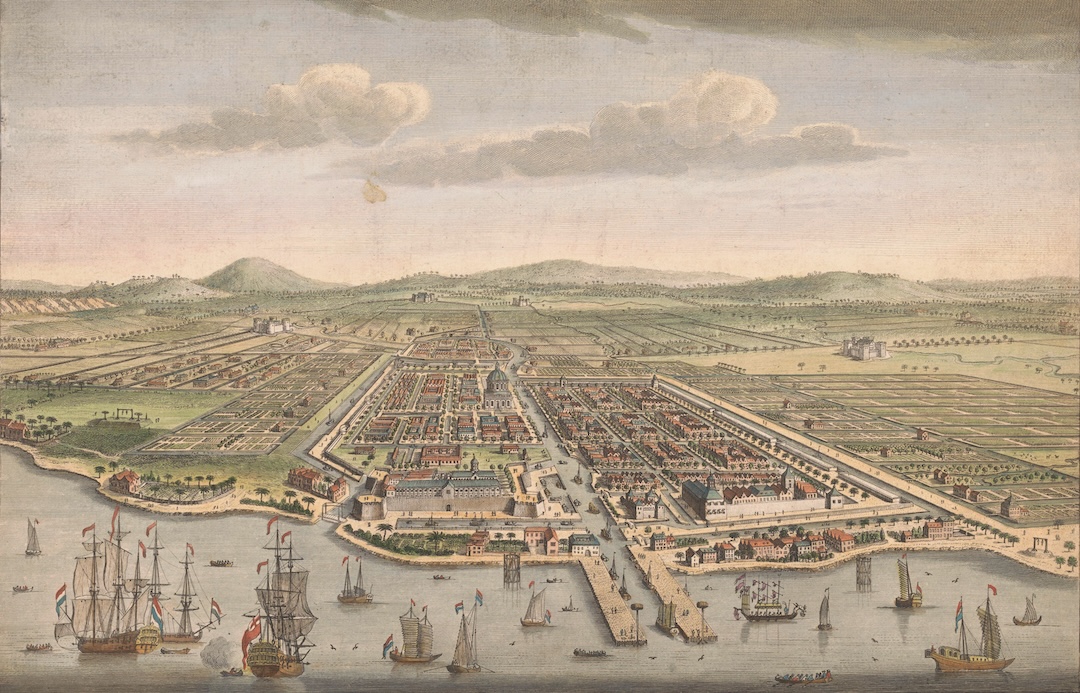
Throughout the sixteenth and seventeenth centuries, the archipelago of capital metastasized as island after island — both in the literal and metaphorical sense — was added to the mercantile universe: Santo Domingo in 1516; Macau in 1557, Batavia in 1619, Manhattan in 1624, Barbados in 1627. (Heritage Images via Getty Images)
Sven Beckert’s doorstop of a book is supremely ambitious, an insightful and well-illustrated history by the Harvard historian who has been a pioneer in the creation of new narratives exploring how an ever-changing capitalism has been a socially and culturally rooted phenomena. At well over a thousand pages, Beckert’s volume offers a synthesis and occasional recasting of almost everything we have learned about the history of capitalism, and not just in the closely studied societies bordering the North Atlantic. It is a global history, holds Beckert, because capitalism “was always a world economy.” Writing within the world-systems schema associated with Fernand Braudel and Immanuel Wallerstein, he probes for the connections, parallelisms, and transformations taking place within an economic and social history stretching back almost a thousand years.
Historian Marc Bloch once wrote that carefully observing the world was just as important in understanding history as time spent in the archives. Beckert agrees. His book is a result not just of an immense amount of bookish research but of visits to factories, plantations, warehouses, railroads, docks, mansions, mosques, churches, and merchant homes stretching from Phnom Penh to Senegal, from Samarkand to Amsterdam, and from Turin to Barbados. I can attest to the importance of such travel: twenty years ago when I visited China’s Pearl River Delta, then becoming the workshop of the world, I not only gained crucial insights into how Walmart sourced its supply chain but also came to a more intuitive understanding of what a booming and fissiparous Detroit must have seemed like nearly a century before.
“There is no French capitalism or American capitalism,” writes Beckert, “but only capitalism in France or America.” And there is also capitalism in Arabia, India, China, Africa, and even among the Aztecs. In his narrative of merchants and traders in the first half of the second millennium, Beckert puts Europe on the margins, offering instead a rich and, except for specialists, unknown account of how the institutions vital to commerce and markets, including credit, accounting, limited partnerships, insurance, and banking flourished, in Aden, Cambay, Mombasa, Guangzhou, Cairo, and Samarkand. These are all “islands of capital,” a recurrent metaphor in Beckert’s book. For example, in the twelfth and thirteenth centuries, Aden was host to a dense network of merchants who played a pivotal role in the trade between the Arabian world and India. It was a fortified, cosmopolitan city of Jews, Hindu, Muslims, and even a few Christians.
They were the world’s first capitalists, writes Beckert, who invested money, made profits, and did not travel with their goods, but stayed put and traded at a distance. A typical dhow carried goods that could fit into two modern-day containers, with the round trip from Cairo to India via Aden taking two years. Yet despite differences in scale and speed, Beckert holds that Aden’s merchants inhabited “a strikingly modern world.” Unlike the landed elites of Europe and beyond, they did not achieve wealth through plunder, taxes, or tribute but instead used the market to buy cheap and sell dear. This was true even within the oriental despotisms that Karl Marx thought so hierarchical and claustrophobic.
Beckert finds plenty of political competition and merchant activism within India’s Mughal Empire. There the sultan and his advisers constituted only a loose layer of authority above the power of local authorities. Beneath the ruling glitter, all the states usually thought of as examples of “Oriental despotism” survived by constantly negotiating with various strata of the populace, merchants above all, for the funds and material necessary to wage chronic warfare.
The merchants are the revolutionaries of Beckert’s history, certainly during the first several centuries. They were “capitalists without capitalism,” meaning that their profit-making activities were confined to scattered cities. Although connected by trading pathways and sea routes, these islands were largely isolated at the edge of a vast hinterland, “mercantile avant-gardes dispersed around the world.” They were “droplets in a sea of economic life whose main currents flowed by fundamentally different logics.”
With Karl Polanyi, Beckert makes clear that the vast majority of the world’s population existed in the countryside where, as Marc Bloch put it, economic life was “submerged [in] social relationships.” That made the merchants a distinct caste, so that “despite immense distances and distinct cultures, Cantonese, Gujarati, Adeni, Genoese, Swahili, and Bukharan merchants would have been broadly recognizable to one another.” Perhaps, but in his account of these early centuries, Beckert is searching diligently for similar patterns among these traders and not dwelling on the obvious religious and social divergencies. He is advancing a thesis in which these “islands of capital” will one day burst forth into the larger society and utterly transform all those ancient and customary bonds that continued in force even after the demise of feudalism.
Beckert is therefore taking issue with historian Robert Brenner, who touched off the “Brenner debate” of the 1970s and ’80s, by arguing that capitalism — at least in England — had its roots not among the urban merchant class but in the countryside, where acquisitive landowners waged class war against peasants and yeomen whose livelihoods depended on such traditions as access to a hunting, pasturing, and wood-gathering commons. They rented land at a customary price from the local lord and expected that markets were constrained by the regional limit of trade in the commodities essential to keep starvation at bay. Luxury goods did travel widely, but they were bought and sold by a thin elite stratum. Marx therefore saw merchants as having a purely external relationship to the feudal mode of production, while Maurice Dobb, writing in the 1930s, saw merchants as “parasites on the old economic order,” a “conservative rather than revolutionary force.” Brenner thought them an integral part of feudal society and therefore hardly disruptive.
The thrust of Beckert’s book stands in agreement with Brenner that a radical transformation of how commodities were produced in the hinterland was essential to the triumph of capitalism on a world scale. He offers two very long chapters on the transformation and capture of the countryside from the early modern enclosures to the rise of factory-like sugar plantations and on to the home-based proto-industrialization that became prevalent in the seventeenth and eighteenth centuries. But the motive force for all these upheavals was not acquisitive landlords enclosing the commons and thereby generating a surplus population destined for wage labor in urban centers, but instead ambitious merchants who had the capital — and backing of the state — that gave them the leverage to begin the dispossessions and enclosures that brought market relations to the rural hinterland.
Beckert’s history also stands at partial odds with that of Jonathan Levy, whose 2021 book, Ages of American Capitalism, was, at over nine hundred pages, almost as long. Levy held that the “liquidity preference” of most capitalists in most times and places has always been in tension with the investment function that trends toward the immobility and illiquidity of some of the most important capital assets. So Levy’s work is more attentive to the speculative, financializing aspects of North Atlantic capitalism, at least from the seventeenth and eighteenth centuries onward. Beckert, on the other hand, sidelines this psychological-cum-economic set of cross currents, although he does write eloquently of the panics, booms, and busts that became a characteristic of world capitalism from the early nineteenth century through our own time. But the expansion of trade and production remains at the heart of his book, even when he narrates the origins and fate of our recent neoliberal era.
The Great Connecting
An explosive growth of merchant capitalism came with the “great connecting” of the fifteenth and sixteenth centuries. The discovery of the New World was most important but not the only way in which a global market was engendered. Historians have long known that Ottoman conquest of Constantinople blocked easy access toward India and the Far East, even as feudalism’s decay motivated rulers to search for new sources of tribute and taxation to pay for near-constant warfare. So merchants and their royal patrons looked west.
In another instance of Beckert decentering the traditional narrative, he offers far more discussion of the Genoese and Portuguese exploration and exploitation of the West African coast than he does to the New World discoveries of one Christopher Columbus. Although those explorers of Africa were propelled down the coast and around the Cape of Good Hope in the expectation that they could circumvent Arab intermediaries, European control of the Atlantic and the New World turned out to be the force that gave the capitalist revolution its Eurocentric flavor.
The growth, ambition, and conflict among all states, but especially those of Europe, advanced merchant power and influence. This happened in two ways. First, the chronic warfare of the long sixteenth century required enormous sums, and those came from the merchants and bankers whose influence consequently grew within royal courts. As states made war, war made states, enhancing merchant power in the process. And second, trade and empire were insolubly linked. Indeed, it was often difficult to distinguish the traders from the warriors and governors. The East India Companies of both the Dutch and the English were practically states unto themselves. With their thousands of soldiers and hundreds of ships, Beckert compares these monopolies to those quasistate purveyors of violence in our own time: America’s Blackwater and Russia’s Wagner Group.
“Wherever we look,” writes Beckert, “warfare was almost the default mode of the great connecting.” He calls this an era of “war capitalism.”
Throughout the sixteenth and seventeenth centuries, the archipelago of capital metastasized as island after island — both in the literal and metaphorical sense — was added to the mercantile universe: Santo Domingo in 1516; Macau in 1557, Batavia in 1619, Manhattan in 1624, Barbados in 1627. Among these many imperial gambits, Beckert profiles two new “islands” whose revenues dwarfed anything attempted by earlier merchant endeavors.
By 1600, Potosí had become the biggest city in the Americas, more populous than London, Milan, or Seville. There, 160,000 Andean, African, and European inhabitants mined 60 percent of the world’s silver. And like virtually every other New World island of capital, Potosí could only thrive on coerced labor, a murderous form of slavery that killed thousands of miners each year, often poisoned by the mercury that was essential to the profitable processing of large amounts of low-grade ore. Because the city sustained Spanish power, Emperor Charles V labeled Potosí the “treasury of the world,” but others called it “the mountain that eats men.”
Barbados was another astounding yet brutal generator of mercantile wealth and political power. By the 1660s, the West Indian island was sending England sugar with a value twice the annual income of that nation’s government. Because the island had been virtually unpopulated, planters there had a warrant to create a productive regime unfettered by the customary obligations that retarded capitalist transformation of the countryside in the old country. There were no meddlesome feudal lords, rebellious peasants, or obstructionist states. With their emphasis on labor discipline, tight workforce organization, and a relentless focus on productivity and time control, these plantations were the first example of modern, large-scale industry.
A truly new world was therefore to be found in the West Indies, not on the eastern edge of the North American continent. More Europeans migrated to the Caribbean than English America in the years between 1630 and 1700, making Boston and the rest of New England mere subordinate links in a global supply chain, utterly dwarfed by the dynamism of these capitalist exemplars. Like an early twentieth-century assembly line relentlessly focused on churning out a single product, these monocrop plantations were the prototype for a new stage of production where labor, capital, and global trade were seamlessly intertwined.
As Beckert makes clear again and again, coerced labor was everywhere and at almost every time central to capitalist growth and profitability. European traders transported 4.38 million enslaved Africans to the New World before 1760, twice the number of European migrants who arrived in the Americas in the same period. Roughly 1.73 million enslaved cultivators, artisans, and miners labored on sugar, tobacco, rice, indigo, and cotton plantations and in the silver mines in the Americas at a time when the entire working population of England was only 2.9 million people. About one-third of the capital assets owned in the British Empire in 1788 consisted of slaves, and when that system was abolished, the government borrowed 20 million pounds sterling, 40 percent of its entire budget, to compensate slaveholders for the emancipation of their human property.
Beckert is here following in the footsteps of once neglected Caribbean intellectuals like Eric Williams and C. L. R. James, whose pioneering work emphasized the role that violence and slavery played in putting these West Indian islands at the center of world capitalism’s phoenix-like rise.
“Free Labor”
The coercion of labor did not end with the abolition of slavery or the institution of wage labor. Truly “free labor” is hard to find in the Beckert narrative, and if it has ever existed in the form Smithian economists have fantasized, its presence has been a historically episodic and fleeting one. Thus after slavery’s formal abolition in the mid nineteenth century, a diabolically clever host of labor regimes were put in its place.
In his 2014 book, Empire of Cotton, Beckert offered the testimony of numerous journalists and officials to the effect that without slavery, the booming cotton economy linking the American South with Great Britain and the rest of Europe would collapse. Those observers were essentially correct, and it would require new forms of slave-like coercion to recruit and retain laborers in the agricultural hinterland, not just for cotton but also rubber, tea, rice and other commodities. We’ve long known about sharecropping, tenant farming, and debt peonage in the post-emancipation American South, but in Asia and Africa, tens of millions of nineteenth- and early twentieth-century agricultural laborers were contractually indentured, living in slave-like barracks and subject to floggings and other forms of physical coercion.
In the century after 1839, European colonial powers transported more than two million such workers to the Caribbean, South Africa, and Latin America. But all that paled beside the twenty-seven million South Asian workers recruited by Indian labor brokers to Burma, Ceylon, and Malaysia to power rice, tea, and rubber plantations — a larger number than in the three-century Atlantic slave trade.
Nor did wage labor mean truly free labor in the new factories. That was a nineteenth-century conceit designed to distinguish the proletarian labor of the industrial heartland from slave labor elsewhere. Whatever the difficulties of agricultural labor or proto-industrial home production, few workers, and certainly not adult males, were eager for employment in the new factories where close supervision and unrelenting work requirements created a prison-like environment. That was one reason that a huge proportion of those so employed were women and children. One landowner spoke of factory villages as a “convenient asylum” for those displaced from their farms when enclosures snuffed out their rural livelihood. Meanwhile, in the cities, vagrancy laws targeted the “idle and disorderly poor,” while Britain’s Master and Servant Act of 1823 made workers criminally liable if they left their employer before the contractual end of their service. In Prussia, workers who left work without permission could be punished with a fine or fortnight’s imprisonment.
Beckert calls this world of cotton factories, coerced plantation labor, royal governance, and merchant power “old-regime capitalism,” in which landed elites still held much power and business enterprises were often state-backed monopolies. But it all tottered on preindustrial foundations. One shock to this system were the revolutions, thwarted or actual, of the mid-nineteenth century. The bourgeoisie did not quite come to full power, but the repeal of the Corn Laws in Great Britain, the continental insurgencies of 1848, the American Civil War, and the Meiji Restoration in Japan all mobilized owners of capital to press against the boundaries of established politics and weaken the grasp on state power of the landed elites.
More decisive, writes Beckert, was the emergence in the last decades of the nineteenth century of giant, integrated enterprises linked to new technologies in iron and steel, electricity, chemistry, transport, and communications. Beckert calls those years “the most monumental turning point in the global history of capitalism.” This was the era in which the merchants were finally displaced by the industrial barons, “a fundamental breaking point in the 500 plus year history of capitalism.”
Beckert’s prime example is not Andrew Carnegie, whose billion-dollar creation of US Steel climaxed the merger movement in the United States, but Carl Rochling, a German banker and coal trader who built an empire of steel in the Saar and, when opportunity arose, extended it into any lands the German Army might conquer. Like Carnegie, Rochling hated the market, which is why vertical integration, trusts, and cartels came to characterize the structure and governance of giant industry at the turn of the twentieth century. Workforces were equally large, upward of ten thousand in each mill and factory, which meant that these sites of industrial production finally matched the number of workers on a Caribbean plantation.
And this was the moment when we can legitimately take a Eurocentric — or at least a North Atlantic–centric — appraisal of the world economy, now growing in stupendous fashion. Railroads tripled their already considerable mileage, world trade quadrupled, and between 70 and 80 percent of all the world’s manufacturing took place in the United Kingdom, Germany, France, and the United States. It was a fleeting moment, less than a century. But while it lasted, it stamped the worldview of generations, including their perception of capitalism.
Enter “Capitalism”
Indeed, these were the years when the word “capitalism” finally came into common usage. Beginning in 1837, panics and recessions periodically created society-wide disturbances at least once each generation, even as society became divided into those with great wealth and those without. Some name was necessary to encompass the new social and economic reality. There had been self-described capitalists since the sixteenth century, meaning a person commanding funds for investment or lending. In Geneva, there were “messieurs les capitalist,” indicating a group of people capable and interested in purchasing public bonds, and Adam Smith wrote of “commercial countries” as distinct from “pastoral countries.”
Despite calling his most famous book Das Kapital, Marx deployed the term “political economy” in almost all of his writings. Although the Académie Royale de Lyon classified capitalism as a “new word” in 1842, socialists in Britain gave it more widespread circulation in the 1850s. The Fabians used it in the 1880s, after which the word migrated from left to center, with the president of the American Economic Association defining the United States in 1900 “as a society of competitive capitalism.” In the United States, the word remained largely on the Left, with businessmen and -women preferring “free enterprise.” But once Forbes magazine began describing itself as a “capitalist tool” in the 1970s, right-of-center politicians and entrepreneurs began to proudly declare themselves and their nation a capitalist country.
Antonio Gramsci called the twentieth century’s interwar era “a time of monsters,” and Beckert concurs, asserting that the twenty-seven years between 1918 and 1945 were the most tumultuous in the entire five-hundred-year history of capitalism. The Bolshevik revolution was not the only upheaval that brought into question the industrial capitalism that had seemed so sturdy in the decades before 1914. Beckert puts on the same few pages Dublin’s Irish rising of 1916, the revolutionary metalworker strikes in Petrograd, a railroad stoppage in Senegal, the Seattle general strike of 1919, the April 1919 Amritsar massacre in British India, the biennio rosso (“two red years”) in postwar Northern Italy, South Africa’s Rand Rebellion of 1922, and the formation in Barbados of a chapter of Marcus Garvey’s Universal Negro Improvement Association.
No revolution came in the 1920s. In Recasting Bourgeois Europe, historian Charles Maier emphasized the degree to which a corporatist compromise between capital and labor legitimized for a time a European society traumatized by war and revolt. Beckert slights that gambit, at least until the post–World War II era, and instead emphasizes the Fordist triumph, which brought scores of European industrialists and production experts to the River Rouge and Highland Park where Henry Ford himself was happy to share the astoundingly productive mass production techniques his engineers had deployed. Fiat’s Giovanni Agnelli was one of those visitors, so Beckert offers a deep dive exploring the degree to which Agnelli was able to emulate Ford’s entire production ethos, including the effort to build Europe’s largest postwar factory in Turin, produce thousands of inexpensive cars, marginalize and deradicalize skilled labor, and create a species of welfare capitalism for his employees.
But America’s economic success also bred some monsters. By 1900, the United States was a manufacturing colossus, easily outproducing Germany and the United Kingdom in virtually every important industrial and agriculture commodity. Fearful of the power that a continental market and the rise of mass production gave to the United States, Europeans saw an “American danger” that could be countered only by imperial access to an equally large territory of the sort that the United States had acquired nearly a century before.
“The right way to look at Africa,” editorialized a British journal in 1905, “is to regard it as another America, lying fallow and ready to yield rich harvests.” Africa is an “America at our doorsteps,” agreed a French paper, with Algeria the “America of France.”
Commodity chains would be nationalized and militarized in a new synthesis of state power and economic hegemony. Comparing the need for German expansion in Eastern Europe to the US conquest of the Trans-Mississippi West, Adolf Hitler demanded “territory and Fordism” if a new Germany were to counter both the Bolsheviks and the Americans.
Such was the context for the autarky, economic nationalism, and trading blocs engendered by the Great Depression. To many, capitalism seemed to have reached a dead end, which may well have encouraged the wide range of statist responses now possible in the crisis. As Beckert has emphasized again and again in his history, capitalism can coexist with a wide variety of political regimes. During the Depression, fascism, rearmament, and imperial expansion were one solution, often endorsed by capitalists like the Rochlings who became enthusiasts of the Nazi regime. The suppression of labor radicalism and the acquisition through conquest of new markets and cheap supply chain inputs fulfilled many of Völklingen Steel’s longstanding ambitions.
Industrial modernism of this sort was accompanied during the war by the reappearance of slave labor in the heart of Europe. Well over 40 percent of all workers in the wartime Nazi empire toiled under duress — a stunning number historically outdone only by the plantation colonies of the Caribbean. The Rochling mill in the Saar took an equivalent share; likewise, huge numbers of workers were imported and enslaved at BMW, Daimler-Benz, Volkswagen, Hugo Boss, Krupp, Leica Camera, Lufthansa, and other famous companies.
Sweden and the United States were also statist but adopted a socially liberal reformism. Both could be described as democratic corporatism. In Sweden, the “Cow Deal” of 1933 established the basis for an increasingly elaborate welfare state, forged when social democrats and agriculturalists reached a concordance that also laid the basis for the nation’s aggressive export drive. Corporatism, albeit of a rather fragmented sort, came to the United States as well, embodying both a high degree of market regulation and state support for a resurgence of organized labor and the elaboration of a racially coded welfare state. In the Global South, Turkey, and Mexico insulated their economies and raised living standards through a program of high tariffs and import-substitution industrial production.
Depression-era statism combined with the traumas of the war may well have offered the capitalist West an ideological and state-building predicate for the “Trente Glorieuses” decades of the early postwar era. Although Beckert offers few new historiographic or theoretical insights about an era characterized by rising real wages, increased productivity, and more consumer spending, his survey of life in Sweden, Australia, and France puts it all in a newish light.
For example, he rightly cites the growth of world tourism, a genuinely new mass phenomenon — and perhaps the world’s largest “industry” — facilitated by the economic architecture blueprinted at Bretton Woods. That economic settlement allowed two seemingly contradictory things to happen simultaneously. A system of semifixed exchange rates boosted free trade, while the persistence of state control over most key currencies protected the ability of nations to maintain and improve their own welfare states. This was “embedded liberalism,” what one economist called “Keynes at home and Smith abroad.”
It couldn’t last. In his discussion of the rise of neoliberalism, Beckert pretty much skips over the oil price turmoil of the 1970s, the Volcker shock of 1979, and Levy’s emphasis on the propensity of capital to migrate from production to speculative finance. Instead, he offers as a kind of overture, a longish account of Augusto Pinochet’s military coup in Chile in 1973 and the complicity and support offered by the American embassy to the repression and austerity that followed.
This is altogether fitting, because it exemplifies two themes ever present in Beckert’s book. First, capitalism has the capacity to exist under virtually any kind of political regime, save that of outright Bolshevism. And second, every time a new modality becomes manifest in the long history of capitalism, the state is sure to play a major role, more often murderous than benign. Neoliberalism was therefore always more than a mere celebration of the market; it saw itself as a particular statist order in which the regime’s job was to create a self-reinforcing framework that entrenched and safeguarded market functions. In some cases, the state in question was supranational, as with the International Monetary Fund’s enforcement of a “Washington Consensus” that straitjacketed economic policy, largely in the Global South.
Labor was hit hard. In Chile, the junta imprisoned and disappeared its enemies on the Left and in the unions. From the US embassy in Santiago, there was hardly a protest, where even before the coup, an official there favored a “trade-off” of “democracy against sound economic measures.” With the advice of the “Chicago boys,” often students of Milton Friedman and Friedrich Hayek, the unions were decimated, real wages fell, and unemployment leaped upward. Writes Beckert: “Pinochet was the Lenin of neoliberalism.”
“The middle class and the upper class suddenly found themselves in heaven,” observed one American official. The US embassy reported that since the labor movement had been crippled and the right to strike suspended, “major means which those who might oppose those income policies can use to protest have been eliminated.” Of the opposition, said the embassy, “being able to rule by decree is a big help in this respect.”
If cheap labor in Chile came with a military coup, cheaper labor on a global scale was also the product of a series of state policies and transformations. The demise of the Soviet bloc put tens of millions of new workers into a wage-making equation highly favorable to capital. But even more important was China’s appearance as a manufacturing superpower and giant source of labor that was free in only the most attenuated sense. This has shifted capitalism’s twenty-first-century tectonic plates.
Deindustrialization in the countries bordering the North Atlantic has been more than compensated by manufacturing growth in East Asia during the most rapid era of industrialization in world history. The mass proletarianization within China has been stupendous and unprecedented. Shenzhen in the Pearl River Delta, for a time the fastest-growing large city on the planet, is the true heir of nineteenth-century Manchester and twentieth-century Detroit. In a replay of some of that history, merchant capitalists are now once again in the saddle, with retailers like Walmart and Amazon and brands like Apple and Nike far more potent than any single manufacturing enterprise. And not only that: as in the early nineteenth century, young women are the backbone of this new wave of industrial proletarianism, with upward of 90 percent of all workers female migrants from the countryside in Shenzhen’s light manufacturing sector.
Like any social phenomenon, Beckert thinks the history of capitalism has a finite end, but that demise is unlikely to come with a revolutionary bang. Instead, he returns to his island metaphor, finding on the one hand the rise of libertarian moguls like Peter Thiel, seeking literal islands on which to park their wealth and secede from the rest of us. On a brighter note, Beckert hopes for the emergence in a post-neoliberal world of polities that are governed by ecologically sustainable, nonmarket relationships. That seems uncharacteristically Pollyannaish given the brutalities that have always accompanied each new iteration of capitalist society. But whatever its fate, Beckert’s capacious volume provides a new generation of capitalists and anti-capitalists with plenty of precedents for whatever world they come to imagine.