From Socialism to Populism and Back
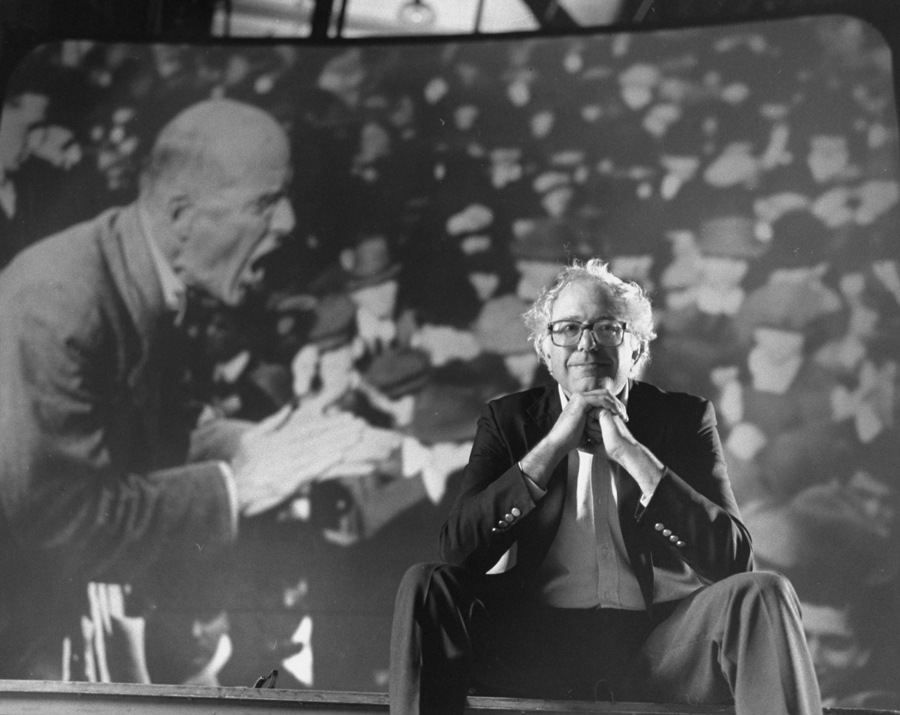
Socialist congressional candidate Bernie Sanders posing in front of a pic of socialist labor organizer Eugene V. Debs. (Photo by Steve Liss/The LIFE Images Collection via Getty Images/Getty Images)
Like training a helper monkey to use a butcher knife — that’s what the Economist crowd thinks about calls to democratize the economy. And with that overriding fear, polite liberals on both sides of the Atlantic have used the “populist” label to blur the line between Sanders and Corbyn on one side promising “the impossible” to wild-eyed kids, and Trump and Salvini on the other stoking xenophobia for political gain.
But in the United States, socialism and populism have a good deal of common ancestry. Socialist politics, after all, have always advocated a popular politics built not just around the interests of manual workers (a minority even in industrialized countries), but around a much broader bloc — farmers, the poor, pensioners, marginalized groups, and more progressive-minded members of the middle class.
This realization didn’t happen all at once. The German workers’ movement, at least as represented by the 1875 Gotha Program, was colored by the views of early socialist Ferdinand Lassalle. “The emancipation of labor must be the work of the laboring class,” read that founding social-democratic document, “opposed to which all other classes are only a reactionary body.” Writing at the time, Marx thoroughly rejected the implication that even other oppressed classes were reactionary or had interests necessarily counterposed to those of workers.