Criminalizing “From the River to the Sea”
A new bill in France would criminalize slogans said to call for the destruction of Israel. In the name of combating antisemitism, establishment political forces want to muzzle criticism of Israel’s apartheid order.
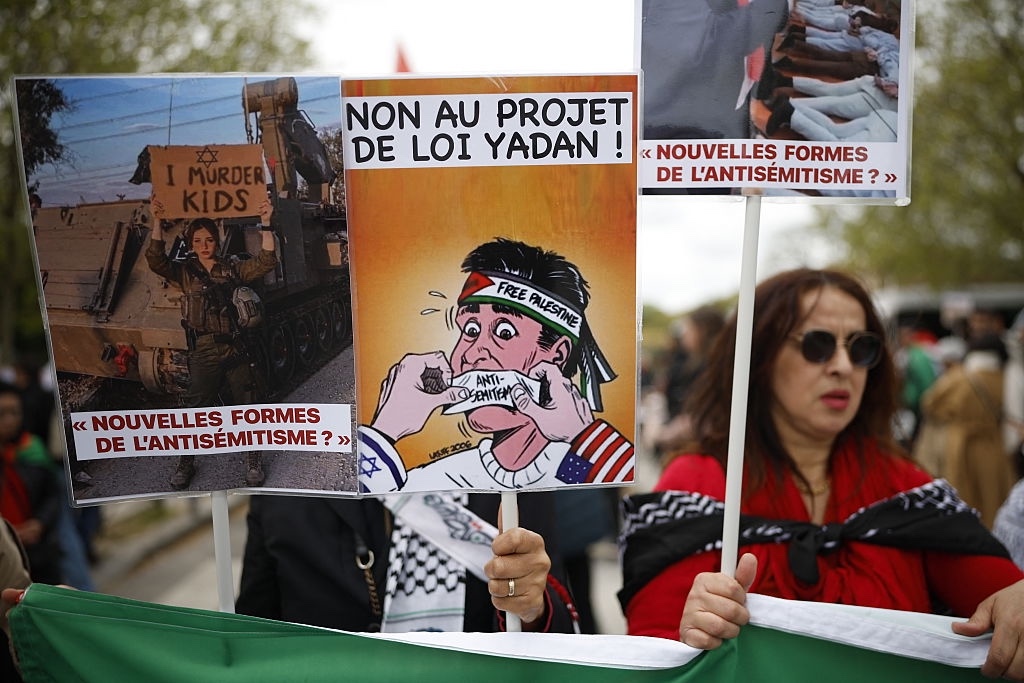
A protester holds a placard reading "No to the Yadan bill" during a rally against the new legislation in Paris on April 12, 2026. (Ian Langsdon / AFP via Getty Images)
There’s no shortage of reasons to have doubts about France’s current push to confront “renewed forms” of antisemitism — the subject of a bill slated for debate before the National Assembly in mid-April.
This winter, the same parliament held a moment of silence for neofascist militant Quentin Deranque, who died from wounds sustained in a February 12 street fight between far-right and anti-fascist activists in Lyon. Thanks to an exhaustive sweep of the slain militant’s social media activity by Mediapart, Deranque can be said to present a textbook sample of France’s antisemitic past and present.
“We have to make all high schoolers read it,” Deranque wrote on X of Adolf Hitler’s Mein Kampf. He professed admiration for homegrown French fascists like Lucien Rebatet, author of The Ruins, an infamous antisemitic tract from the Vichy era of Nazi-collaboration. A “murderous slut” is how he termed Simone Veil, the Holocaust survivor and former health minister credited with France’s 1975 legalization of abortion.
That kind of antisemitism isn’t the target of the so-called Yadan law now being debated by lawmakers. Rather, this bill is a brazen attempt to silence France’s Palestine solidarity movement. Named after the bill’s chief promotor, Caroline Yadan, an MP aligned with President Emmanuel Macron, the legislation is set to be discussed before parliament starting on April 16.
It has its roots in the controversial definition of antisemitism by the International Holocaust Remembrance Alliance (IHRA), which encompasses criticism of the State of Israel. Its adoption could have France following in the footsteps of Germany, which in 2024 adopted legislation to enforce public adherence to the IHRA definition. The IHRA now boasts as many thirty-five “member countries” according to its own tally, overwhelmingly in Europe and North America.
The major innovation of the Yadan law would classify as a criminal offense calls for the “destruction” of any state recognized by France — with Israel mentioned as an example in the law’s preamble. To opponents, that’s a backdoor way of criminalizing criticism of Zionism and the support by the French state and arms industry for Israel since the onset of the latest Middle East crisis in October 2023.
The law likewise threatens to expand the purview of “terrorist apologism,” an item in the criminal code that has already been used to repress pro-Palestine activists, left-wing politicians and trade unionists. With the revamped formulation put forward in the new bill, terrorist apologism could extend to forms of speech that result in “undervaluing” or “trivializing” terrorist attacks. Jurists warn that this represents a major widening of the infraction, which could even be used to clamp down on journalistic coverage.
Free Speech
“This law presents a textbook threat to the freedom of expression,” Nathalie Téhio, president of Human Rights League, said of the Yadan bill. “The target is deliberately broad. We’re talking about people protesting or speaking in public, whether orally or in written form in the press. Journalists should also be seriously concerned, and researchers as well. It’s freedom of expression in the broadest sense that’s under attack when you make the correlation between criticizing the state of Israel and antisemitism.”
For Elie Leibovitch, a spokesperson for the Kessem Collective — a feminist and decolonial Jewish grouping — the Yadan law throws the door open to state repression. “Take, for example, a poster with the slogan ‘from the river to the sea’ — that risk being criminalized,” Leibovitch told Jacobin. “Police charges against [pro-Palestine] protests will have a new legal justification. University lectures on the Israel-Palestine conflict will be muzzled.”
Wide condemnations of the Yadan law heard from civil rights advocates and left-wing Jewish activists are starting to making inroads in public opinion. In early April, a petition for the bill’s defeat surpassed half a million signatories.
But it’s unclear if that will be enough to fracture the broad political convergence in favor of the legislation. While not formally sponsored by the government, the Yadan bill has backing from key allies of President Macron such as gender-equality minister Aurore Bergé. In January, the bill was approved in the lower house’s laws commission with support from Macron’s camp, together with the conservative Les Républicains and Marine Le Pen’s far-right Rassemblement National. While there are some signs of cold feet among centrist MPs in the face of mounting public opposition, that could prove weak compared to the pressure to adopt the bill.
In a February 19 speech at the annual gala of the CRIF (Representative Council of French Jewish Institutions, a powerful pro-Israel lobby), Prime Minister Sébastien Lecornu promised to support the proposed legislation and to bring it to a vote this spring. “Calling for the annihilation of a state can no longer be tolerated,” said the French premier.
It’s a Trap
Téhio referred to the Yadan law as a political “trap” for MPs: “I fear that many representatives will simply see the [law’s] branding before saying to themselves, ‘if I vote against, I’ll be attacked by people who’ll say I don’t want to fight against antisemitism.’”
She continued: “We all understand the importance of confronting antisemitism. The problem today is the party-political instrumentalization of the antisemitism question.”
That context has observers worried that France’s constitutional safeguards may fail to resist this patent threat to freedom of speech. If it receives approval from parliament, the Yadan law will be up for examination before a Constitutional Council whose current chief, the close Macron ally Richard Ferrand, was nominated by the president in 2025.
Ferrand had previously served as president of the National Assembly between 2018 and 2022, during which the body adopted a nonbinding resolution endorsing the IHRA definition of antisemitism. In its most pointed elements, the IHRA damns as antisemitic claims that the State of Israel is a “racist endeavor” — think of the growing accusations of apartheid or genocide — “double standards” that demand of Israel “behavior not expected . . . of any other democratic nation.”
While that 2019 National Assembly resolution spoke of a “guidance tool” for identifying antisemitic acts, this could soon be transformed into a potent legal weapon. For a broad swath of forces represented in France’s otherwise divided parliament, confronting the so-called “new antisemitism” is ultimately a stand-in for delegitimizing France’s pro-Palestine movement.
A Divided Left
The offensive is also heightening divisions on the Left. Key figures from the Parti Socialiste, including former President François Hollande (today an MP), are even cosignatories of the proposed legislation. In January, the Parti Socialiste’s abstention was critical in allowing the bill to clear the National Assembly laws commission, as it bucked the opposition mounted by representatives of the Greens, the Communists, and France Insoumise. Parti Socialiste leader Olivier Faure has since said that the party would oppose the legislation, although in reality some MPs may break from the party line.
The intraleft fight over antisemitism and the criticism of Israel has returned to the forefront in recent months. In February, France Insoumise leader Jean-Luc Mélenchon prompted a wave of media outrage when he quipped about the pronunciation of Jeffrey Epstein’s name during a campaign stop in Toulouse. On April 2, France Insoumise European Parliament member (MEP) Rima Hassan was once again taken into police custody on charges of “terrorist apologism.” The police summons was motived by a since-deleted post on X by the MEP in support of Kozo Okamoto, a Japanese militant involved in the 1972 Lod Airport attack in Israel. It’s the latest in a series of criminal proceedings targeting the Franco-Palestinian MEP, a vocal critic of the French and EU establishment consensus for Israel.
For the Kessem Collective’s Leibovitch, the perennial tug-of-war over left-wing antisemitism is a key front of the center’s attempt to marginalize its radical-left competitors. It is also an expression of the fear in establishment circles provoked by the rejection of the French state’s support for Israel, a position for which France Insoumise has become a leading political outlet.
Like all forms of bigotry, antisemitism is a problem in France, and Leibovitch stresses that “antisemitism on the Left persists, just like misogyny or homophobia,” adding that “resisting it is a constant battle.” But that fight is a far cry from the punitive legislation currently being put forward, one whose sole purpose is to muzzle an increasingly vocal sphere in French society.