Wallace Shawn’s Road to Socialism
The left-wing actor and playwright Wallace Shawn, the writer of two plays currently running in New York, describes a harsh midlife conversion to class politics — transforming from a disengaged liberal to someone who sees himself as “a participant in the world struggle.”
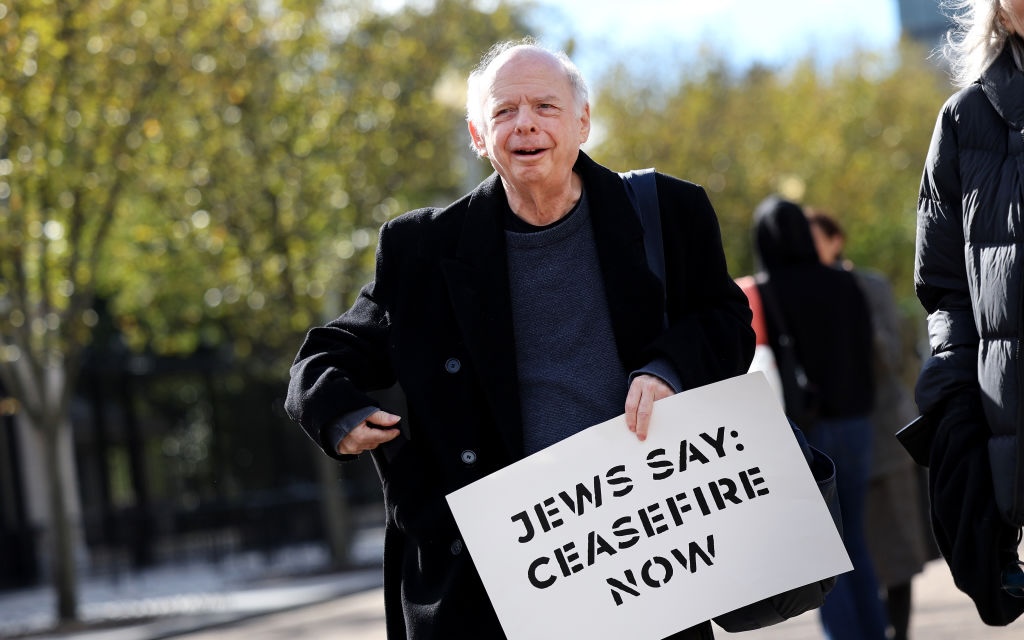
Wallace Shawn describes the subtlety and delicacy of his new play What We Did Before Our Moth Days as “a political rebuke to the crudeness of people like Trump.” (Kevin Dietsch / Getty Images)
A funny kind of energy ripples through a crowd as Wallace Shawn saunters through, as he did on March 9 at Greenwich House Theater. It wasn’t an immersive show, but Shawn, dressed in T-shirt and jeans, entered with the audience and chatted with random people as he made his way to the stage. The evening’s production of his one-man show, The Fever, had not yet begun, but the play was first performed in friends’ living rooms, and Shawn tends toward intimacy in some of his live performances. When he mounted the stage, he addressed the entire audience with small talk — the temperature, the microphone, the trouble with cell phones in the theater — and then stepped from chatter into monologue. We hushed. Having made us comfortable guests in his home, he gave us the signal to focus.
Wallace Shawn has two plays currently being performed in Manhattan, off-Broadway: his new play What We Did Before Our Moth Days, directed by André Gregory and costarring fellow Democratic Socialists of America (DSA) member John Early, and his 1990 one-man show The Fever. the latter, which contains distinctly Marxist themes, was performed in January by Shawn as a fundraiser for New York City DSA’s Tax the Rich campaign.
Shawn is today best known for his acting roles. He played the comical villain Vizzini in The Princess Bride (1987) and more recently the eccentric nerd Dr John Sturgis on the TV show Young Sheldon (2017–2024). His inimitable voice, which can leap mid-sentence from serious and gravelly into an excited falsetto, is probably instantly recognizable to you. But theater aficionados might also be familiar with Shawn the playwright and his sixty years of experience in avant-garde theater and collaborations with Gregory, an experimental director. If you are part of the organized left, you might be familiar with Wallace Shawn the socialist and advocate for Palestinians. Eldest child of New Yorker editor William Shawn and partner to the short story author Deborah Eisenberg, Wallace Shawn’s career can seem like a vibrant convergence of cultural and political streams in American life.
Shawn has written plays and essays in a socialist vein for decades, including his 2011 essay “Why I Call Myself a Socialist” and his 1996 anti-fascist play The Designated Mourner. In recent years, he has appeared at demonstrations for a ceasefire in Gaza. The eighty-two-year-old writer was even spotted in Manhattan last year canvassing for Zohran Mamdani.
The Fever is an unbroken monologue by an unnamed character who is in the grip of a harsh internal conversion to class politics. He describes waking in a hotel room in a poor country where rebels are taking over the government. He torments himself by idling over the gruesome details of an execution he had read about.
“They shave his head,” the character describes, “a section of his leg, so the electrodes will fit closely on the skin.” He asks, “Does panic mount in the man’s heart? An attendant covers his head with a hood so none of us will see his pain, the horror, the distortion of his face.” We receive this image in the first seconds of the play.
“I had always thought of myself as a regular liberal,” Shawn says when describing the origins of The Fever. “I didn’t have an awareness of myself as a participant in the world struggle. I thought of myself as an observer and as someone who observed the suffering of others with sympathy. Until I was around forty, it really didn’t occur to me that the suffering of a poor person in Guatemala had anything in particular to do with me, except that it was a sad situation, and I felt sorry for the person who was suffering.”
The Fever dramatizes this experience of radicalization, and the character attacks himself and members of his class for their lies and solipsism.
“I realized that some of the suffering, quite a good deal of the suffering, on the planet was caused to preserve the status quo that benefited me,” says Shawn. “I actually felt a very personal hatred for myself and frankly for the other people in my group. I became unbelievably aware that there was a trail of blood between me sitting in an enjoyable restaurant in New York and someone being tortured or killed in Honduras or Guatemala or El Salvador.”
The play is an excoriating critique of bourgeois liberalism and draws a line from Western capitalist comfort to violence in the Global South. Perfectly nice liberals having concerned political discussions in lovely restaurants are juxtaposed with poverty, kidnapping, imprisonment, torture, and execution in the unnamed countries the character visits.
The play alternates between the man in the hotel room and his thoughts and memories of his comfortable, bourgeois life in a faraway city. Early on in his radicalizing journey, the character reads Volume I of Marx’s Capital and is able to “see the fetishism of commodities everywhere.” Each object he sees becomes the story of the workers who created it. “The cup of coffee contains the history of the peasants who picked the beans, how some of them fainted in the heat of the sun, some were beaten, some were kicked.”
Through a series of random encounters, he is eventually drawn to poor countries where he meets desperately poor people and revolutionaries and encounters wholly different sets of values and ways of living. On his return home, he gradually becomes disgusted with and alienated by his own class. Hearing a friend describe sitting at his own father’s bedside as he died peacefully, surrounded by family, the character says, “I couldn’t help mentioning those others who died every day on the torture table, screaming, carved up with knives, surrounded on their bed of death by other experts who were doing all they could to be sure that the ones they surrounded would die in howling agony — unimaginable agony.” A testament to his considerable acting skill, Shawn was able to deliver this quote as a laugh line.
The play is also an accurate and sensitive portrait of a psychological crisis. It shows a character stuck between two ways of thinking, between passive liberalism and engaged socialism, and experiencing the contradictions of liberalism as an acute depressive episode. Where young people often experience radicalization as liberating, a throwing off of an oppressive ideology, the middle-aged character in The Fever parts with his politics painfully and regretfully. His radicalization is an agony in which he is consumed in self-hatred and cannot experience pleasure or relate to his friends.
The Fever is affecting as a left-wing work of art for how it shows an adult mind rebelling against capitalist values. It shows that you don’t have to be a particular kind of person — a young, idealistic, unsubtle, or ascetic person, for instance — to become a socialist. Shawn’s monologue is absorbing, funny, and self-aware. As harrowing as the experience is for the character, the use of humor and detail humanizes the depiction of a very real, very grown-up psychic rebirth.
About halfway through the monologue, the character gorgeously and sensuously describes the luxurious sights of a night on the town in his city.
Do you know! — there are nights in the city where I grew up, the city I love most of all, when it’s too cold for rain, but the sky can’t snow yet, although you feel it would like to, and so instead it seems that at a certain moment every car and face and pane of glass is suddenly covered in a delicious wetness, like the wetness you see on a frozen cherry, and on nights like that, when you walk through the streets of the nice parts of town, you see all the men, in overcoats that hang straight to the ground, staring harshly with open-mouthed desire at the fox-headed women whose lipstick ripples, whose earrings ripple, as they step through the uneven light and darkness of the sidewalk. And that is the sort of thing that the communists will never understand, just as human decency is the sort of thing that I will never understand.
This last sentence Shawn delivered somewhere between a punch line and a sob, and it has the effect of a gut punch. In language so rich it approaches self-parody, he describes the rainy evening, the wet concrete, the pedestrians lusting after each other. Communists, the bourgeois liberal writer muses, would never understand these observations, “just as” — and here the descriptive language is driven off course by an intrusive thought — ”human decency is the sort of thing” he can’t understand. Posing the strident “human decency” with the conversational “sort of thing,” the character assaults himself and is ripped out of his reverie. The monologue is full of these kinds of misdirections where class analysis asserts itself in the form of a neurotic episode.
Shawn says that the person he became after writing The Fever has remained decidedly radical. The character in The Fever asks himself if he would become an active leftist, someone who demonstrates, chants slogans, and lies down in the street.
“Before I wrote The Fever,” says Shawn,
I never went to a demonstration. I certainly was around in the ’60s when people were demonstrating against the Vietnam War, but at that time, when I was a college student, I found it very, very upsetting that people would be all chanting the same thing at the same time. The idea of a mob was frightening to me. Aesthetically, it was sickening to me.
Today Shawn demonstrates, chants slogans, and has even lain down in the street. “I cheerfully call myself a socialist.”
Moth Days
His new play What We Did Before Our Moth Days, while not an overt interrogation of the characters’ politics, shares an intellectual and emotional space with The Fever. As in The Fever, the characters are bourgeois, work in or near the arts and publishing, and live in a wealthy, unnamed American city. The four characters stare forward into the audience, sharing monologues, their stories gradually building and intertwining. The play is loosely inspired by Shawn’s experience of discovering his own father’s long-term affair with the writer Lillian Ross.
The story begins with the dissolute, sexually frustrated adult son, Tim, played by John Early, having an evening with a sex worker interrupted by the death of his father. We hear from the father, Dick, a popular literary novelist, played by Josh Hamilton, speaking to us from after death about his marriage and the events leading up to his affair and death. Elle, the mother, an English teacher in an impoverished and dangerous high school, describes her isolation within her marriage and her closeness with her son. Finally, we hear from Elaine, the father’s mistress, played by Hope Davis, about her affair and her visit to Dick’s deathbed. Like the father, Elaine is a writer, and like the son, she lives on the margins of polite society.
John Early, as Tim, radiated a nervous luminousness. He was ethereal beside the more solid formations of his parents. The characters are all careful and conscientious and moved by moral concern for each other, even as they sometimes act out of selfishness or narcissism. One of the most moving scenes is between Tim and Elaine following the father’s death. While most of the play is performed as distinct monologues in which the characters only address the audience, in the only actual dialogue in the play, Tim and Elaine turn their chairs toward each other and discover how much they have in common.
The play is infused with Shawn’s affection for the characters. His writing carefully moves us around them, taking in every angle, closely considering each moment’s moral import. The three hours of monologues slipped by quickly on my viewing, the audience held in a trance.
The play was directed by André Gregory, Shawn’s longtime collaborator and costar in the breakout independent film My Dinner With Andre. While most plays in New York City get rehearsed for a few weeks, Gregory rehearsed Moth Days with the actors for over a year. In the resulting performance, the actors appear to have merged with the characters, and their delivery is breathlessly vulnerable and somehow never wrong.
Shawn has described this subtlety and delicacy in Gregory’s direction as “a political rebuke to the crudeness of people like Trump.”
“The care that André Gregory and the four actors have put into every moment of that play is a rebuke to the rushed, brutal approach you might say that Elon Musk quite openly used and boasted about in the first months with his Department of Government Efficiency. It’s a totally different approach to life,” Shawn says.
In its meticulousness and intensity, Moth Days feels both old-fashioned and avant-garde. Shawn’s decidedly adult new play, while not overtly political, does feel like a psychic balm to our current political moment. Shawn’s analysis of Gregory’s direction also shows a subtle approach to the place of art in times of political crisis: a more grown-up engagement with characters who are brilliant, caring, and sympathetic, as well as deeply flawed and wounded. This patient, careful, full-bodied play is a reminder of much of what we are missing as we bull forward into a century defined by Trumpian recklessness and brutality.
“We’re kidding ourselves if we think, oh, the poem that I wrote or the painting that I painted is going to change people’s view of their world and lead them to do great things,” says Shawn. Art, however, can sharpen our brains. It reminds us that there is more to life than the acquisition of money and power, and that there are “beautiful things inside the human monster.”