Trump’s $1.5 Trillion for War Comes From Americans’ Pockets
Donald Trump is proposing to increase the defense budget by nearly half to wage war on Iran. How does he want to pay for it? Cut nearly everything that might help average Americans, from food, housing, and education programs to health care and childcare.
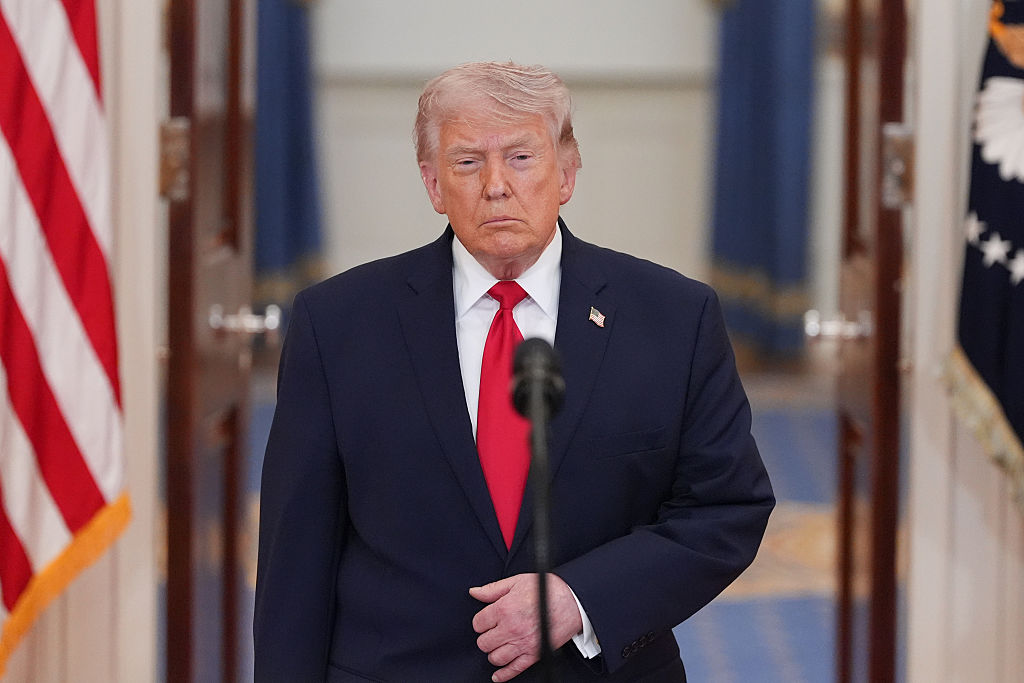
Donald Trump wants Congress to increase the defense budget by 44 percent in 2027. (Alex Brandon / AP Photo / Bloomberg via Getty Images)
Donald Trump made an uncharacteristically blunt statement on his priorities last week, inadvertently encapsulating the modern right’s philosophy. “It’s not possible for us to take care of day care, Medicaid, Medicare, all of these individual things. They can do it on a state basis; we can’t do it on a federal basis. We have to take care of one thing: military protection,” Trump said at a private lunch at the White House.
When Trump’s budget proposal came out on Friday, it became clear that he meant it. He wants Congress to increase the defense budget by 44 percent in 2027. This would make just the requested increase nearly the same size as the total military budgets of China and Russia combined.
Some of this spending would simply add to the national debt, but Trump proposes to offset part of it by cutting 10 percent of nondefense spending from the budget. Many of the proposed cuts would come from reducing or eliminating housing aid and health programs for marginalized groups, agricultural research, and teacher training.
Jacobin’s Branko Marcetic enumerates the proposed cuts in great depth here and rightfully points out that much of the proposed spending will inevitably go to weapons contractors to replenish supplies that have dwindled in the course of the United States’ reckless war on Iran.
Since the beginning of the year, stocks for four of the five biggest Department of Defense contractors are up: 25 percent (Lockheed Martin, which has nearly double the number contracts as the next largest contractor), 5 percent (RTX), 20 percent (Northrop Grunman), and 1.5 percent (General Dynamics). In contrast, the S&P 500, the Dow Jones Industrial Average, and the Nasdaq index, which measure the market more broadly, are down between 4 and 6 percent over the same time period. Defense contractor Boeing’s stock is also down; compared to the other companies, a larger percentage of Boeing’s revenue comes from nonmilitary business.
Cut health care and childcare and use the money to kill more people. That’s Trump’s proposition. It’s difficult to imagine a starker or bleaker picture of right-wing priorities as a whole. In fact, in the context of Trump’s second term so far, his statement is even worse than it appears.
The first piece of context to understand is that Trump has probably already passed his most important spending bill. The One Big Beautiful Bill Act (OBBBA) of summer 2025 succeeded in making permanent huge upper-income tax cuts first passed in 2017. It paid for these handouts in part with big cuts to Medicaid and food stamps, largely achieved by pushing costs for those programs onto the states, many of which will simply not pay them. The same law dramatically changed the funding paradigm for federal law enforcement, turning Immigration and Customs Enforcement (ICE) into by far the largest federal police agency by budget.
The second piece of Trump’s economic policy is tariffs. Despite the constant legal wrangling and Trump’s own capriciousness, increased tariffs are almost certainly here to stay, at least while Trump remains president. Absent any coherent industrial policy, the tariffs are, in effect, a national sales tax on consumers. They will inevitably have a higher impact on the poor and working class, who have to spend a higher proportion of their income to meet their basic needs than those with higher incomes. Though Trump and the Republicans have rarely made the connection explicit, income from tariffs is another way to charge the poor more to fund tax cuts for the rich.
We should note here that Trump’s budget proposal has no legal force — only Congress can set appropriations. But that brings us to our third point: not only have Republicans in Congress generally gone along with Trump’s priorities, they have also encouraged him to take for himself more of Congress’s legal spending authority.
Created by executive order, the Department of Government Efficiency (DOGE) cut at least 260,000 federal jobs and tried to eliminate entire agencies and congressionally mandated programs. In addition, DOGE cut billions in federal grants to basic research, environmental protection, and other programs, all appropriated by Congress. Like the tariffs, Trump merely asserted he had the ability to impose DOGE’s cuts, and congressional Republicans, despite a little grumbling, went along with the executive power grab.
Also like the tariffs, DOGE’s actions have faced, at best, a mixed outcome when challenged in court, but the court rulings have had relatively little real-world impact. When it loses in court, the administration either finds a legally novel way to try the same thing again or simply ignores the ruling.
It’s not as if Republicans as a whole have usually objected to beefing up the military and cutting taxes for the rich while starving schools, hospitals, and most social programs. Trump’s budget proposal won’t be the final word on the budget, but there are strong reasons to believe he’ll get much of what he wants.
And what Trump wants is war: most immediately, an unwinnable war on the Iranian people with shifting rationales and increasing brutality and sadism. Unable to do much to degrade Iran’s military capacity, Trump has gleefully shifted to making war on its factories, hospitals, universities, pharmaceutical researchers, bridges, and school children.
But read that target list again. Then consider cuts to food and medical aid Trump already made in the OBBBA, his tariffs and immigration enforcement that have helped drive up the cost of food, his campaign to extort universities and to make existing student loans more expensive and new ones more difficult to obtain, his past and future cuts to K-12 education, and his desire to abolish the Department of Education entirely.
Recall his administration’s attempts to undermine well-tested vaccines and roll back access to HIV treatments. Don’t forget that he has weaponized infrastructure construction, including river crossings, to try to get back at his political opponents or extract concessions. Remember the heavily militarized ICE and Border Patrol operations that — before big, sustained protests made them untenable — essentially occupied major American cities with shifting rationales and increasing brutality and sadism.
Trump’s budget cuts are not just incidental to making war on Iran. They’re part of the same war that people in Trump’s income bracket are waging on Americans and Iranians alike. Let’s not be glib — bombing hospitals and schools is worse than defunding them. But while the tactics are different, the targets are strikingly similar.
Almost any institution that helps people in need or contributes to human flourishing has a bullseye on its back. All of this is done so that people with more money than anyone could ever need can take even more money from the rest of us.