Serbia’s Government Is Targeting the Public University
The recent death of a student at the University of Belgrade triggered a police raid and fresh government attacks on education. Professors appear as the vanguard of a broad social movement, but their plans for change are less clear.
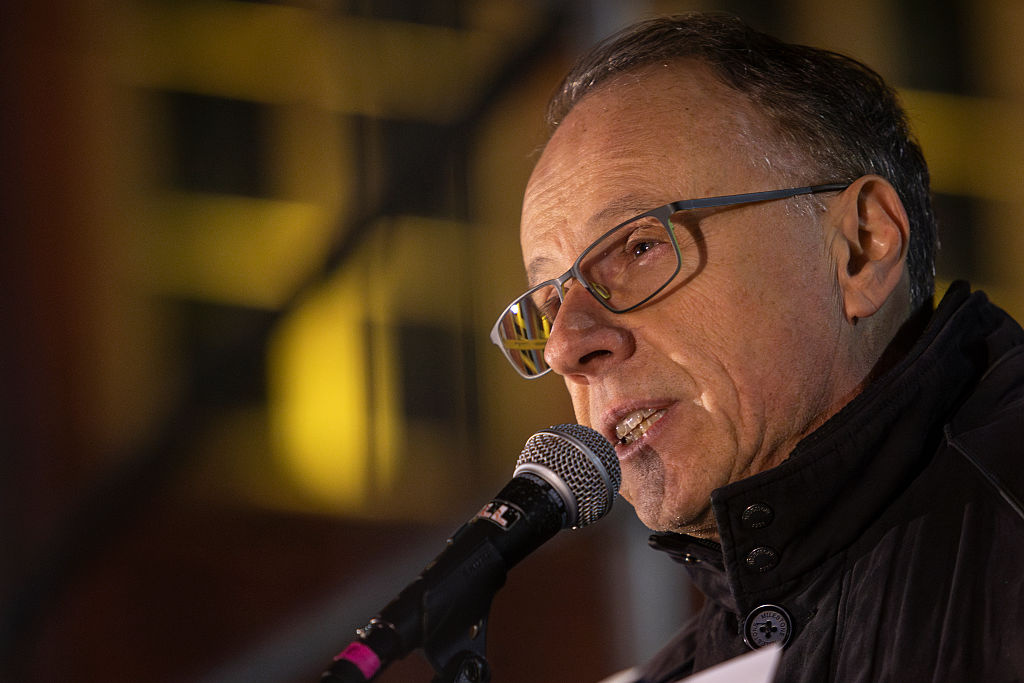
A recent speech by the rector of Belgrade university, Vladan Đokić, was soon immortalized as a defiant response to rising authoritarianism. Calls for him to run for election show the importance of the university protests but risk limiting the movement’s ambitions. (Maxim Konankov / NurPhoto via Getty Images)
In the seventeenth month of a student-led mass movement in Serbia, the death of a student at the Faculty of Philosophy triggered an orchestrated attack on the University of Belgrade by the country’s government-police-tabloid complex. On the eve of the police raid, protesters gathered in front of the rectorate, and the rector delivered a historic speech situating the university as the last autonomous institution in the country ready to confront ruling-party power. But the question remains: what kind of politics, and in whose name?
Raid
We stood on the street that divides the University of Belgrade Rectorate from Student Park, counting police officers who, lined up in a row around the building’s facade, were “protecting” the building from students and professors. There were maybe thirty of them, though we knew armored vehicles and riot police were stationed nearby. The protesters — students, professors, deans, citizens — were breathing down their necks less than half a meter away.
In my small wannabe avant-garde group, we fantasized about an Iran-style hostage crisis, in which we would, as an unexpected force, overpower those thirty-odd men in blue and take them hostage inside the rectorate building. Our first demand would be the return of all student documentation previously seized from the Students’ Archive at the Faculty of Philosophy. We would immediately restore the banner proclaiming “Students Win,” which the police had removed from the rectorate facade earlier that day, in a gesture that seemed to say: After seventeen months of a popular, student-led mass social uprising, enough of you, squatters, we’re taking things into our own hands now. This was a pipe dream: in reality, members of the Criminal Police Directorate were not only outside but inside, too, holding the rectorate hostage, along with Rector Vladan Đokić and the staff, while carrying out a thorough search of the building.
Among those gathered outside the rectorate, I see familiar faces, friends from a past life and those who became comrades over seventeen months of pushing forward or “pumping it up” (as a popular slogan has it). I run into a local DJ. He tells me the situation has escalated, that this won’t be resolved without violence. He adds that, back in the summer, when dumpsters were burning in the streets, that was the real state of affairs, a mirror of the country itself. A bittersweet uncertainty hangs in the air after a brief afternoon standoff with the police, and no one knows which way the evening will turn. Soon messages spread through countless group chats: the students do not want confrontation or a violent break-in to the rectorate. Everyone complies. The deans of Belgrade’s faculties physically shield the entrance to prevent incidents.
Later that evening, in a scene as surreal as everything else over recent months, we first see the rector’s fist pumping the air, and then he himself appearing on the balcony. The whole picture is ready for media use. From a piece of paper, he reads what becomes clear from the very first sentences is a historic speech. He underlines: “The University is the last institution still standing. That’s why they came.” Government representatives, led by President Aleksandar Vučić, and pro-government tabloids denounce the speech as inappropriately political for a rector, while the rebellious citizens celebrate it for exactly the same reason. The speech was indeed political, almost a victory speech by someone ready to take power and represent the people. It indirectly confirmed speculation about the rector’s role as the figurehead of the so-called student electoral list, a hypothetical campaign representing the recent protests’ demands.
Death as Pretext, Once Again
Previously we have reported on the transition from the university blockades and street protests to the electoral front. The mass student-led social movement itself was triggered by the death of sixteen people killed by the fall of the canopy of the Novi Sad train station in November 2024.
Death again served as pretext for the current wave of mobilization. A few days prior to the rectorate seizure, a female student fell late at night from the fifth floor of the Faculty of Philosophy. Her body was found on the concrete below. While the circumstances of her death remain murky, the government, the police, and the tabloids responded with ready-made clarity. The culprit is said to be the “blockaded university,” incapable of ensuring even minimal safety for its wards, the students. The university must be cleansed, de-occupied in order to be counter-occupied by government loyalists. Or simply abolished. The public university, the president and his ministers make clear, is an enemy of the people. It is not recommended that you send your children there, “’cause they will return in coffins”, as Darko Glišić, one of the ministers in the government, said.
The Criminal Police Directorate, a department under the strict control of the ruling party and populated with loyalist cadres, was first dispatched to the Faculty of Philosophy. There, officers seized all student documentation and whatever else they could get their hands on. Then, on March 31, they moved into the rectorate under the pretext of an investigation, citing the building’s position across from the faculty and the need to inspect surveillance cameras. From the rectorate, where students often held plenum meetings, they took not only receivers but various other items used during protests, including first aid materials, immediately portrayed in tabloids as potential tools of mass terror. Informer TV, acting as the true state broadcaster of a warped regime, was first on the scene everywhere, staging a Serbian version of a Trump-ICE live-stream spectacle, lifting the sheet covering the student’s dead body and following every police action and seizure.
The student’s death remained hanging between the fifth floor and the concrete. On the plateau of the Faculty of Philosophy, where students usually stand and smoke, only flowers and candles bear witness that something tangible and material happened here. Her death has become absent. A ready-made, a mere signifier, that will be used again by whomever can construct a lucrative narrative.
University Politics, From More Socialism to More Capitalism
The University of Belgrade is historically the birthplace not only of students’ blockades of their faculty buildings, but of broader social movements. In 1936, the revolutionary youth of the Communist Party fought police repression and fascism while demanding lower tuition and better education. Students demanded more self-managed socialism in 1968. From the ’90s onward, in the framework of the restoration of capitalism in former Yugoslavia, students and citizens alike demanded “transition” (verbalized in free elections and free media), that already happened in other parts of the formerly communist East.
The notable exceptions are smaller student blockades of faculties (primarily the Faculty of Philosophy) that in the new era resisted neoliberal reforms in higher education, demanding a free, publicly financed and publicly accessible education for all as a prerequisite of any democratic society.
Last year’s university blockade, the longest and most massive in the country’s history, has, from the outset, enjoyed the support of professors, who handed over faculties with almost no resistance. This time, professors’ own material rights were also under threat.
For years, the ruling SNS (nominally, the Serbian Progressive Party) has worked to dismantle the university, intensifying its attacks throughout 2025: proposing a new law to limit university autonomy, promoting the wholesale privatization and commodification of higher education, manipulating financial resources, publicly targeting professors involved in the student movement, blocking promotions and pushing dismissals. In short, doing everything to subjugate public education in the same way it has subjugated and captured all other sectors of society.
Here, Rector Đokić is entirely right when he says that the university is the only place not yet on its knees.
Employment at the university remains among the most privileged positions in Serbia. Although salaries are incomparably lower than in EU member states, job precarity is not widespread, and it is still possible to study entirely free of charge at the highest levels. Yet this legacy of Yugoslav socialism has been systematically attacked and eroded across all post-Yugoslav republics. Only 38.1 percent of 250,000 current students in Serbia are funded from the public budget, with 61.9 percent self-financing. The extent to which self-financing has become normalized is evident in the fact that today’s students in the blockade struggled to agree even on the call for a 20 percent increase in the higher education budget, which was put as their fourth demand at the beginning of the blockades.
From Public Communion to Private Separation
Within the rebellious public, professors have been cast as heroes who stood up to the ruling party and the criminal, corrupt regime it has built. The university appears as a magically autonomous institution, full of honor, wisdom, appropriate cultural codes, and decency, entirely detached from any material interests and thus uniquely suited to lead, protest, and represent.
Yet in the struggle for free education, the professors often acted as a counterrevolutionary class, identifying their own survival in correlation with the number of self-financing students. In previous faculty blockades, they refused dialogue with students, disabled power outlets, shut off heating, and initiated disciplinary proceedings.
Today’s support, however, has gone through several transformations since the movement began in November 2024. A kind of public communion and quiet private divorce is documented in the philosophy faculty students’ zine, titled Voice of the Blockade. In its first issues, students and professors appear as a shared community, on the same path toward societal recovery. But as the struggle intensified and state repression escalated, the narrative shifted from “professors cook for us” and “we read Voice of the Blockade together” to disappointment and a sense of betrayal, rooted in the short-lived nature of professors’ commitments and their fundamental lack of interest in the problems of other social groups, such as factory workers or peasants.
Indeed, professors not only pushed for an expert government and, when that failed, for early elections, but under the threat of continued salary suspension, after already being denied two months’ pay by the ministry, they reached an agreement with the government to de facto end the blockades and provide express compensation for the entire academic year in just a few summer months of 2025.
Exams were scheduled back-to-back, as if nothing had happened, as if that material had been taught and studied all year. Students, instead of their previous collective approach to problems, were forced into individual struggle, each coping according to their own exhaustion or resilience. Some passed, others failed, losing the year and their dorm rooms, and left to deal alone with the psychosocial consequences of what was likely the most important year of (not only) their lives.
No One Represents the People
Speculation about the rector’s possible role as the figurehead of a student list has been largely welcomed in the loudest segments of the oppositional public. His politics remain unknown, while some point to his previous ties to the ruling SNS party, casting doubt on any sudden change of course. For most commentators, this does not seem to be an issue. The rector is instead seen as a transitional figure, acceptable to all, capable of rallying both the rest of the list and the broader social movement behind him. In this reading, Serbia is now fighting for normalcy (“Belgrade is the world again,” as a popular protest banner has it). All differences aside, we are marching toward a better future, no longer captured by the ruling party and, ideally, a European one. Because there is no alternative.
Sociologist Todor Kuljić, who used to teach at the Faculty of Philosophy and is one of few professors who, during previous blockades, publicly supported students in their demands for free education, recognizes that one significant achievement of the protest is that it has neutralized right-wing themes in the public sphere and freed citizens from fear of the authorities. Still, as he points out,
the student-civic protest in Serbia is centered on political divisions for or against power, for or against the president. Through its mass presence in the square, it has approached only one side of radical democracy, but by reducing its critique of the state to corruption, it has remained outside it. It does not call the socioeconomic totality into doubt. For that reason, though in conflict, students and the regime are complementary parts of a single whole, Serbian capitalism. These are different, yet fundamentally kindred elements, opposed, but not antagonized enough for something new to emerge from their tensions. The outcome can only be an improvement of what already exists, a better capitalism.
For many on the rebellious front, in the current conjecture in Serbia, this is quite enough.
A mass student and social movement that organized through plenums, and gathered different ideological and political streams together, also involved the creation of the Social Front (an initiative aimed at connecting students with workers and unions). It called for citizens across Serbia to assemble while taking power into their hands. The demand for snap parliamentary elections and thus the need to present a united front has heightened the dominance of the expert class, while the openings created during the past year seem now reduced to a change of government. Reigniting mass participation at student plenums, in citizen assemblies, and in the streets may be the only way to keep those tensions alive.