SCOTUS Is Siding With Capitalists Over Trump
The Supreme Court’s willingness to protect the Fed — in contrast to every other independent regulatory commission — reflects the strength of its loyalty to neoliberal capitalism over the Trump administration and even the vaunted “unitary executive theory.”
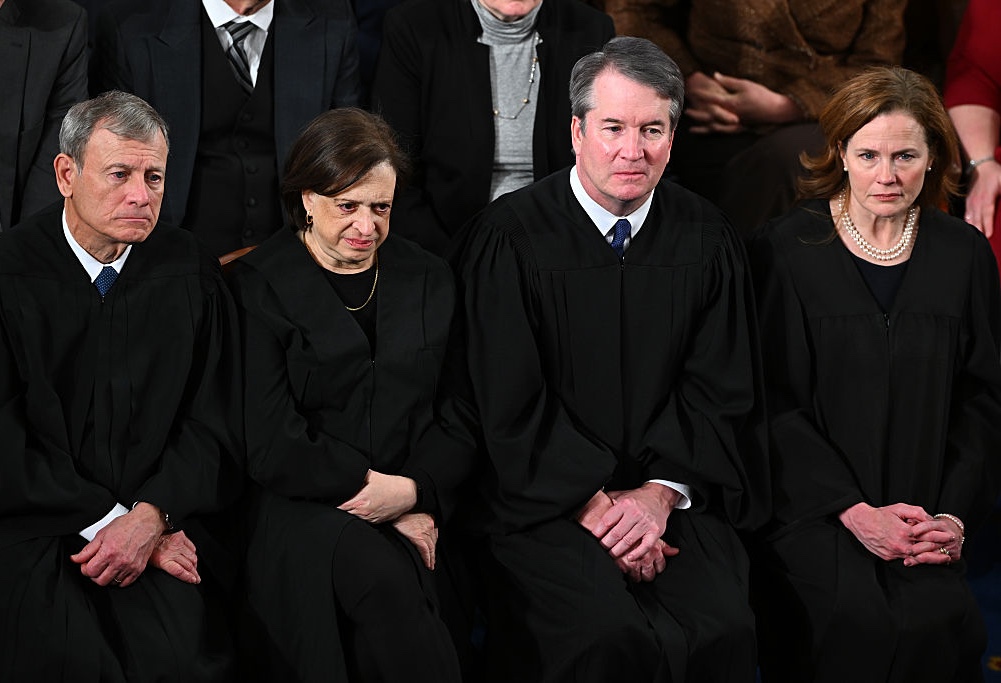
In Trump v. Cook, the conservative justices are poised to vote against Donald Trump, eager to preserve a financial system that already serves them and their allies well. (Graeme Sloan / Bloomberg via Getty Images)
In the ongoing dispute between Donald Trump and the Federal Reserve, the Supreme Court has strongly indicated that it will side with the Fed. It is now abundantly clear that the conservative justices want to protect the independence of the Fed — in contrast to that of virtually every other independent regulatory commission, like the Federal Trade Commission (FTC), the National Labor Relations Board (NLRB), and the Security and Exchange Commission (SEC).
In both the recent Trump v. Cook oral argument and in prior arguments and opinions, the justices have argued that the Fed is somehow different, specifically in that it does not exercise executive powers. But this simply isn’t the case: it regulates banks, credit card fees, and financial advertising, among other things, and issues fines. So what’s actually different about the Fed?
Justices Amy Coney Barrett and Brett Kavanaugh have hinted at pragmatic concerns: if the president can violate the independence of the Fed, it would have potentially serious economic consequences. They are betraying their commitment to the “unitary executive theory,” which respects the president’s complete authority over the executive branch, simply not to spook the markets.
As with the tariffs case, the conservative justices are poised to vote against Trump again, displaying where their real loyalties lie. The current financial system, without a doubt, already serves them and their allies well.
Unitary Executive Theory (But Not Like That)
If the current conservative Supreme Court loves one thing, it is the unitary executive theory. This theory holds that the president possesses the sole authority to control the entire executive branch, directing federal agencies and enforcing laws without interference from other branches of government. Although multiple versions of the theory exist, the current court has committed to one key point: the president must retain broad power to remove executive officials, even if Congress says otherwise.
The court is likely to bolster this doctrine over the summer, as a decision in Trump v. Slaughter is widely expected to uphold President Trump’s efforts to fire Federal Trade Commissioner Rebecca Slaughter. Nevertheless, the court has also clearly signaled that it will protect Federal Reserve governors from presidential removal — to such an extent that the Trump administration did not even attempt to apply the unitary executive theory to the Fed in the recent Trump v. Cook oral argument.
The court’s willingness to extend presidential authority over almost everything except the Fed reflects the strength of its loyalty to capitalism and the weakness of its loyalty to Trump.
Conservatives have long defended the unitary executive theory on structural grounds, appealing to both accountability and the preservation of the separation of powers. Justice Antonin Scalia’s dissent in the 1988 Morrison v. Olson case is the classic statement of this view. Scalia argued that Article II of the Constitution’s vesting of executive power in a single president reflects the Framers’ commitment to an energetic executive branch that could be held accountable through the elected president.
When Congress attempts to insulate federal government agencies or independent counsels from presidential removal, he argues, it is guilty of creating a “mini-Executive”: figures and agencies exercising executive power without electoral accountability. In other words, conservatives fear the emergence of a “fourth branch” within the administrative state that evades democratic control and undermines the structure of the Constitution.
Scalia’s views are widely held by the six conservative justices on the Supreme Court today. They were reflected to a large extent in the crucial 2020 case Seila Law v. CFPB, which invalidated legislation protecting the director of the Consumer Financial Protection Bureau (CFPB) from removal by the president — unless the president could demonstrate cause for removal, such as malfeasance or corruption.
In that case, Chief Justice Roberts, writing for a 5-4 court divided along ideological lines, did at least preserve Congress’s authority to protect multimember regulatory commissions (such as the FTC, NLRB, and SEC) from presidential control. This authority stems from the Humphrey’s Executor v. United States precedent dating back to 1935.
In December, however, during oral argument in Trump v. Slaughter, the Supreme Court’s conservative majority signaled its willingness to narrow and potentially overrule Humphrey’s Executor. In other words, the court now appears on the brink of finally fulfilling the conservative dream of dismantling the quasi-independence of the administrative state from presidential power once and for all.
However, in the recent oral argument regarding the president’s authority to fire the Fed governor in Trump v. Cook, the conservative justices did not even consider extending the unitary executive theory to the Federal Reserve. The reasons given by the court are, as Amy Howe has noted, “muddled at best.”
In Seila Law, the court noted in passing that the Fed can “claim a special historical status” that allows Congress to give it more independence from the president than an institution like the CFPB. In a DC Circuit opinion written before he was a Supreme Court justice, Justice Kavanaugh referred to the Fed’s “unique function . . . with respect to monetary policy.” In another case about the CFPB in 2024, Justices Samuel Alito and Neil Gorsuch described the Fed as “a unique institution with a unique historical background.”
Then, in May last year, when reviewing a lower court’s order reinstating members of the NLRB and Merit Systems Protection Board, the conservatives on the court described the Fed as “a uniquely structured, quasi-private entity that follows in the distinct historical tradition of the First and Second Banks of the United States.”
The argument, in short, appears to be that the quasi-independence of the Fed — enshrined in Congress’s requirement, by law, that its governors can only be removed “for cause” — is not going to be challenged by the Supreme Court because Congress has a long history of creating Fed-like institutions and because monetary policy is not an inherently executive power.
But Fed independence itself is not the product of any constitutional theory. Rather, it is a postwar political struggle between the Treasury Department and the Fed over interest rates and inflation. Moreover, as Mona Ali notes in a recent Jacobin interview, the term “independence” is a misnomer: although Fed governors are independent from presidential control, the Fed is deeply entangled with global financial markets, and it has shown its willingness to depart from monetary orthodoxy in order to serve these markets, such as when it engaged in quantitative easing (massive purchases of government bonds) during the 2008 and 2020 financial crises.
To be sure, however, Trump’s attacks on the Fed are not grounded in any concerns about its excessive entanglement with finance capital. By all accounts, he just wants to bully the Fed into lowering interest rates — for some combination of electoral and personal financial gain. Nevertheless, sensing the intense skepticism of the Supreme Court, the Trump administration did not even try to argue in Trump v. Cook that the president has an unfettered right to fire Fed governors. More cunningly, the administration argued that even though governors can only be removed for cause, the president has the sole right to define this cause.
As every justice on the court seemed to realize during oral argument, if they accepted this argument, then the “for cause” legal protection granted to Fed governors would be meaningless. For this reason, Trump v. Cook could be decided very narrowly and without any serious elaboration of the Fed exception: a possibly unanimous court could simply say that if the “for cause” statutory protection is accepted by all sides, a removed official must be granted some semblance of administrative or judicial review.
The conservatives on the court may wish to avoid such elaboration, since the constitutional basis for the Fed exception is highly dubious. First of all, the Fed plainly does exercise executive powers, particularly powers to legally enforce regulations. As the National Civil Liberties Alliance, a right-wing litigation group, noted in a Trump v. Cook amicus brief, the Fed regulates “bank advertising, debit-card fees, and borrower credit evaluations.” It
imposes penalties, including heavy fines, on entities that violate its regulations: for example, in 2024, it fined Toronto-Dominion Bank $123.5 million for “violations related to anti-money-laundering laws” and fined Green Dot $44 million for what it called “numerous unfair and deceptive practices and a deficient consumer compliance risk management program.”
Defenders of Fed independence do not tend to contest these facts.
Second, while the idea that Fed-like institutions have some historical pedigree going back to the First Congress is undoubtedly correct on its face, a similar argument could be made for the other agencies whose independence this Supreme Court wants to abolish. In their current form, such agencies — of which there are approximately twenty today, including the FTC, NLRB, and SEC as well as the Equal Employment Opportunity Commission and the Consumer Product Safety Commission — have existed since the establishment of the Interstate Commerce Commission in 1887.
Yet as scholars such as Jerry Mashaw, Victoria Nourse, and Christine Chabot have demonstrated, the First Congress also created quasi-independent commissions to deal with the payment of the national debt and intellectual property disputes. The historical basis for arguing that these commissions violate the separation of powers while the Fed doesn’t is far from clear.
No Messing With the Markets
Reading between the lines of Trump v. Cook oral argument, the real reason for treating the Fed differently comes to light: fear of consequences for financial markets. Justice Barrett, for example, reminded the solicitor general that “we have amicus briefs from economists” telling the court that if Trump were to win this case “it could trigger a recession.” Justice Kavanaugh repeatedly referred to the “real-world downstream effects” of allowing the president to remove a Fed governor on mere pretexts.
It is noteworthy that Governor Cook was represented during oral argument by Paul Clement, who has perhaps argued more conservative cases before the Supreme Court than anyone else alive today. While Clement fed the justices plenty of originalism, he also emphasized how “it’s less important that the president have full faith in every single [Fed] governor, and it’s more important that the markets and the public have faith in the independence of the Fed.”
“The ultimate imperative,” Clement added, “is that the markets don’t think that rates are being lowered for political pressure. When rates are lowered, the markets are going to understand that that’s actually prudent financial management of our monetary policy.”
Clement was selling the classic conservative policy defense of central bank autonomy: a central bank is independent when it makes its decisions based on the dictates of financial markets rather than on the dictates of elected officials. He is surely correct that the markets will be more confident in a central bank that reliably serves their interests. And the conservative justices on the Supreme Court appear to have accepted this view but disguised it in questionable legal arguments — arguments that are hardly conducive to the radical economic transformation that this country ultimately needs.
This court, we often hear, is subservient to Donald Trump. But Trump v. Cook is going to be another case in which conservative allegiance to neoliberal capitalism prevails over any attachment to the president.