No, Western Marxism Wasn’t a CIA Plot
Gabriel Rockhill’s polemic against Western Marxism seeks to condemn a set of postwar left-wing intellectuals such as Herbert Marcuse. Heavy on innuendo but light on evidence, the result is more like a show trial than a serious political indictment.
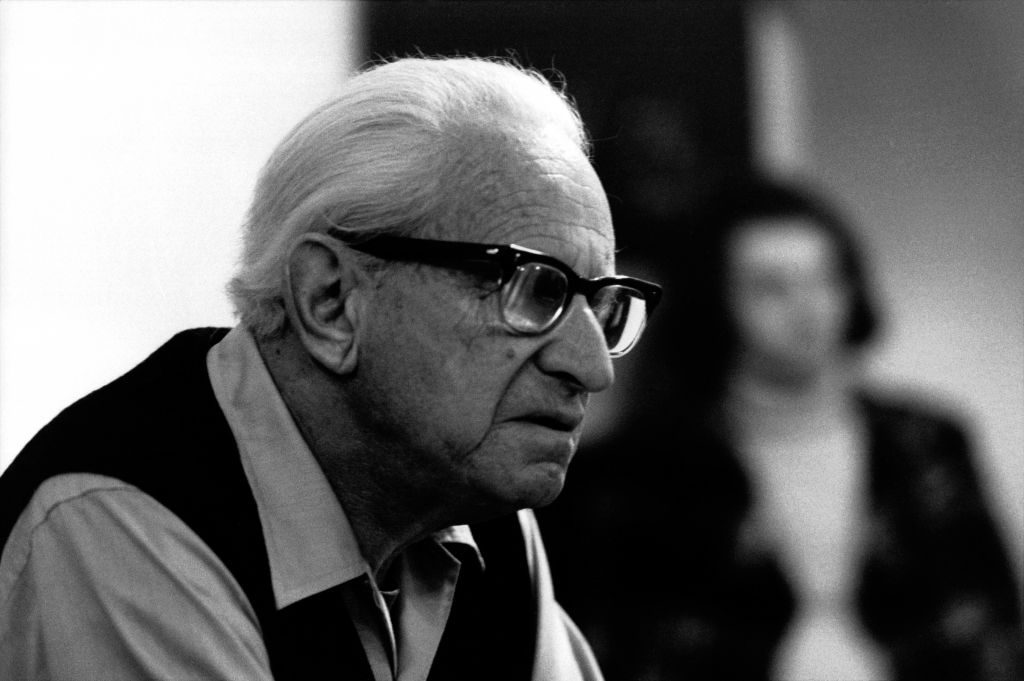
Gabriel Rockhill draws a sharp contrast between the supposed virtues of Soviet-inspired Marxism and the supposed failings of the New Left’s leading intellectuals, especially the Frankfurt School. But he fails to deliver a fair criticism of his subjects. (William Karel / Gamma-Rapho via Getty Images)
“All the old crap of the thirties is coming back again — the sh-t about the ‘class line,’ the ‘role of the working class,’ the ‘trained cadres,’ the ‘vanguard party,’ and the ‘proletarian dictatorship.’ It is all back again, and in a more vulgarized form than ever.” So declared the anarcho-ecologist Murray Bookchin in his 1969 pamphlet, Listen, Marxist!
Sixty-odd years later, do these words ring true again? Some of the phrases remain on the margins. Yet something that spooked Bookchin is afoot in our troubled land: a return of Marxist-Leninist slogans and the eclipse of a New Left esprit. A sign of the times: A new book from a socialist publisher, Who Paid the Pipers of Western Marxism?, exemplifies and ratifies this revival.
Its author, Gabriel Rockhill, draws a sharp contrast between the supposed virtues of Soviet-inspired Marxism and the supposed failings of the New Left’s leading intellectuals, notably those associated with the Frankfurt School. But he fails to deliver a fair criticism of his subjects. Rather, he resorts to innuendo and guilt by association in a bid to demolish their reputations. He might be viewed as a Marxist-Leninist in the school of Donald Trump: use any means to defame your foe.
Origins of the New Left
The New Left emerged in the late 1950s as the outcome of political events and generational shifts. As the baby boomers became teenagers, civil rights and antinuclear movements roiled the national political scene. These movements took place amid a fraught global situation, with the death of Joseph Stalin in 1953, Nikita Khrushchev’s denunciation of his predecessor in 1956, and uprisings in the Soviet sphere from Berlin to Budapest.
The workers revolted against the avowed workers’ states, only to be suppressed by Soviet troops. For older leftists who still looked to the Soviet Union as a revolutionary inspiration, these events brought a final disappointment. For younger leftists who sought guidance, if not inspiration, Soviet Marxism garnered little or no enthusiasm.
These younger leftists — at least the budding intellectuals among them — cast about for a form of Marxism less rigid than the Soviet version. They studied Marx’s early writings and the first critics of Russian Marxism such as Rosa Luxemburg. They returned to (and in part invented) a Western Marxism.
The phrase “Western Marxism” first emerged in the 1920s as an insult used by Soviet spokesmen who lambasted some European Marxists, accusing them of being too philosophical and too little invested in the ideas of Lenin and vanguard party–building. The term is a misleading one inasmuch as the line of demarcation does not denote geography but ideas. “Soviet Marxists” existed aplenty in the West, while dissident “Western Marxists” popped up in the Soviet Union itself.
However, the term did point to real contrasts between European and Soviet-style varieties of Marxism. The Europeans mulled over the differences between the industrialized West with a large working class and an agrarian Russia with a much smaller working class and a vast peasantry. The West needed, they believed, not vanguard parties but vanguard intellectuals. The issue in the West was less how to subvert the state than how to subvert a bourgeois culture that had seduced its populations.
Divergent historical experiences lay behind the divergent intellectual trajectories: on the one hand, the success of the Russian Revolution; on the other, the failure of European revolutions after World War I. As one Dutch Marxist declared in 1927: “From 1918 to the present day, every chapter of European history could be headed: The Defeat of the Revolution.” This experience of defeat informed Western Marxism for the next several decades.
The Frankfurt School
The boomer generation took up a legacy of Western Marxism that they found to be less authoritarian and dogmatic than Soviet Marxism. The New Left intellectuals and their journals — Studies on the Left, Radical America, New Left Review, Telos — sought to rethink the Marxist tradition. In this endeavor, they rediscovered not only the writings of the young Marx, but also the scholars of the so-called Frankfurt School, who had been hewing a path between a cramped Soviet Marxism and a flaccid social democracy.
The Frankfurt thinkers came together in that German city during the 1920s. By the mid-1930s, virtually all of them — in peril both as leftists and as Jews — had fled Germany for the United States. They worked as researchers with little public notice until the 1960s, when Herbert Marcuse in the United States and, to a lesser extent, Theodor W. Adorno and Max Horkheimer in Germany (where they had returned after the war), became celebrated as New Left philosophers.
Marcuse loomed above the others because of his charisma, his embrace of the New Left, and the public notoriety of his student Angela Davis, who had also studied in Frankfurt with Adorno. She was one of the few women ever to feature on the FBI’s Ten Most Wanted Fugitive List for her supposed role in the 1970 courtroom killings that aimed to free the imprisoned Soledad Brothers. For a moment, Davis transfixed America.
Fast forward almost sixty years, and where are we? The New Left blew apart, but its humanism, counterculture ethos, personal politics, and democratic instincts remain its legacy on the Left — or do they? While the Soviet Union and its domain unraveled, the Marxist left hardly enjoyed a renaissance. If anything, the reverse was true: conservatism and anti-Marxism have plowed ahead.
Against this dismal backdrop, Joseph Stalin, Mao Zedong, and their Marxism-Leninism have enjoyed a resurgence. In Who Paid the Pipers of Western Marxism?, Rockhill sets out the case that the Western Marxists, mainly the Frankfurt School philosophers, were not cautious revolutionaries, but rather paid agents of American capitalism. They impugned communist countries and national liberation struggles as they lived the good life, reaping the profits from what he calls the “radical theory industry.”
We are informed that subsequent volumes — this is just the first of a planned trilogy — will tackle French intellectuals and “cutting-edge” scholars with their ideas about postcolonialism, subaltern studies, and Afro-pessimism. Rockhill will argue that all these leftists have served American imperialism and abandoned a true version of Marxism.
In this first volume, he attacks the Frankfurt thinkers as “members of the petty-bourgeois intelligentsia,” who spearheaded an anti-communist “imperial Marxism” from the comforts of their “capitalist-funded professorial citadel.” In his politics, Rockhill follows another recent book, Western Marxism: How it was Born, How it Died, and How it can be Reborn by the late Italian Marxist Domenico Losurdo, whose works include a defense of Stalin. Rockhill, like Losurdo, advances an unreconstructed Marxist-Leninism against what he sees as the bought Frankfurt School thinkers.
DHM
What does Rockhill’s case amount to? A salute must be given: Rockhill is a diligent researcher who seizes upon the slightest scrap that might cast aspersions on the Frankfurt School, however remote the connection. To make his argument, he declares regularly that he proceeds dialectically. Indeed, he has coined an acronym, DHM (Dialectical Historical Materialism), as shorthand for a political philosophy that he boasts has a “proven record of success.”
He never gets around to the proof of success, which sinks his project. For he pounds the Western Marxists with a hammer of “actually existing socialism” that they ignored or criticized. “Actually existing socialism” refers to the past Soviet Union, its allies, China today, national liberation struggles, and numerous revolutionaries, mainly familiar eminences such as Vladimir Lenin, Mao, and Che Guevara. He never mentions North Korea, but why not?
Although the book opens with the capture and killing of Che Guevara, Rockhill does not expend a sentence on telling us how or why Mao or Che speak to a Western left today. What Maoism, a program of peasant insurgency, meant in urban New York or London was always a mystery, even while Mao was alive, but Rockhill cannot be bothered to explain it. With his hammer he mounts posters of glorious communism that the Western Marxists deprecated.
Rockhill will not expound on the achievements of “actually existing socialism,” he admits, because it would require additional volumes. He refers us instead to a list of twenty experts. Unlike the “unresearched and superficial accounts of Western critical theorists,” the works of these brilliant comrades offer “rigorous material histories” of existing socialism.
One example I plucked from his list is that of Cheng Enfu, president of an Academy of Marxism in China. A recent pronouncement of Professor Cheng runs as follows: “Russia’s special military action [in Ukraine] triggered by the West has led more people in the world to realize that the socialist system and policies are peaceful in nature.” You might want to call your local DHM specialist to explain this sentence.
Rockhill hammers and yammers away. It turns out that Professor Herbert Marcuse was not the same as the black revolutionary George Jackson. Rockhill pursues this “revealing” comparison, although he admits it is “far from perfect.” Unlike Marcuse, who was interviewed, feted, and died at the age of eighty-one, Jackson was killed in a prison break at the age of thirty, which apparently means that Marcuse was a sellout. Rockhill himself is still alive as a fifty-four-year-old tenured professor, which apparently also means he has sold out.
Silent Dogs
Rockhill is a master of guilt by association, guilt by geography, or guilt by anything at all. Sherlock Holmes’s “the dog that did not bark” becomes Rockhill’s dog that never barks, a fact that confirms guilt everywhere. He claims that after the war, Adorno and Horkheimer, having returned to Frankfurt, worked with scholars who had Nazi pasts, but that is not enough for his indictment.
In 1952, according to Rockhill, a former SS officer revealed he was serving in a secret Fascist army, in Frankfurt no less. At this point, sleuth Rockhill springs into action, drawing the link with Adorno and Horkheimer. “I am unaware,” declares our intrepid detective, “of any public statement that the Frankfurt critical theorists made about these revelations regarding a Nazi militia in their hometown.” What could be more damning? They must have supported the secret Fascist army.
But anyone can play this game. Rockhill teaches at Villanova University, a Catholic institution in suburban Philadelphia. The Catholic diocese of Camden, which includes suburban Philadelphia, recently paid millions to settle sexual abuse cases. I am unaware of any public statement that our fearless investigator made about these abuses in his hometown. What could be more damning? He must support the Church’s sexual malpractices.
The non-barking dog only confirms Rockhill’s larger argument that the Frankfurt School thinkers were at best agents of American imperialism or at worst “objectively” Nazis. The bulk of the book details the interlocking network of governments, foundations, and the “radical theory industry” of the Western Marxists. Much of this is not news, but Rockhill pursues it with manic energy.
Did you know that in 1959 Marcuse received a grant of $6,250 from the Rockefeller Foundation, half his Brandeis salary, to complete his book One-Dimensional Man? Rockhill discovers this fact deep in the Rockefeller archives, although he could have found it in the acknowledgments on page one of One-Dimensional Man. The author’s conclusion: “It is not an exaggeration to say that One-Dimensional Man was funded by the capitalist ruling class.”
Or did you know that Horkheimer once took a sponsored “junket” to Hamburg? Exposed! The big bucks and fast world of the radical theory industry! Coming soon: The Wolves of Frankfurt, a remake of the movie The Wolf of Wall Street.
Base and Superstructure
There is a real issue here that our crack dialectician barely interrogates: How does one manage, even prosper, in a capitalist society without capitalist means? By the way, who pays Rockhill’s own salary — Third World revolutionaries?
Quiz: “Fill in the blank: ______ was a textile magnate and fox hunter, member of the Manchester Royal Exchange and president of the city’s Schiller Institute. He was a raffish, high-living, heavy-drinking devotee of the good things in life: lobster salad, Chateau Margaux, pilsner beer, and expensive women.” The next sentence of this biography states: “But for forty years Friedrich Engels funded Karl Marx.” So Capital was funded by capitalists!
The Frankfurt scholars were refugees from Nazism; and yes, several found employment in American government agencies during the war, mainly the OSS, the Organization of Strategic Services, where they analyzed Germany and Nazism. They had no qualms about it. Why should they? They aided a war effort against Nazism. But the OSS is considered the predecessor of the Central Intelligence Agency (CIA), which was founded after the war.
Rockhill spends many pages trying to show that Marcuse was a high-level CIA agent. This is a charge that goes back to 1969 and to a Maoist grouplet, the Progressive Labor Party, that festered in an internecine demimonde where Rockhill still mentally lives. Our indefatigable gumshoe knits together various innuendos, including the suggestion that Marcuse partook of a CIA anti-Soviet spy network centered in Frankfurt.
The proof? The usual absence of a barking dog. One L. L. Matthias, who made the assertion, offers as evidence the fact that Marcuse never sued Progressive Labor for libel, as if anyone in their right mind would have done that. Not enough proof? Matthias also stated his charges were “confirmed in a letter” he received from a “former CIA agent,” who now lives in Philadelphia. Case closed!
After the war, Marcuse, like many of his colleagues, found positions in university programs. Rockhill cannot believe that the government and big foundations, rather than the homeless or the proletariat, funded these outfits. Unfortunately for Rockhill, one of the stalwarts of Monthly Review, the socialist press that publishes his and Losurdo’s books, followed the same trajectory as his Frankfurt School confreres.
Paul Baran, a close friend of Marcuse, coauthored the classic Marxist text Monopoly Capital with Monthly Review’s Paul Sweezy (an omitted chapter of that book drew on Adorno). Baran studied in Frankfurt, became a refugee, joined the OSS, held government jobs, and became a tenured professor at Stanford. He even worked on Wall Street as an adviser to capitalists.
To make use of Rockville’s patented DHM, Stanford University, founded by exploitative railroad magnate Leland Stanford, paid Baran’s salary. It is not an exaggeration to say that Baran’s books were funded by the capitalist class.
Science Fiction
The larger discovery that Rockhill trumpets is not exactly news: some of the money that supported these scholars came from an anti-Soviet Cold War effort. Much of this story has been told years ago by Frances Stonor Saunders in her book The CIA and the Cultural Cold War. Rockhill borrows his title from the British edition of that book, Who Paid the Piper?
There are real issues here about the extent to which intellectuals knew they were being funded by the CIA, cooperated with it, and curbed their criticism of the United States. But Rockhill is not interested in such subjects; he likes to keep things simple. “At the end of the day,” he insists, bourgeois democracy and fascism are two forms of capitalism. Support the former, you support the latter. The only real distinction is between capitalism and communism.
In reality, putting aside labels, both systems came (and still come) in many varieties. Had the Frankfurt scholars fled to the “really existing socialism” of the Soviet Union and not the United States, they would have ceased to really exist in Soviet camps. That fact warmed them to the Western democracies. Yes, they worked for the “national security state” that practiced segregation, as Rockhill continually points out, but what were the options? A Soviet prison?
He reminds us often that the Soviet Union made the greatest contribution to the defeat of Nazi Germany, as if that answers everything, but he seems unaware of its history. He quotes incredulously Horkheimer’s statement from the 1930s that the Soviet communists and Nazis might strike an alliance. The Molotov–Ribbentrop Pact between the Soviets and the Nazis did indeed follow in 1939, with its secret protocol agreeing to divide up Poland and the Baltic states. Not only that, but the Soviet Union also delivered hundreds of refugees, including Jews and Communists, into the custody of the Nazis while the pact was in force.
Rockhill is an indefatigable researcher; he operates in several languages; and he is all over YouTube with bold pronouncements. He hawks DHM as the universal cure-all: dialectical, proven, scientific. But in his hands, it is less dialectical, proven, or scientific than science fiction. With élan, he washes away all the well-documented crimes of Soviet and Chinese communism.
In recent decades the Left can point to precious few victories, but the way to advance is not to follow Rockhill. He offers, to alter the title of a Lenin pamphlet, no steps forward and ten steps back. A graying New Left/Western Marxism still holds more promise than Mao or Stalin 2.0.