What Mexico Can Teach New York About Public Groceries
Zohran Mamdani’s proposal for government-run grocery stores echoes a long-running system in Mexico — one that delivers affordability, but not without trade-offs.
NYC’s grocery plan isn’t a “socialist fantasy.” It’s already a reality in Mexico. (Lara Nour-Walton / Jacobin)
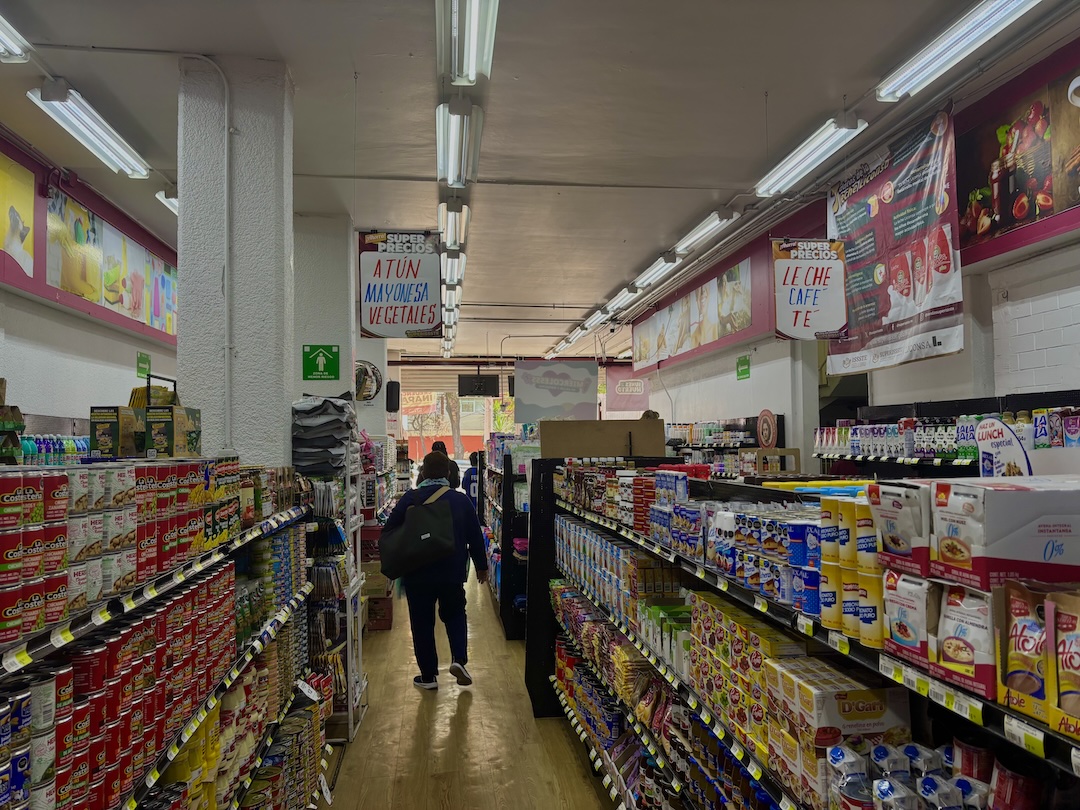
On a bright mid-February morning, the SuperISSSTE in Mexico City’s working-class Tacubaya district was already busy. The store sits along a major thoroughfare across from Parque Lira station, where passengers alight from crowded buses onto an already teeming sidewalk.
Its interior is closer to the size of a large New York City bodega than a Whole Foods. Handwritten signs dangle from steel wire above the aisles. Two employees stand on tiptoe arranging a row of sliced white bread. Nothing about the store screams that it is owned by the Mexican government.
But if you look closely, there are clues. Outside the entrance, two women in maroon vests from the Secretaría de Bienestar sit behind a folding table validating benefit cards for older shoppers (people over sixty receive a 10 percent discount at SuperISSSTEs). Inside, a shelf of dairy products from the state-owned company, Liconsa, offers the lowest milk prices you can find on the Mexican market.
The store in Tacubaya belongs to a government grocery chain that first opened in 1953. SuperISSSTEs were originally created to provide affordable staples for federal workers. But after a catastrophic earthquake ravaged Mexico City in 1985, the stores became emergency food outlets for the broader public. Today anyone can shop there.
SuperISSSTEs are only one piece of a much larger state presence in the country’s food distribution system. Since the 1960s, Mexico has also funded a vast network of rural supply stores designed to bring subsidized products to food deserts where private retailers either never arrived or acted only as local monopolies. Under the current administration of President Claudia Sheinbaum, food insecurity in remote areas is being addressed via the new “Tiendas Bienestar,” a nationwide program intended to distribute basic foods at low prices in rural regions, while prioritizing domestic and indigenous growers.
“The Mexican government had a long history of involvement in different parts of food distribution until certain government agencies were rolled back during the ’80s debt crisis,” explained Jonathan Fox, director of American University’s Accountability Research Center and author of The Politics of Food in Mexico. “But many efforts of the [two most recent administrations] have been going back to that previous model of government intervention,” he said.
New York City Mayor Zohran Mamdani, who announced this week that he plans to move forward with the establishment of municipally owned grocery stores, has faced criticism from commentators who have described his proposal as a socialist fever dream, an invitation for organized shoplifting rings to run amok, and a logistical impossibility.
Yet Mexico can provide a working example of how such a model can function in practice. SuperISSSTEs, like New York’s prospective grocers, buy at wholesale prices, partner with local producers to source goods, centralize warehousing, and manage distribution. Though they’re not designed to operate at a loss, affordability, not profit, is their central objective.
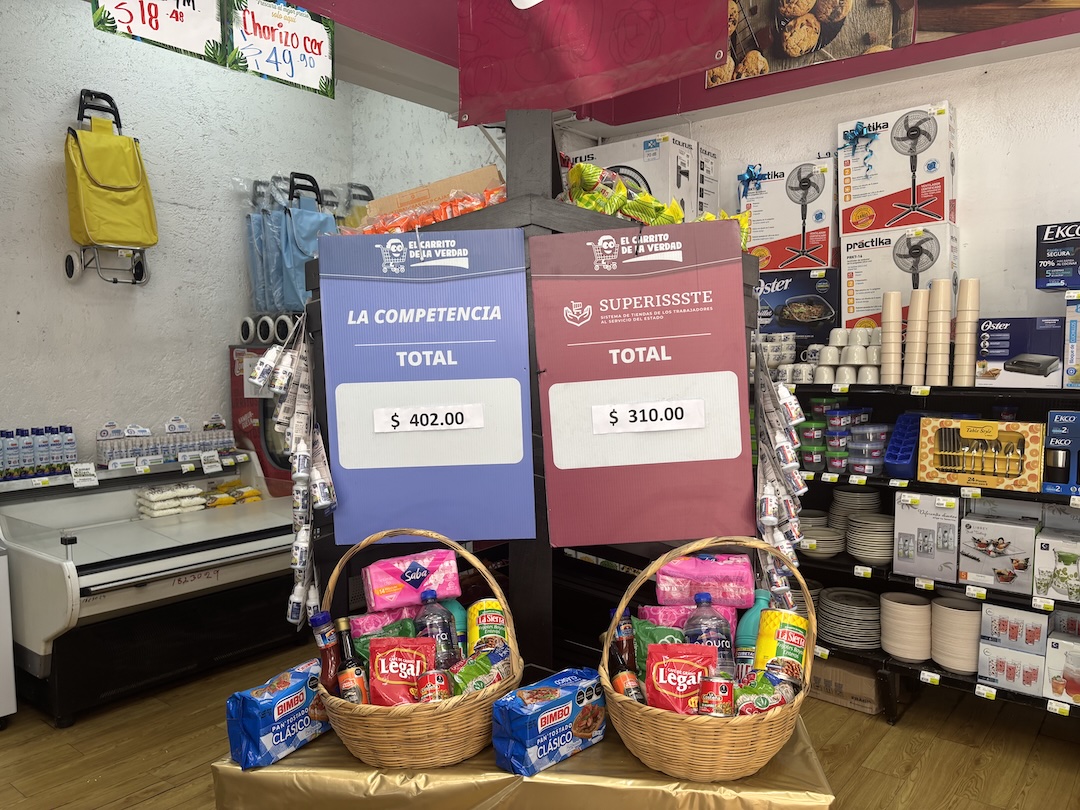
To what extent SuperISSSTEs actually offer prices lower than the market is less certain. At the entrance of the Tacubaya branch was a display of two wicker baskets meant to illustrate savings. Both held a peculiar jumble of sanitary pads, beans, pickled jalapeños, a bottle of Worcestershire sauce, and Cloralex disinfectant. One basket — labeled, somewhat nebulously, “the competition” — was listed at 402 pesos ($22.34). The SuperISSSTE basket, in contrast, was priced at 310 pesos ($17.22).
The comparison wasn’t particularly convincing. It was unclear how representative this combination of goods was of typical savings, who “the competition” referred to, or how the store had calculated the purported price variance.
Nevertheless, when I asked customers — Laura buying cream; Rodrigo picking up peanuts; Vanessa surveying the government-brand chocolates; and Alicia, so busy preparing for dinner that she did not even look at me as she spoke — they all told me that SuperISSSTE does, indeed, boast lower prices and that this is a big draw.
Shoppers — who ran the age, gender, and socioeconomic gamut — also mentioned another motivation: a federal initiative to source more products from domestic farmers and producers. “I want to contribute to the local economy,” Vanessa told me.
This impulse to buy local has taken on added significance in a grocery market increasingly dominated by multinational corporations. Over the past two decades, the American retail giant Walmart has captured more than 60 percent of Mexico’s supermarket trade. Its discount chain, Bodega Aurrerá, uses Walmart’s immense purchasing power and low-wage labor model to edge out competitors, often offering prices 17 percent to 22 percent cheaper than other Mexican grocers.
But such dominance comes with trade-offs. With so much of the market concentrated in one corporation’s hands, Walmart effectively sets the terms for suppliers and consumers alike, determining what products appear on shelves and what prices shoppers ultimately pay. The recent Trump tariffs have already driven up Walmart’s Mexico prices. For Enrique Ochoa, author of México Between Feast and Famine, this amounts to “supermarket colonialism.”
The dynamic is hardly unique to Mexico. In the United States, a handful of corporations like Walmart, Kroger, and Albertsons control the lion’s share of the grocery market, giving them enormous leverage over food producers and pricing. There are economic benefits to this scale, but there is also evidence that leading retailers have unnecessarily jacked up food prices for consumers.
In such an environment, government-run grocery stores like SuperISSSTE can fill a space in the food system where public interest goals — lower prices, local sourcing, and food security — take precedence over corporate greed.
Mexico’s government-owned supermarkets have had an uneven record, however. The multidecade project has weathered both economic populism and austerity. Its success has always been dependent on the whims of who’s in power, and the stores have been dogged by bureaucratic maladies like corruption and mismanagement.
At its most robust, the SuperISSSTE operated over 300 stores across all 32 of Mexico’s states. But after a stretch in the mid-2000s of steady losses, embezzlement to the tune of 650 million pesos, spoiled food, and inventory shortages, only 40-some locations remain. Of those hanging on, most are in Mexico City.
The government-backed Tiendas Bienestar are far more numerous — over 25,000 locations are active — but they are not immune to such afflictions. Fox observed that leakage and corruption have plagued the rural supply network. While the stores were “the first national program to include institutionally validated citizen oversight,” and the centralized warehouses served as places for freedom of assembly in regions “dominated by violent local bosses,” community participation has only remained nominally.
“In general, continuous public oversight to keep track of what is working and what isn’t in real time is very important,” Fox said. “The rural stores were supposed to be cooperative, but most of them became more like de facto franchises.”
When Sheinbaum came to power in late 2024, she was intent on revitalizing the SuperISSSTE and rural food supply network. In fact, in her first year in office, she brought the previously decentralized grocery store chain under national jurisdiction, opened new locations, added a distribution center in Guadalajara, and integrated nearly 750 new domestic suppliers, resulting in 181 percent sales growth.
Sheinbaum has also spearheaded a variety of different partnerships with farmers to place government products in SuperISSSTEs and the rural Tiendas Bienestar. Her expectation is that government investment in foods aligned with the indigenous milpa diet, including tortillas, corn, cacao, and beans will boost “food sovereignty” and encourage the consumption of homegrown goods, which is on the decline. Mamdani is similarly proposing local partnerships to source his municipal grocers.
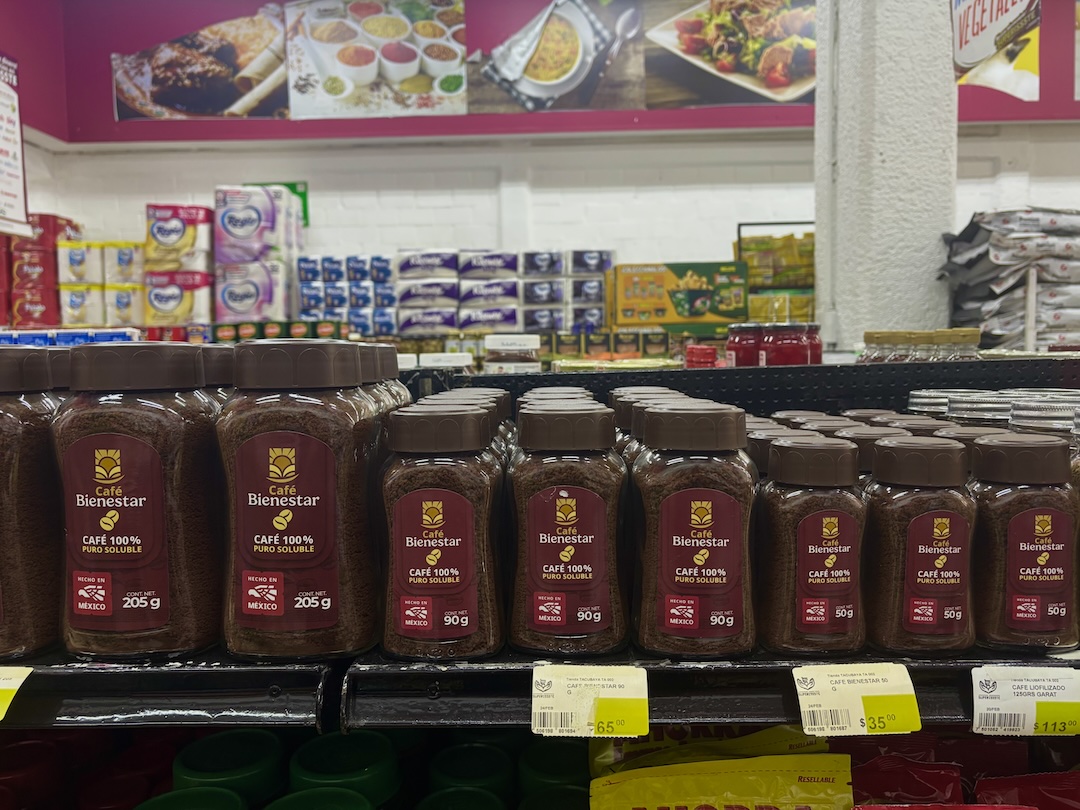
“In the ’90s and 2000s, a lot of what was on the shelves of [rural stores] and SuperISSSTEs was from transnational companies, not locally grown,” remarked Ochoa. With Sheinbaum’s food sovereignty plan, this could change.
Ochoa also noted that, like in the United States, the corporatization of the Mexican food system has yielded negative health outcomes. “This is about going back to more traditional, healthier diets, which is a good start,” they said.
Despite their challenges, Mexico’s government grocery stores are not spelling the return of Soviet bread lines as Mamdani’s naysayers would have you believe. They can, in fact, lower prices and reach food insecure rural communities. But they are also fragile institutions, prone to corruption, weak in oversight, and swayed easily by whoever sits at the helm of governance — for better and for worse.
Still, for a municipality flirting with the prospect of plunging into the grocery business, Mexico — alongside the 235 Department of Defense-owned military commissaries and the fact that New York City is already operating six supermarkets — offers one of the more convincing arguments to date.
When I asked Rodrigo, standing outside the SuperISSSTE with his packet of peanuts, whether he thinks government-run grocery stores are a good idea, he simply shrugged: “I don’t really know anything about that — I’m just a consumer. But, for me, it’s working.”
His answer was simple and clarifying. After more than seventy years of existence, Mexico’s public grocery stores have persisted not because they are ideologically intoxicating or paragons of bureaucratic virtue, but because enough shoppers keep finding them useful. And utility, it turns out, can be a powerful form of political durability.